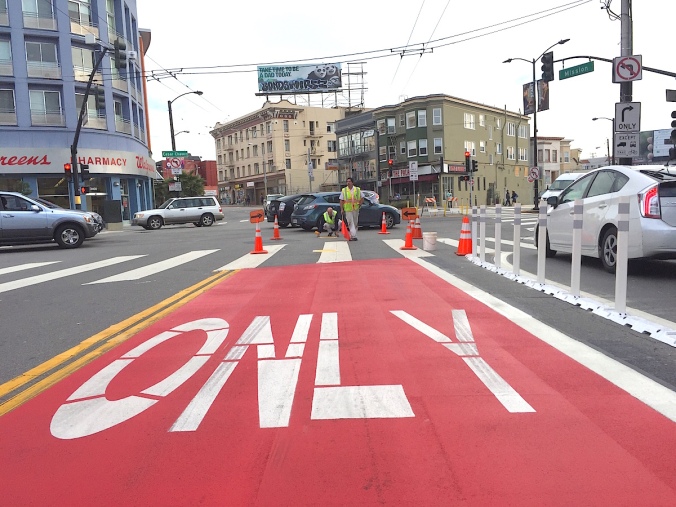
Your Bernalwood editor rode a MUNI 14 bus down Mission Street yesterday for the first time in a long time. The bus was modern and new, and the ride was conspicuously swift. Thank you, Mission Street red carpet!
A few weeks ago, D9 Supervisor David Campos decided to stand with the cars, arguing that the new Mission Street red carpet and transit improvements must be rolled back:
I have heard from many of you — car commuters frustrated by traffic jams that stretch multiple blocks; pedestrians concerned about increased safety risks because of irate drivers; residents along the corridor dealing with nonstop yelling and honking horns; and small businesses unable to get goods into their stores because unloading zones have been taken away. That’s why I’m calling on the San Francisco Municipal Transportation Agency to make a radical shift in the program
While it’s certainly true that the new configuration on Mission Street has caused some disruption and side-street spillover, it’s not at all clear the program should radically revised right now. A “Transit First” policy is city law, after all, and it takes time for old habits to change and new traffic patterns to become familiar. Best of all, there are already signs that the red carpets and mandatory turns are working as intended; MUNI riders say the changes have dramatically improved bus service along Mission Street:
Writing at the N Judah Chronicles, transit blogger Greg Dewar says the backlash typifies why it’s so devilishly hard to make MUNI the much-better transit system everyone says they want:
If you’ve ever wondered why it is hard to Get Things Done with Muni, the current brouhaha over improvements in the Mission to the 14 Mission, and to traffic in general is an example. Muni rolled out some significant improvements to the 14 Mission line, and already there’s “anger” from a few nuts online. The changes have had less than a few weeks to take hold, but apparently dealing with the changes is too difficult for some people to handle like adults – hence the temper tantrums online in places like the infamous “NextDoor.com” and in the media.
These folks have found politicians eager to score political points, enough so that the SFMTA may back down on plans it has been working on for almost TEN years (and about a zillion “community meetings” in the process).
The SF Transit Riders, a grassroots organization that represents public transit users, has launched a #KeepMissionRed campaign to support the red carpet lanes:
Starting in March, after a decade of numerous community discussions, planning and studies, Muni finally started installing transit priority treatments on Mission Street. Just a month in and despite flagrant violations by drivers, they are already benefiting riders by making their rides faster and more reliable.
However, there has been a major backlash against these changes, and some, in particular Supervisor David Campos, have called for rollback of this major progress. It is a betrayal of the 65,000 riders who are served by the 14, 14R and 49 buses, as well as a betrayal of the Transit First charter of this city.
Along with my high-speed ride down Mission Street yesterday, I’ve also noticed that the morning traffic backups at the Mission/Cesar Chavez intersection have subsided. The line of cars waiting to turn left from Cesar Chavez onto South Van Ness is longer than it used to be, but the new queue seems to move pretty quickly.
It’s reasonable to assume that some adjustments to the new red carpet configuration may be needed. But a “radical shift” to the program, as Supervisor Campos has suggested, would be irresponsible and unprogressive. The recent rollback of the single-lane configuration for the San Jose Avenue exit from I-280 provides an encouraging sign that transit officials will abandon new traffic schemes when time, data, and experience demonstrate that changes aren’t working as intended. Truth is, we don’t yet know what’s best for Mission Street.
Patience seems like the best policy here. The red carpet lanes on Mission Street need more time to settle in. If we sincerely want to improve our public transit system, the SFMTA should be encouraged to try new things, and we should expect that real progress usually takes time to reveal itself.
PHOTO: Top, a worker installs flexible bollards to prevent traffic from crossing Mission Street at Cesar Chavez, April 7, 2015. Photo by Telstar Logistics






 Bernalwood