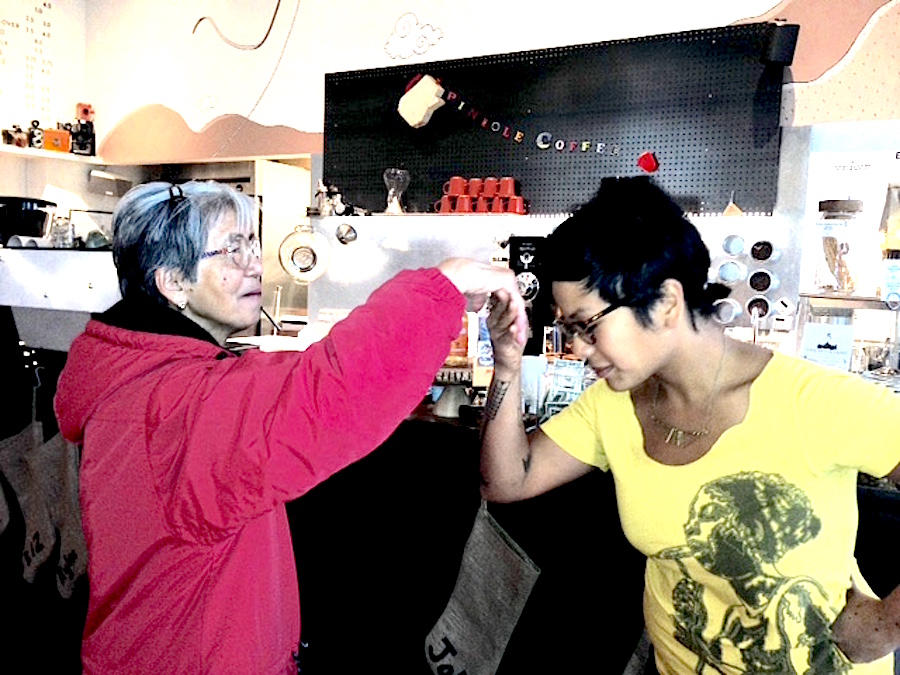
A few weeks ago, Bernalwood’s search robots brought an interesting headline to our attention: “Enterprising Filipina opens hip cafe in hot San Francisco neighborhood.” The accompanying article tells a very cool story about JoEllen Depakakibo, the fashionably caffeinated Filipina entrepreneur who opened Pinhole Coffee on Cortland Avenue.
Inquirer.net, a news site for Filipinos, describes how Miss JoEllen from Pinole has connected with the Filipino community in Bernal Heights:
“[Bernal Heights] was the type of neighborhood I was looking for, a mix of the old and modern, giving me the feel of the 1950s,” Depakakibo related.
“Here, you see amazing people walking and talking to each other,” she added. […] Bernal Heights has had its share of woes because of the rapid gentrification occuring in San Francisco. Before the tech surge, it was a more diverse mix of working class residents, artists and activists. Buck Bagot one of the founders of the Occupy Bernal Movement, was quoted in a piece in Bernalwood blog, saying, “When I moved here, every house on my block had a different ethnicity. There were Latinos, Blacks, American Indians, Samoans and Filipinos. … Now they’re all gone.”
Members of the Occupy Bernal movement are currently fighting to save homes from foreclosures and maintain diversity in the neighborhood. When Depakakibo chose Bernal Heights for her venture, she was not yet aware of the history of Filipinos in the neighborhood.
The late Filipino American Bill Sorro, a longtime resident and beloved civil rights and housing activist, was one of the leaders of the movement in the 1970s that struggled for nine years to prevent the eviction of low-income senior citizens, including Filipinos, from the International Hotel in San Francisco’s Chinatown. (The International Hotel Manilatown Center now stands on the site, a testament to the early organizing for affordable housing rights in the city.)
The number of Filipinos in Bernal Heights spiked starting in the late 1960s and early 1970s because of the passage of the Immigration and Nationality Act of 1965, which paved the way for immigrants from Asia, Africa and the Middle East to become permanent residents in the U.S.
Gloria Carvajal, one of the beneficiaries of the law, has lived in the neighborhood since she arrived in the US in 1968 and worked for Pacific Bell Telephone Company (now AT&T) for almost 30 years until her early retirement in 1996. She was active in Saint Kevin Church’s close-knit Fil-Am Association, which no longer exists, but she continues to keep in touch and care for housebound members of the group. […]
One afternoon, Carvajal went to Pinhole to have a cup of java, and as soon as Depakakibo saw her, she bowed, took Carvajal’s hand, and put it against her forehead, a sign of respect for elders among Filipinos. In turn, Carvajal gave her a blessing and welcomed her to the neighborhood, immediately proceeding to tell the young Pinay about Filipinos living and working in Bernal Heights. While decades separated their ages, respect for an age-old tradition and love for coffee and community bonded them instantly.
Read the whole thing on Inquirer.net, here.
PHOTO: JoEllen Depakakibo (right) gives longtime Bernal Heights resident Gloria Carvajal a traditional Filipino greeting at Pinhile Coffee. Photo my Mila De Guzman for Inquirer.net














 Bernalwood
