After some observation, Janet has noticed some disturbing signs that the coyote is in danger — and the problems stem from people who are putting her at risk with misguided “kindness.” Janet explains what this means in this special contribution to Bernalwood:
AN UPDATE ON THE BERNAL COYOTE
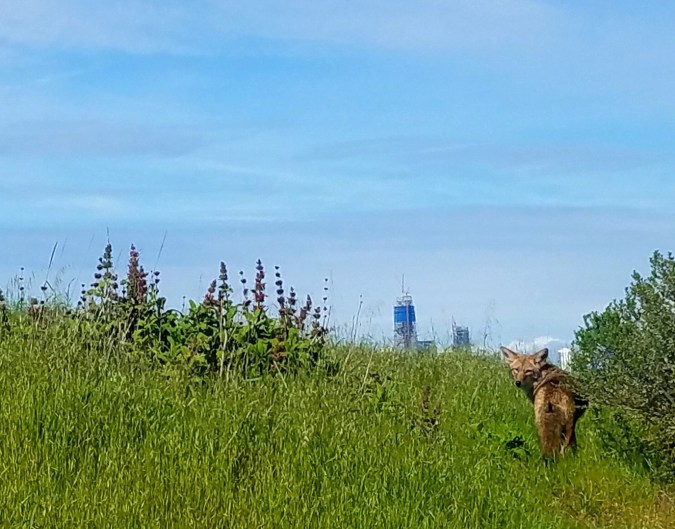
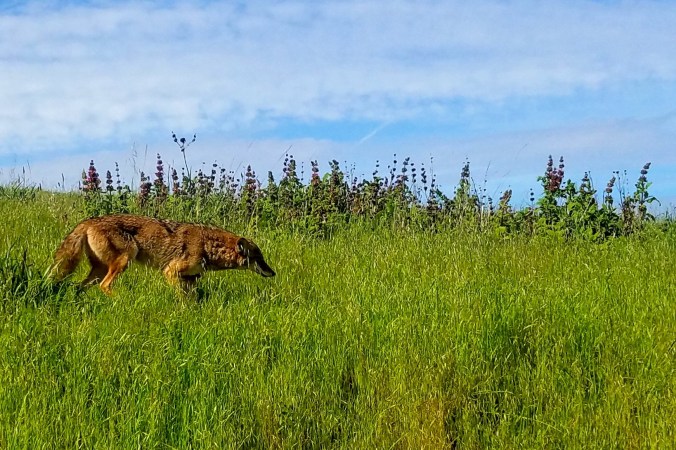
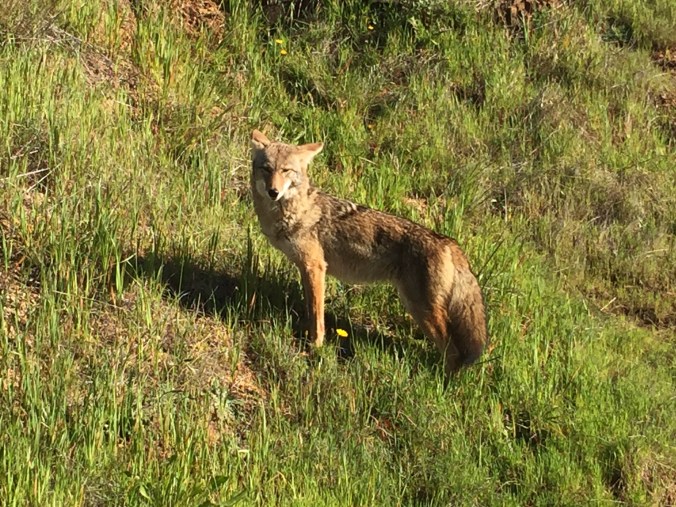
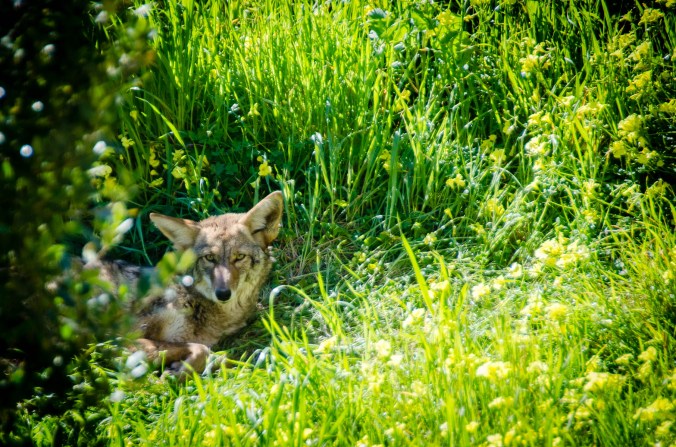
In case you haven’t heard, the Bernal Hill coyote is most definitely a “she!”
Almost all Bernal Hill visitors love her. How could anyone ask for a more congenial neighbor! She’s good natured, photogenic, good-willed and fun-loving. She knows how to entertain herself. I watched her play exuberantly with a stick several times within the span of an hour.

Some people love the Bernal Coyote so much that they are literally throwing “kindness” at her. However, the “kindness” she’s being showered with is actually cruel. Unintentionally so, but nonetheless cruel: it’s hurting her tremendously.
Feedingthe Bernal Coyote is bad enough, but feeding her from cars is detrimental. As a result, she’s now out in the streets, approaching cars, stopping traffic, and even just hanging out there. Please remember: the last Bernal Hill coyote was killed by a car.
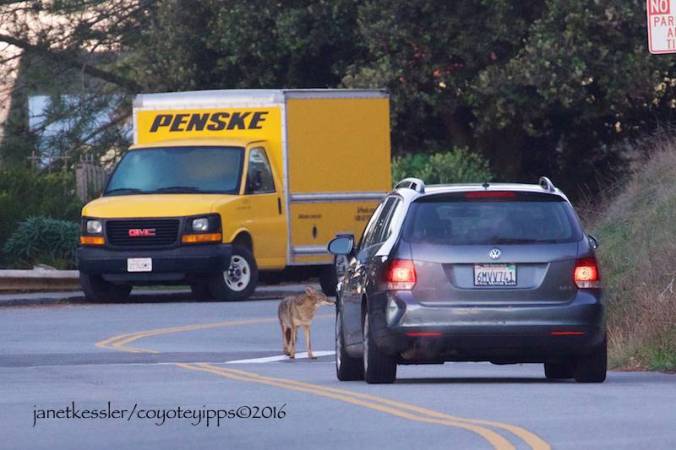
A few days ago I witnessed her run repeatedly to a bluff overlooking the road whenever she heard a certain type of truck go by. A couple of people said that two months ago they witnessed someone in a white truck deposit food for her. I saw her run towards a coffee cup as it was tossed from a car window — she was expecting food.
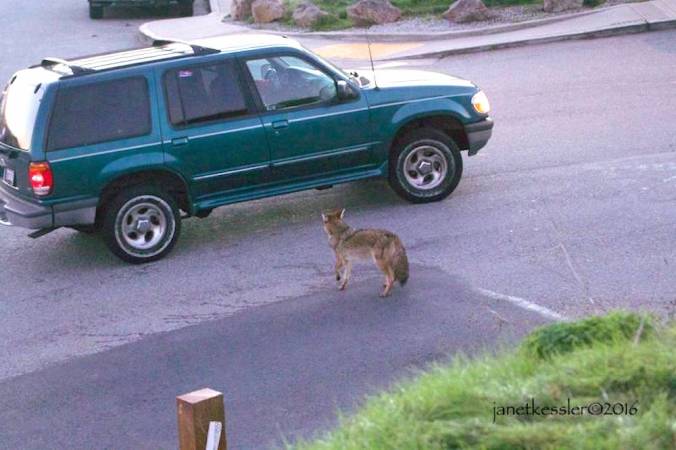
When cars stop on the road to observe her, she often hurries down the hill to the car. And I witnessed her chasing four separate cars, one after the other. Her motive would be the expectation of food. She would only expect food if she has been given it in the past. Witnesses have seen her being fed from car windows. By feeding her, people have “trained” or “food conditioned” her (rewarded her behavior with food) to come down into the streets. It will be much harder to break this behavior than it was to start it.
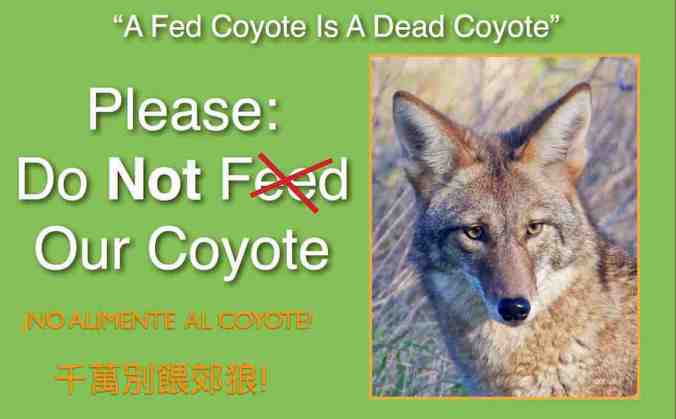
She has also been coming in towards walkers, again in the hopes for food. This scares some people. If she’s expecting food, she could start closing the gap and nudging people for what she wants. A spooked human may startle her and she may react with a self-protective nip. Although dogs are allowed their first bite free, this is not true of coyotes. If she bites a human, she’s dead. This is why, “a fed coyote is a dead coyote.”
Some folks are being overly “friendly” towards the coyote. Dogs with their owners sit and commune with her only 15 feet apart. This, also, is an unkind thing to do. It’s important not to be so friendly, not to engage physically or psychologically with her. Rather, be neutral if you can and always walk away from her. You are not respecting her wildness by engaging with her or by allowing your dog to interact/engage with her in any way.
On the bright side, this little female does not seem territorial: she does not defend her space against intruder dogs. The reason for this is that she’s a loner who does not claim a territory, she’s not a member of a family. Nonetheless, if and when she hooks up with a mate — coyotes mate for life — her mate will be territorial. Male coyotes can be very protective and jealous of dogs getting too close to their mates or pups. By respecting her wildness and giving her plenty of space, we can maintain a balance for coexistence which will work.
What to do now? First, DO NOT FEED THE COYOTE — EVER! Second, become an ambassador for the Bernal Coyote: If you see anyone giving her food, speak to them about what is needed for the well-being of the coyote. If the person resists, report them to the police; It’s actually against the law to feed wildlife.
The Bernal Coyote will the one who pays the price for humans’ misguided “deeds of kindness.” Please — please! — never feed her, be as neutral and uninterested towards her as possible, and always walk away from her, don’t engage her with your dog or talk to her. If she persists in coming closer to you, spook her away by picking up a small stone and heaving it towards her (not at her so as to actually hurt her, just towards her), and keep walking away. The Bernal Coyote’s behavior is not her fault; it’s our fault.








 Bernalwood