UNIQUE PLAN FOR BERNAL HEIGHTS
Ugly Hill to Be Beautified
Thursday, May 31, 1962
By GEORGE DUSHECK
News-Call Bulletin Staff Writer
[Photo caption: Bernal Hill today: the new approach will concentrate on beauty as well as function]
An odd surgical team — the city and the Pacific Telephone Co. — shortly will undertake to repair the scarred face of Bernal Heights.
Both hope the result will justify a new approach to industrial development in San Francisco, with new emphasis on beauty as well as function. The plan has been worked out jointly by telephone company engineers and administrators, and city planners.
PACIFIC TELEPHONE bought a little more than one acre (for $90,000) on the 20-acre brow of Bernal Heights, standing 430 feet high in the outer Mission District. It will put a 400-circuit microwave relay station, a link in a nationwide chain which complements telephone lines and underground cables, on this site. It is a $2 million project.
The building which houses the electronic equipment will be thoroughly screened with silver wattle trees, small gum trees and oaks. Wild lilac and creeping manzanita will be planted farther down the slope.
Only the microwave antenna will rise above the trees. A proposal by planner Ruth Joffe to make the antenna itself a kind of free-form sculpture or monument was reluctantly abandoned as not feasible.
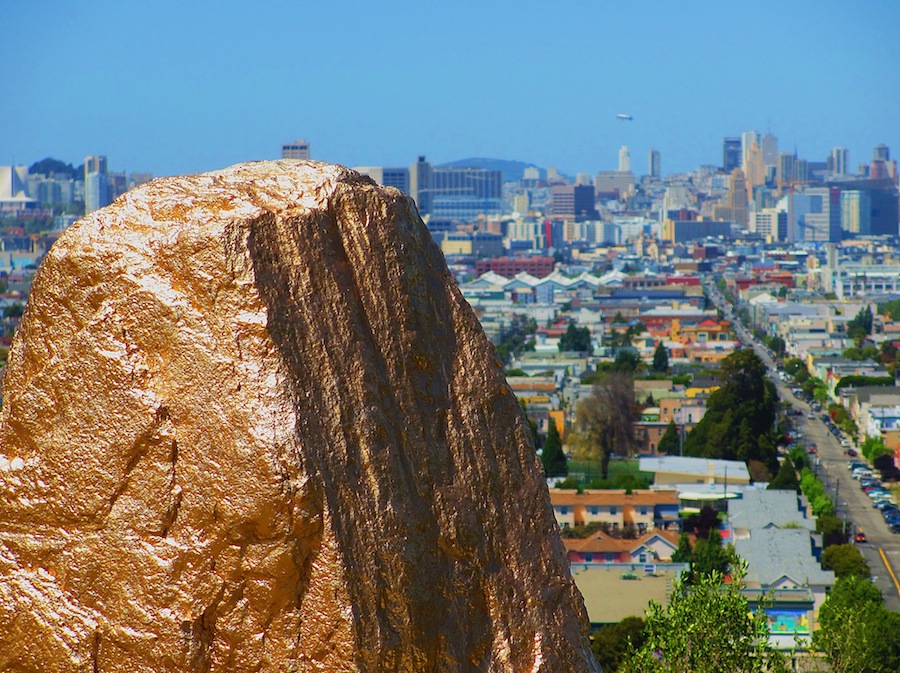
The landscaping will go beyond the company’s own site. In addition, the company will use the earth and rock it excavates from the hilltop to smooth over an ugly scar on the south face of the hill; a scar caused by 30 years of quarrying by the city.
When the job is done — sometime in late 1963 if all goes well — the city Planning Dept. and Pacific Telephone hope Bernal Heights will be a handsome park, instead of a scarred, grassy knob.
The knob takes it name from Juan Francisco Bernal, a soldier who accompanied Juan Bautista de Anza to the Bay Area in 1776. Bernal was given more then 4400 acres surrounding his knob — or about seven square miles of what is now the Mission District, Bayview District, and Diamond Heights. Potrero Heights was the pasture for his cattle.
ONLY THE top of the hill remains in public hands.
From it one gets an exhilarating view of San Francisco’s downtown, to the north; the Bay and its shoreline industry to the east; San Bruno Mountain and the intervening hills, to the south; Twin Peaks and Mount Davidson to the west.
The hill face which has not been quarried is covered with wild grasses; one bright windy day recently a visitor saw wild hollyhock, wild radish, and California poppies blooming there.
Henry Morris, the telephone company’s district manager (and a grandson of former Mayor Angelo Rossi), is enthusiastic about the project.
“The city planners have been patient and helpful,” he says. “Ruth Joffe worked many hours with our people, helping them to make the access road conform to the hill’s contours, to curve the roof of the structure to conform to the hill, to use some native trees and shrubs for landscaping.
“We think the result will enhance the city. The microwave station is badly needed to supplement the cable crossings. When the station is in operation San Francisco will have a modern communications link with the east, north, and south.”
San Francisco’s chief planner, James McCarthy, agrees.
“Bernal Heights has been an eyesore for a generation,” he said. “The landscaping project around the microwave station is a step in the right direction.”
THE AREA will be open to the public — no fences. The high voltage power lines which serve the station will be underground. Eventually the Planning Dept. would like to have the Recreation and Park Dept. take over the hilltop from the Works Dept. Chief Administrative Office Sherman Duckel says:
“There won’t be any more quarrying on the hill. It was started by the WPA during the 30’s, and continued by the city on a small scale until half a dozen years ago. I’m now convinced the area should be a park.”
Through co-operation between a corporation and the city, it may become one.












 Bernalwood