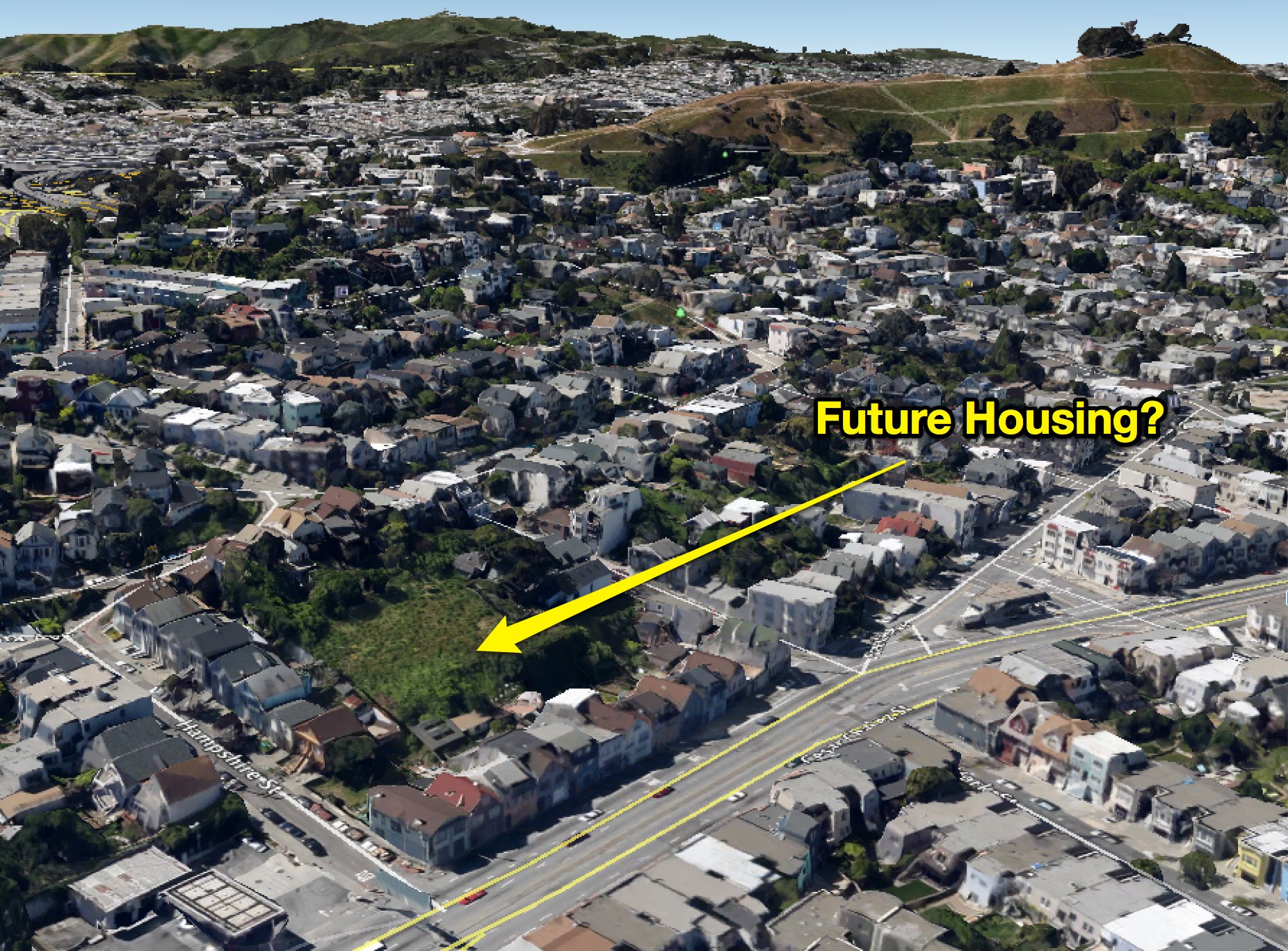
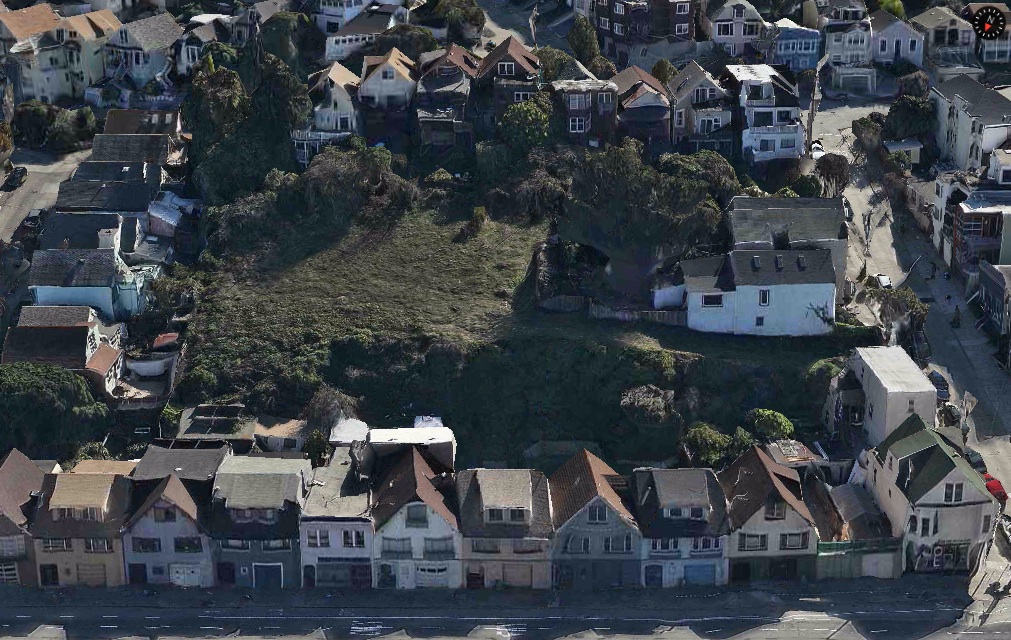
Neighbor Jenna attended last week’s neighborhood review meeting for the proposal to build new homes on the “secret lot” at York and Cesar Chavez. Bernalwood noticed a few tweets she sent during the meeting, so we invited her to share her notes with us. Neighbor Jenna reports the meeting was somewhat depressing — though it helped her understand why San Francisco’s housing crunch is unlikely to go away anytime soon:
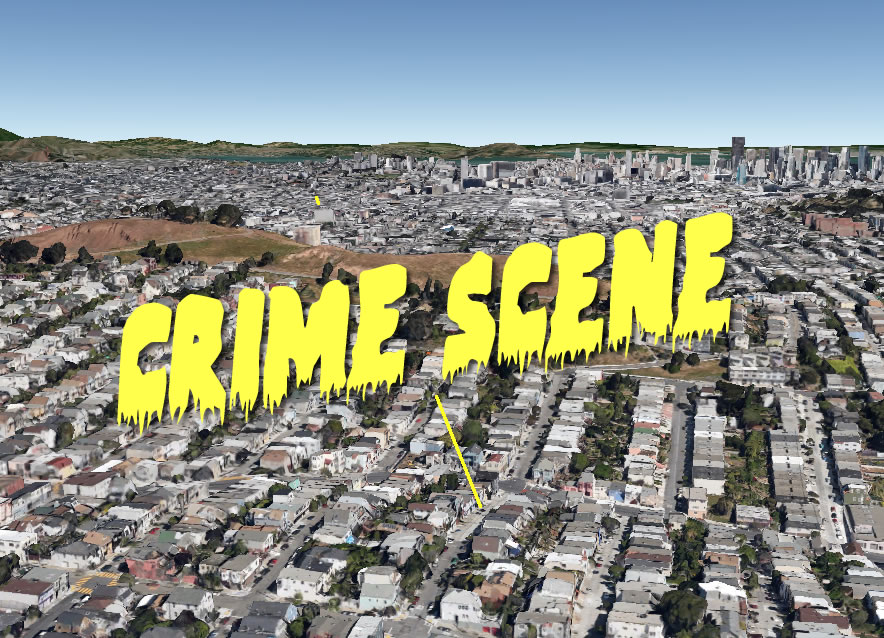
As you know from this post, there is a proposed 6-unit development attempting to go in at two of the empty interior lots inside York, Hampshire, Cesar Chavez & Peralta. I live on the 200 block of Peralta, not immediately bordering the land, but up a bit.
This meeting was bigger than the last I went to, which was also very frustrating. (That one was about the house on Alabama near the cafe that’s currently under construction. The woman that owns that Alabama house left the meeting in tears because she was being hated on for wanting to renovate and move into her own home).
This proposed development is mainly reasonable. Offering four single-family homes with 3-car parking, water capture & recycling and solar panels and 2 unit townhomes on the 25′ lot / access way on York. While the final “design” hasn’t been done, what was shown looks fine, if generic.
As far as I understood, both by the committee’s acknowledgement & the owner & architect, this is the fourth or fifth visit to the NE slope special committee with as many different proposals. The most recent previous proposal was for 12 units total, instead of six.
The entry to the interior lot containing the 4 single-family homes is through the garage on York shared by the townhouses. So, in theory, if each unit had two cars, there would be a total of 12 cars coming and going every day from a single 12′ garage. In my opinion, this is the most troublesome part of the proposal, but that’s part of city life. I can’t imagine if they had the 12 units with 2 cars per (24 cars!) going into one garage on narrow York.
According to the owner, he bought the land in 1979, and has been “trying to build ever since.” Wow.
After presentations from the owner, the architect, the fire deputy for our part of Bernal, and the geology expert who did the land and grading surveys, questions were flying.
The stuff you’d expect to hear was in abundance: Blocking light & views, the entrance on York, traffic behind people’s houses on the “driveway”, where will the garbage bins go, how will they prevent landslides, how tall are the units, how tall are the retaining walls, where will the water go, etc.
While I understand that people’s most valuable possession is their home, the objections to this eminently reasonable proposal began to feel more and more outrageous. People were saying, they bought their houses because of access to the “nature” lot behind their houses, the trees and quiet, concern about electromagnetic sensitivity” to a proposed car turntable, etc. Legally, homeowners have no right to “light, views, or nature” of undeveloped lots. This should have been part of research done during the purchasing phase and a risk taken by homeowners purchasing homes bordering undeveloped, but owned, land.
To me, it was a lot of “we like it the way it is” even though the development, in my opinion, would bring much needed housing to desirable Bernal and create more neighbors to add to our community of awesome folks.
There were objections to the (legal) heights of the roofs, the height of the retaining walls, fundamental misunderstandings about the way cisterns and water recycling works (I can’t tell you how long we spent on fundamental mis-understanding of the water re-direction) , and objections to things that are relatively new or rare like the car turntable (we spent a good 15 minutes on making sure everyone understood it was an electric turntable, not a turn around circle).There were even more objections about the construction noise, parking during construction, and the construction starting just after the Cesar Chavez construction was ending.
There were people challenging the experts on their reports. Particularly the fire marshall and the geologist. Challenging him on what was bedrock, exactly. Saying that the excavations would cause the collapse of the hill and surrounding retaining walls (many of which were hand-made by the owners). Challenging the fire marshall on the ins-and outs of his experience fighting fires at properties like this one.
All of this, in my opinion, is fine to bring up as a concern. But once the question was answered by an expert, it was challenged and re-challenged. There were people saying it was wrong to remove mature trees, chasing off the “nature” permanently. (If anyone wants extra squirrels, they can have mine!) There were even people simply saying “we like the way it is” and the standard “it doesn’t fit the character of the neighborhood” argument – which seems to be a catch-all when reason fails. (There were even jabs and jokes made about how “rowdy” the patrons of Precita Park Cafe were, twinged with resentment. I’m so grateful for that cafe, it changed in a huge way, how we live and participate in our neighborhood).
In my opinion, we are in a desperate housing crisis in SF. There are not near enough available units to cover the number of people trying to live here.
As a homeowner who recently purchased a home (4 years ago) that 20 years ago was in an IDENTICAL situation, with two interior lots that their owners worked for YEARS to develop, I can feel the pain of the owner and architect acutely.
I’m SO grateful for my home, and my neighbors, and we watch out for them and they watch out for us. But our lot was the same as this one before the development. The neighbors used to run and play in our lots with their dogs and plant plants and treat it like public land, even though it never was. This created deep resentment during planning and development, which lingers to this day.
We fell in love with Bernal Heights because the neighborhood felt like a community. We could go the park with our dog and have people asking after us and catching up. For me, this meeting was extremely frustrating because it seemed like people felt entitled to things that ultimately weren’t theirs. It felt very uncompromising, negative and un-neighborly.
Is the owner going to get rich over this? Probably. Are we going to get six great new neighbors to watch out for our ‘hood? Likely. Are six families going to get to move to the neighborhood of their dreams? Yes. Will people’s lives be impacted in the short term? Definitely. Is everything ultimately going to be fine? Yes. Better, even.
One friend later told me I had seen “the dark heart” of the housing problem. Other friends said they stopped going to their neighborhood meetings because they couldn’t take it. The folks at these meetings are driving new and different perspectives away through their sheer endurance.
We live in a city. Cities are dense. We need to progress. This is not the face of progress.







 Bernalwood