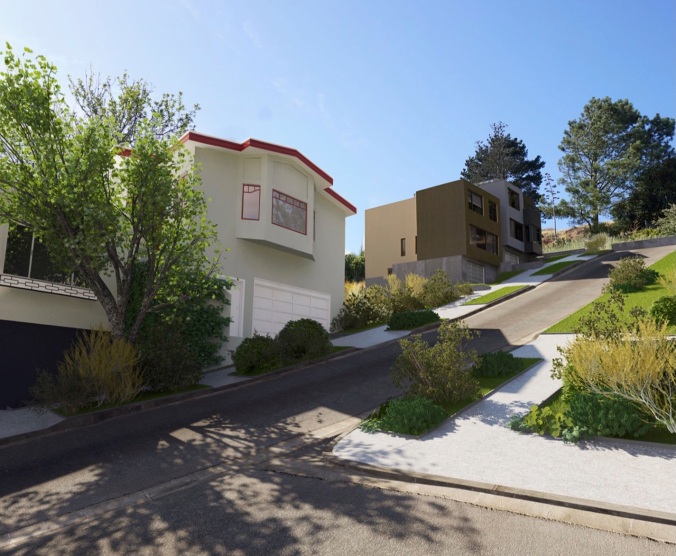
Rendering of proposed homes and new Folsom Street extension; view northwest from Chapman
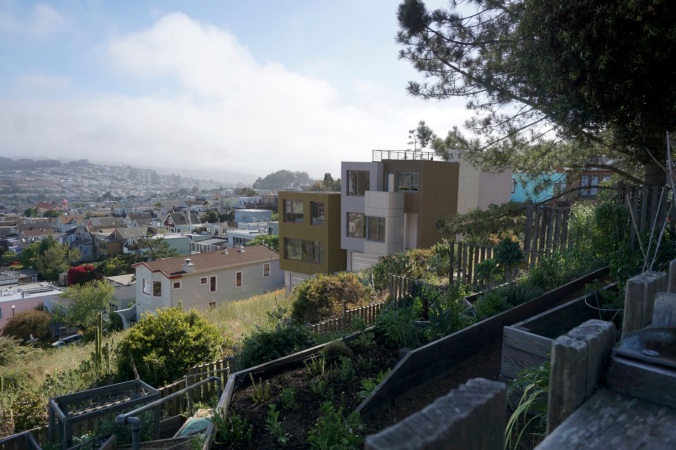
Rendering of proposed homes, view southwest from public garden below Bernal Heights Blvd.
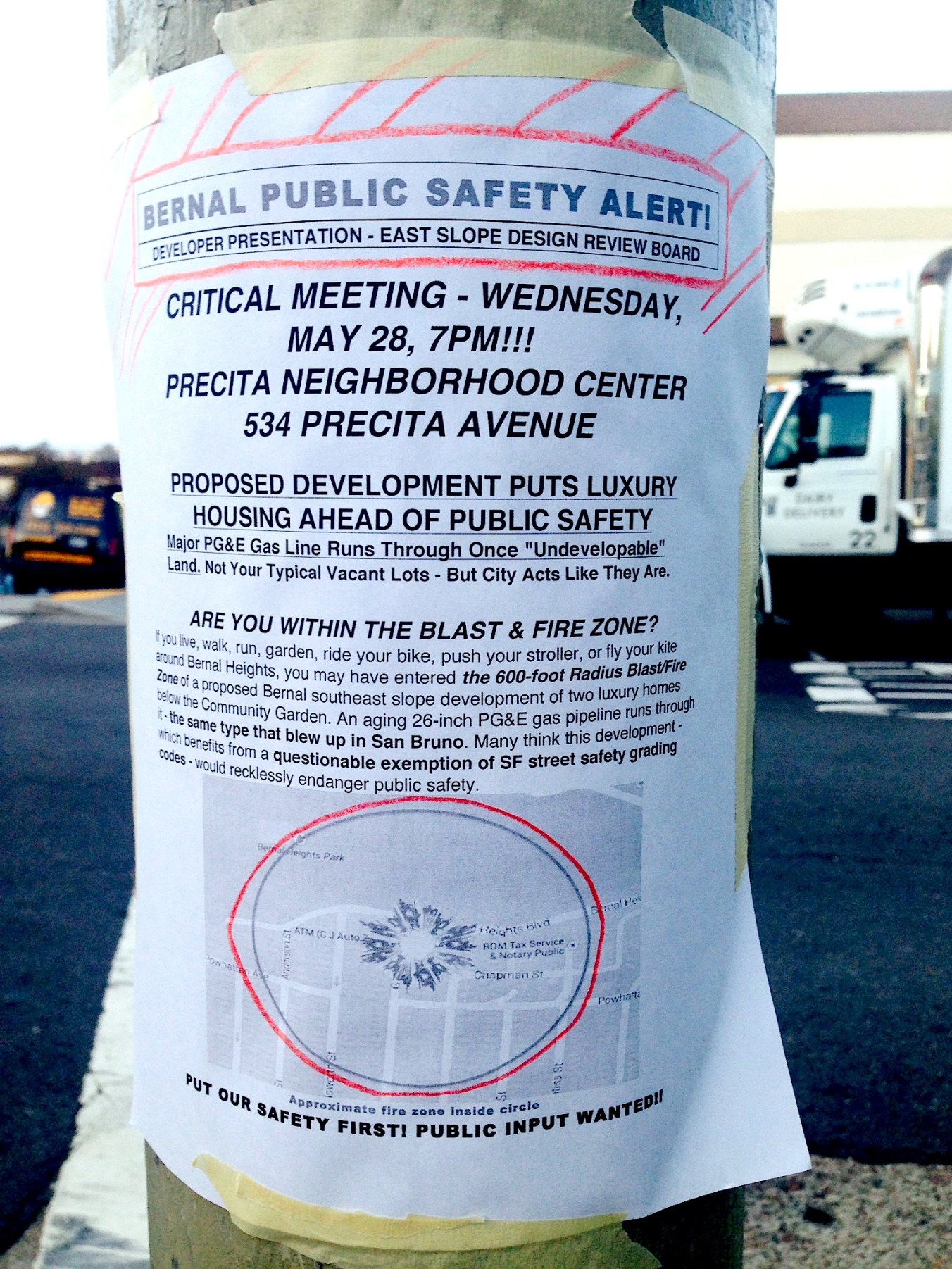
A group of Bernal neighbors are still concerned that if two homes are built on a Folsom Street lot, the site could explode in a gigantic fireball. As a result, the neighbors will appear before the Board of Supervisors on Tuesday, July 19 in hopes of delaying the project to conduct an environmental analysis. The Bernal Heights Neighborhood center has been providing organizational assistance to the nervous neighbors.
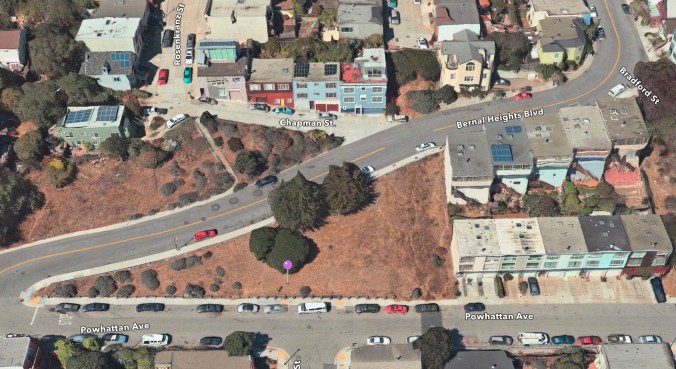
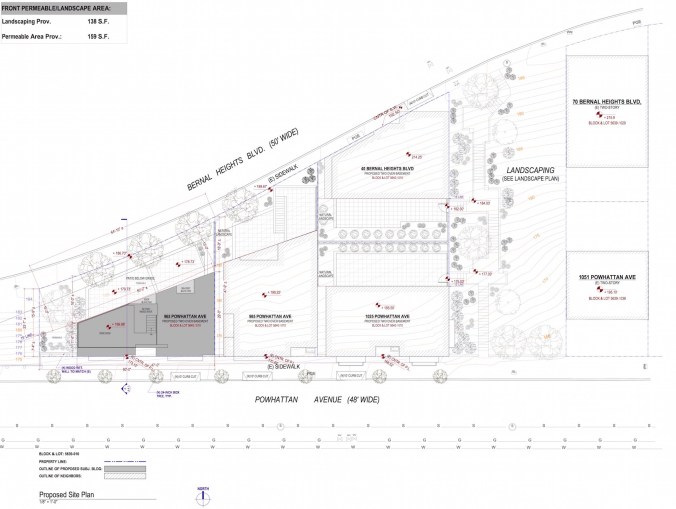
The neighbors hope the Board of Supervisors will intervene to delay construction of two proposed homes at 3516 and 3526 Folsom, on an undeveloped lot near the intersection of Folsom and Chapman, just below Bernal Heights Boulevard.

The project, which will require the construction of a new stub roadway extending Folsom Street to the north, has already secured approval from the San Francisco Planning Commission.
“We’re not against development. This is not a development issue,” says Neighbor Herb Felsenfeld, who lives near the proposed homesites and has been spearheading the effort to collect signatures for a letter to the Board of Supervisors. “it’s a public safety issue and a traffic issue.”
Bernalwood obtained an undated draft of the letter to the Board of Supervisors that Neighbor Herb has circulated:
Dear Board Members,
Request for Environment Review – Our safety and even our lives are at stake.
Construction on two lots at 3516 and 3526 Folsom Street have been given categorical exemption from environmental review, however this particular plot of land, encompassing 6 lots and a street right of way, poses significant, potentially life-threatening, safety and problems.
These include:
- Construction by a private developer over a 26” PG&E gas pipeline without industry recommended safety protocol in place and made public, resulting in the potential loss of life and property. All safety guidelines and oversight must be transparent and shared with residents. The San Bruno tragedy is fresh in our minds.
- Difficult-to-manage traffic conditions at the corner of Folsom and Chapman Streets. The projects have no on-street parking, and on-street parking will be eliminated from 2 more houses. (And, there is the potential for 4 additional new homes) Delivery trucks, construction vehicles, and visitors will be forced to park at the base of the street, blocking access to many homes.
- The project’s lack of planning for garbage, recycling, and compost pickup will impace both public health and safety.
- The project site’s proposed steep street presents a significant threat to drivers and residents, and a liability issue for homeowners and the City.
- The structures would create a north-facing solid wall blocking significant public vistas from Bernal Heights Boulevard along the open-space park.
There are specific NTSB and Pipeline Information and Protection Act protocols that should be followed for all land use near pipelines, and we expect assurances from you that these will be met.
This is your opportunity to keep your promise to the keep the citizens of San Francisco safe by requiring that a complete environmental review is undertaken and all appropriate safety measures are in place before any construction is approved for this undeveloped section of Folsom Street and the adjacent properties. We also request that the safety measures and oversight is transparent to the impacted neighbors.
In May 2014, when the fear of a Folsom Fireball first emerged among neighbors in the theoretical “blast zone” of the surrounding homesites, Bernalwood contacted PG&E to learn more about Pipeline 109, the existing gas line buried below Folsom Street. We also asked about the safety procedures used when construction occurs at a pipeline site. Bernalwood’s 2014 questions, and PG&E’s responses, are again provided here in their entirety:
1. When was the section of pipeline under the the proposed home site installed? When was it last upgraded?
The line was installed in 1981. PG&E has a comprehensive inspection and monitoring program to ensure the safe operation of this line.
2. How often is this section of 109 inspected? What does the inspection entail? When did the last inspection take place? What were the results of that inspection?
This section of L-109 was successfully strength tested (via a hydrostatic pressure test) at the time of installation. PG&E records show no history of leaks for L-109 in this area.
PG&E has a comprehensive inspection and monitoring program to ensure the safety of its natural gas transmission pipeline system. PG&E regularly conducts patrols, leak surveys, and cathodic protection (corrosion protection) system inspections for its natural gas pipelines. Any issues identified as a threat to public safety are addressed immediately. PG&E also performs integrity assessments of certain gas transmission pipelines in urban and suburban areas.
Patrols: PG&E patrols its gas transmission pipelines at least quarterly to look for indications of missing pipeline markers, construction activity and other factors that may threaten the pipeline. L-109 through the [Bernal Heights] neighborhood was last aerially patrolled in May 2014 and no issues were found.
Leak Surveys: PG&E conducts leak surveys at least annually of its natural gas transmission pipelines. Leak surveys are generally conducted by a leak surveyor walking above the pipeline with leak detection instruments. L-109 in San Francisco was last leak surveyed in April 2014 and no leaks were found.
Cathodic Protection System Inspections: PG&E utilizes an active cathodic protection (CP) system on its gas transmission and steel distribution pipelines to protect them against corrosion. PG&E inspects its CP systems every two months to ensure they are operating correctly. The CP systems on L-109 in this area were last inspected in May 2014 and were found to be operating correctly.
Integrity Assessments: There are three federally-approved methods to complete a transmission pipeline integrity management baseline assessment: In-Line Inspections (ILI), External Corrosion Direct Assessment (ECDA) and Pressure Testing. An In-Line Inspection involves a tool (commonly known as a “pig”) being inserted into the pipeline to identify any areas of concern such as potential metal loss (corrosion) or geometric abnormalities (dents) in the pipeline. An ECDA involves an indirect, above-ground electrical survey to detect coating defects and the level of cathodic protection. Excavations are performed to do a direct examination of the pipe in areas of concern as required by federal regulations. Pressure testing is a strength test normally conducted using water, which is also referred to as a hydrostatic test.
PG&E performed an ECDA on L-109 in this area in 2009 and no issues were found. PG&E plans to perform another ECDA on L-109 in this area in 2015. This section of L-109 also had an ICDA (Internal Corrosion Direct Assessment) performed in 2012, and no issues were found.
Automated Shut-off Valves: There are two types of automated shut-off valves recognized within the natural gas industry: Remote Controlled Valves (RCV’s), which can be operated remotely from PG&E’s Gas Control Center, and Automatic Shutoff Valves (ASV’s) that will close automatically as a result of rapidly falling pipeline pressures and/or increased flows at the valve location. There is an RCV on L-109 in Daly City that can be used to isolate the section of L-109 that runs through this neighborhood.
3. Is this section of pipeline 109 “the same type that blew up in San Bruno?”
No. Line 109 operates at a much lower pressure and is smaller in diameter, and is of a much more recent vintage.
4. What safety procedures does PG&E put in place when home or street contruction occurs on the site of a major gas pipeline like 109?
Anytime a contractor or resident makes an excavation on franchise or private property, they must call 811 (State Law for Underground Service Alerts [USA]) in advance so we can identify and properly locate our UG facilities. When our Damage Prevention group gets the USA request and identifies a critical facility like a gas transmission line in the scope of work, they notify the caller that they must contact PG&E for a standby employee. PG&E must observe a safe excavation around our lines if any digging is within 10’ of it. We must be present when they dig around this line. Our standby inspector will instruct and guide the excavating party to avoid damage. Excavators who violate this Law are subject to fines.
5. Does the steep grade of the Folsom site have any impact on Pipeline 109? Given the grade at the proposed site, are any special provisions or procedures required to ensure the safety of the pipeline during construction?
The grade of the street have no impacts on the operation of the line. If the cover is not removed or disturbed within 10’ of the line, there are no special precautions needed.
6. Are there any specific technical or safety challenges posed by the proposed home site, and if so, how does PG&E plan to address them?
As long as the structures are built within the property lines similar to the existing [homes on Folsom Street], they will not pose any issues for us patrolling and maintaining that line. The proposed home sites are not on top of line 109, and are no closer to the line than existing homes in the neighborhood.
Additional Background: In the area outlined in the map [Bernalwood sent PG&E, shown above], PG&E’s natural gas transmission pipeline L-109 runs down Folsom Street and turns east to follow Bernal Heights Blvd. Line 109 in this area is a 26-inch diameter steel pipeline installed in 1981 and has a maximum allowable operating pressure (MAOP) of 150 pounds per square inch gage (psig), which is 19.8% of the pipe’s specified minimum yield strength (SMYS). This provides a considerable margin of safety, since it would take a pressure over 750 psig to cause the steel in the pipe to begin to deform.
When we cited PG&E’s previous Bernalwood comments about the project, Neighbor Herb said, “We want NTSB standards to be followed.” However, Neighbor Herb was unable to point Bernalwood toward the specific NTSB standards he wants PG&E to follow.
To be sure, independent of the pipeline on Folsom Street, recent events have not inspired much confidence in PG&E’s ability to manage its pipelines safely. In the wake of the 2010 San Bruno Pipeline explosion, documents presented earlier this month in a criminal trial related to the San Bruno blast revealed that, in 2008, PG&E had prioritized profitability over safety management.
But the pipeline is just one of several concerns shared by neighbors near the proposed homesite. “Once the road gets put in, it’s likely more houses will go in,” Neighbor Herb says. “Once the road goes in we can have six pretty big houses there, with six times as many garbage cans, and six times as much construction, and six times the concern about emergency vehicles.”
Parking is also a concern. “Adding three more cars fighting for parking space will make parking even more difficult,” Neighbor Herb said.
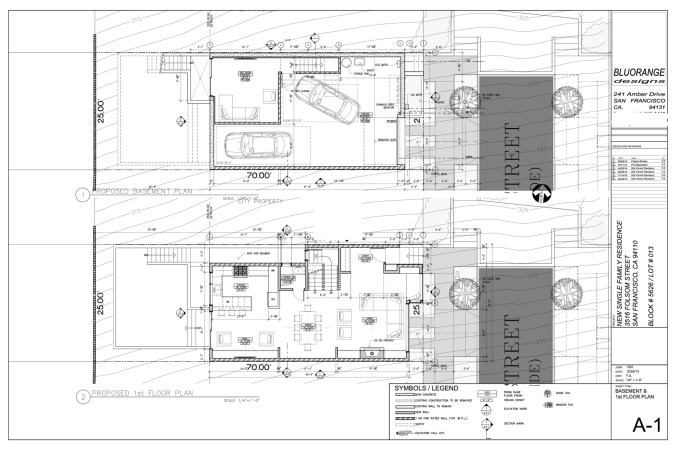
3516 Folsom, ground floor plan, showing two-car garage
A review of the plans for both of the proposed homes shows that each will include a two-car garage.
“The issue more with the City than with the developers, given that the City did not require a CEQA [environmental] review and gave the project a waiver,” said Neighbor Marilyn Waterman, another neighbor who has also been active in the effort to gather signatures for a letter to the Board of Supervisors. Neighbor Marilyn, who divides her time between her home on Gates and a home in Menlo Park, adds,” The City needs to take responsibility for the neighborhood’s public safety issues.”
Ailed Paningbatan-Swan, director of community engagement for the Bernal Heights Neighborhood Center, confirms that BHNC has gotten involved in the issue. “I’ve been helping to connect [those seeking environmental review] with other neighborhood leaders,” she tells Bernalwood.
“I’m not going to say anything about the parking issues; my concern is the public safety,” Ailed adds. “We are not opposed to having the houses built, we are concerned about the public safety issues around the PG&E pipeline.”
“It’s difficult to get much information from PG&E, but there will be safety process established to protect the gas line,” says Fabian Lannoye, who owns one of the lots at the proposed site. “PG&E is not willing to do any work on this project until it is approved.” Fabian tells Bernalwood he owns one of the proposed homesite lots, and that be plans to live in the house he hopes one day to construct.
The Bernal Heights Democratic Club and the San Francisco Chapter of the Sierra Club are also said to be planning to submit letters to the Board of Supervisors about the 3516 and 3526 Folsom project.
D9 Supervisor David Campos is expected to recuse himself from tomorrows Board of Supervisor’s vote on 3516 and 3526 Folsom, because he lives a block away, within 500′ of the proposed homesite.
IMAGES: Renderings via Fabian Lannoye






 The 2003 study estimated that a 30th Street Station would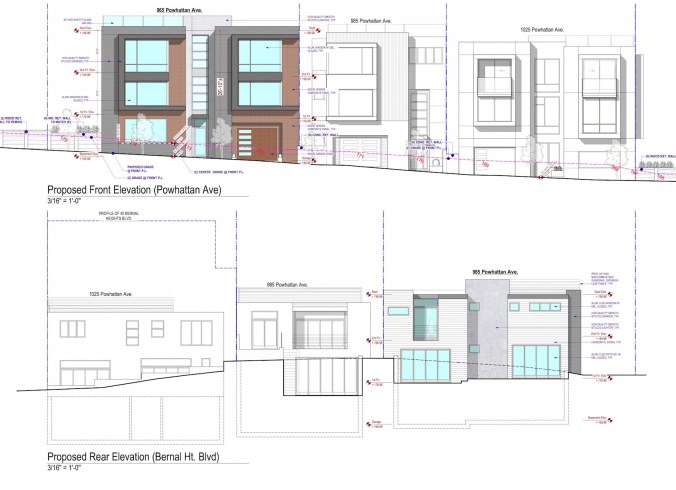


 Bernalwood