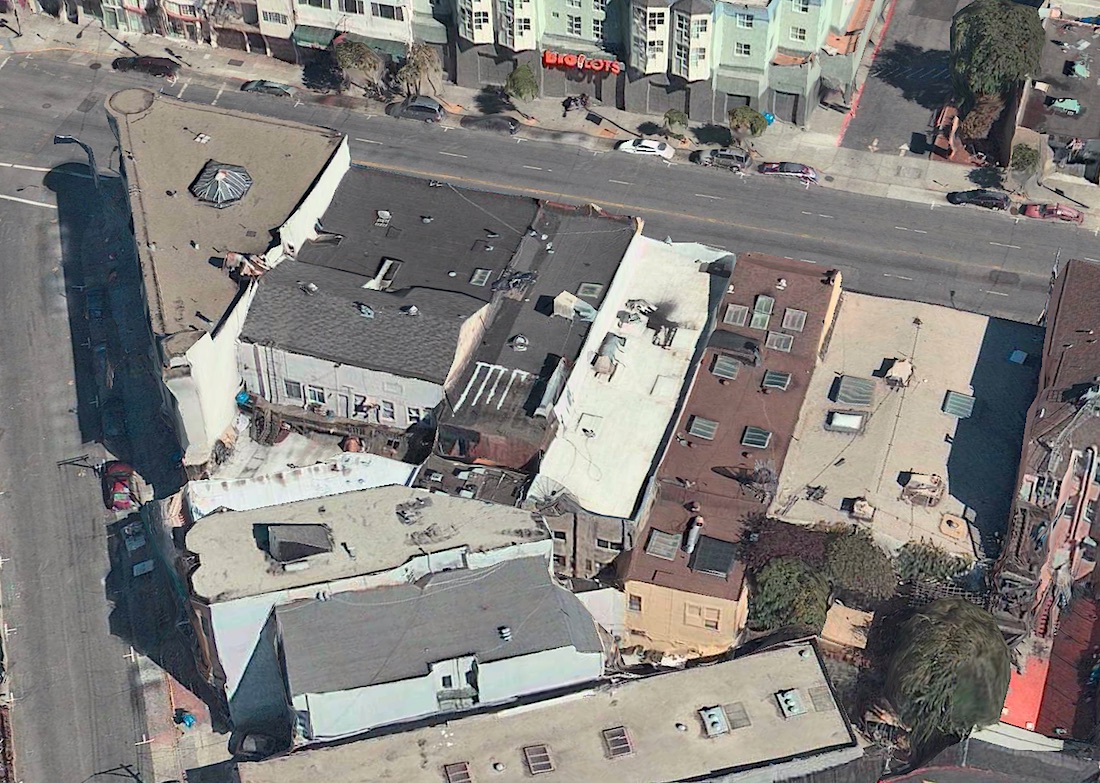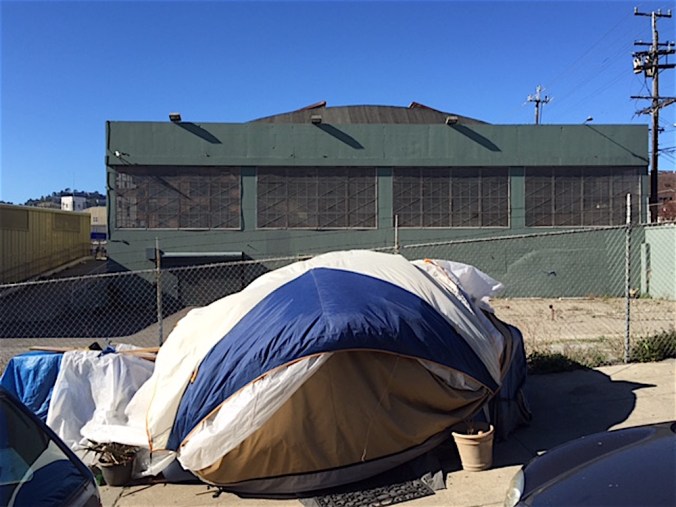
Proposed mixed-income housing site at 1515 South Van Ness, as seen on Nov. 16, 2016
In one of his final moves before departing the San Francisco Board of Supervisors, a petulant David Campos sided with Mission District NIMBYs to block the construction of 157 new units of mixed-income housing at 1515 South Van Ness, on the corner of 26th Street.
As previously covered by Bernalwood, the proposed housing at 1515 South Van Ness would occupy the site of the former McMillan Electric (and Lesher-Muirhead Oldsmobile). Developed by Lennar Corporation, 1515 South Van Ness would be built with union labor, and it would include 39 units of subsidized-affordable housing, or 25% of the total units in the development.
J.K. Dineen from the San Francisco Chronicle describes what happened:
In a move that shocked city officials and housing advocates, the Board of Supervisors on Tuesday rejected a 157-unit Mission District development, claiming that city planners failed to take into account the impact the complex would have on displacement and gentrification in a district that has been the heart of the city’s working-class Latino community.
The board unanimously upheld a challenge to the environmental review of 1515 S. Van Ness Ave., sending it back to city planners for further study. While the decision sent tremors through the city’s housing development community, it was uncertain whether the move signaled that future development proposals would be scrutinized for their impacts on gentrification and the displacement of residents and businesses from a neighborhood.
“It’s not clear whether this is precedent-setting — I just don’t know,” said Planning Director John Rahaim. “I presume it’s something the city attorney will look at.”
Under the state’s convoluted California Environmental Quality Act, proposed developments require a painstaking analysis of everything from noise to air quality to traffic to historical and biological resources. Until now, however, efforts by antigentrification advocates to argue that displacement is a environmental impact have gone nowhere.
The vote was particularly surprising because Supervisor David Campos, who represents the Mission District, had previously backed the project, which won unanimous approval at the Planning Commission.
He had helped negotiate a deal under which the developer, Lennar Multifamily Communities, agreed to rent 39 of the 157 planned units to low- and middle-income families. That agreement marked the first time a developer had voluntarily agreed to make 25 percent of units affordable without receiving any benefits in return, like increased height or density.
Campos said Wednesday that he likes a lot about the project, which calls for the redevelopment of a site previously occupied by McMillan Electric, but that he has been increasingly worried of the impact that large market-rate development will have on the Calle 24 Latino Cultural District, which was formed in 2014 to preserve the neighborhood’s Latino heritage and community.
“The difference with 1515 S. Van Ness is it is taking place within the Latino Cultural District,” he said. “Does that change the analysis? Should that require additional study? That’s what flipped me on it.”
Campos also said he was upset by some of the rhetoric of those fighting the environmental review appeal, including members of the pro-growth group San Francisco Bay Area Renters’ Federation, known as SFBARF. At the hearing, SFBARF founder Sonja Trauss compared the antidevelopment activists to President-elect Donald Trump.
“When you come here to the Board of Supervisors and say that you don’t want new, different people in your neighborhood, you’re exactly the same as Americans all over the country that don’t want immigrants,” she said. “It’s the same attitude, it’s the exact same attitude.”
Campos called the comparison “offensive, divisive and clueless.”
“That really turned off my colleagues,” he said. “It tells me some of these people behind the project don’t care about the neighborhood.”
It’s rare for an appeal of an environmental study to be upheld, and Tim Colen, executive director of Housing Action Coalition, said he never dreamed it would happen in this case. He said it was only the third time in a decade that such an appeal had been upheld in San Francisco.
“It’s shocking,” said Colen. “Here you have the first market-rate project come along that voluntarily agreed to do 25 percent affordable housing. Turning down that many affordable housing units is not going to help displacement in the Mission.”
For what it’s worth, here is a complete transcript of the comments from SFBARF’s Sonja Trauss that upset Supervisor Campos:
Earlier, a commenter said, “You’re bringing a stranger into our neighborhood,” as if it was self-evident that that was bad.
As if everyone here could obviously see that that’s bad.
And that disturbed me a lot. I’ve actually always been disturbed by nativism in San Francisco. In San Francisco of all places, we should not take for granted that bringing strangers into our neighborhood is gonna be a bad thing. The opponents of this project seem to know a lot about who’s gonna live there, which I think is mysterious. I don’t know how they would know that.
The Mission Moratorium report that the controller’s office prepared last year said that in new buildings, 84% of residents are people that already lived in San Francisco, so the idea that– If this building was filled with newcomers, first of all, so what, right? In Trump’s America we’re already disturbed by nativism everywhere. We don’t like it. And when you come here to the Board of Supervisors and say that you don’t want new, different people in your neighborhood, you’re exactly the same as Americans all over the country that don’t want immigrants. It is the same attitude. It is the exact same attitude.
So basically, you can be the kind of person that’s ready to have new people come into your neighborhood or you can be the kind of person that wants to keep people different than you out of your neighborhood. I know what kind of person I am: I want to build more housing, I want more people to be able to live here, and I want a wide diversity of people to be able to live here. And I’m not going to pretend to know who’s going to live in that building. Thanks.
For those who need a refresher, here’s a rendering of what the proposed housing at 1515 South Van Ness would look like:
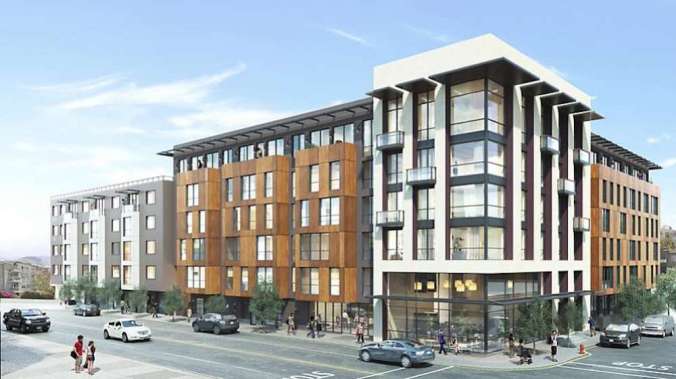
Under the proposal, 1515 South Van Ness would be a 6-story complex with 81 onsite parking spaces that conforms with current zoning requirements for its location. 1515 South Van Ness would be located on an adjacent lot just north of 1296 Shotwell, the nine-story, 100% subsidized affordable housing development that that would replace an existing automotive repair (PDR) space, as shown:
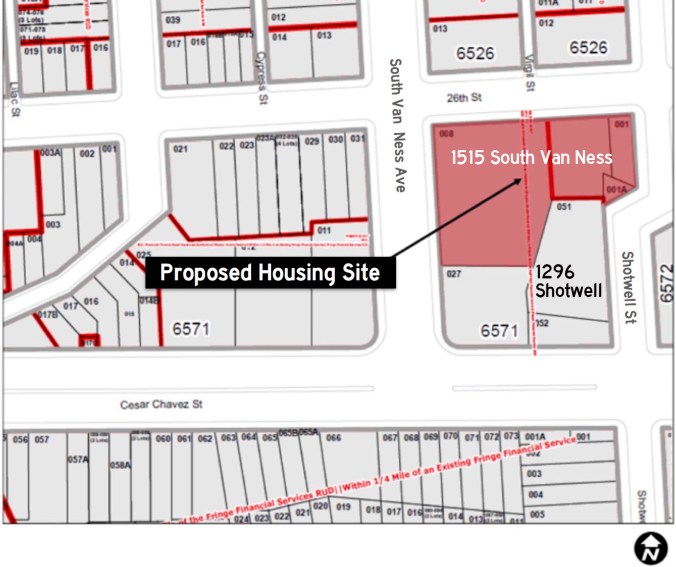 1296 Shotwell is 20 feet taller than current zoning allows, so an initial hearing at the Planning Department will be held on December 1 to consider granting 1296 Shotwell a required variance.








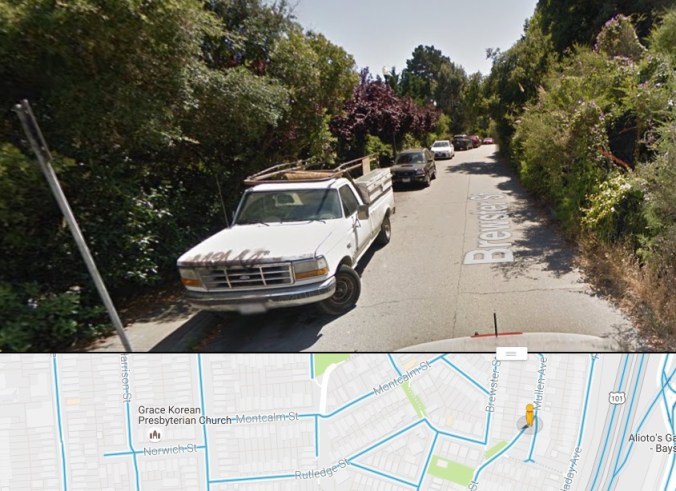 It’s not clear if any Bernalese humans will have a Martin Avenue address, but earlier this year, I actually (and unknowingly) visited Martin Avenue with Bernalwood’s Cub Reporter to capture a sighting of a

 Bernalwood