
As you probably know, Bernal neighbor David Campos represents District 9 on the San Francisco Board of Supervisors. Yesterday, he introduced a proposed ordinance that would deliver a windfall to Mission District homeowners and provide new incentives for Mission District landlords to evict existing tenants.
Supervisor Campos calls his proposal a “Temporary Moratorium on Market Rate Development,” and he says it is intended to halt displacement and maintain diversity in the Mission. In reality, it will almost certainly do the opposite. The San Francisco Business Times broke the story about the Campos proposal:
Voters will be asked in November whether to halt market-rate housing construction in the Mission District if neighborhood activists have their way, the Business Times has learned.
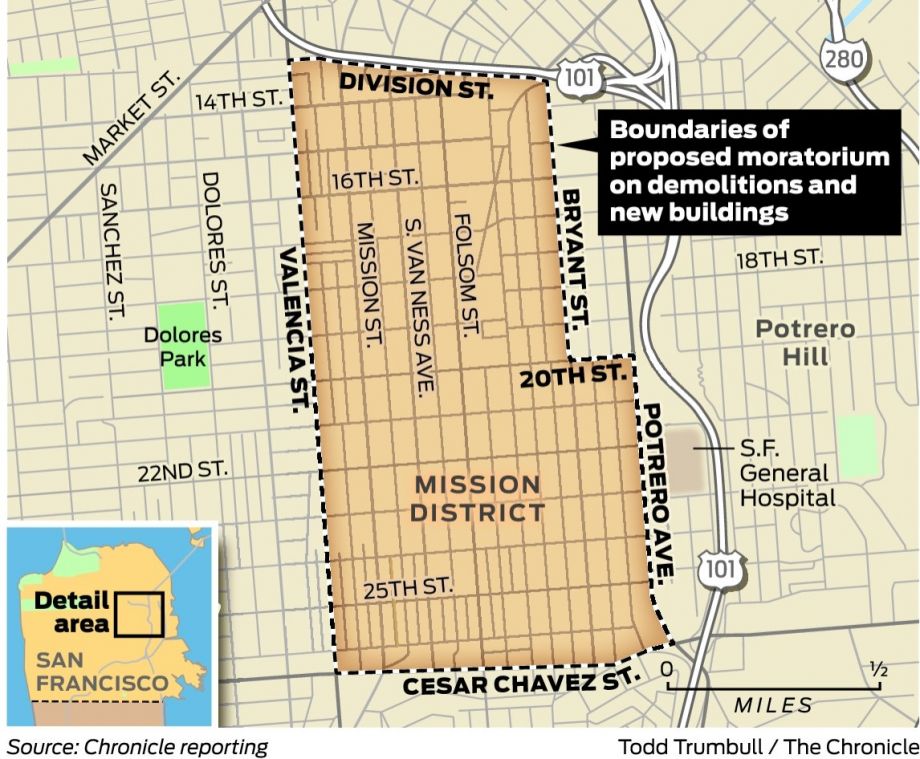
Edwin Lindo of the San Francisco Latino Democratic Club said Monday that a coalition of affordable housing and progressive groups soon will submit a potential ballot measure to the city attorney that would delay market-rate housing projects in the Mission for up to 18 months.
They would then attempt to collect the roughly 9,400 signatures needed to qualify the measure for the ballot.
A draft of the ballot measure, obtained through a public records request by a neighborhood activist, showed that the moratorium would apply to projects larger than 20 units. The moratorium would apply to the entire neighborhood, not just the 24th Street area on the south side of the neighborhood considered a Latino cultural district, as had been previously floated by Supervisor David Campos.
“Our goal is not to stop all development. Our goal is to stop incredibly large development that focus exclusively on market-rate housing,” Lindo said. “We need a pause to ensure that if developers are going to build in our city they’re going to figure out a way to build affordable housing, even if that could be cutting into their 15 to 20 percent profit margins.”
Many economists, urban policy groups like SPUR, and policymakers like Mayor Ed Lee and Scott Wiener have all said this kind of strategy will exacerbate the neighborhood’s problems. With a shriveling pool public dollars available to build affordable housing, the city has looked toward more market-rate development to pay for housing for low-income residents through inclusionary laws and fees.
The SF Chronicle adds the measure “would implement a 45-day moratorium on planning approvals, demolitions and building permits for multifamily residential developments in a 1½-square-mile area. It could be extended for up to two years under state law.”

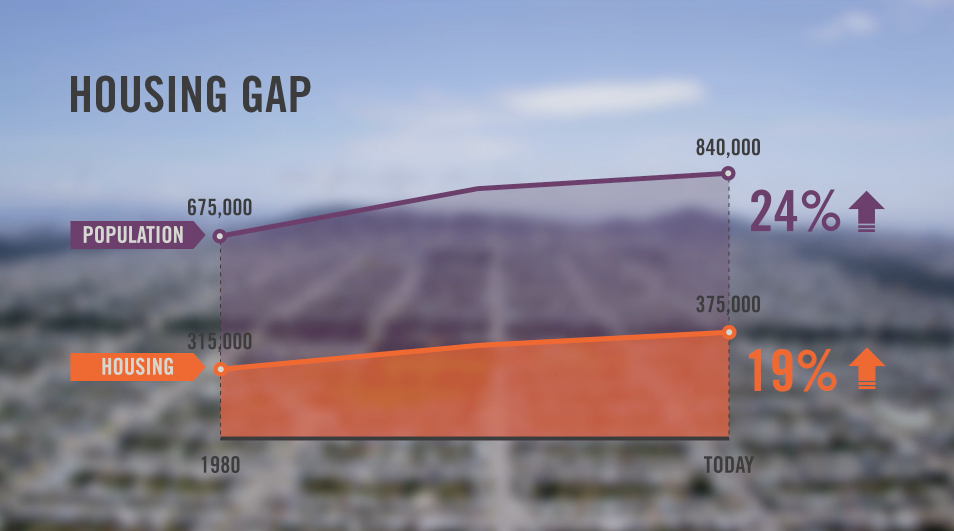
You don’t have to be an economist, or an urban policy wonk, or or a government policymaker to envision why this proposal from Supervisor Campos and progressive allies will put lots and lots of money in the pockets of existing Mission District property-owners. All you have to do is take a moment to consider this graph:

The housing gap graph (which comes from this video) shows that San Francisco’s population has been growing steadily for several decades, but our supply of housing has failed to keep pace. The housing deficit has grown more extreme with each passing year, which has made housing more expensive for San Franciscans at all income levels, across the board. This effect is called supply and demand, and supply and demand is sort of like the law of gravity, in that even if you don’t much like it, you still can’t realistically hope escape it.
The local economy is booming and San Francisco’s population is growing rapidly, so the only real way to make housing more affordable for everyone is to increase the overall supply. That’s a slow and imperfect process, to be sure, but if your goal is to reduce displacement, stabilize prices, and create opportunities for all San Franciscans across the board, there’s really no viable alternative. Building more affordable housing is something we absolutely must do, but increasing the overall housing supply and increasing the amount of affordable housing is not an either/or proposition. Indeed, by law market-rate housing development actually provides substantial funding for the creation of more affordable housing.
Supervisor Campos’s moratorium offer no proposals to provide additional funding for affordable housing, nor does it propose a way to offset the affordable housing funds that will be lost by blocking the construction of market rate housing. And he has had nothing to say about accelerating construction of affordable housing projects that are already on the table, like the proposed building at Cesar Chavez and Shotwell that your Bernalwood editor is eager to look out upon.
Supervisor Campos and his NIMBY allies say the goal is to reduce evictions and displacement, but that doesn’t hold much water either. Their opposition to new housing development has been fierce — even when absolutely no one would be displaced by the construction, and even when projects contain a substantial number of affordable housing units. In March, for example, activists shouted down a proposal to build 291 units of market-rate housing with an additional 41 units reserved for middle-class buyers on the squalid site next to the 16th Street BART station that is today occupied by a chain drug store and a Burger King. Last month, many of the same activists disrupted a proposal to build 115 units of market-rate housing on the site of a semi-abandoned warehouse at 2675 Folsom near 23rd Street.
There is one surefire way to make housing in The Mission even more expensive: In a transit-rich location with two BART stations, several arterial MUNI lines, and excellent freeway access, where demand for housing already vastly exceeds supply, blocking the creation of new housing will only make existing housing even more precious. And that is what Supervisor Campos proposes to do.
So if the moratorium makes no logical sense and is unlikely to do much to address the housing affordability crisis, what purpose does it hope to serve? On the 48 Hills site, Bernal neighbor Tim Redmond described the scene yesterday as Campos announced his plan:
The existing zoning, under the Eastern Neighborhoods Plan, “has failed the Mission,” [Campos] said, pointing out that 8,000 Latino residents have been lost in the past decade. The population of the Mission was 52 percent Latino a decade ago; now it’s down to 40 percent.
That tribal logic may be the most candid explanation Campos has yet provided. The proposed moratorium mirrors Calle24’s effort to create a legally-protected Latino enclave along 24th Street, but it seeks to extend privileged incumbent status to an area that includes almost all of the Mission District. Progressive power brokers may have a weak understanding of housing economics, but they sure know how to rewrite the rules to protect their turf.
It may be true that San Francisco can’t really build its way out of the current housing crisis. But it’s definitely true that we can’t not-build our way out of it either. As San Francisco adds thousands of new residents each year, every delay and every postponed project means housing gets even more expensive as competition intensifies for whatever housing already exists.
That’s a miserable state of affairs longtime renters, new residents, and would-be home-buyers alike. But if you already own property in the Mission (or North Bernal, for that matter), the moratorium proposed by David Campos and progressive activists will have you laughing all the way to the bank.
PHOTO: David Campos, via 48 Hills







 Bernalwood