Remembering Bernal’s Back Yard Motocross Track

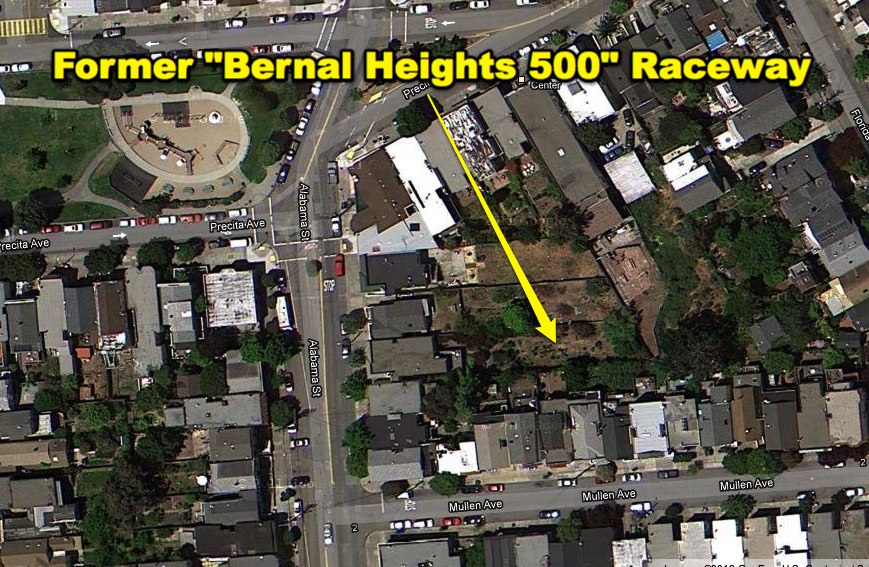
Bernal Heights old-timers sometimes grumble that the neighborhood used to be a more wild and wooly place, back in the day. And that may be true. But “back in the day” wasn’t really all that long ago. For example, did you know that Bernal Heights was once home to a private motocross raceway? And that this raceway was in operation as recently as 2007?!

The track was located on a loooooong, narrow yard on Alabama Street near Precita Park, and the homeowner at the time was James Sidwell. He tells Bernalwood:

I operate Superplush Suspension, a motorcycle suspension shop in Dogpatch.

I owned that house for ten years. We built a pretty good minbike track with the leftover yard space out back. Around fourth of July, I would have an annual BBQ and XR 100 race out in the yard. We cooked pork shoulder from 5am, brought in a keg of Pabst, and ran laps till dark.

There were injuries, kids playing, a good time had by all. The neighbors were great, since we mandated stock quiet exhausts and only ran all day once a year, at the party.

As proof, here’s some footage shot during the 2007 Bernal Heights 500. (Extra bonus, kids on a trampoline!) How’s that for city living?

House Portrait: Carlos Santana’s House on Mullen

Santana House

Santana House

The Mission District usually gets the credit for having been home to Carlos Santana, but the truth of the matter is that Santana commuted to the Mission from Bernal Heights.

Specifically, according to longtime Bernal resident Peter Wiley, Santana lived in this house on Mullen Avenue. Here’s how Neighbor Peter guided me to it:

The house is on the north side of Mullen just east of the Franconia steps. There is a Franconia cul de sac that runs south from Mullen just east of the bend as you drive up (east) Mullen from Franconia. The first house to the east of the steps is an old storefront. The second house is a shingled cottage. Maybe not shingled. That’s the one. It is flanked to the east by a cottage that is set back from the street.

Neighbor Peter confirmed to Bernalwood that the home shown here was indeed the Santana House. Carlos, if you’re out there… care to chime in???

PHOTOS: Telstar Logistics

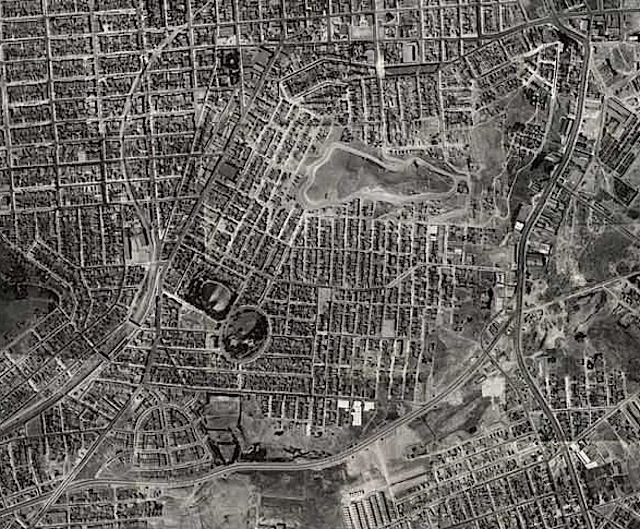
A Bird’s Eye View of Bernal Heights in 1938

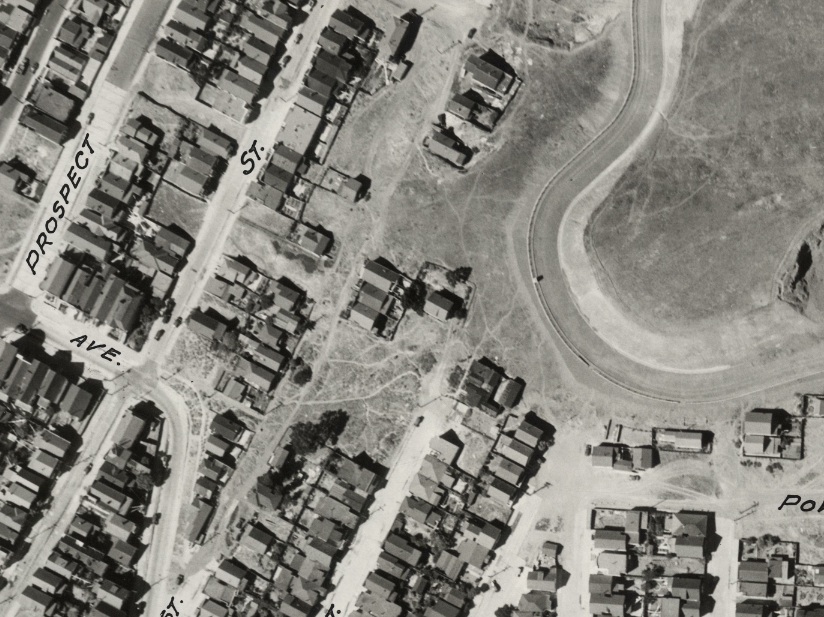
La Lengua rebel propagandist Burrito Justice recently alerted me to the existence of an online set of aerial photographs taken over San Francisco in 1938.

Within that set of pics, there are some very detailed shots taken over Bernal Heights, with crazy-spooky Google Earth-like resolution. The detail is stunning. So strap in to your seat, and let’s tour some Bernal Heights highlights, way back in 1938, shall we?

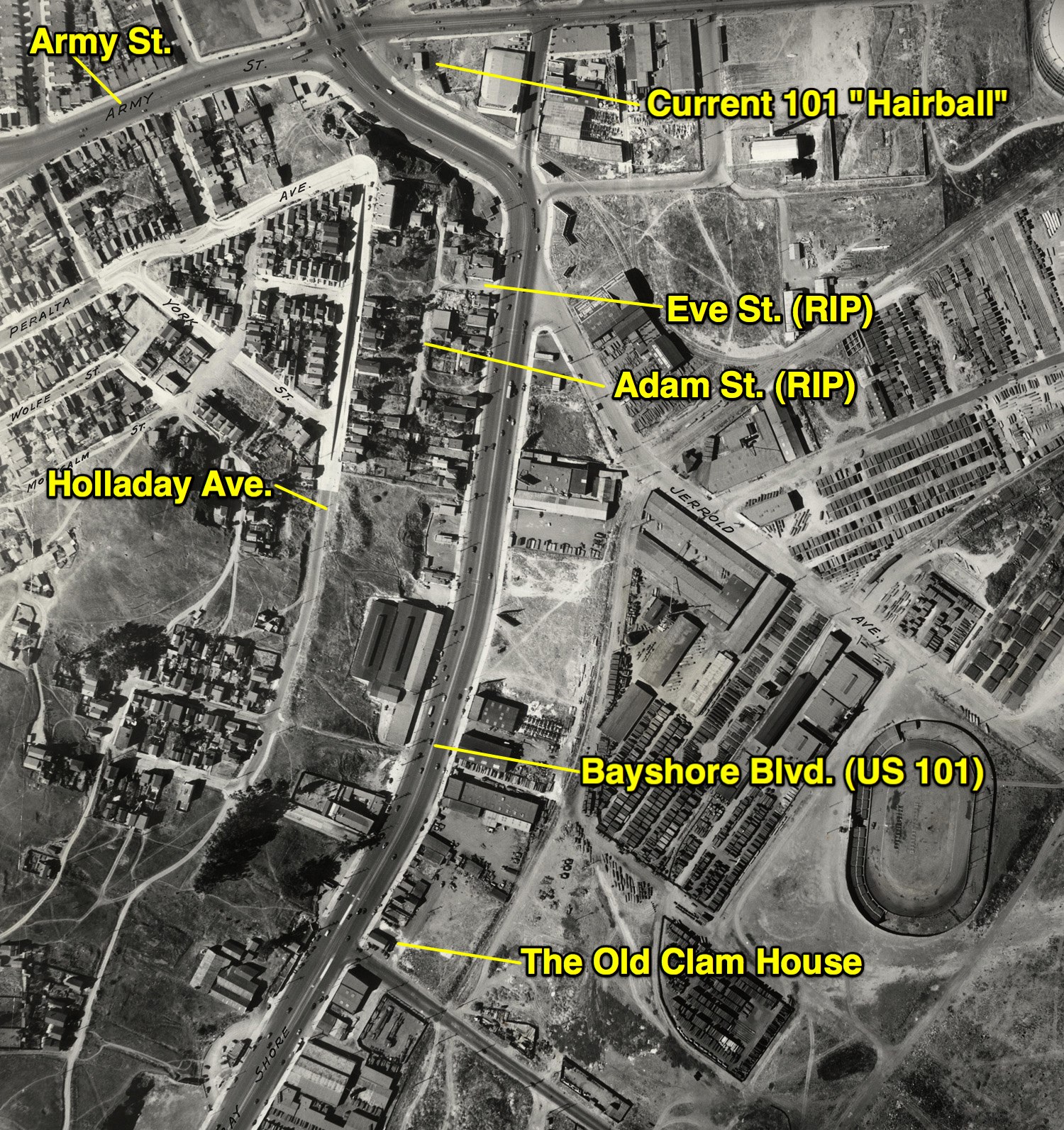
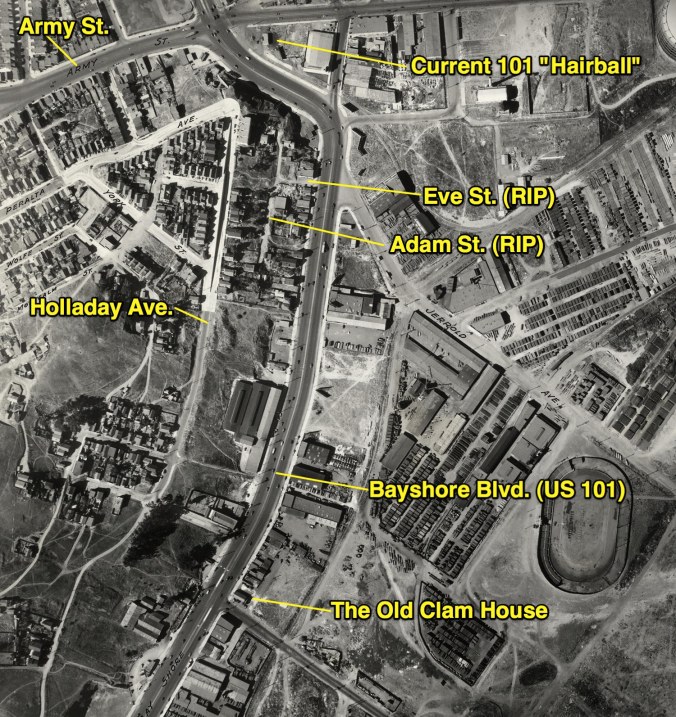
First, look to the east: There’s no 101 freeway yet; instead, Bayshore Boulevard carried traffic as US 101. Also clearly visible is the micro-hood centered along Adam and Eve Streets, all of which was plowed under when the freeway was built.
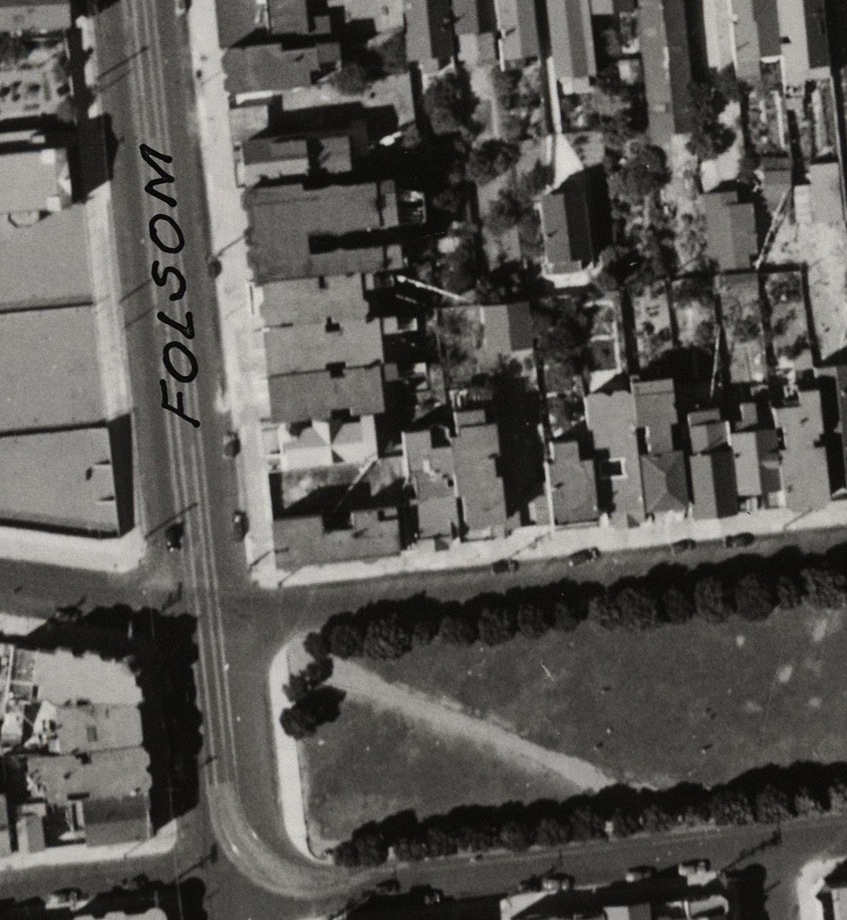
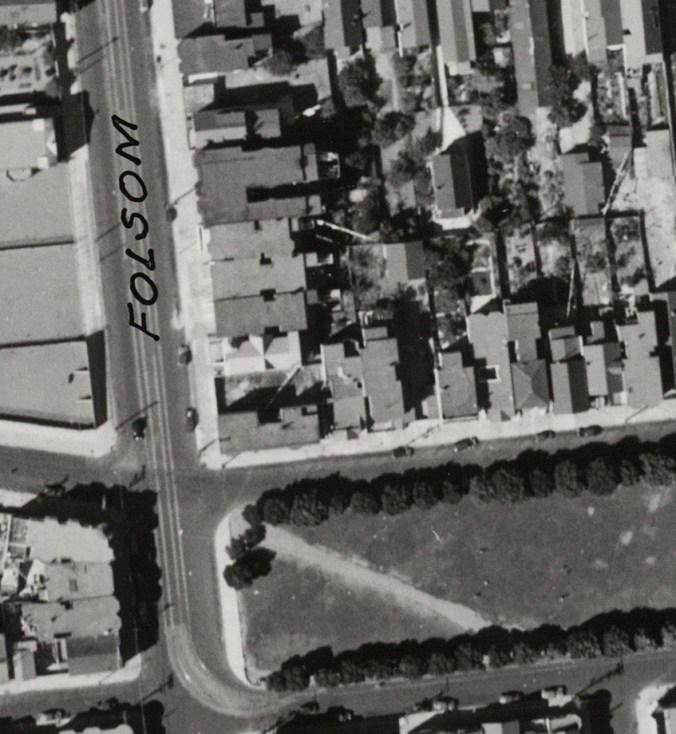
To the north, along Precita Park, we see the tracks of the 36 Folsom streetcar line, which terminated at the park:
There’s no playground at the east end of Precita Park, but it looks like the neighborhood kids created an impromptu baseball/stickball diamond in the center of the park, just west of the walkway that cuts through from Harrison Street:

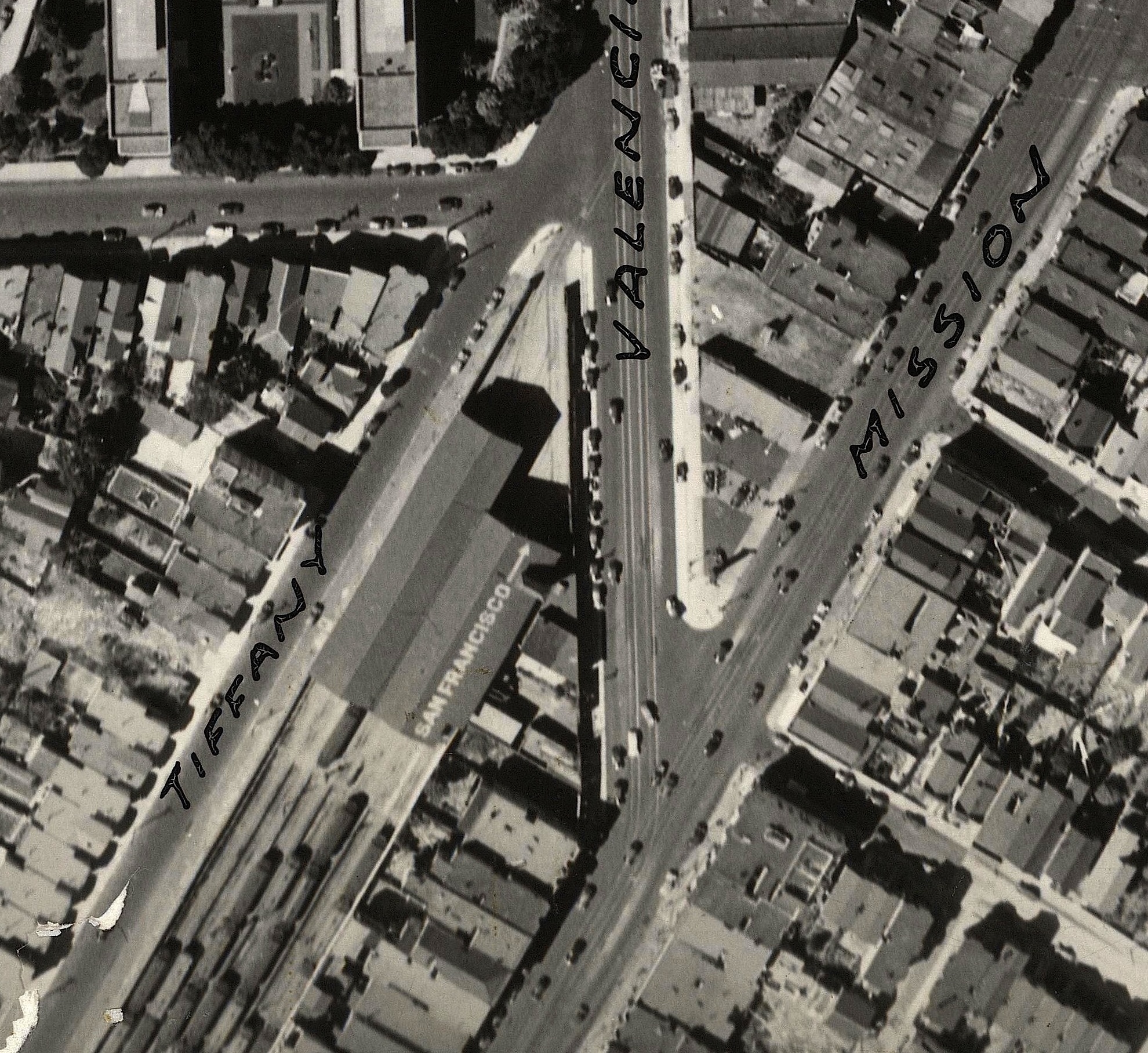
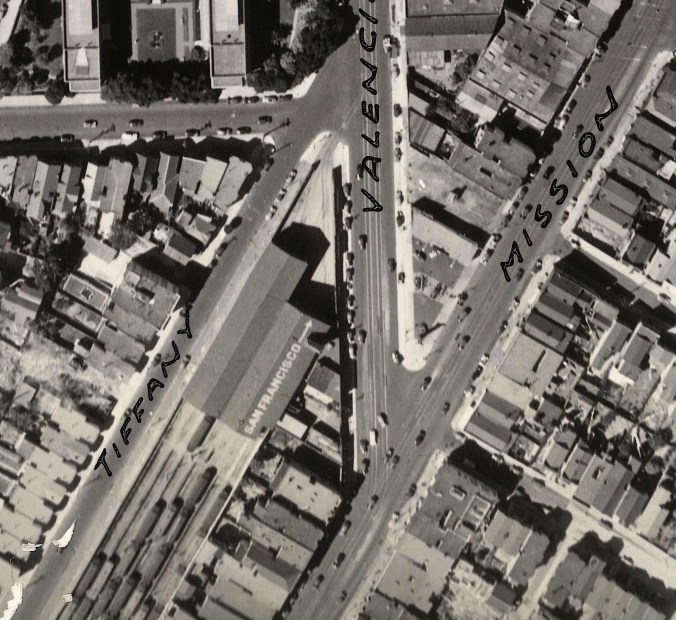
A little farther west, on Tiffany near the junction of Valencia and Mission, there was a streetcar shed, with “San Francisco” painted on the roof, and an arrow pointing north. (A navigational aid for aviators, perhaps?):
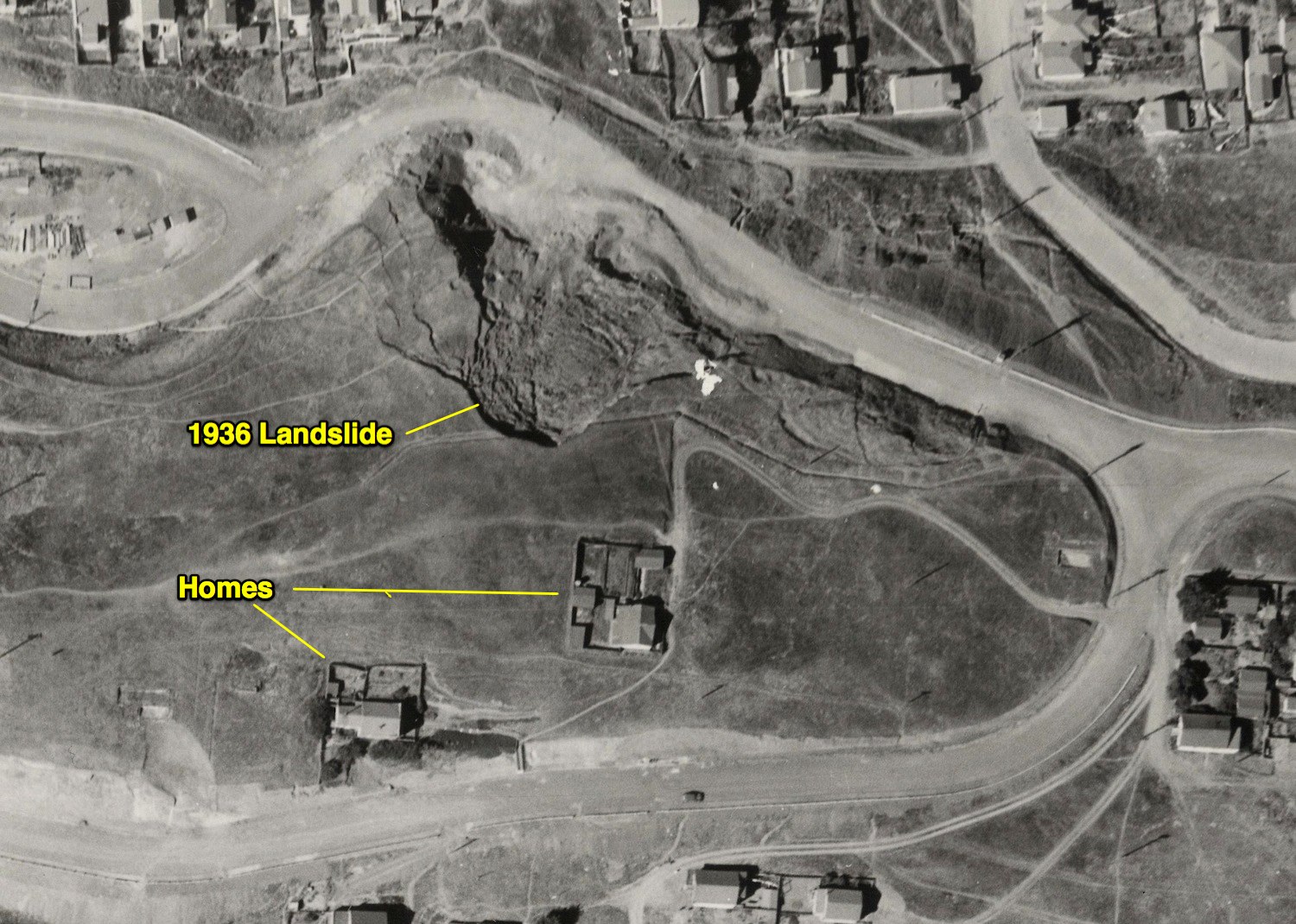
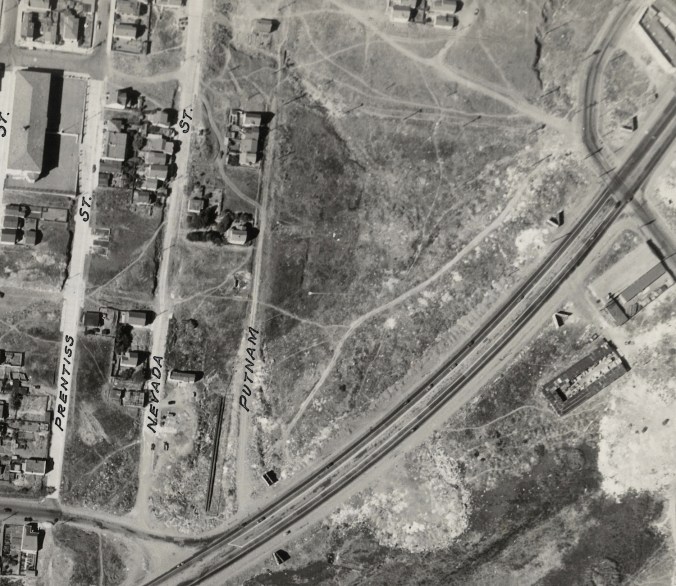
The late 1930s were a particularly interesting time up on Bernal Hill. There were two homes on the hill, Nos. 26 and 39 Prentiss Street, and both were occupied until the 1960s:

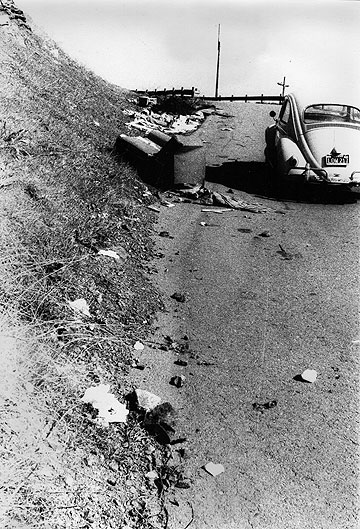
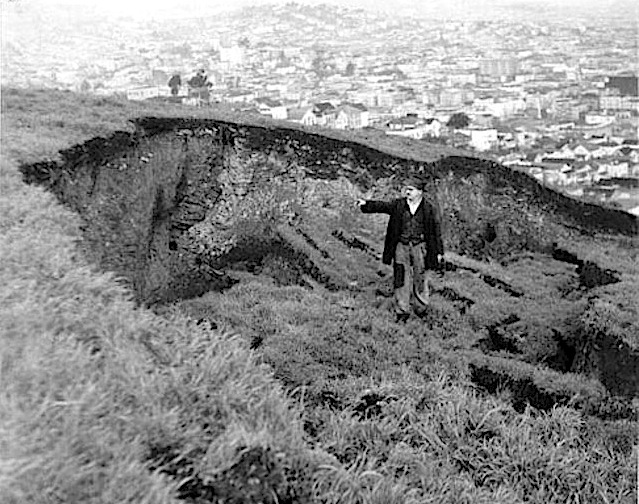
At the time when this photo was taken, Bernal Heights Boulevard was less than three years old. Bernal’s circular road-to-nowhere had been carved out of the hillside in 1935, as a WPA project. But construction of the roadway triggered a landslide in February, 1936, on the north slope of the hill just east of today’s Folsom gate. As you can see above, the debris from the slide was still present in 1938. Here’s a ground-level perspective on the landslide from 1936, courtesy of the SFPL:
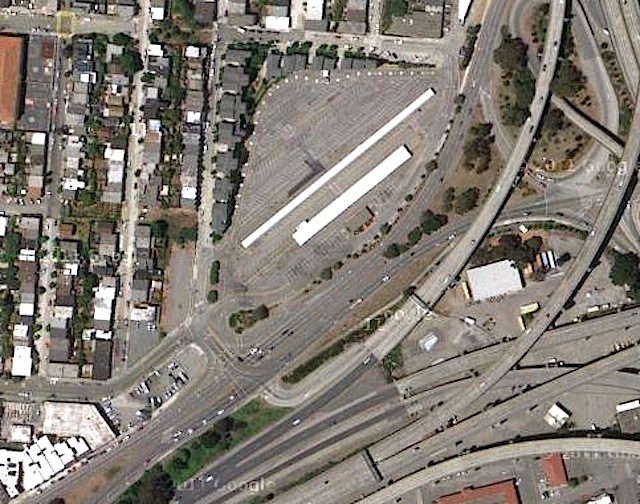
In the southeast, we see the overgrown site that would become the Alemany Farmer’s Market during the 1940s:
Compare with 2011, which also includes the 101/280 “Spaghetti Bowl”:
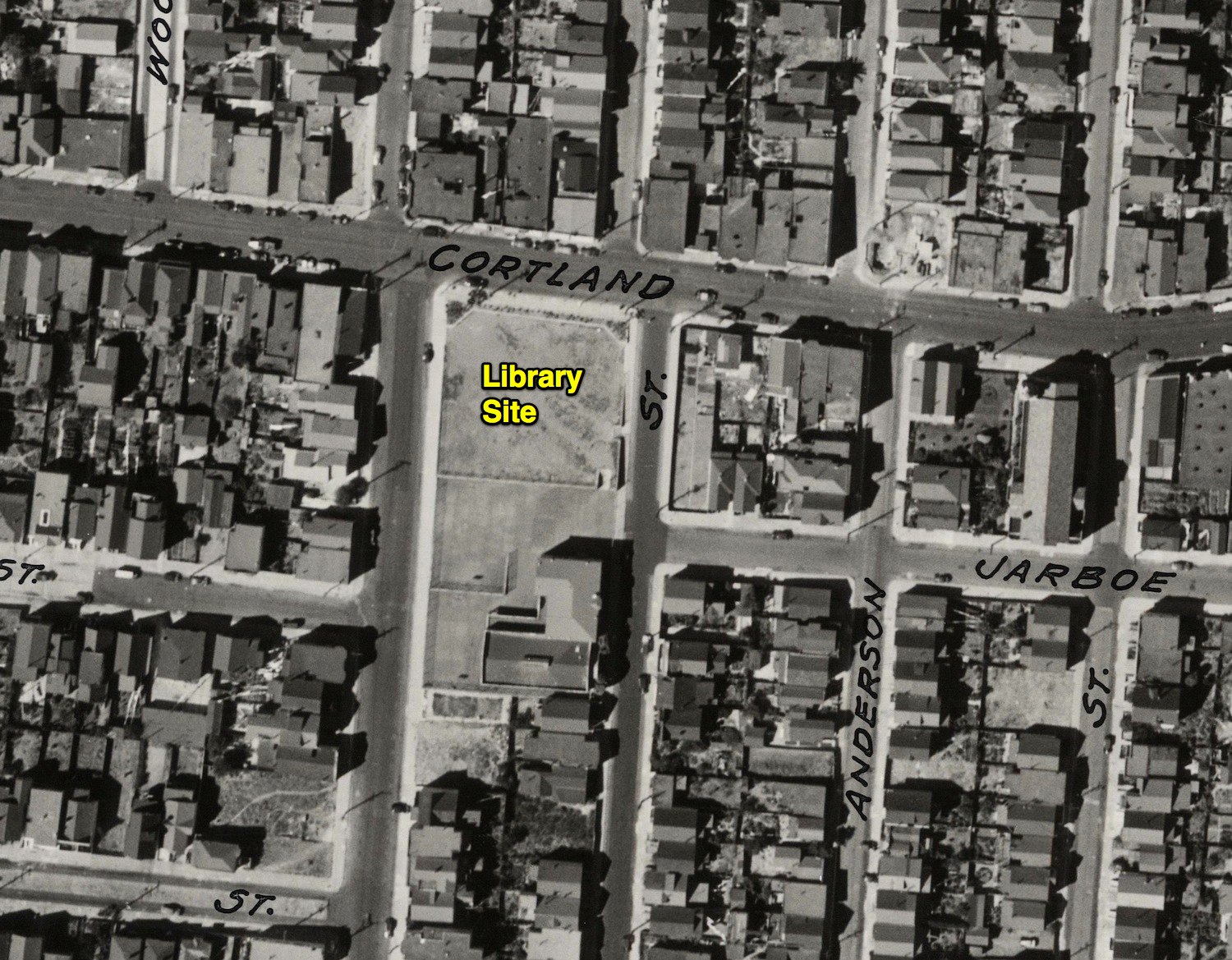
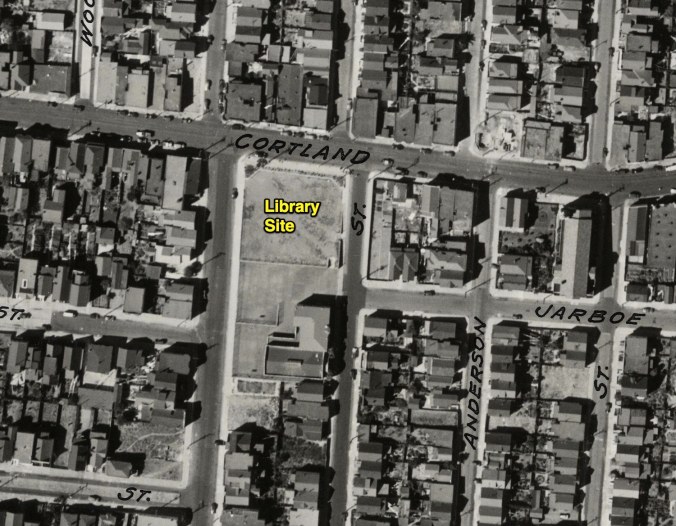
Over on Cortland, the lot has been cleared to begin construction of the Bernal Heights Branch Library (which was dedicated in October, 1940):
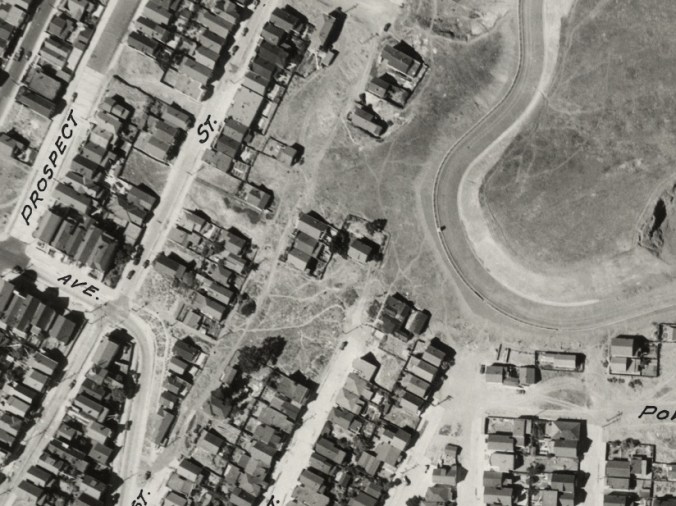
Just west of the Bernal summit, Elsie Street was still an unpaved dirt path:
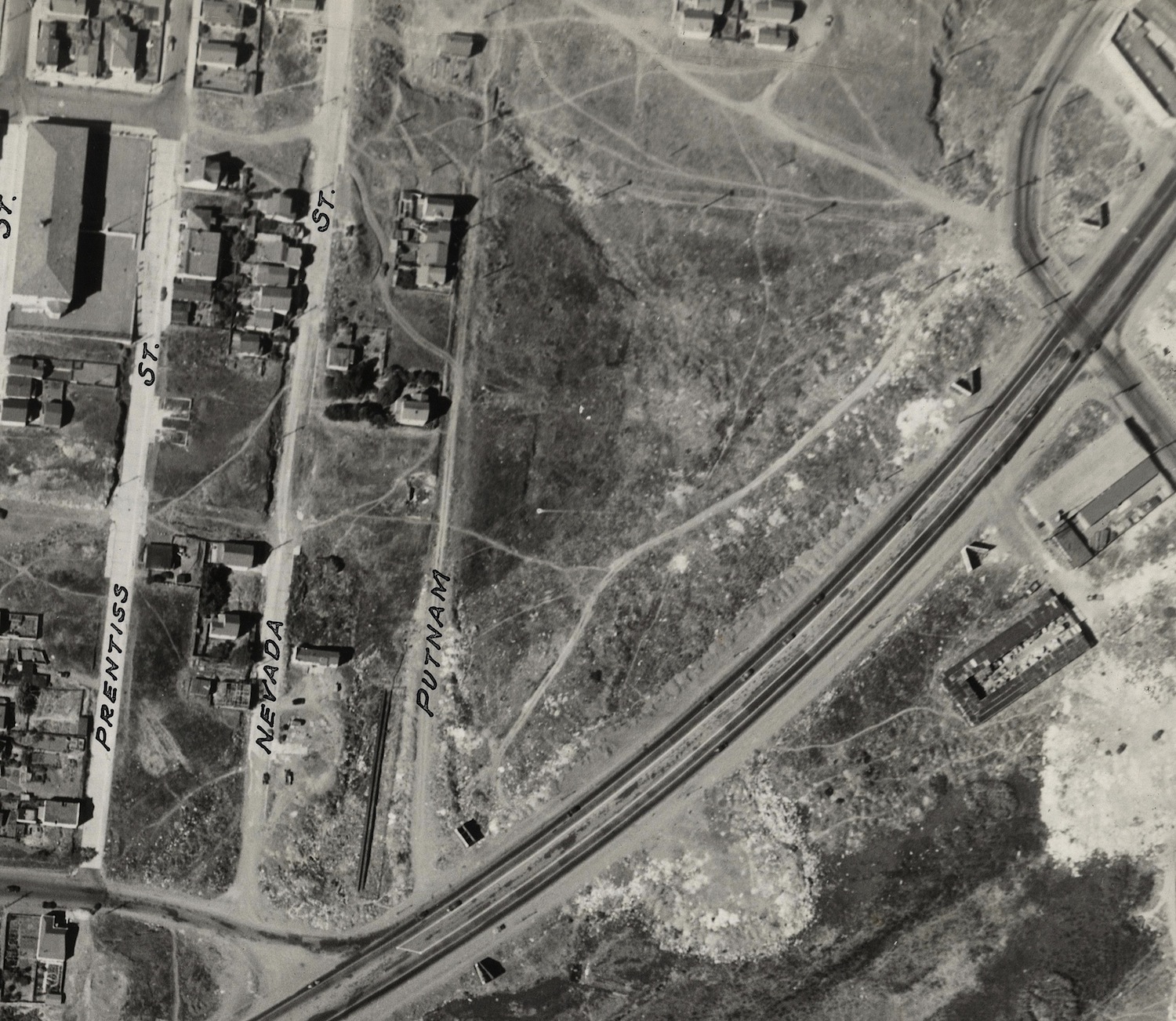
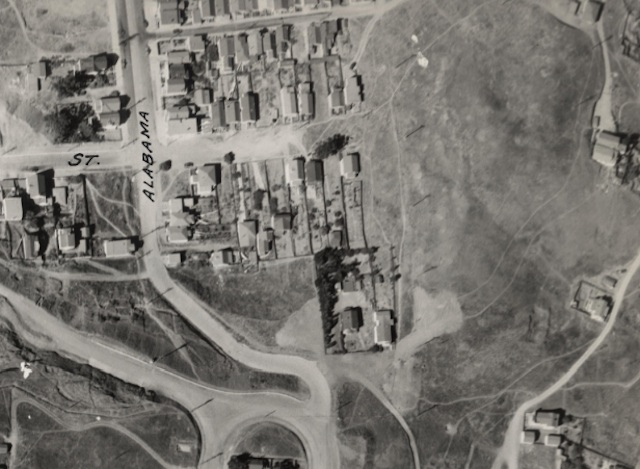
Meanwhile, east of Alabama Street, the area of today’s Ripley, Peralta, and Franconia streets was still just plain… dirt:
Okay, so now how do you explore Bernal Heights in 1938 on your own? You can either download individual photo tiles (tedious), or you can use the Google Earth-enabled Web interface (much easier) to cover more terrain more quickly.

Have fun, procrastinate wisely, and please do share any other discoveries you might make about what Bernal Heights was like back in 1938.

PHOTOS: via the David Rumsey Map Collection
Meet the Kuta Family. They Lived Here For A Long Time

Every once in a while, Bernalwood receives a note from someone who used to live in Bernal Heights, but moved away. It seems that some of these ex-neighbors now read this blog to stay in touch with the old neighborhood. They’re the Bernal Heights Alumni Network, and they carry our history with them.

Last week, I received a lovely note from one such Bernal alum. Patricia Kuta now lives in Santa Rosa, Calif., and she writes:

I spent my first 20 years on Bernal Heights… 1st on Gladys St. then Nevada St.  My mom was born on Crescent Ave., and lived on Nevada St. for 70 years.  It is so heartwarming to get your posts and tidbits from the ‘hood!!  I don’t get into the City as much as I want, but you bring me “home” daily!  Bless you all….

First of all, that made my day. Secondly, it made me realize how much of our history now lies in places far, far away from here.

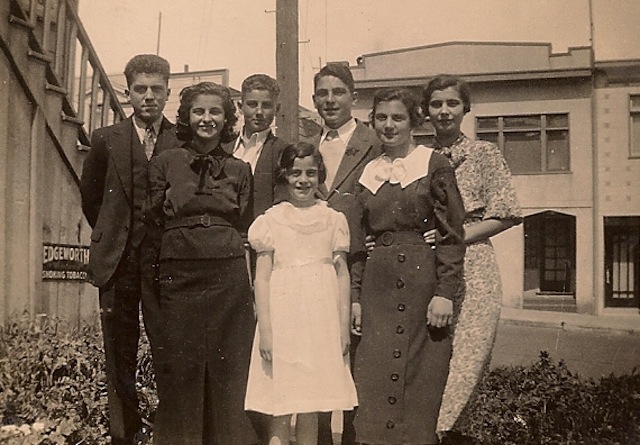
So when I replied to Patricia, I asked her to send a photo of her mother when she lived in Bernal Heights. The fantastic photo you see above is what I received.

This is a picture of my mom, Erma Crociani Kuta (the youngest in the middle) with her siblings and cousins… I think on Crescent St. They moved to 176 Nevada St. in 1929.

Many thanks to the Kuta family, on behalf of everyone here, now, in glamorous Bernalwood.

PHOTO: Erma Kuta, courtesy of Gregory Fearon

St. Mary’s Park in Sunday’s New York Times

St. Mary's

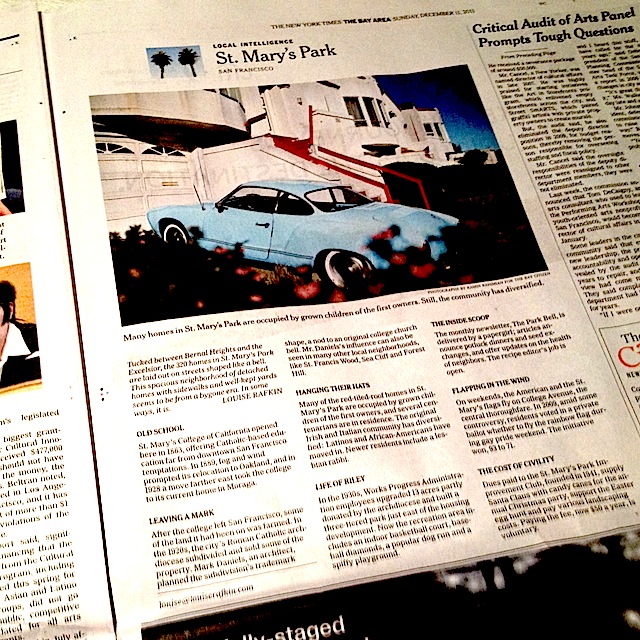
In case you missed it, there was a spiffy little overview article in yesterday’s print edition of the New York Times about St. Mary’s Park, the cute micro-‘hood in the southwest corner of Bernal Heights.

A sampler:

OLD SCHOOL
St. Mary’s College of California opened here in 1863, offering Catholic-based education far from downtown San Francisco temptations. In 1889, fog and wind prompted its relocation to Oakland, and in 1928 a move farther east took the college to its current home in Moraga.

LEAVING A MARK
After the college left San Francisco, some of the land it had been on was farmed. In the 1920s, the city’s Roman Catholic archdiocese subdivided and sold some of the property. Mark Daniels, an architect, planned the subdivision’s trademark shape, a nod to an original college church bell. Mr. Daniels’s influence can also be seen in many other local neighborhoods, like St. Francis Wood, Sea Cliff and Forest Hill.

HANGING THEIR HATS
Many of the red-tiled-roof homes in St. Mary’s Park are occupied by grown children of the first owners, and several centenarians are in residence. The original Irish and Italian community has diversified: Latinos and African-Americans have moved in. Newer residents include a lesbian rabbi.

PHOTOS: Telstar Logistics

Oops! Bernalwood Forgets Its First Anniversary

I just looked back at some of the logs for this blog and realized… yesterday was Bernalwood’s first anniversary. Nice work! We forgot our own birthday!

Bernalwood began not with a bang, but with a sound-check. The complete text of our very first post read as follows:

We Are Live, People
Posted on November 28, 2010 by Todd_Lappin

Is this thing on? Check, one-two. ONE-TWO. Check, check….

Very auspicious, eh?

I won’t bother describing all the reasons why Bernalwood was started, because that has very little to do with what inspires and animates it today. I will say that working on Bernalwood for the last year has been a marvelous experience, in ways that I never would have imagined.

Bernalwood is an Internet thing, but it has become an incredibly powerful tool for converting digital bytes into atom-to-atom human relationships. I can’t describe how many terrific people I’ve met because of this blog, and how many new friends and neighbors I’ve gotten to know along the way. In fact, many of those relationships already feel so familiar that it’s hard to believe they’re less than a year old.

So thanks to everyone who helped make this year so fun: Bernalwood’s regular cast of contributors, our colorful coterie of commenters, all you phabulous photographers, our marvelous Bernal merchants, those strident separatists from La Lengua, and our many thousands of next-door neighbors.

Onward! For glamour! For the Dominion of Bernalwood!

Then and Now: Mission at Virginia, c. 1925 vs. 2011

Mission at Virginia-circa 1920

I found this historical photo of Mission Street looking north from Virginia Street recently. The photo was unattributed and undated, but judging from the cars on the street, it looks as if it was taken sometime during the mid-1920s.

I particularly like this, because it illustrates two themes we’ve discussed recently on Bernalwood: To the left we see the former Lyceum movie theater (which is now part of the Taoist Safeway parking lot), and the big brick building on the right is the former Market Street Railway Car House (which later became our bowling alley, and then today’s Big Lots).

And here’s how the same scene looks today:

Mission at Virginia-2011

PHOTO: 2011, by Telstar Logistics

Once Upon a Time, There Was Bowling in Bernal Heights

I really loved the tale Eric Fermon told earlier this week about growing up during the 1970s in the Bernal Heights Projects on Ellsworth Street. But did you happen to catch this line he tucked in there?

Learning how to bowl at Mission Bowl while participating in a Saturday morning youth bowling league and looking forward to eating the best french fries on the planet there, and knowing that with just the right amount of ketchup they were extra-extra special.

That caught my eye. Bowling? At Mission Bowl? WHAAAAAATT!!!???

I’m a history geek, but I’d never heard of Mission Bowl. So what was it? And more importantly, where was it???

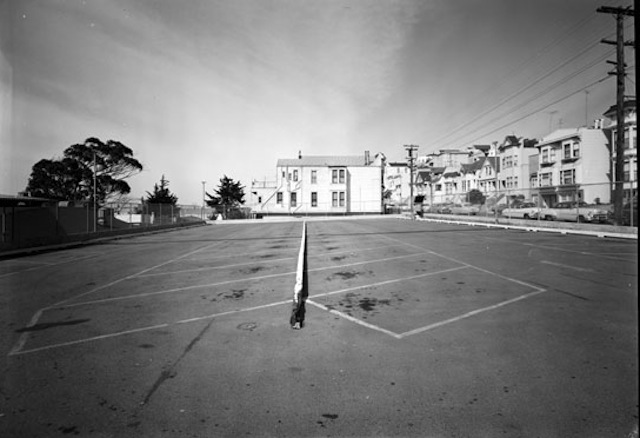
The brilliant Vicky Walker of the Bernal History Project provided the answer: Mission Bowl — or Sports Center Bowl, as it was formally called — used to occupy the lot at 3333 Mission that is now home to the large residential complex and Big Lots store, kitty-corner across the street from our Taoist Safeway.

But before we get to that, let’s back up a few decades to recall what that site looked like before Mission Bowl — and the reason why I was confused about its existence. My understanding had been that the present-day site of the Big Lots etc. used to be a streetcar repair facility operated by the Market Street Railway Company. And indeed, for the first half of the 20th century, that’s exactly what it was. Here’s how the “car barn” looked in 1921:

And here’s another view looking north up Mission Street in 1928. (Notice how the tracks have a switch that heads into the building on the right):

I knew about the Mission Car House, so I thought I understood the history of that site. But apparently, there was a gap in my timeline. Sometime between the time when the Car House was torn down and the Big Lots was constructed, the site had been home to the postwar Sports Center Bowling facility, aka Mission Bowl, which is shown in the image at the top of this post.

I found this little remembrance about Sports Center Bowl on Facebook:

This bowling alley was the epitome of 50’s and 60’s ambience. Dimly lit and smoky. A simpler times vibe with Dan O’Glove as your host. He was a great promoter of the sport of bowling. His Sports Center Bowl attracted the elite adult bowlers in not only San Francisco, but of the bay area and even southern California. His 32 lane house was a staple of AMF theme houses. Located at 29th and Mission streets in San Francisco. Home to The Washington Birthday Tournament. Such Pro and elite bowlers as Terry and Mike Leong ran the Pro Shop. Woman’s pro bowler Vesma Grinfelds was a regular when not on tour. Notable juniors and future adult stars to have frequent the lanes were Wayne Chester and Joe Goldstein. A 1 to 4 board shot was the norm and pot games were always flowing. The counter served up delicious American food fair right out of the 50’s and 60’s and the pinball machines were always full of adults and kids jockeying to play!

That “American food fair” [sic] presumably included the french fries Eric Fermon remembers so fondly. It also offered ample parking on the roof, via Coleridge Street:

So there you have it. Sadly, Mission Bowl is gone without a trace, and with it, Bernal Heights lost its bowling alley. But on the bright side, bowling is set for a revival in the Mission District, with new lanes planned for the Mission Bowling Club, which hopes to open in February on 17th Street near South Van Ness.

HISTORICAL PHOTOS: via the awesome San Francisco Public Library Historical Photograph Collection

Tales from the Bernal Heights Projects, Class of 1971

Eric Fermon doesn’t live in Bernal Heights anymore.

But when he did, Eric was a young kid from the Bernal Heights Projects on the south side of Bernal, alongside I-280. Richard Nixon was president, and life wasn’t always easy, but Eric remembers it fondly. He wrote to Bernalwood recently to share some of his memories of what it was like here back in 1971:

I remember so many things about Bernal Heights while we lived there between 1967 and 1971, but the sunny days and the vantage point from living near the top of Ellsworth St. on the south side overlooking the 280 as it snakes through the Portola Valley are encompassing memories. We arrived there one sunny afternoon in a rented moving van driven by my cousin Big Mike who couldn’t have been older than 16 or 17 at the time. Pulling up over the crest of Ellsworth St and parking on the right side of the street just a few feet from the apartment entry way is a stark memory. We had a bunch of oranges contained in a red plastic mesh bag and my sister Gladys had been eating oranges all morning and when we got there she was itching like crazy and her skin had broken out with hives.

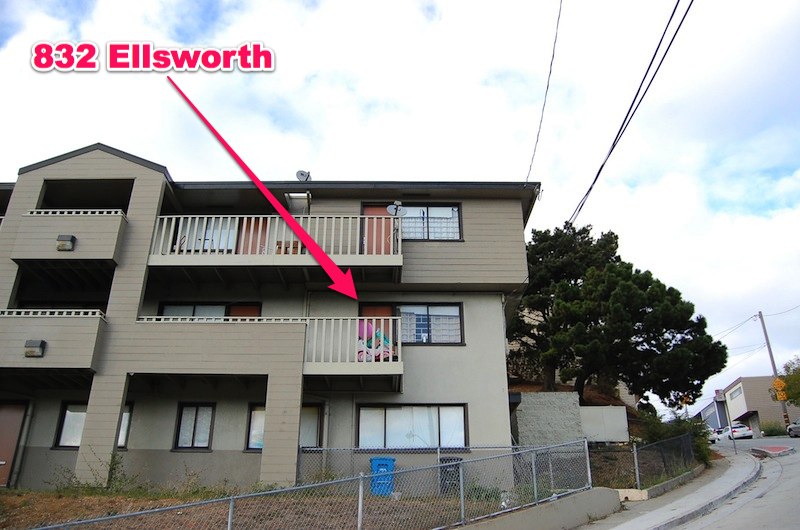
We moved into 832 Ellsworth that day and as far as I could tell, leaving the Potrero Hill projects and moving to the Bernal Heights projects was a step up.

Here’s some of the things I remember most about living in Bernal Heights:

Climbing Bernal Heights hill on a sunny day or flying kites up there or at Holly Park on a windy day.

Going to the Library and nearby play ground on Cortland Ave.

Throwing dirt bombs on the Muni bus that drove up Ellsworth St.

Walking home with my two sisters and at times with my older brother from the Potrero Hill child care center to Bernal Heights on afternoons when we either didn’t have a ride home or money to take the bus. We would walk down Connecticut St. and cross Army (now Ceasar Chavez Ave) onto Evans Ave., then pick up Toland St. and walk through the host of industrial and construction companies until we got to Industrial St. We’d then make a right on Industrial St. and cross under the 101 overpass then march through Farmers Market and past Sun Valley Dairy before heading up the hill on Crescent Ave. until we got to Ellsworth St.

Attending Paul Revere in the 5th Grade and taking class in the Bungalow that was located in the school yard.

Having races in the school yard at Paul Revere to see who was the fastest in the class and me being second to a girl named Sharon, who incidentally came to Aptos Jr High in my eighth or ninth grade year. I had a brief crush on her at Aptos and didn’t even realize it was the same girl from Paul Revere until she reminded me one day some years later as young adults while helping a family member move.

Fond memories of Claire my very first grade school crush. She was hispanic, had long black hair, a pretty face, beautiful smile, athletic body and happened to be a pretty good kick-ball player.

Making friends with Keith Lewis a basketball prodigy who saved me from Danny the bully and who eventually attended Lowell HS where I had the privilege to play against him in a few varsity basketball games while I attended Lincoln HS.

Watching my older brother Carl run down the hill and return triumphantly riding his 3 speed Schwinn StingRay bike back up Ellsworth St. after telling him a teenager from down the hill took the bike from me while I was riding it out in front of the apt.

Seeing local teenagers sniffing glue out of a paper bag in the bushes right across from our apt. and later while walking back home from the corner store seeing one of those teenagers on the roof of a house crying and whacked-out threatening to jump off the roof, while a group of people tried to talk him down.

Meeting the new next door neighbor Sheldon and eating Mushroom Pizza for the first time with him & listening to him talk about his parents having sex.

Learning how to bowl at Mission Bowl while participating in a Saturday morning youth bowling league and looking forward to eating the best french fries on the planet there, and knowing that with just the right amount of ketchup they were extra-extra special.

I’ve lived in a number of places since then but the time we lived in Bernal Heights was an awakening period of sorts for me because I lived there between the ages of 6 and 10 years old. The few notable memories listed above characterize my stay in the Bernal Heights projects and make me a proud member of it’s Class of ’71.

The Coda? Eric is an Air Force veteran who lives in Seattle. He does information systems work for AT&T, and is currently writing a book.

PHOTO: 832 Ellsworth in 2011, by Telstar Logistics

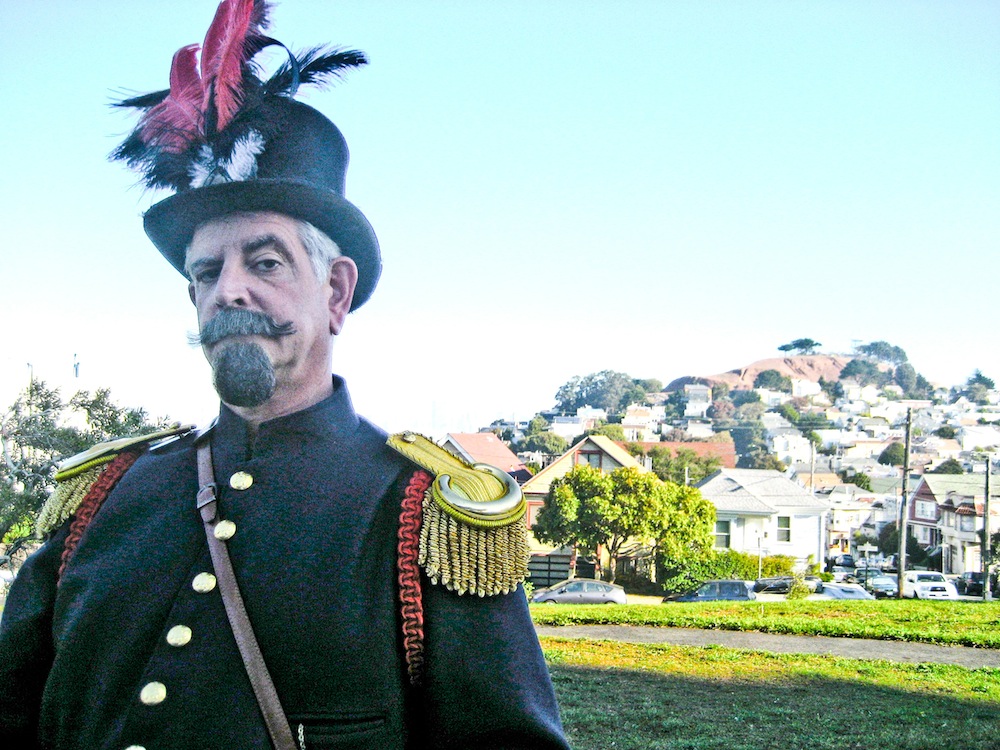
Emperor Norton is Alive and Well and Living in Bernal Heights

His Imperial Majesty, Emperor Norton I was a nineteenth century San Francisco eccentric who fancied himself Emperor of the United States. Joseph Amster is a twenty-first century Bernal Heights resident who resurrects the spirit and dress of Emperor Norton to lead tourists on downtown historic tours. From his media kit:

Amster, a displaced journalist with an acting background decided he wanted to create a walking tour with a twist, offering his patrons a unique experience. “I decided early on that I wanted to do my tour in character and researched the historical figures from San Francisco’s past,” says Amster. “At first I thought about doing the tour as Mark Twain, but the more I read about Emperor Norton, the more fascinated I became with him.” After completing his research, Amster took on the character of Emperor Norton, complete with uniform, beard and plumed top hat. He now offers his tour to anyone with an interest in history.

A businessman originally from England and South Africa, Joshua Abraham Norton arrived in San Francisco in 1849 with $40,000, which after some shrewd investing, increased to $250,000 (which would be $3 million today). After losing his fortune to a bad rice investment, Norton disappeared, returning to San Francisco in 1859, declaring himself Norton I, Emperor of the United States and Protector of Mexico. In any other city, he would have been dismissed as a madman, but the people of San Francisco embraced his reign. During his lifetime, Norton printed his own currency (which was accepted by San Francisco merchants), was served gratis in the city’s restaurants and always had the best seats at the theater. He also issued numerous proclamations, including calling for a bridge to be built between San Francisco and Oakland, and the founding of a league of nations. Today the Bay Bridge and United Nations stand as testaments to Emperor Norton’s vision.

As part of preserving Emperor Norton’s legacy, Amster is seeking to pay proper tribute to this visionary. “San Francisco has no memorial to Emperor Norton,” says Amster. “No streets are named after him, no statue has been erected, and there is no historical marker. The only plaque dedicated to his memory was on the old Transbay Terminal.” That plaque now rests with the Transbay Joint Powers Authority, and will be part of an interpretive exhibit when the new Transbay Terminal opens. The tributes Amster proposes include naming Commercial Street’s Empire Park (Emperor Norton’s address when the 1870 census listed his occupation as “Emperor”) Emperor Norton Park, and naming the Bay Bridge in Emperor Norton’s honor.

Fine proposals, all. And kudos to Joseph Amster to reviving the spirit of Emperor Norton in high fidelity and grand style. Oh, and if you happen to see him in full Norton I regalia waiting for the bus to take him to work downtown, do not be alarmed. To the contrary, approach him with Bernal pride and admiration, because he is clearly one of our own.

PHOTO: Top, Joseph Amster as Emperor Norton, by  Chris Ellen Montgomery. Below, Emperor Norton I, circa 1880, via Wikimedia Commons

Part II: A Brief History of the Unusual Building That Is Now Home to Bernal’s Best Ninja Equipment Shop

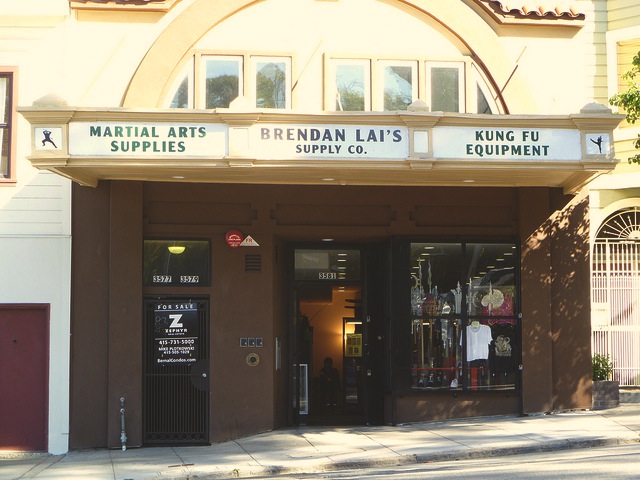
Earlier this week Bernalwood presented the history of Brendan Lai’s Supply Co., the kung fu equipment store on Mission Street near the Randall intersection. But just as intriguing as the business itself is the building that houses it — the structure clearly looks as if it used to be something else. But what was it? Supersleuth Vicky Walker of the Bernal History Project takes on Part II of the mystery:

Store manager Al Lai recently asked the Bernal History Project to help research the landmarked building on Mission Street that now houses Brendan Lai’s Supply. Several customers and neighbors had told him the building might have once been a movie theater, because of its distinctive overhang and window design. But was it?

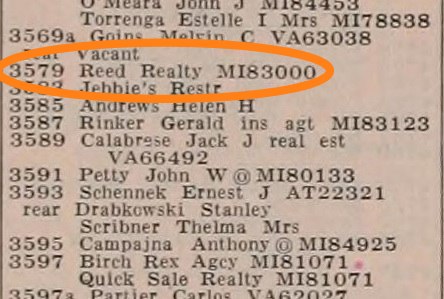
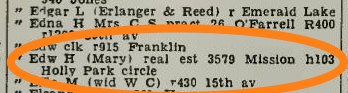
BHP got to sleuthing. According to city records, the building was constructed in 1930. In 1932, it was the office of real estate agent Edward H. Reed, who lived with his wife, Mary, at 103 Holly Park Circle. Edward began his real estate business at 3835 Mission in 1925. By 1932, it had moved into 3579 Mission. Here’s a clip from the 1932 city directory:

Edward Reed Sr. passed away near the end of World War II. His son, Edward D. Reed (b. 1920), took over the family business in 1948. He lived in Millbrae and later San Carlos with his wife, Shelagh. The Reed family ran a real estate office at this address for more than two decades; here’s the 1953 directory

BHP found some more clues in the background of two photos from the collection of S.F. streetcar and movie theatre historian Jack Tillmany. Jack’s pictures show that Reed Realty’s frontage and vertical sign are visible in a 1938 photo, which also features the 23 streetcar barreling down Mission near Randall on its way to the Geneva car barn. (Click to enlarge.)
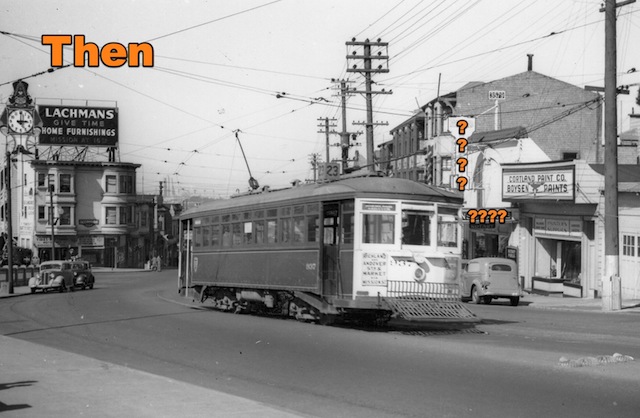
Next door is the Cortland Paint Co., while at 3593 Mission is Schifano Ladies Tailoring, a clothes-cleaning store and tailor’s run by Joseph and Mary Schifano of 91 Whitney Street. The apartment building below the Lachman’s sign is now the Shell gas station.

And then there’s this stunner: A 1944 color photo from a similar angle shows that the paint store is gone and Reed Realty’s sign has been revamped in black and white. Schifano’s, just out of shot, is no longer listed in city directories and seems to have been converted to a residence.

The 1954 city directory shows Reed Realty still going strong, with neighbors Jebbie’s Restaurant at 3583 Mission (sister restaurant to Jebbie’s Hot Dogs at 1131 Ocean) and a clutch of real estate businesses.

By 1956, the building had become a State Farm office, and it stayed that way until very recently, when Brendan Lai Supply moved in.

So, alas, there was never a movie theatre here, despite its elegant frontage. Instead, his building has had a prosaic and orderly life – until the ninjas came to town.

(Find out how you can learn to research your own Bernal building.)

HISTORIC PHOTOS: Courtesy of Jack Tillmany

A Brief History of Bernal’s Very Best One-Stop-Shop for Ninja Equipment

You want artisanal meat? Bernal Heights has it. A fine selection of tasteful, high-quality gifts for any occasion? Got it. Equipment to supply a lethal army of martial arts warriors? Bernal has you covered.

Vicky Walker of the awesome Bernal History Project has done some research into the mysterious and fascinating Brendan Lai Martial Arts Supply Co. on Mission Street, and she brings us this report:

Not many San Francisco neighborhoods can claim to host a full-scale ninja emporium. But if you find yourself on Bernal’s northwestern edge, near the entrance to 280 at Mission and Randall, you’ll spot a storefront with a domed frontage and what looks like a movie theater awning.

Brendan Lai’s Supply Co. at 3581 Mission Street (at Appleton) has been in business in San Francisco since the early 1970s.

The business was founded by Brendan Lai, who moved to the U.S. from Hong Kong in the 1960s and rapidly gained a reputation for his mastery of the Seven Star Praying Mantis Kung Fu system. You can see him in action in this vintage demonstration footage:

Here he is in an instructional video:

Brendan Lai taught kung fu and chin-na classes at his studios on Clement and California Street, as well as in Italy, Canada, Brazil, South Africa, and Puerto Rico. He died in 2002.

Today, store manager Al Lai, son of martial arts master Brendan Lai, continues to manage the store, which moved to its current location last year. Al Lai says the family business supplies locals – “practitioners, fanatics, hipsters, and the plain curious” – as well as students and practitioners nationwide.

You can drop by anytime and test out a sword or two, ask for advice on studio referrals, or invest in some bruise medicine, posters, or uniforms. One Yelp reviewer promises, “You’ll be a kid in a kung fu candy store.”

PHOTO: Damon Styer

WTF? Ugly Pile of Trash Dumped on Bernal Hill Reminds Us That Such Ugliness Was Once Very Common

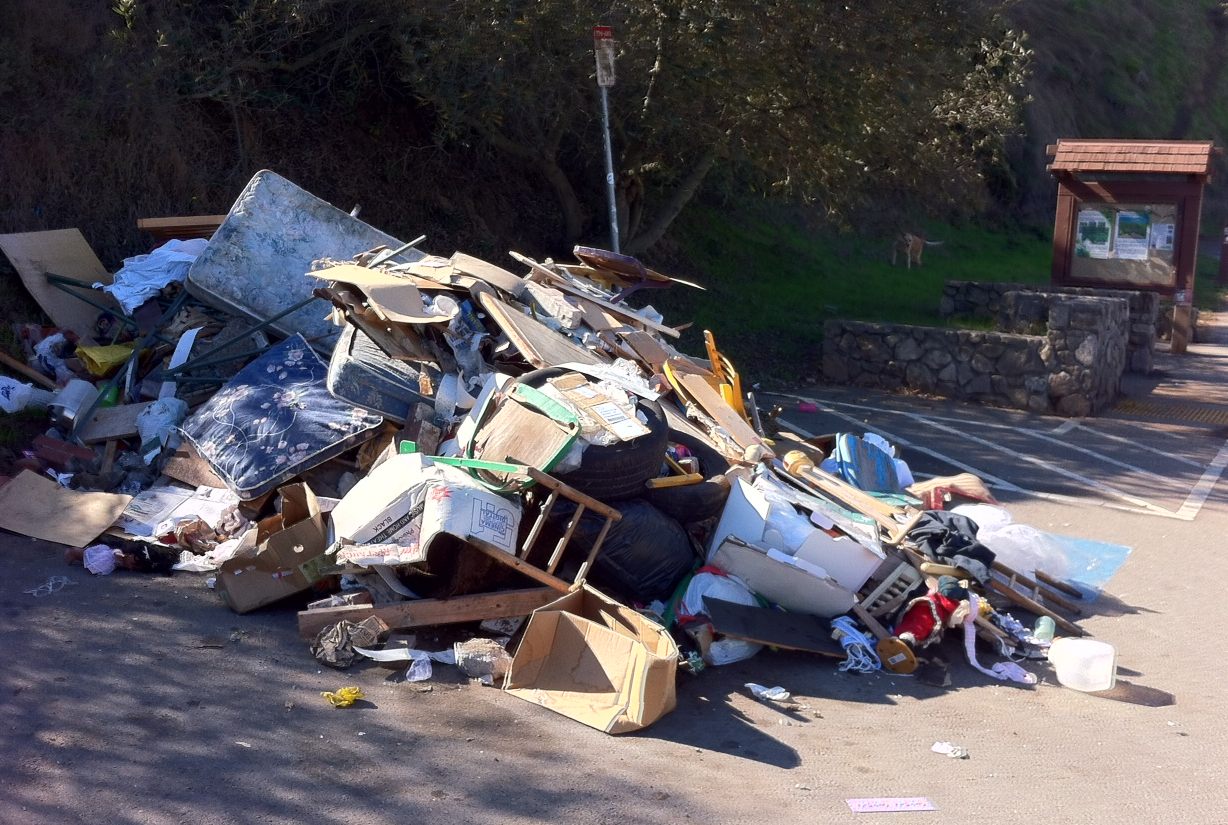
Reader Tony, who captured this grim photo on the north side of Bernal Hill on Sunday morning, asks:

WTF? Too poor to pay the dump fee, so we dump it @ Bernal Hill? What’s SF coming to?

WTF is right. (CUE: Crying Indian) But if there is a bright side to the tale, it is that this pile of trash stands out as a relatively rare anomaly. Indeed, this wretched scene is less an indicator of what SF is coming to, than a reminder of how far it as come. After all, not all that long ago, Bernal Hill was routinely used as a dump.

Consider this recollection by Jerry Schimmel about what Bernal Heights Boulevard was like during the 1960s and early 1970s:
The hill was actually a large open wasteland under nominal purview of the Department of Public Works, known by most as DPW. The west and east quarries were in regular use as auxiliary dumps by citizens too cheap, poor, or lazy to pay for hauling or couldn’t manage the drive to Beatty Avenue. Neighborhood residents were among the offenders, if not the worst. I remember Gloria Jiunti at 44 Mullen Avenue once sounding off about a load of worn car parts: “Aw, take it up on the hill and dump it!” And her attitude was not uncommon.
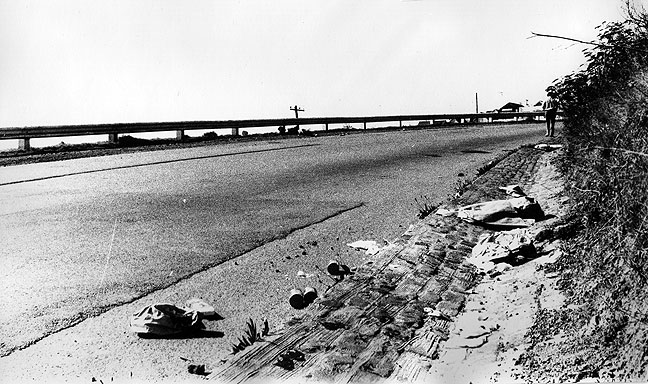
Like the quarries, the roadside verge was and still is an easy place to leave anything from a stained, lumpy mattress to the aromatic leftovers of Saturday night’s blowout. Some dumpers put their trash behind the guardrail (and still do) in a guilty effort to hide it, making it that much harder to retrieve.
In 1966, street sweepers made regular trips to keep the boulevard clear, but in order to get a really big mess hauled away from the quarries, several residents simultaneously had to put the screws on DPW’s Army Street office.

So as grim as this weekend’s trash dump was, the fact that it is so unusual, and attracted so much scorn, is actually a sign of progress. That said, when I drove around Bernal Hill on Monday night, the big trash pile was still there. Ew. Looks like someone needs to put the screws to 311.

PHOTOS: Top, Reader Tony. Historic photos, Jerry Schimmel via Found SF