
After a long and disgraceful delay, the San Francisco Medical Examiner’s office finally released its report on the March 21 officer-involved shooting death of Bernal resident Alex Nieto on Bernal Hill. Yet in the style of a politician or corporate bigwig who seeks to disclose information while blunting its impact, the medical examiner’s report in the Nieto case was released on Friday — just as San Francisco headed into the low-attention weekend.
So now, on a paying-attention Tuesday, let’s consider what the report says, and what it might tell us about the case of Neighbor Alex Nieto.
If you’re a primary-source kind of person who wants to read the medical examiner’s report in unfiltered form, you can find the full text of the report right here (courtesy of KQED).
If you want the digest, we’ll share the SF Appeal’s version, which highlights both Nieto’s injuries and the section of the report detailing his mental-health history:
The San Francisco medical examiner’s office released a full autopsy report Friday for 28-year-old Alejandro “Alex” Nieto that confirmed he was struck by at least ten bullets when he was fatally shot by police at Bernal Heights Park in March.
Nieto, a San Francisco native who lived on Cortland Avenue in the Bernal Heights neighborhood, was a security guard who attended City College of San Francisco. He had aspirations of being a probation officer.
Nieto was killed on March 21 by San Francisco police officers and the autopsy report indicates that Nieto suffered as many as 15 gunshot wounds from as few as ten bullets.
The Nieto family’s lawyer, civil rights attorney John Burris, said Friday that he has never seen an autopsy report that released so much information about the deceased’s alleged history regarding mental health problems and police contact.
The medical examiner’s office notes numerous details in the autopsy report, such as an incident in 2011 in which Nieto was not taking his medication and received 72-hours of involuntary psychiatric treatment after allegedly “attempting to burn his parents’ house down.”
Burris said he was surprised to see that the medical examiner’s office included medical records from San Francisco General Hospital that, according to the autopsy, “revealed a history of aggressive and bizarre behavior, auditory hallucinations,” as well as Nieto’s noncompliance to prescriptions for two atypical anti-psychotic drugs.
The medical examiner’s office reported traces of cannabinoids in Nieto’s system at his time of death and no trace of anti-psychotic medications.
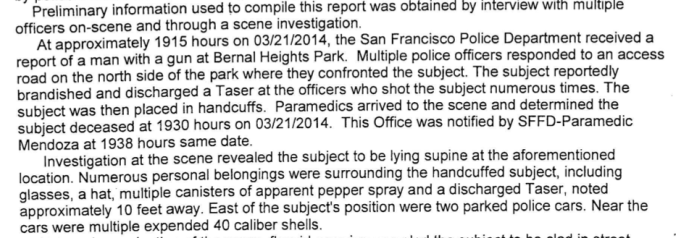
The other item of note in the report is the assertion that Nieto’s pistol-shaped Taser had been discharged at some point during his confrontation with the SFPD. Here’s how that section reads in the report’s case history:
Justice for Alex Nieto, the committee formed by Alex’s family and friends in response to his death, has published a lengthy response to the medical examiner’s report that seeks to refute many of its key assertions. Here’s an excerpt:
There is no reason or authority for the Medical Examiner to act as a police detective investigating any possible rationale for anything that happened on Bernal Heights on Friday, March 21. Their job is simply to conduct an examination of the body and notify the public of the medical examination concerning the cause of death. The San Francisco Medical Examiner is not a detective agency; if they were, then they should also be investigating the background and disciplinary records of the police officers who killed Alex Nieto, yet we still do not even have those officers’ names. The San Francisco Medical Examiner is supposed to be unbiased and transparent in safeguarding the public good, yet here they are obviously attempting to besmirch the character of Alex Nieto, even though that is not their job.
The report also claims that Alex brandished his taser, yet it is not the medical examiner’s job to make any determinations on possible brandishing of tasers. In an unbiased manner, they are simply supposed to determine cause of death. Their statement about brandishing obviously shows that they are using the police account as fact, which is not part of the medical examiner’s job.
The long-awaited release of the medical examiner’s report is an important milestone in the Nieto case, because it’s first time in almost six months that new information about the shooting has been officially released. Moreover, the medical examiner’s report plays an important role in the parallel (but opaque) investigations underway to ascertain if officers acted legally when Nieto was shot on March 21.
The investigation process as a whole is slow, cumbersome, secretive, and far from ideal. Unfortunately, it’s also the only process we currently have.
PHOTO: Telstar Logistics














 Bernalwood