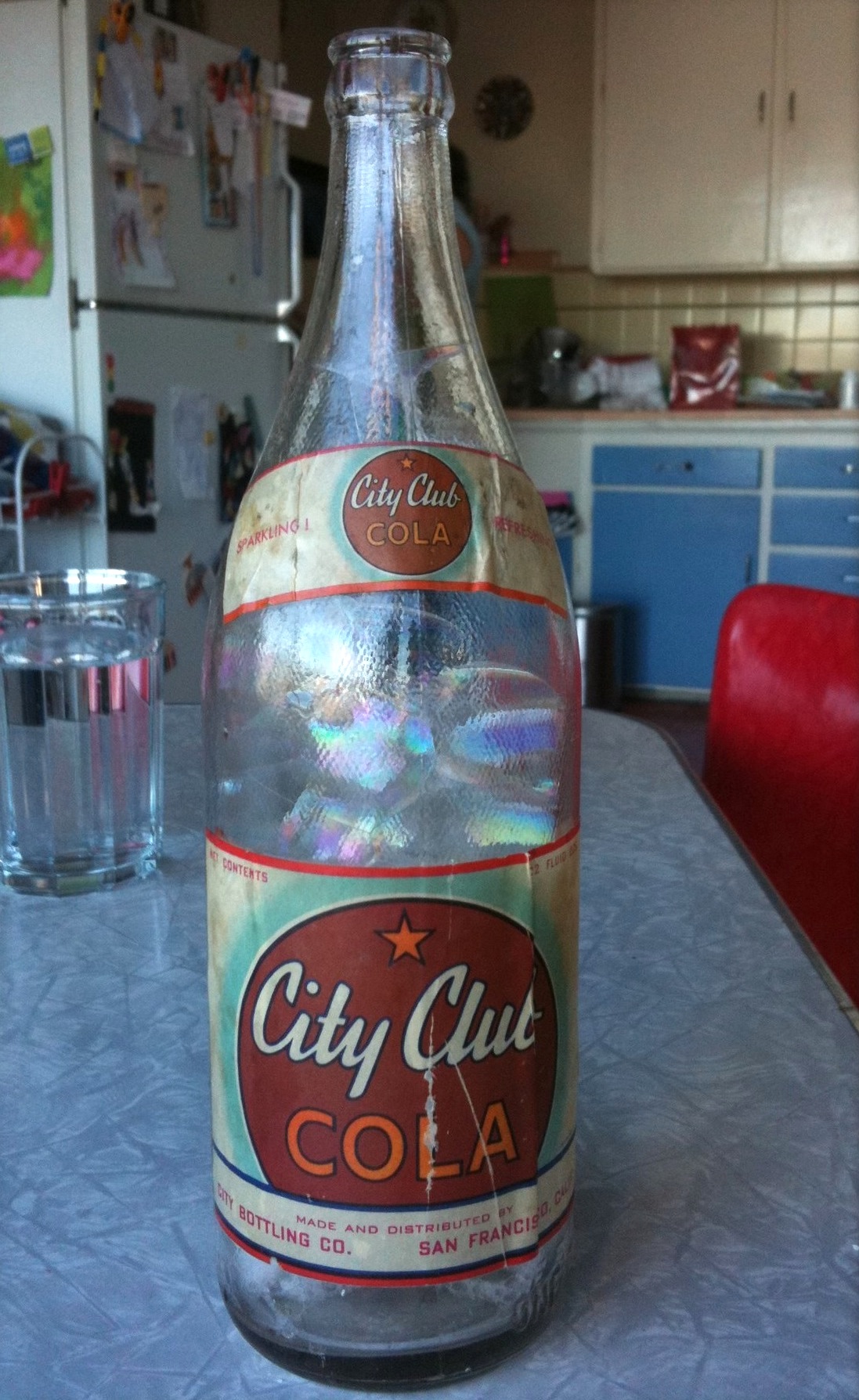
Here’s a fizzy little mystery for all you armchair consumer-product sleuths and local history enthusiasts. Neighbor Brent explains how this colorful bottle came into his possession:
Maybe you and your crack team of City researchers can provide information about the City Bottling Company of San Francisco?
The joy of homeownership: leaks. To combat a leak in our house, we’re replacing some siding. Yesterday, when removing the siding from one of our walls, our contractors found a bottle inside the wall. The bottle is for “City Club Cola”, and the label reads at the bottom, “Made and Distributed by City Bottling Co. San Francisco, Calif”.
A simple (but not exhaustive) search on Google found no references to the cola or the bottling company. We figure it could date back to 1945, when the house was built. Maybe your crack team of researchers, or your readers, can solve our mini-mystery!
I’m curious about something that was San Francisco made and distributed, and wonder if the bottle really dates from 1945. I mean, the label is in decent condition considering that it could be 66 years old!
Let the historical geekery and barroom hypothesizing begin!
PHOTO: Neighbor Brent
 Bernalwood
This is hardly scientific, but my dad, who was born in Bernal in 1936, didn’t recognize the label. Nor did my mom, who is a smidge younger and grew up in the Mission. Also completely anecdotally, they both recognized the milk bottles found during an excavation project in our backyard a few years ago. Looking forward to learning more from the intrepid Bernalwood followers!
Found reference to it here in the 1945-1946 Pol’s Crocker-Langly SF City Directory: http://www.archive.org/details/polkscrockerlang194546dire
City Bottling Company, A Lugliani Owner. Bottlers of City Club Beverages, Goody Root Beer, 1705 Church, Tel VA-lencia 5495(?)
You may want to try this guy who collects soda bottles:
http://www.antiquebottletrader.com/soda.htm
The condition of the label is not at all surprising, considering that it was protected from the elements and sunlight whilst entombed in the walls.
As for the company, probably a good starting point would be the City Directories (available at the library) for that period.
Found it! 1706 Church St:
CITY BOTTLING CO.
CITY CLUB BEVERAGES AND GOODY ROOT BEER
1706 CHURCH STREET
SAN FRANCISCO, CALIF.
Phone Mission 7-93 18
(from http://www.archive.org/stream/policepeaceoffic19471947sanf/policepeaceoffic19471947sanf_djvu.txt)
Proprietor was Anthony Lufliani
Also shows up with an address of 1705 Church, and phone number of VAlencia 4-5095
Weird the business phone is MIssion but the home phone is VAlencia.
Is my post showing up?
Sure is!
Zowie. What great leads!
1) 1705 Church Street seems less likely than 1706 Church, based upon the buildings that are at those addresses now. 1706 is currently Drewes Brothers Meats, which I would guess had a longer history of some industrial purpose, while 1706 looks like a residential building that may have been there for a while.
2) Wild. I used to live about three blocks from there.
3) I would love to learn more about the history of that company. What years did it operate, what products did it sell, and when?
Seem Jen’s reference to the 1945-1946 Pol’s Crocker-Langly SF City Directory validates that the bottle *could* be 66 years old. It would be great to know when that cola was no longer produced, to further validate the age of the bottle.
Seems my little corner to Bernal is all cola-happy! I live around the corner from the now famous Coca-Cola sign.
There’s also a listing for them in the 1943 City Directory. There is an extremely poorly OCR’d version at: http://www.ebooksread.com/authors-eng/rl-polk–co/polks-crocker-langley-san-francisco-city-directory-volume-1943-eri/page-318-polks-crocker-langley-san-francisco-city-directory-volume-1943-eri.shtml
Found it on the 1950 Sanborn maps! (marked in red).
It was on the east side of Church St (Bernalward), one house south of 29th (next to the Star Bakery).
Note this was right by the old SPRR line which might sense for supplies and shipping until you remember that the train ran on a 20 foot berm with trestles all through Noe Valley…
Interesting! When was the berm levelled? Does any of it survive anywhere?
No, it was all ripped out, I believe in the late 40s and early 50s.
Digging up info on that transition and carving the right of way into lots is on my long list.
The beginning of the berm lives on the western half of Juri Commons Mini Park. The building just north of the tot lot used to be a brewery. Trains stopped at the beginning of the berm, and the brewers rolled the kegs onto the train from the 2nd floor of the brewery.
And in 1915, that space was a “fuel yard” – coal, etc.
Bakery was still there. (And that building that looks like it should be the Italian Consulate was a doctors office.)
Same thing in 1905.
Speaking of which, the Sanborn alignment project is going quite well over at http://sanborn.maptch.org
Arrrgh, stupid vowels. http://sanborn.maptcha.org/
Aaaaaand in 1886, an empty lot.
Though there was a tannery by the tracks between 29th and Dolores. Noe must have had a special smell then.
And given all the industry by the tracks, they must have been able to load and unload anywhere.
Whoops, looks like that 1886 map got a little cropped, here’s a better version.
(I had to add the street names — each 1886 map is scanned as two images, and the street names are all on the other page.)
Ugh, not a good image editing day. 1886, with all streets labeled, and the (empty) lot marked in red.
Interesting. Note that on the 1905 map, the lot south of 1703/1705 seems empty. I’m thinking that during the earthquake, since this building was not supported on the south side, it could have collapsed into the empty lot. This might explain how those lots combined to later become the Fuel yard in 1915. Then later (1950s I’d guess) it was converted to the residential building it is today.
Given the style of the bottle, I would guess that City Bottling Co. setup shop somewhere else. Maybe across the street? This might explain the multiple addresses.
Ah, you mean the wagon house in the 1905 map?
I just noticed that the 1709 changed from a church to a wagon house.
I love the thought of a windmill on Church Street (next to 1711 on the 1905 map, gone by 1915).
From the 1951 county record, via @untraveling: Dream Orange Soda!:
CITY CLUB BEVERAGES – DREAM ORANGE
GOODY ROOT BEER – A. LUGLIANl
And on the same page, $167 flights to New York (direct!) That’s about $1400 today, accounting for inflation.
Goody Root Beer was a national brand, but he could have been a local bottler?
I feel like there may not be any way to get complete answers to my main questions.
I wonder, if I posted to http://en.wikipedia.org/wiki/Template:Colas about the existence of City Club Cola, if it would get taken down because it is “original research”, or if someone with more knowledge of the bottling company and the cola would amplify the article.
Brent, what kind of questions do you want to answer?
– What years did the City Bottling Co of San Francisco operate?
– What other products did they sell?
– How long was City Club Cola produced?
– How and why did the local bottling company go away? Was it bought out? Did it go out of business because of Coca Cola and PepsiCo?
I love this comment thread! What great research. Also love the City Club logo- someone should make t-shirt replicas or something.
What a great idea! Maybe I’ll take a better picture and pull something together in Illustrator, then post it to CafePress and let Bernalites know.
Seconded. Happy to promote it here if you make it.
so the remains of the SPRR is what you see cutting diagonally from Harrison & 22nd SW to Dolores & 27th on lot lines/building shapes/open space? were the endpoints there or beyond?
It straightened out onto Harrison at 21st to run downtown. From Dolores & 27th it curved through Noe to the Bernal cut. More here:
http://www.missionmission.org/2008/08/03/freight-trains-barrelling-through-the-mission/
My grandfather named Lugliani started City Bottling and later his olderst son Tony became his partner. My grandparents were from a little hill side town named Castiglione Garfagnana in Tuscany an hour drive from Lucca. My grandparents came to American around 1900. My grandfather and his brother married two sisters also from the same town in Tuscan and they came to America together and each had homes on Bernal Heights. He bottled soda water in Tuscany. He started City Bottling prior to 1940 probably shortly after he came to America. I grew up on Dolores Street and visited the plant a number of times when I was a little boy in the 40’s and early 50’s and my father worked there for a few years. The soda water plant was on the east side of Church Street. My grandfather also bottle Nesbitt. He had 7 children (4 boys and 3 girls, all have passed away) and lived on Bernal Heights most of the time he was in America. My mother was born in 1914 and she was one of the youngest children so my grandparents must have moved to Bernal Heights soon after they came to America. I think his house was on Anderson Street and other relatives lived on Moultree (misspelled) Street. Several of his siblings and cousins lived on Bernal Heights and my grandfather supplied them with soda water so that’s how the bottle ended up in the house on Bernal Heights. As you probably know Bernal Heights was an Italian neighborhood from the turn of the century until the1950’s. I remember in the late1940’s going to a park on or just off of Courtland Ave. and watching the Italian men play boche ball and listening to them speak Italian. A great Italian uncle of mine owned a bar on Courtland Ave. named Duvalls. There was a little theather on a NW corner on Courtland Ave. a few blocks from Mission Street. In 2005, a few years before my mother and one of her sisters died, I took them on a driving tour of Bernal Heights and we stopped in front of the house they grew up in and the lady who owned the house was working in front of the house and I told her my grandfather built her house and asked her if she would let my mother and my aunt tour the house and she did and they gave her the history of the house. That was great!
Wow. What a great piece of history!
So pardon, but you make it sound like only the siblings and cousins would have access to the soda water produced by your grandfather. That seems to suggest that one of them might have been involved in the building of my house…? Or, did others buy City Club Cola more commonly…?
Saw three unopened and original City Club sparkling water bottles at the Alameda flea market this past weekend.
I thought they looked familiar from bernalwood. Kicking myself I didn’t buy them!!
The bottles looked to be a bit newer with a blue and white label. Itook a picture, which can be aeen here -> http://instagram.com/p/X2cpXbDHeo/
Oh my! The differences and similarities are fascinating!
– I guess the label color for Cola is brown because the fluid is?
– I see how significant the light blue, faded outline is to their design scheme
– Interesting that the top labels are either not present, or have been removed
– Much more modern looking glass, with references to deposits? When did that start? These bottles, to my untrained eye, seem like they might be from the 70s.
– Interesting how the fonts and general label did not change
Thanks so much for posting!