Bernal Heights 1BR Apartment Rental Prices Double In Three Years

SFneighborhoods_pricenomicsE

*sigh* This is not the sort of news Bernalwood likes to share, yet share it we must — because it is happening whether we like it or not.

Or rather, it happened. You see, during the last three years, the price of a one-bedroom apartment rental in Bernal Heights has doubled.

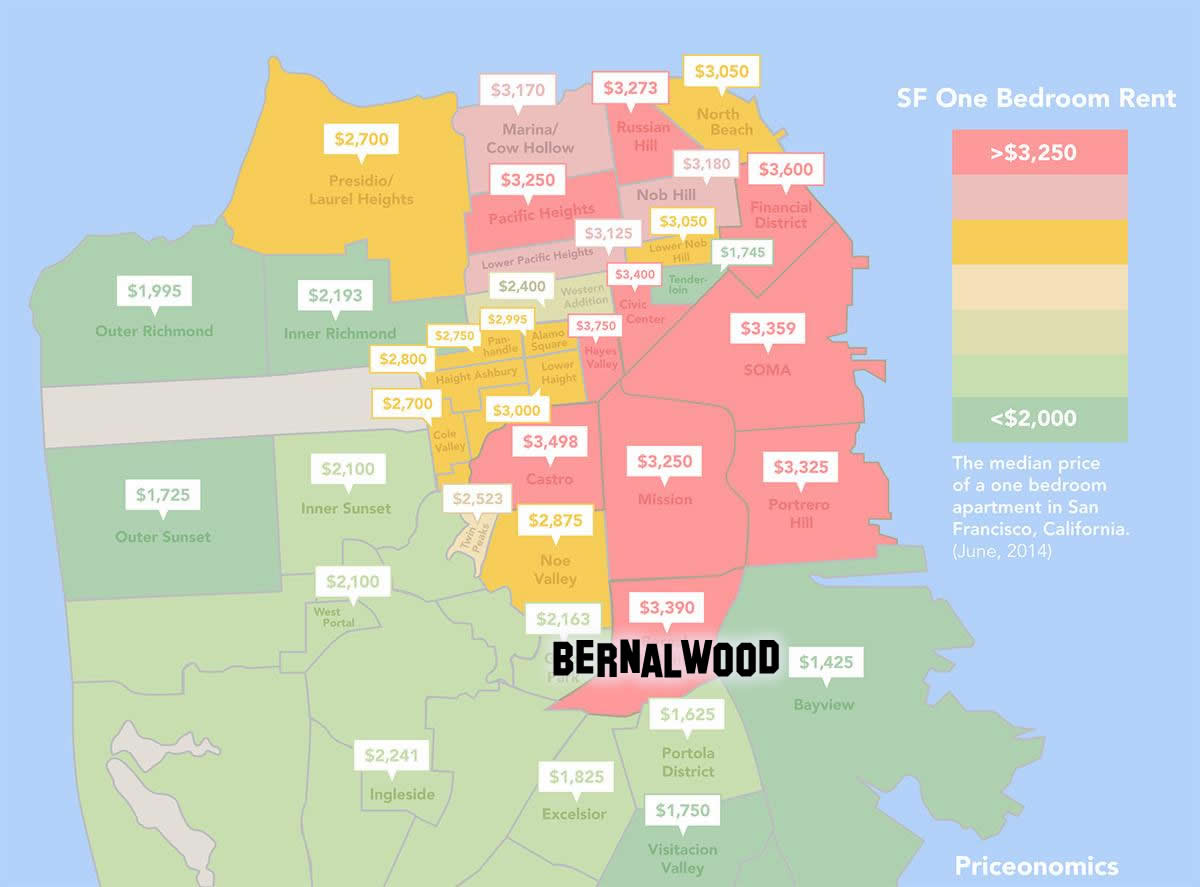
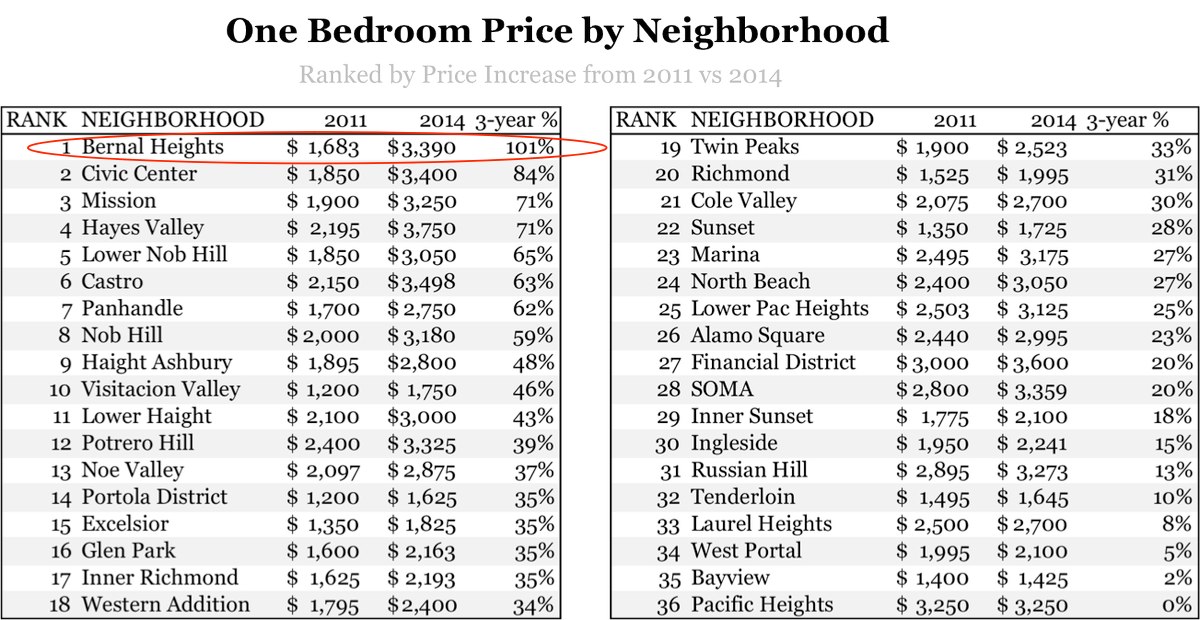
According to the number-crunchers at Pricenomics, between 2011 and 2014, the median price of a one-bedroom apartment rental in Bernal rose by 101%, from $1683 to $3390. In fact, during that same period, median one-bedroom apartment rental prices in Bernal Heights rose the most of any neighborhood in San Francisco. Oy:

1brrentalsW

This is not the kind of We’re Number One we wish to be associated with.

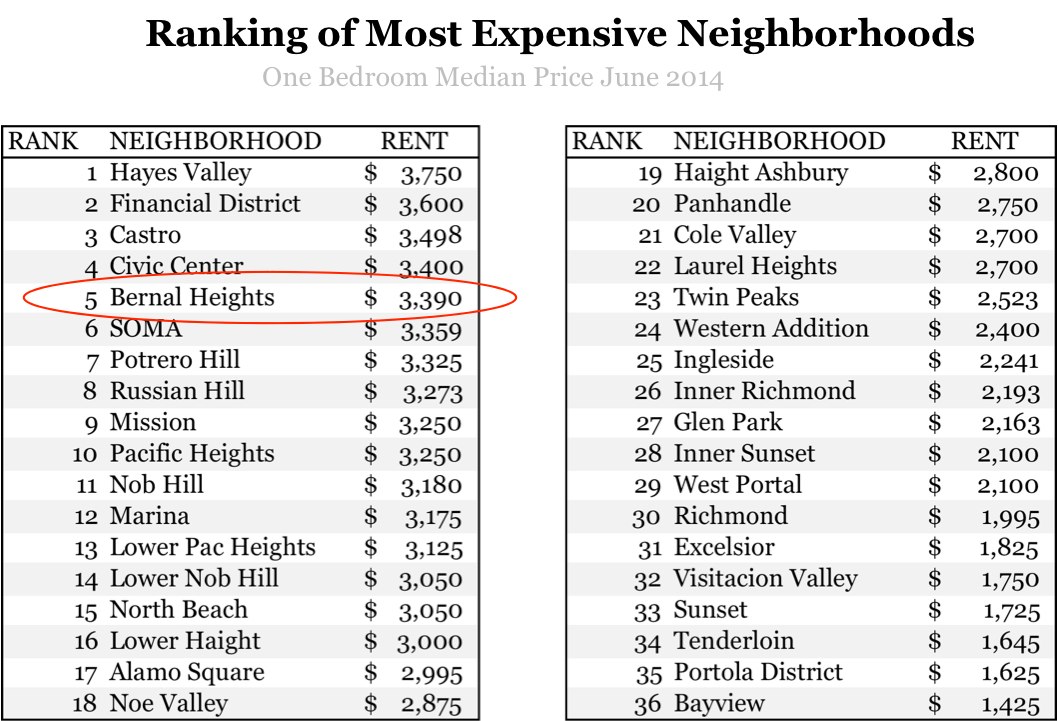
In absolute terms, 1BR rentals in Bernal are also on the spendy side, ranking fifth overall citywide —  higher even than Noe, Nob Hill, and Pac Heights. Oh my:

chart4sfrentE

Why is it happening? Blame our innate awesomeness, combined with very limited rental supply and very favorable geography. In other words, Econ 101.

As Pricenomics explains:

The San Francisco real estate market is, technically speaking, muy caliente. If you’ve looked for an apartment recently, or follow our blog, you know that rental prices have exploded and small homes sell for more than Detroit skyscrapers. San Francisco is a beautiful place, with a bustling economy that has drawn tens of thousands of new residents over the past few years. But the supply of housing is relatively fixed as large swathes of the city aren’t zoned for the type of high density housing that could accommodate the increased demand. So the price of housing has increased.

For us in particular, Pricenomics says:

Proximity to the highways and shuttle buses that take tech workers south to companies like Google, Facebook, and Apple is also reorienting the real estate landscape. Living in neighborhoods like Bernal Heights or Portero was once (arguably) like living in a backwater, but these commuting-friendly areas are now expensive and popular.

ALL CHARTS: from Pricenomics

Bernal Heights Lives Up to “Hottest Neighborhood” Hype, Despite Ongoing Ambivalence

unicornhill

You may recall that awkward moment last winter when the real estate gurus at Redfin decided to honor and torment us by naming Bernal Heights the Hottest Neighborhood in the Entire Galaxy. Since then, the Citizens of Bernalwood have struggled with a deep sense of ambivalence about what it means to be recognized for our (rather obvious) hotness — and what that portends for the future of our humble-proud village on the hill.

Well, now Redfin has decided to torment us yet again by revisiting their decision to name us Hottest of the Hot, to see if Bernal Heights has lived up to the hype (which they themselves created).

Thankfully, SF Weekly wrote up the result, so I don’t have to:

There’s no better time than the present to quote supermodel turned Project Runway host Heidi Klum: “One day you’re in and the next day you’re out.” Klum is absolutely right in her tough-as-acrylic nails approach; however, we shouldn’t fail to recognize that there’s always an exception to the rule and in this case the Bernal Heights neighborhood is one mighty fine exception.

Back in January, real estate site Redfin chose Bernal Heights as the hottest neighborhood in America, due in large part to its affordable housing (not really, but go on), reasonable commute and a better-than-average school system. Seven months later (as in this very second), Redfin revisited the list and decided that Bernal Heights still smolders amidst the summer heat (felt everywhere but in S.F.) as the nation’s coolest neighborhood.

The reasons behind all this Bernal Heights summer of love include 22 percent increase in the median home sale price compared to this time last year and 81.5 percent of homes in the area selling above the list price.

On the unambiguous side, we can take pride in the fact that Bernal Heights lived up to expectations and did not disappoint, which are core attributes of our neighborhood character and brand identity.

IMAGE: Bernalwood Bureau of Unicorn Management

Airbnb Hosts Stage Backyard Rally in Bernal Heights

bernalfairshare

In addition to the counter-protest at Planned Parenthood, there was another demonstration event in Bernal Heights yesterday, but this second action was taken by neighbors who generate income by renting out space in their homes for vacation rentals. They call themselves Fair to Share San Francisco, and the Examiner tells the story:

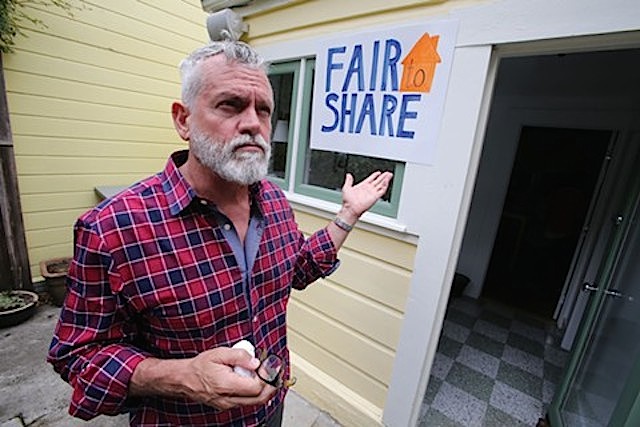
It helped Marcia Weisbrut get on her feet after cancer. It paid for Rodolfo Cancino’s dental bills. It has allowed [Bernal resident] Greg De Meza to start paying off debts incurred during the recession.

The common thread in all their stories was the short term rental service provided by Airbnb, which is illegal in San Francisco.

The testimonials — some voiced over a P.A. system — were on display in a Bernal Heights backyard Thursday by groups launching the Fair to Share San Francisco campaign. The campaign’s aim is simple: Legalize the money-making short term rentals that Airbnb’s business model is built upon.

On hand to make their case were a collection of short-term rental hosts, representatives of Airbnb and Peers, a “sharing economy” advocate.

The push comes amidst efforts by local leaders to solve or at least ameliorate a severe housing shortage combined with steep rents, which some Airbnb opponents have linked to the company, among others.

Into that fray, the campaign aims to back legislation like Board of Supervisors President David’s Chiu’s proposal to regulate and legalize short term rentals.

The Examiner explains that Fair to Share has received substantial support from Airbnb — including the group’s basic organizational push, recruitment, brochures, and even the PA system used at the Bernal event. That’s not a bad thing — Airbnb and its hosts are a legitimate interest group with an interest in the City’s political process — but it is important to note.

In the article, Neighbor Emily, who launched the rather clever Airbnb concierge service we’ve told you about before, argued for the stabilizing effect that vacation rentals can have on San Francisco neighborhoods:

Emily Benkert, a 17-year city resident who rents out rooms in her Bernal Heights home and has started a business that helps people run their Airbnb rentals, said the service is not a detriment to The City. “This isn’t hurting anybody,” she said. “We’re not kicking people into the street.”

Instead, she argues, Airbnb’s absence would force people to leave San Francisco since the extra income they make is what allows them to stay.

PHOTO: Bernal neighbor Greg De Meza, by Mike Koozmin, SF Examiner

Boozy Miscreants Use Dormant Home as Million-Dollar Party Shack

partyshack3

partyshackliquor

partyshack2

It is 2014 and San Francisco is booming, housing is scarce, real estate is ridiculously expensive, and Bernal Heights is officially the sexiest neighborhood in the entire galaxy. And yet, somehow, in the middle of all this, it’s still possible for a million dollar home to become a semi-abandoned party shack where local miscreants can get drunk, enjoy the view, and trash the joint.

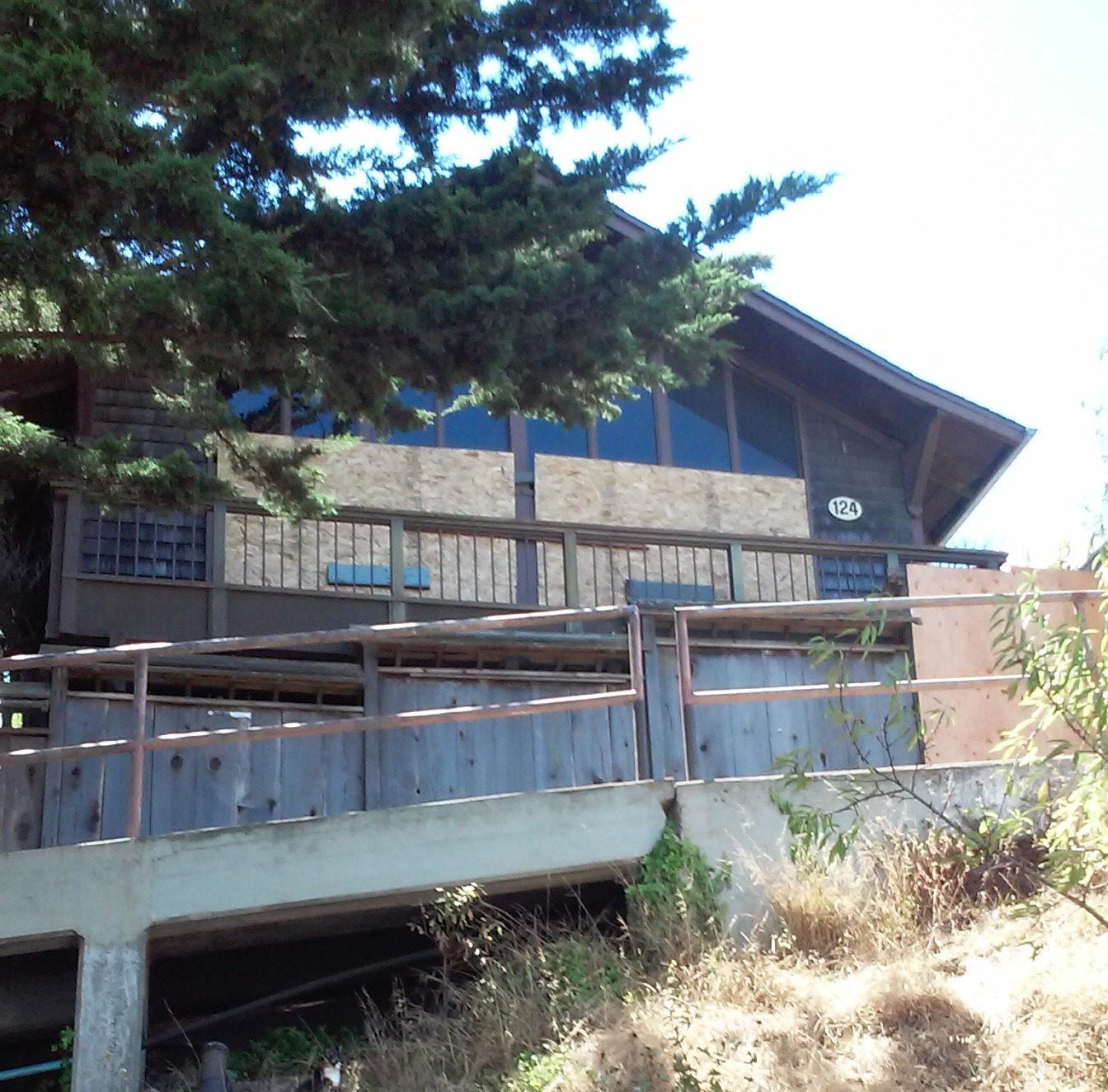
The party house is that Tahoe-style ski chalet that came up for sale on Mullen last March. The place sold for $950,000 in April, but since then it has had no regular occupants — except some errant local youths.

Neighbor Ian explains the rest:

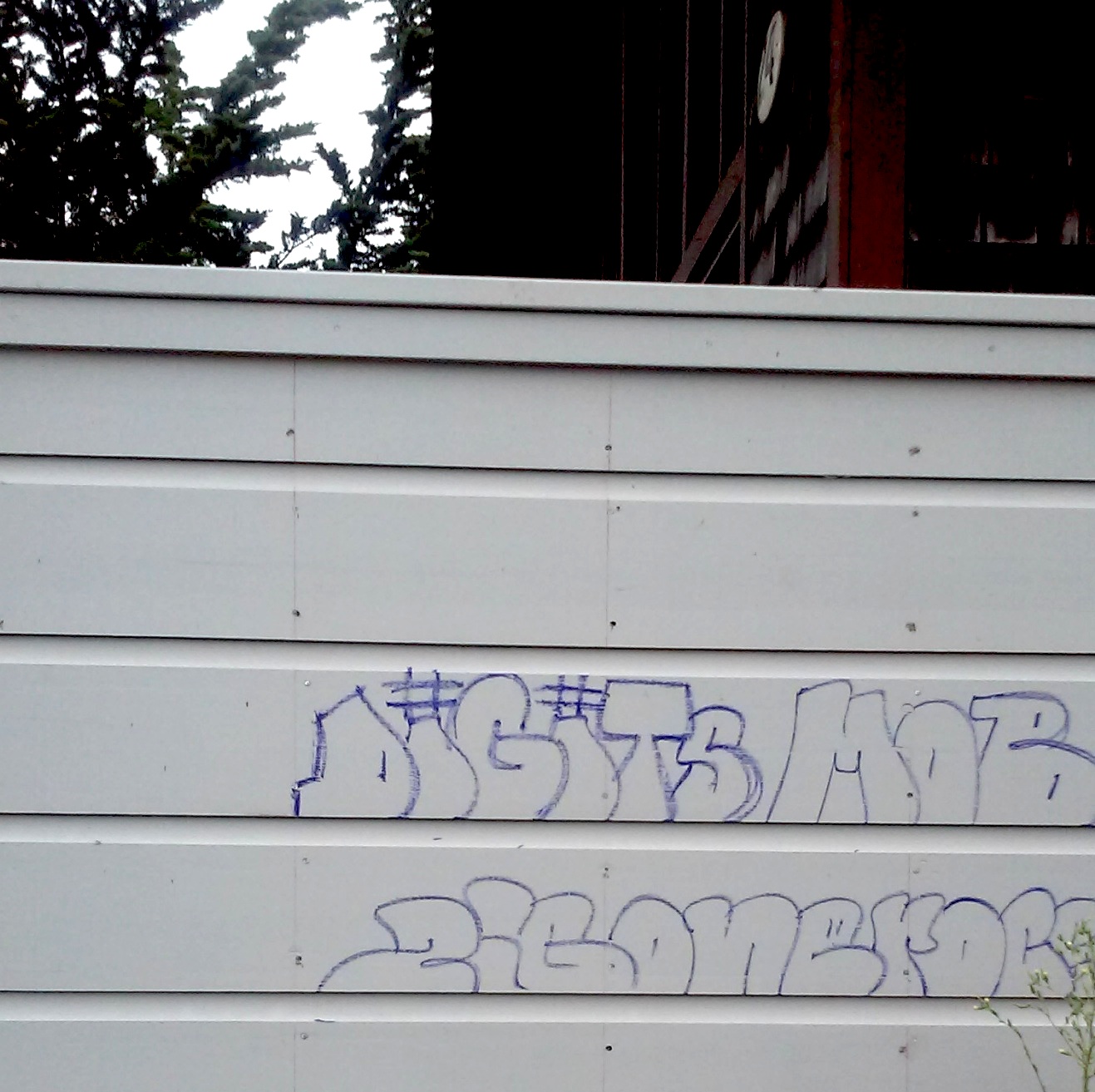
The house that recently sold on Mullen Ave has sat dormant since the sale, encouraging locals to break in and party. It’s unclear who the culprits are, but there have been many gatherings of youth on the open space next to the house. Police responded a few weeks back and apparently nabbed a few people, but the partying continues. The next morning, dog walkers typically find liquor bottles strewn about, (along with the security caps found on higher-end booze.)

Neighbors have not met the new owner, but workers have come from time to time to add new plywood to the facade, only to have it pried off within 24 hours. I took these pics from outside, but I could have easily entered this million-dollar fixer-upper. Neighbors worry that these gatherings will continue. What is the obligation of the new owner to prevent these break-ins?

On the bright side, this can only mean Bernal has not yet gentrified to the point of becoming like Greenwich, Connecticut. Woo hoo!

PHOTOS: Neighbor Ian

Guess Which San Francisco Neighborhood Has Homes That Sell for the Most Over Asking Price?

hinthinthint

No commentary. Let’s just get to the grubby business. From the San Francisco Chronicle:

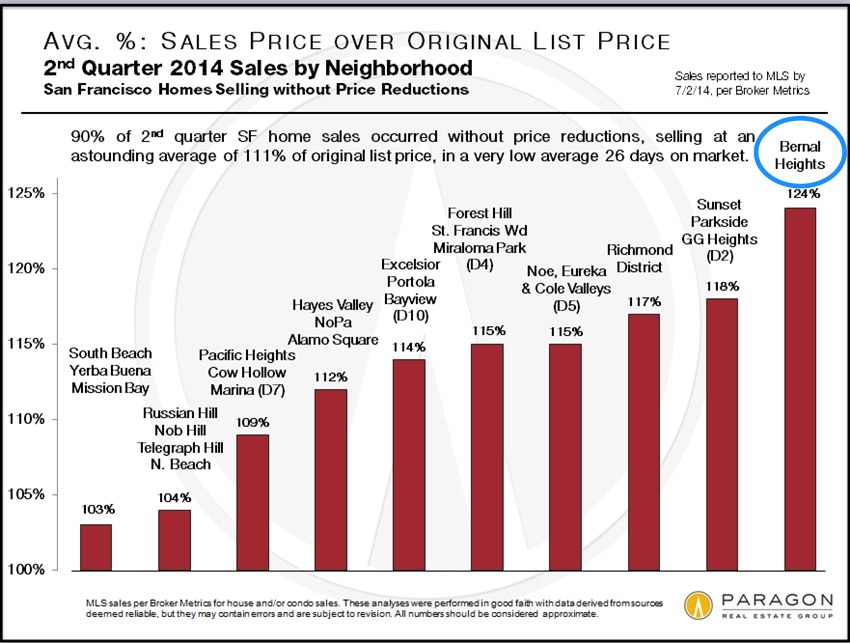
An astounding 90% of San Francisco homes sold at or over their asking prices in the second quarter of 2014, according to data compiled by Paragon Real Estate. The average in the city during the spring quarter was 11% over list price with only 26 average days on the market. As Paragon notes, these statistics may indicate the prevalence of agents underpricing homes in order to create bidding wars.

Some neighborhoods fared even better than that already high average, with top over-asking neighborhood Bernal Heights selling at an average of 24% over.

How about a chart to go with that?  Here is a chart:
By_Neighborhood1

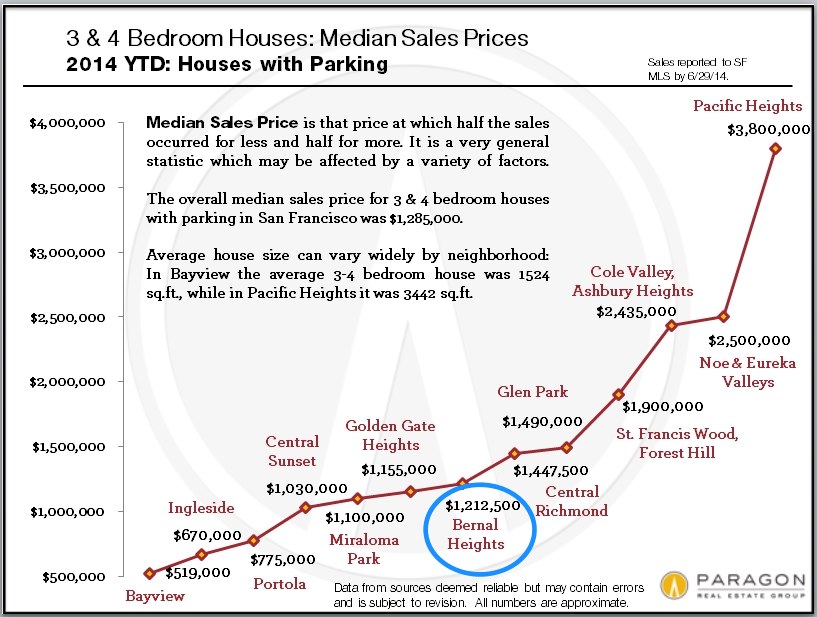
Absurd though it might seem, Bernal remains on the moderate side when you look at home prices citywide:
Median_Price1

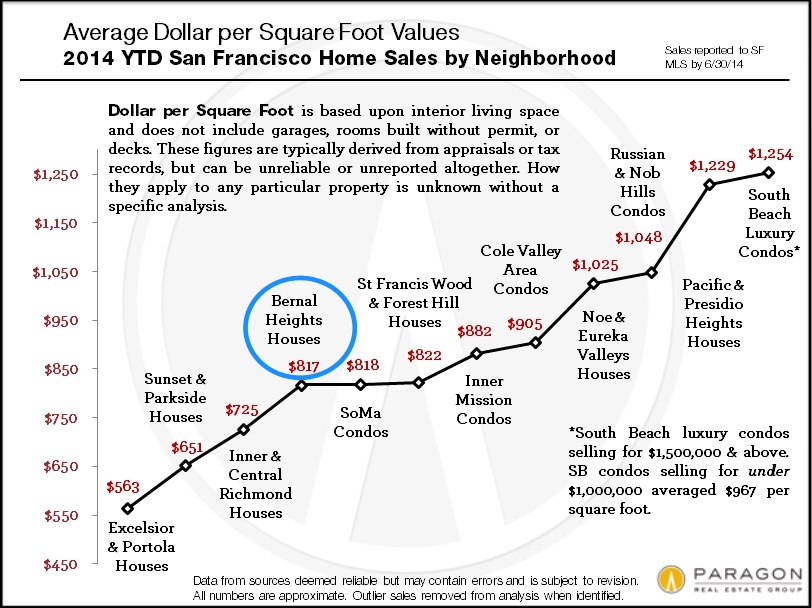
And you still get a pretty good deal for your money on a square-foot basis in Bernal— within the context of total citywide insanity. Plus, we’re still $5 per square foot cheaper than St .Francis Wood. Yesssssss!
AvgDolSqFt1


Finally, San Francisco created 2290 new units of housing in 2013, but added 26,700 new jobs during the same period. See above, rinse, and repeat.

IMAGES: Aerial photo by Telstar Logistics. Charts via Paragon

Occupy Bernal Disavows Rogue Graffiti on Peralta Home

occupyhouserallyp

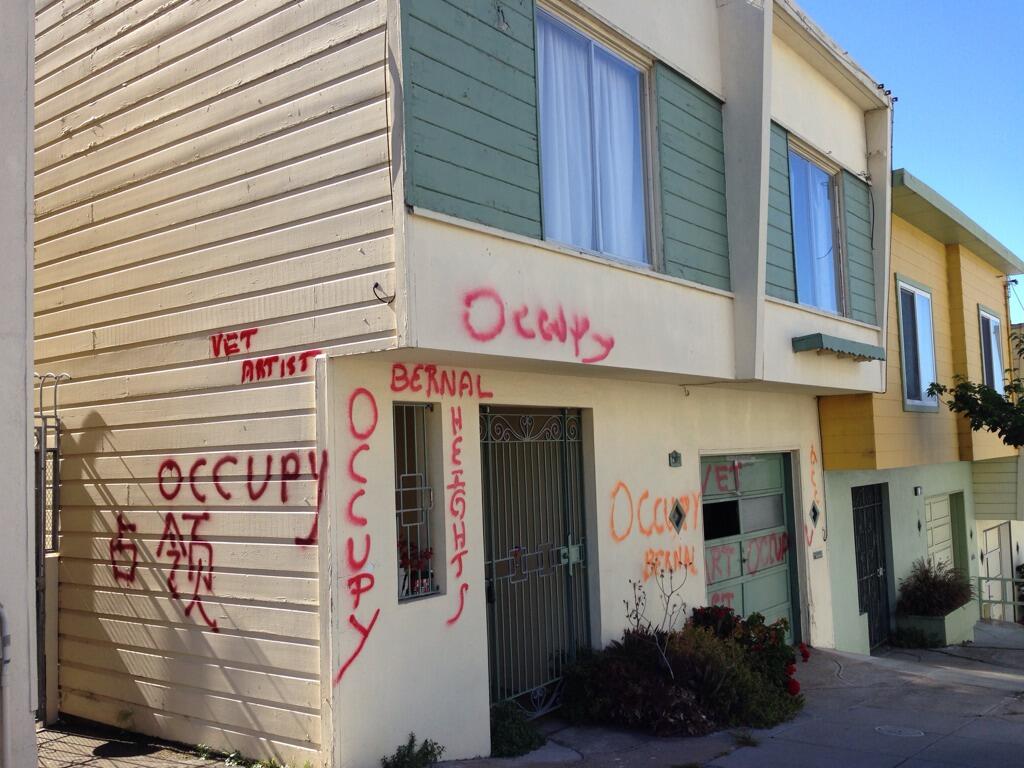
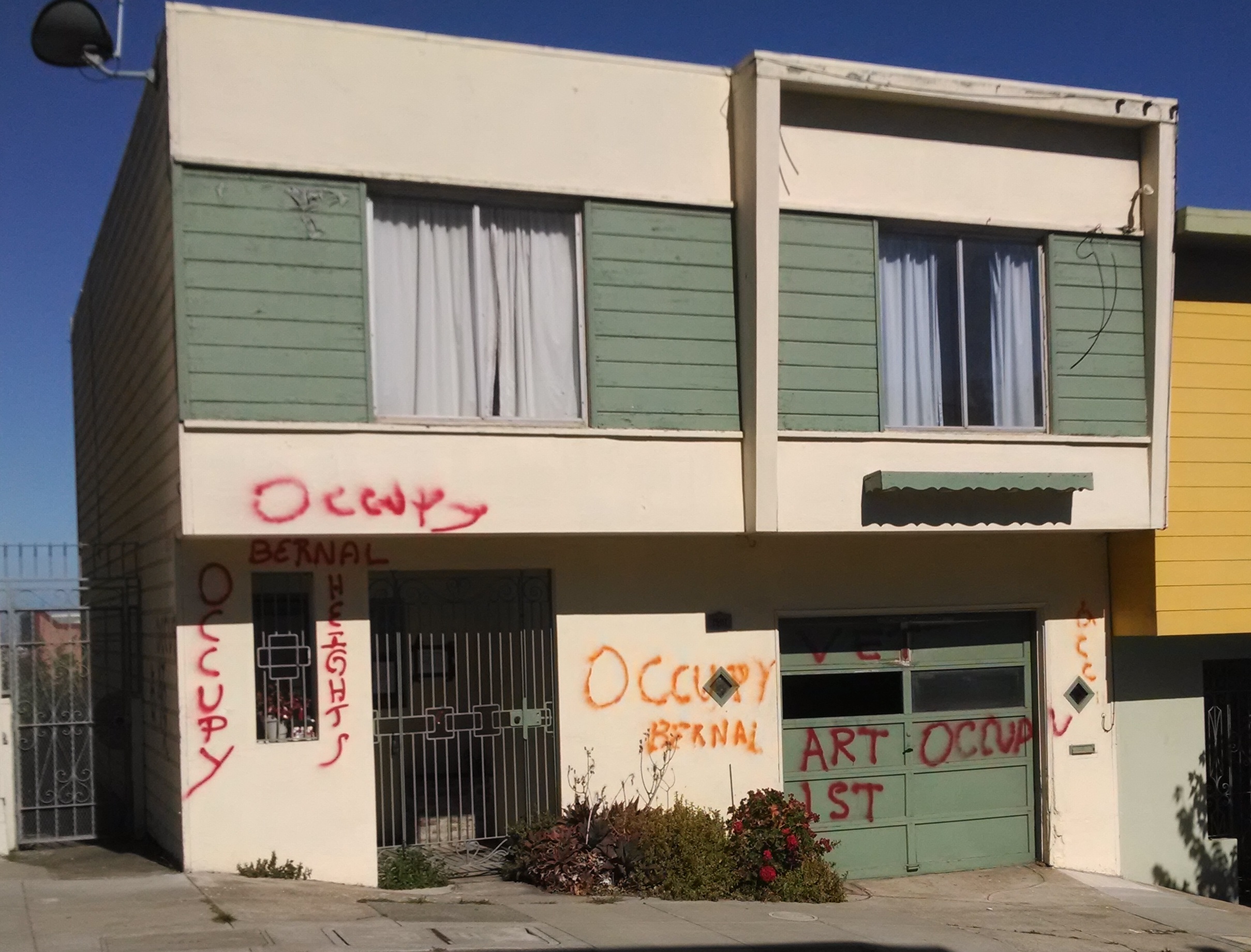
occupyhouseOver the weekend a home on the 600 block of Peralta Avenue in Bernal Heights was tagged with Occupy Bernal Heights graffiti, prompting several neighbors to share photos of the damage with Bernalwood.

Graffiti seems incongruent with the above-board (and generally impressive) tactics of Occupy Bernal Heights activists, so Bernalwood reached out to Neighbor Buck Bagot from Occupy Bernal for insight. He replied:

Occupy Bernal hasn’t been active as Occupy Bernal in over a year, since we folded into SF ACCE. We’re now doing a lot of work helping folks in Bernal and the Mission fight Ellis Act evictions. (We helped the tenants at 23rd and Florida save their 10-unit building). And that’s not our style. No vandalism or violence, especially towards the Police.

Whatever vandal did it must think they evicted prior residents of something – no excuse though. Juvenile and destructive. And not effective either. A very few of the Occupy SF folks have no aspirations to tap the support of the vast majority of our neighborhood/City/nation. Like the term “99%” – we mean it. [Graffiti is] destructive, and counter productive.

PHOTOS: Top, Rally P.; Below,  Evan S.

Here Are the 10 Cheapest Homes For Sale in Bernal Heights Right Now

curbed10cheapest

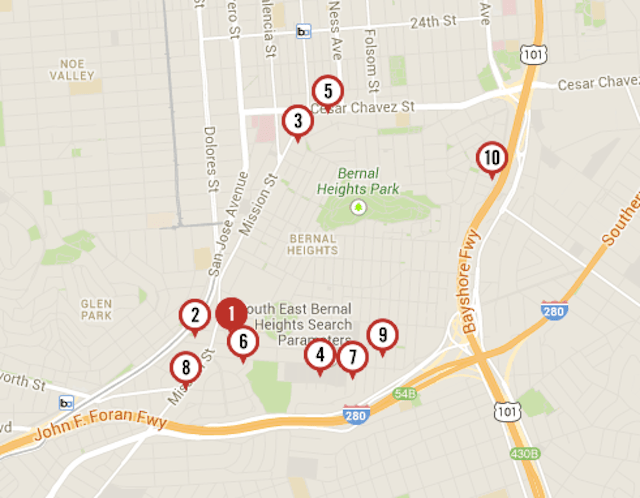
What does a bit more than half-a-million buy in Bernal Heights these days? For those morbidly inclined to explore that question, our real estate-obsessed friends at the CurbedSF blog have pulled together an interesting list of the “The 10 Least Expensive Properties for Sale in Bernal Heights”:

Finding a deal in Bernal Heights has become next to impossible, but we’ve combed the listings and mapped the ten least expensive homes for sale in the neighborhood. They start at $500,000 and head on up to $899,000. A few have been flipped in the past year, while others are probably about to be sold to flippers. Quite a few have unwarranted space and one recommends building a brand-new home to replace what’s there now.

It’s a revealing list — notice that all the properties are on the Bernal borderlands, for example. Yet for anyone with the fortitude to do some renovation and remodeling, there may be opportunities for some wannabe homeowners. Maybe.

MAP: via CurbedSF

Bernal Heights Real Estate Report: Ridiculous Spring 2014 Edition

BernalHomes.May2014

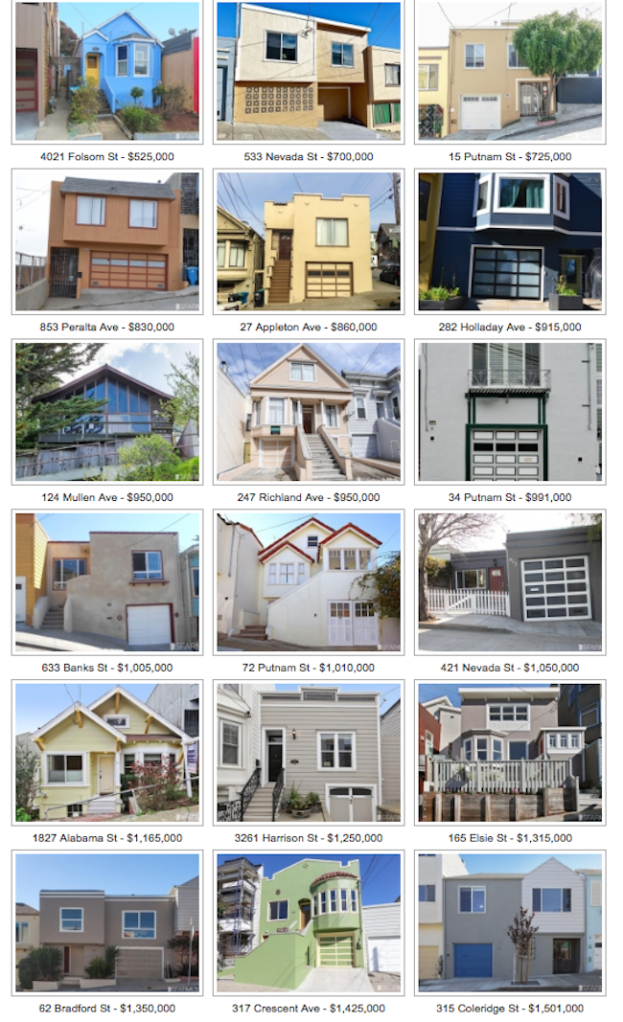
The latest monthly real estate report from Downing & Company indicates that the Bernal real estate boom show no sign of abating — which is good or bad, depending on your personal situation. Either way, the average sale price in April 2014 hovered at around 1.03 million, with the median at $998K. Downing says:

April was a busy month for home sales in Bernal Heights. Last month 18 sales were completed at an average sale price of $1,028,722.

With the cat out of the bag about Bernal Heights being named the hottest neighborhood in the country and all the hype that came with that designation we thought it would be interesting to take a look at some recent price appreciation on a few homes in this ‘hood. Some of the results we found were impressive.

Case in point, the sale of 315 Coleridge Street. Back in January 2012 this home was purchased for $850,000. It just sold for $1,501,000 representing a 78% bump in value. But here’s the real kicker – this home was NOT significantly renovated prior to its recent sale. That is some serious organic price appreciation over a 28 month holding period.

Here’s another one – 3261 Harrison Street. Back in July 2011, this home was purchased for $842,500. It sold last month for $1,250,000, a 48% increase in value. And how about 165 Elsie Street. Its prior sale was in December 2009 at $862,000. This home recently sold for $1,315,000, representing a 53% increase in value. Like the Coleridge property, neither of these homes were significantly updated prior to sale.

Those are some healthy price gains in a relatively short period of time. So what’s driving up prices? The hype factor? Tech job growth? The tech IPO market? The severe imbalance in the supply & demand of homes for sale? International investors? Low mortgage interest rates? A combination of all these things? Take your pick.

Click through for a more detailed breakdown of the sales mix.

IMAGE: Downing & Co.

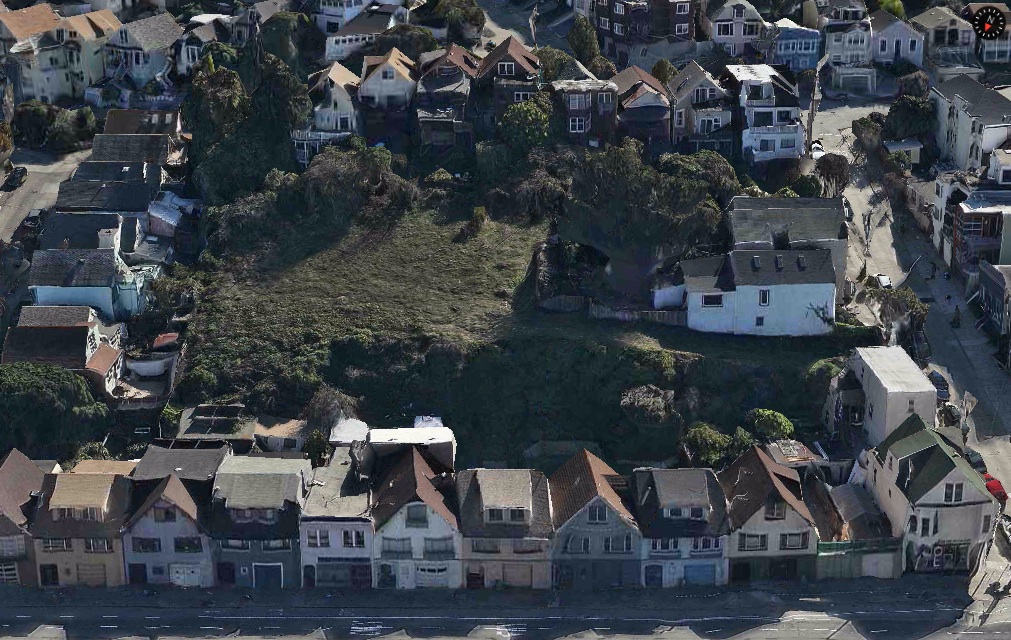
If Two Homes Are Built on This Bernal Heights Property, Will It Explode in a Giant Scorching Fireball?

bernaldevsite2

There’s a design review committee meeting happening tomorrow night, Wednesday, May 28 at 7 pm at the Precita Center.

The topic on the agenda will be that proposal to build two single-family homes at 3516 and 3526 Folsom on the southeast slope of Bernal Hill, on the undeveloped lot just below Bernal Heights Boulevard at Folsom and Chapman. There are questions to consider. Like, how is the new right-of-way going to work, since there’s no road there now, and the slope is so hella steep? And what about drainage, and the garden that’s now on the site, and the existing character of the neighborhood? Also, if homes are built here, will the site explode in a gigantic, scorching, San Bruno-style fireball?

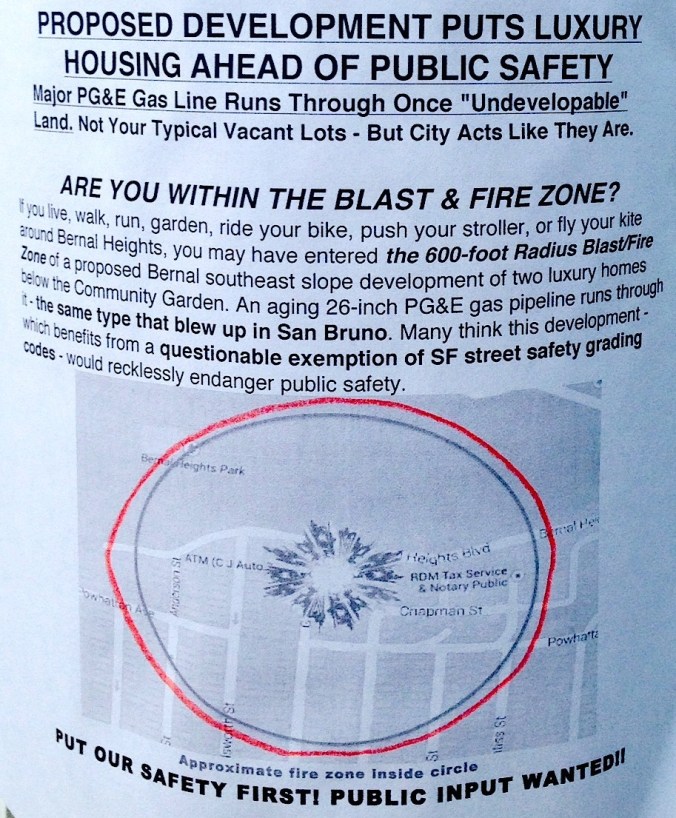
The mortal peril associated with the giant scorching fireball scenario introduces a dramatic new element to the usual Bernal Heights design review fare. The giant scorching fireball scenario has been popularized by some neighbors around the proposed development site, and they have detailed their concerns in a flyer:

blastradiusposter

Let’s zoom and enhance for better legibility:
blastradiusposter.detail

Blast radius! Oh my.

But is this true? Is this pipeline the same type that blew up in San Bruno? How likely is it that a giant scorching fireball scenario will ultimately engulf everything inside the red circle?

Remain calm, Citizens of Bernalwood. Let’s walk through this piece by piece.

The gas pipeline that runs through Bernal Heights is called Line 109, and it is definitely serious business. The 2010 San Bruno explosion is fresh in Bay Area memory, but that was Line 132 — a different pipeline altogether. That said, Line 109 also exploded once, in a giant scorching fireball, right here in Bernal Heights, back in 1963.

So there’s that.

pgepipelinebernal.2014

Bernalwood reported on the present-day status of Line 109 back in 2011. At the time, we said:

The good news is, our section of Line 109 is relatively new [installed in the early 1980s], and thus hopefully does not have any of the shoddy, 1950s-era welds that were blamed in the San Bruno explosion. Likwise, it seems that an active inspection regimen is in place to validate the line’s integrity.

And so, we concluded:

Given the magnitude of PG&E’s recent mismanagement of its pipeline infrastructure, and the tremendous potential for harm, unwavering diligence will be required by both Bernal Heights residents and our local authorities to ensure the pipeline will remain safe for decades to come.

So, diligence.

That brings us to the present day. Bernalwood has been contacted by a group of neighbors around the proposed development who have been raising alarm about the giant scorching fireball scenario and rallying to oppose construction on the site. We also sent a series of technical questions to PG&E, to get additional information about the status of the pipeline at this location.

We will hear from both sides.

Writing on behalf of the neighbors who oppose the project, Neighbor Maiyah tells Bernalwood:

The site is at Folsom and Chapman, right next to the community garden. There’s a huge gas transmission line right next to the two plots… just like the one in San Bruno. It’s the same line that exploded in 1963 near Alemany and injured 9 firefighters (one also died of a heart attack) and blew up a house. I’m now a part of a small group of concerned Bernal residents who are trying to bring to light the facts of this situation and to inform others of the potential dangers.

I saw the developer (Fabien Lannoye) at the East Slope Design Review Board Meeting in April and he seemed to be not very concerned about the pipeline, not knowing the exact depth of it. He sort of shrugged when he said PG&E had no record of it. Bernal residents had asked him for a comprehensive site plan, the exact location of the pipe, the impact on the nearby community garden, and many more questions and his answer was that he didn’t ever receive the letter in the mail. It made me feel uneasy to say the least.

Just thinking about that huge transmission line with heavy construction equipment digging and moving earth over and around it on one of the steepest grades in San Francisco (35%), makes me cringe.

One of our members recently emailed Robert Bea, Professor Emeritus at the Center for Catastrophic Risk Management at UC Berkeley, who investigated the San Bruno disaster. She asked him if she should be concerned about the pipe line here in Bernal. He replied yes, with the facts that have been gathered so far: (1) the pipeline is old (1980’s) installed in an area with highly variable topography, (2) there are no records on the construction, operation and maintenance of the pipeline, (3) there are no definitive guidelines to determine if the pipeline is ‘safe’ and ‘reliable’, (4) there is apparent confusion about who is responsible (government, industrial – commercial) for the pipeline safety, reliability, and integrity.

This list is identical to the list of concerns that summarized causation of the San Bruno Line 132 gas pipeline disaster.

I live about a block from the proposed construction site, so I’m not too worried, but those of us who live right next to the pipeline are thinking twice about their safety right now.

That’s the argument against building two homes on the lots at 3516 and 3526 Folsom.

To better understand the technical issues, Bernalwood reached out to PG&E with a detailed series of questions related to Line 109 in Bernal Heights and potential construction hazards at the proposed development site. PG&E was very responsive, and we received answers to our questions late last week.

Bernalwood’s questions, and PG&E’s responses, are provided here in their entirety:

1. When was the section of pipeline under the the proposed home site installed? When was it last upgraded?

The line was installed in 1981. PG&E has a comprehensive inspection and monitoring program to ensure the safe operation of this line.

2. How often is this section of 109 inspected? What does the inspection entail? When did the last inspection take place? What were the results of that inspection?

This section of L-109 was successfully strength tested (via a hydrostatic pressure test) at the time of installation. PG&E records show no history of leaks for L-109 in this area.

PG&E has a comprehensive inspection and monitoring program to ensure the safety of its natural gas transmission pipeline system.  PG&E regularly conducts patrols, leak surveys, and cathodic protection (corrosion protection) system inspections for its natural gas pipelines.  Any issues identified as a threat to public safety are addressed immediately.  PG&E also performs integrity assessments of certain gas transmission pipelines in urban and suburban areas.

Patrols:  PG&E patrols its gas transmission pipelines at least quarterly to look for indications of missing pipeline markers, construction activity and other factors that may threaten the pipeline.  L-109 through the [Bernal Heights] neighborhood was last aerially patrolled in May 2014 and no issues were found.

Leak Surveys:  PG&E conducts leak surveys at least annually of its natural gas transmission pipelines.  Leak surveys are generally conducted by a leak surveyor walking above the pipeline with leak detection instruments.  L-109 in San Francisco was last leak surveyed in April 2014 and no leaks were found.

Cathodic Protection System Inspections:  PG&E utilizes an active cathodic protection (CP) system on its gas transmission and steel distribution pipelines to protect them against corrosion.  PG&E inspects its CP systems every two months to ensure they are operating correctly.  The CP systems on L-109 in this area were last inspected in May 2014 and were found to be operating correctly.

Integrity Assessments:  There are three federally-approved methods to complete a transmission pipeline integrity management baseline assessment:  In-Line Inspections (ILI), External Corrosion Direct Assessment (ECDA) and Pressure Testing.  An In-Line Inspection involves a tool (commonly known as a “pig”) being inserted into the pipeline to identify any areas of concern such as potential metal loss (corrosion) or geometric abnormalities (dents) in the pipeline.  An ECDA involves an indirect, above-ground electrical survey to detect coating defects and the level of cathodic protection.  Excavations are performed to do a direct examination of the pipe in areas of concern as required by federal regulations.  Pressure testing is a strength test normally conducted using water, which is also referred to as a hydrostatic test.

PG&E performed an ECDA on L-109 in this area in 2009 and no issues were found.  PG&E plans to perform another ECDA on L-109 in this area in 2015.  This section of L-109 also had an ICDA (Internal Corrosion Direct Assessment) performed in 2012, and no issues were found.

Automated Shut-off Valves: There are two types of automated shut-off valves recognized within the natural gas industry: Remote Controlled Valves (RCV’s), which can be operated remotely from PG&E’s Gas Control Center, and Automatic Shutoff Valves (ASV’s) that will close automatically as a result of rapidly falling pipeline pressures and/or increased flows at the valve location. There is an RCV on L-109 in Daly City that can be used to isolate the section of L-109 that runs through this neighborhood.

3. Is this section of pipeline 109  “the same type that blew up in San Bruno?”

No. Line 109 operates at a much lower pressure and is smaller in diameter, and is of a much more recent vintage.

4. What safety procedures does PG&E put in place when home or street contruction occurs on the site of a major gas pipeline like 109?

Anytime a contractor or resident makes an excavation on franchise or private property, they must call 811 (State Law for Underground Service Alerts [USA]) in advance so we can identify and properly locate our UG facilities.  When our Damage Prevention group gets the USA request and identifies a critical facility like a gas transmission line in the scope of work, they notify the caller that they must contact PG&E for a standby employee.  PG&E must observe a safe excavation around our lines if any digging is within 10’ of it.  We must be present when they dig around this line.  Our standby inspector will instruct and guide the excavating party to avoid damage.  Excavators who violate this Law are subject to fines.

5. Does the steep grade of the Folsom site have any impact on Pipeline 109? Given the grade at the proposed site, are any special provisions or procedures required to ensure the safety of the pipeline during construction?

The grade of the street have no impacts on the operation of the line.  If the cover is not removed or disturbed within 10’ of the line, there are no special precautions needed.

6. Are there any specific technical or safety challenges posed by the proposed home site, and if so, how does PG&E plan to address them?

As long as the structures are built within the property lines similar to the existing [homes on Folsom Street], they will not pose any issues for us patrolling and maintaining that line.  The proposed home sites are not on top of line 109, and are no closer to the line than existing homes in the neighborhood.

Additional Background: In the area outlined in the map [Bernalwood sent PG&E, shown above], PG&E’s natural gas transmission pipeline L-109 runs down Folsom Street and turns east to follow Bernal Heights Blvd.  Line 109 in this area is a 26-inch diameter steel pipeline installed in 1981 and has a maximum allowable operating pressure (MAOP) of 150 pounds per square inch gage (psig), which is 19.8% of the pipe’s specified minimum yield strength (SMYS).  This provides a considerable margin of safety, since it would take a pressure over 750 psig to cause the steel in the pipe to begin to deform.

Whew. Someone should turn that into a TED talk.

Bernalwood’s conclusion from the above is as follows: The handbill that has been posted around Bernal Heights by concerned neighbors contains several errors. Line 109 in Bernal Heights is not the same type of pipeline as Line 132, which exploded in San Bruno. The inspection history provided by PG&E undermines the assertion that “there are no records on the construction, operation and maintenance of the pipeline.” Line 109 has been the subject of a recent and ongoing inspection regimen, and if the developer follows the required safety protocols, the hazards associated with construction on the proposed development site should be routine and manageable.

Here too, rigorous diligence will be required to ensure the project is executed and managed properly. If such diligence is applied, the Citizens of Bernalwood may soon enjoy the company of a few new neighbors on the upper reaches of Folsom Street, without having to endure the hardship and mortal peril associated with a giant scorching fireball emanating from the new home site.

Reasonable minds might reasonably view this matter differently. Either way, see you at the design review meeting, 7pm on Wednesday, May 28 at Precita Center.
Neighbor Attends Design Review Meeting, Gets Depressed, Sees “Dark Heart” of San Francisco Housing Crisis

futurehousing

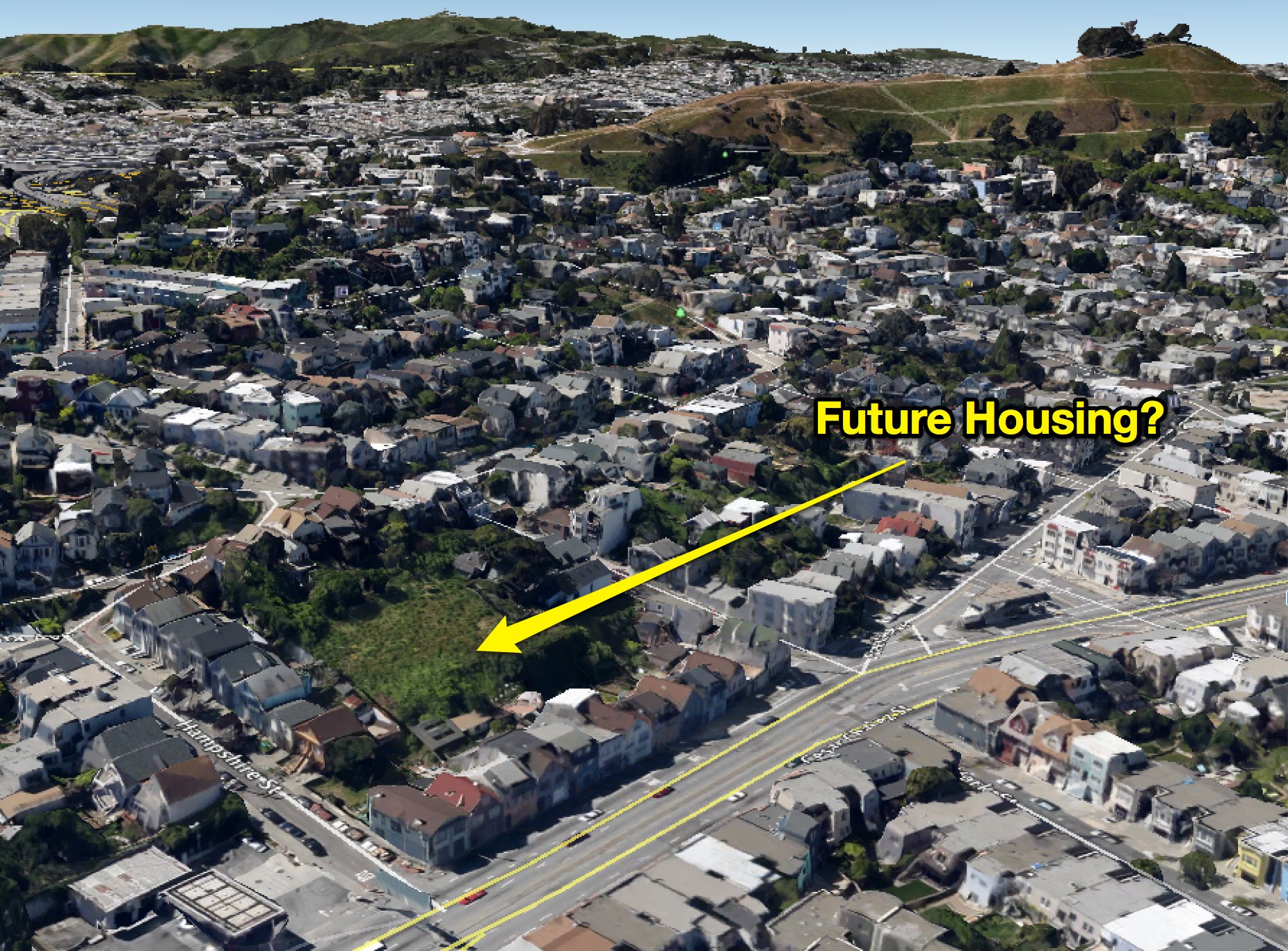
Neighbor Jenna attended last week’s neighborhood review meeting for the proposal to build new homes on the “secret lot” at York and Cesar Chavez. Bernalwood noticed a few tweets she sent during the meeting, so we invited her to share her notes with us. Neighbor Jenna reports the meeting was somewhat depressing — though it helped her understand why San Francisco’s housing crunch is unlikely to go away anytime soon:

As you know from this post, there is a proposed 6-unit development attempting to go in at two of the empty interior lots inside York, Hampshire, Cesar Chavez & Peralta. I live on the 200 block of Peralta, not immediately bordering the land, but up a bit.

This meeting was bigger than the last I went to, which was also very frustrating. (That one was about the house on Alabama near the cafe that’s currently under construction. The woman that owns that Alabama house left the meeting in tears because she was being hated on for wanting to renovate and move into her own home).

This proposed development is mainly reasonable. Offering four single-family homes with 3-car parking, water capture & recycling and solar panels and 2 unit townhomes on the 25′ lot / access way on York. While the final “design” hasn’t been done, what was shown looks fine, if generic.

As far as I understood, both by the committee’s acknowledgement & the owner & architect, this is the fourth or fifth visit to the NE slope special committee with as many different proposals. The most recent previous proposal was for 12 units total, instead of six.

The entry to the interior lot containing the 4 single-family homes is through the garage on York shared by the townhouses. So, in theory, if each unit had two cars, there would be a total of 12 cars coming and going every day from a single 12′ garage. In my opinion, this is the most troublesome part of the proposal, but that’s part of city life. I can’t imagine if they had the 12 units with 2 cars per (24 cars!) going into one garage on narrow York.

According to the owner, he bought the land in 1979, and has been “trying to build ever since.” Wow.

After presentations from the owner, the architect, the fire deputy for our part of Bernal, and the geology expert who did the land and grading surveys, questions were flying.

The stuff you’d expect to hear was in abundance: Blocking light & views, the entrance on York, traffic behind people’s houses on the “driveway”, where will the garbage bins go, how will they prevent landslides, how tall are the units, how tall are the retaining walls, where will the water go, etc.

While I understand that people’s most valuable possession is their home, the objections to this eminently reasonable proposal began to feel more and more outrageous. People were saying, they bought their houses because of access to the “nature” lot behind their houses, the trees and quiet, concern about electromagnetic sensitivity” to a proposed car turntable, etc. Legally, homeowners have no right to “light, views, or nature” of undeveloped lots. This should have been part of research done during the purchasing phase and a risk taken by homeowners purchasing homes bordering undeveloped, but owned, land.

To me, it was a lot of “we like it the way it is” even though the development, in my opinion, would bring much needed housing to desirable Bernal and create more neighbors to add to our community of awesome folks.

There were objections to the (legal) heights of the roofs, the height of the retaining walls, fundamental misunderstandings about the way cisterns and water recycling works (I can’t tell you how long we spent on fundamental mis-understanding of the water re-direction) , and objections to things that are relatively new or rare like the car turntable (we spent a good 15 minutes on making sure everyone understood it was an electric turntable, not a turn around circle).There were even more objections about the construction noise, parking during construction, and the construction starting just after the Cesar Chavez construction was ending.

There were people challenging the experts on their reports. Particularly the fire marshall and the geologist. Challenging him on what was bedrock, exactly. Saying that the excavations would cause the collapse of the hill and surrounding retaining walls (many of which were hand-made by the owners). Challenging the fire marshall on the ins-and outs of his experience fighting fires at properties like this one.

All of this, in my opinion, is fine to bring up as a concern. But once the question was answered by an expert, it was challenged and re-challenged. There were people saying it was wrong to remove mature trees, chasing off the “nature” permanently. (If anyone wants extra squirrels, they can have mine!) There were even people simply saying “we like the way it is” and the standard “it doesn’t fit the character of the neighborhood” argument – which seems to be a catch-all when reason fails. (There were even jabs and jokes made about how “rowdy” the patrons of Precita Park Cafe were, twinged with resentment. I’m so grateful for that cafe, it changed in a huge way, how we live and participate in our neighborhood).

In my opinion, we are in a desperate housing crisis in SF. There are not near enough available units to cover the number of people trying to live here.

As a homeowner who recently purchased a home (4 years ago) that 20 years ago was in an IDENTICAL situation, with two interior lots that their owners worked for YEARS to develop, I can feel the pain of the owner and architect acutely.

I’m SO grateful for my home, and my neighbors, and we watch out for them and they watch out for us. But our lot was the same as this one before the development. The neighbors used to run and play in our lots with their dogs and plant plants and treat it like public land, even though it never was. This created deep resentment during planning and development, which lingers to this day.

We fell in love with Bernal Heights because the neighborhood felt like a community. We could go the park with our dog and have people asking after us and catching up. For me, this meeting was extremely frustrating because it seemed like people felt entitled to things that ultimately weren’t theirs. It felt very uncompromising, negative and un-neighborly.

Is the owner going to get rich over this? Probably. Are we going to get six great new neighbors to watch out for our ‘hood? Likely. Are six families going to get to move to the neighborhood of their dreams? Yes. Will people’s lives be impacted in the short term? Definitely. Is everything ultimately going to be fine? Yes. Better, even.

One friend later told me I had seen “the dark heart” of the housing problem. Other friends said they stopped going to their neighborhood meetings because they couldn’t take it. The folks at these meetings are driving new and different perspectives away through their sheer endurance.

We live in a city. Cities are dense. We need to progress. This is not the face of progress.

New Housing Proposed For Hidden Lot in Northeast Bernal Heights

futurehousing

quinlanblock

Neighbor Margo writes on Nextdoor.com about a plan to build some new houses on a secret lot in the interior of a block in northeast Bernal Heights, alongside Cesar Chavez Blvd.:

The owner of the interior lots bordered by Hampshire, Peralta, York and Cesar Chavez is planning to build on that land soon. He will bring preliminary plans to an open meeting of the East Slope Design Review Board on Wed., May 14, at 7 p.m. at the Precita Community Center, on Precita near the park.

The owner, Patrik Quinlan, came by our house last night and showed us plans for four single family homes of about 2,200 square feet, placed on an angle on the lots, so they would face northeast.

He also plans two small units in a building on top of a driveway through the lot on York Street that would serve as the access to the interior lots. So those would be an odd new sort of home – above a driveway.

On the interior-lot land, the buildings and their driveways would be situated on the property line nearest Cesar Chavez Street. So the people on Cesar Chavez would have a driveway, possibly on the ground and possibly on a ramp (Quinlan wasn’t sure), right on their property lines. Because of the slope of the hill, that driveway or ramp would be way above their heads. So… I think this means that long-term, their lives would be most affected by this.

In the past, Quinlan has presented plans for four or five duplexes, that is 8 or 10 units. So this is much less dense than he’s proposed in the past.

Issues that have come up in the past over development on this land are: fire truck access; where to place garbage containers; parking, of course; views and light; the geologic stability of the hill; potential displacement of underground streams.

Anyway, anyone interested should come to the meeting.

Old Bernal House Is Not Crappy, It Was Just Built That Way

2014-04-11-12-17-56

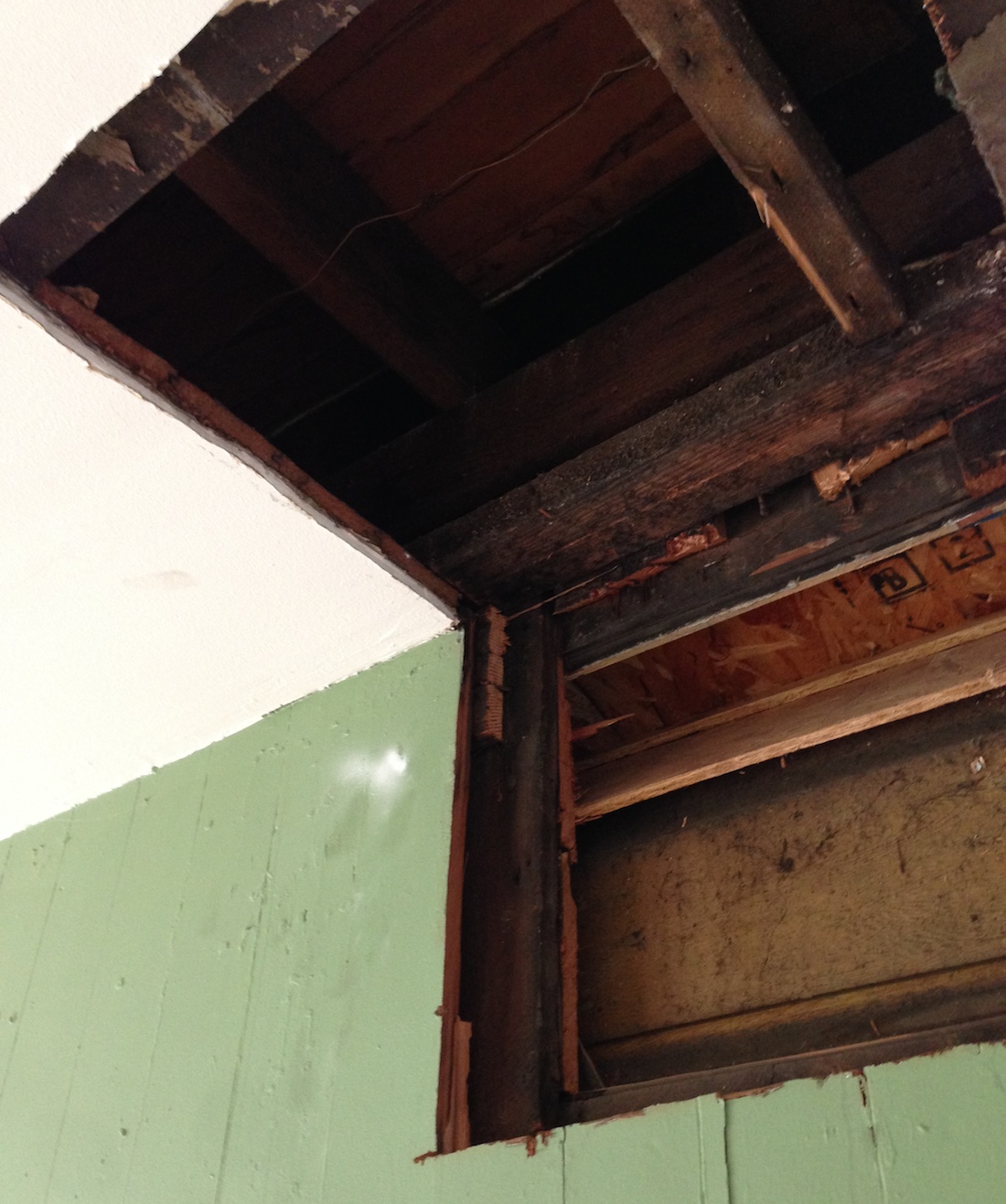
Neighbors  Kiren and Carolyn are continuing with their big home renovation project, and along the way they are learning some enlightening facts about a few of the more unfortunate aspects of their home’s fundamentals:

The Internet tells me that no, our house was not built by someone so blitzed out on opium that he forgot to build the framing. Instead, it was built in a style that had brief fits of popularity across the US from the mid-1800s through the turn of the century. Called “plank framing”, with 12″ wide wood planks running vertically from the foundation to the roof. Battens could be nailed along the seams, though some owners find glued cloth instead.

According to one of the few writeups on the technique,

The low cost, combined with the little skill needed for their construction, made it a popular house type in communities where quick and/or inexpensive housing was in demand. Groups of these box houses are typically found in communities that were originally company-built mining towns, lumber camps, tenant or workers cottages on farms, and summer resort communities that were popular around the turn of the last century.

Despite all this, Neighbor Kiren retains impressive poise, concluding,  “I feel better knowing that our bones were part of a construction trend (which admittedly was short-lived, probably for a reason), and not simply the result of sloppiness, corner cutting, amnesia, and the like.” 

In other words, Neighbor Kiren and family are glad to know that whoever built their house was not necessarily hepped up on too much Goat Chaser — although it is also possible that they were.

PHOTO: Exposed plank framing at Neighbor Kiren and Carolyn’s house, via Bernal Renovation

Bernal Neighbor’s Essay Ponders Housing Prices, Public Policy, and the Future of San Francisco’s Middle Class

realestateneon

Neighbor Hina Shah is associate professor at the Golden Gate University School of Law. She rents in the La Lengua Autonomous Zone, on 29th at Mission — for the moment. Her housing situation has been stressful, and she wrote about that, and some possible solutions, in last Friday’s Chronicle:

The discussion about the housing crisis has focused exclusively on how the burgeoning tech industry is affecting low-income residents. However, middle-class, moderate-income families like mine are also being squeezed out of the city.

My family lives in a non-rent-controlled unit in the Mission-Bernal Heights district. My husband and I moved into our apartment 10 years ago, when we were still dating. Since then, we got married and had two children. When it was time for our daughter to go to elementary school, we chose our neighborhood public school. We occasionally considered buying a place but, with our incomes as nonprofit and public-sector workers, owning seemed like a financial stretch.

In January, however, our commitment to raising our children in the city was severely tested. We were notified that our rent would increase by $600 a month.

So what is to be done? Neighbor Hina proposes:

To ensure economic diversity in our communities, the city must embrace nonmarket solutions, such as:

Increase city-owned land that can be developed into subsidized housing for all income levels. Vienna offers an excellent model for how San Francisco could be a major player in social housing. In Vienna, the city controls 25 percent of the housing stock and indirectly controls another quarter of housing built and owned by limited-profit, private developers. Housing cannot be controlled solely by the private market, as irrational exuberance is once again overvaluing housing and pushing long-term residents out of the city. Here in San Francisco, the city must become a key player by owning and managing housing stock.

San Francisco’s Housing Trust Fund should be used to build affordable housing units, with a mix of diverse price points, limited equity units and rental units.

Induce tech giants such as Google to invest in community land trusts or other funds to help build more affordable housing. Google’s recent gift to fund free Muni passes for youth for two years is inconsequential. The public and the city officials who represent us should demand more from our tech neighbors.

Preserve and expand rent control: Units constructed after 1979 (like mine) are exempt from rent control. The state’s Costa-Hawkins Rental Housing Act exempts from rent control single-family homes and condominiums where the tenancy began on or after January 1996. The act also removed vacancy controls, allowing landlords to set new rents when a unit becomes vacant.

Change the Ellis Act to stop speculator evictions of rent-controlled tenants. Preserving and expanding rent control will need full public engagement and the city’s muscle, as it did in 1979 when the city passed emergency legislation to stem the tide of quadrupling rents in the Mission District.

There’s a lot to consider in all this, so discuss in the comments if you’re so inclined.

PHOTO: Telstar Logistics