KQED: Lama Family Feud Lies at Heart of Big Bocana Rent Increase

bocanarental3

Veteran reporter Dan Brekke knows how to do the legwork required to crack a story open. These days he works for KQED, where he just published a remarkably detailed report on the Lama family dispute that lies at the heart of the now-infamous 315 Bocana rent-increase controversy.

Brekke’s reporting largely confirms rumors that have been rippling through Bernal Heights for the last few days, to the effect that as a result of the family feud, Bernal neighbor and 355 Bocana property owner Nadia Lama hoped to evict Neigbor Deb Follingstad, because Neighbor Nadia herself needs a place to live.

Brekke reports:

Superior Court filings show that Nina Gelfant and Gayle Worrell alleged they were forced from their one-bedroom, one-bathroom, 720-square-foot Cortland Avenue apartment [in 2013] after the Lamas raised the rent from $1,650 to $4,250 — 157 percent.

The suit argued that the rent increase was far above market rate and designed to get Gelfant and Worrell to leave so that Lamas could sell the property.

That sale, [tenant-rights lawyer Joe] Tobener suggested in a trial brief that outlined more than $1 million in potential damages, was triggered by a battle among Shukry Lama’s heirs over the property he’d left behind when he died in 2012.

“Chuck Lama’s heirs were fighting over their share of the inheritance which demanded selling properties or having the heirs occupy them as residences,” Tobener’s brief says.

That alleged squabble also appears to have played a role in Nadia Lama’s dramatic increase of Deb Follingstad’s rent.

In September 2013, she filed a probate petition in Superior Court seeking to compel her sister Claudia, the overseer of several family trusts set up by [deceased family patriarch] Chuck Lama, to account for the family’s assets. Assets named in the petition and exhibits include a small Cortland Avenue market, Chuck’s Store, the store’s liquor license, eight residential properties in San Francisco, one in Burlingame, and unspecified real estate in Chile.

The court proceeding resulted in an agreement last Dec. 31 in which the three Lama sisters and their three brothers, along with some of their children, agreed to close the family trusts and distribute their assets.

The property Nadia Lama was to receive includes a 2006 Toyota Avalon; $25,000 to pay the legal bills she’d incurred; a little more than $750,000 in cash due upon the sale of two of the family’s properties; and finally, the Bocana Street residence occupied by Deb Follingstad and the $7,500 to hire a lawyer to evict her.

The agreement also requires Nadia Lama to vacate her current home, a couple of doors up from Follingstad and still owned by her siblings, by the end of April. If she doesn’t, the document says, she’ll have to pay $4,000 a month rent to four of her siblings who will continue as owners; and if she does anything to interfere with their renting out the home she’s supposed to vacate, she’ll owe her siblings $10,000 in damages.

Kudos to Dan Brekke and KQED for the excellent work following the paper trail. Read Brekke’s full report on the KQED website, right here.

PHOTO: Telstar Logistics

UPDATED: Bernal Resident Stunned by 315% Rent Increase

bocanarental3

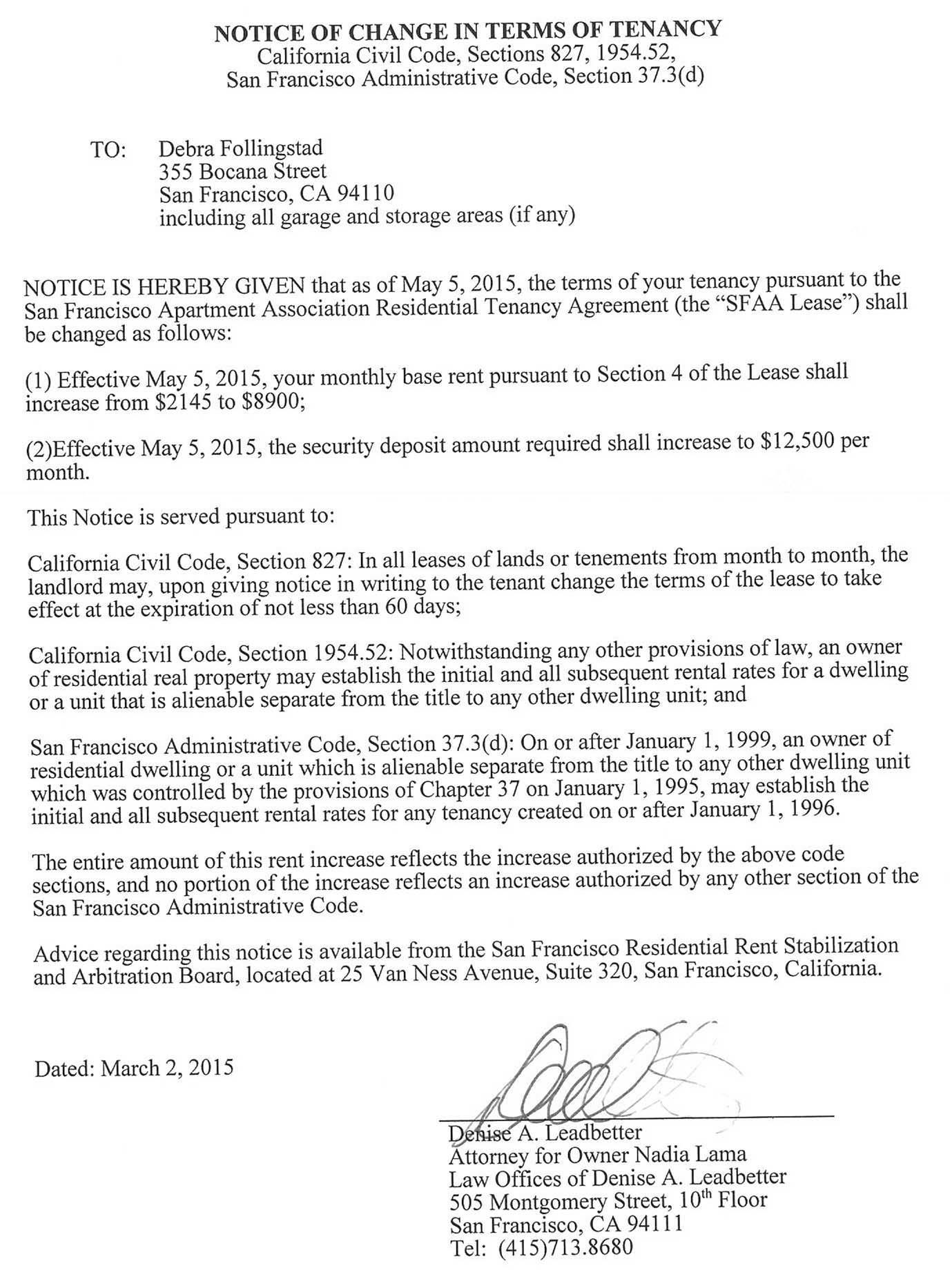
Neighbor Deborah Follingstadt is a tenant at 355 Bocana. This month, she says, she was given notice that her landlord plans to raise the monthly rent from $2145 to $8900a month— a jaw-dropping 315% increase. Posting about it on Facebook, Neighbor Deborah says:

I guess I should say 1st – I need a place to live if anyone knows of anything please let me know, even if it is a temporary roommate situation or temporary sublet.

I am not sure if I can stay in the Bay Area for the “long haul”, but in the short term I have a job that I won’t abandon and a community I love. I will give it my best shot but it looks kinda bleak from where I am standing currently.

A lot of you know about this and that for the last two weeks I have been trying to find anything that can make this illegal. Because it looks so absurd when you read it seems that it must be illegal.

However, this is loophole that landlords have found in San Francisco to evict their tenants without actually having to pay relocation, do an “owner move in” or Ellis act. All of which carries a penalty to them and is costly.

So here is the short version of the story, 1st they transferred the title of the house to one of the 6 siblings, stripped the apartment downstairs (the one that Wayne lived in for close to 25 years before they bullied him out) took out the bathroom, and kitchen, put down some crappy carpet and now call it a “storage” space. By doing this it changed the title of the building to a “single family dwelling” which is not protected by rent control and raised my rent to $8900 a month with a $12,500 damage deposit a month. Obviously above market rate and obviously more than anyone would pay.

The few of us who still remain in San Francisco have no choice but to live in sub-par conditions like mold, windows that don’t shut, rodents and countless other issues because there is no other choice, because the rents are so high you can’t move so you don’t. And you know that one day the ax will fall and you will be kicked out so it is not surprising when this happens, but this is just gross and greedy and wrong.

So here it is this is page 5 of the 23 page document that I was served on Monday March 2 (feel free to share and no the typos don’t matter)

Here is the scan of the letter Neighbor Deb claims to have received, outlining the terms of the rent increase proposed by property owner [and Bernal resident] Nadia Lama:

bocanaletter

Owner Nadia Lama is member of the Lama family, which has been a presence in Bernal Heights for decades. (CLARIFICATION: Bernalwood’s understanding, not yet fully confirmed, is that 355 Bocana is owned by Nadia Lama alone, and not the entire Lama family. A recent ownership transfer indicates that Nadia Lama acquired the property from a family trust.)

Bernalwood reached out to Nadia Lama and her lawyer over over the weekend to verify the content of the letter and provide an opportunity to respond. We also reached out to Neighbor Deb to do the same. Thus far, Bernalwood has not received a response from any of the parties involved.

UPDATES: Lots happening with this story as it sweeps through the local mediasphere. Much of this is technical, most of it is confusing, and some of it seems somewhat contradictory. Plus, math is hard. Let’s begin:

>> Jeremy Pollock, an aide to D11 Supervisor John Avalos, reached out to Bernalwood to say this:

I’m a legislative aide for Supervisor John Avalos. I just wanted to add my two cents on the 355 Bocana case: it seems pretty clear to me that if the landlord did remove the downstairs apartment, they didn’t get a permit for it, which makes it an illegal merger. There’s no record of any merger permits in the Planning’s system. We’ve asked Planning Department staff to look into this.

>>But Planning approval may not have been required for the single-family conversion, according to some terrific CurbedSF reporting. Curbed was able to reach both Neighbor Deb and Neighbor Nadia Lama’s lawyer to confirm the basic facts presented by Bernalwood above. Long story short: Through a complex series of moves, it appears the property owner effectively reclassified 355 Bocana in a way that made the gobsmacking rent increase legal:

For most of her 11-year tenancy, Follingstad, 46, was protected from large rent hikes under the Rent Ordinance of 1979, because she was living in a multi-unit building (single-family homes and condos are treated differently under the Rent Ordinance). But by 2014, a tenant who had been living in the downstairs apartment moved out, after which, recalls Follingstad, the Lama family ultimately removed the stove, sink, and toilet from the vacant ground-floor unit. “They put down some crappy carpet and now call it a ‘storage’ space,” she wrote in her Facebook post. That change turned her building into a single-family dwelling and effectively dissolved the protection against large rent hikes, or what is known as rent-ceiling-limitation protection.

Normally when landlords want to take a unit out of service, they need to go through discretionary review with the Planning Department, Tobener explains. But because the downstairs unit was not on the books—city documents reflect just one dwelling unit at the address—the landlord needed only building permits to do the work, no blessing from Planning required.

>> Legal notices suggest Nadia Lama became the sole owner of the property at 355 Bocana in December 2014, after ownership was transferred to her from a family trust. (H/T: Neighbor Arno)

>> Nadia Lama also lives in Bernal Heights, according to rather cranky commenter GoldenGateShark. Bernalwood has not been able to verify this independently. Nevertheless, Nadia Lama shall hereafter be Neighbor Nadia Lama.

>> Fallout from the incident took the form of a sign taped to the door of the Lama family’s former store on the corner of Bocana and Cortland this afternoon. Neighbor Jim shared a photo:

shame.Jim

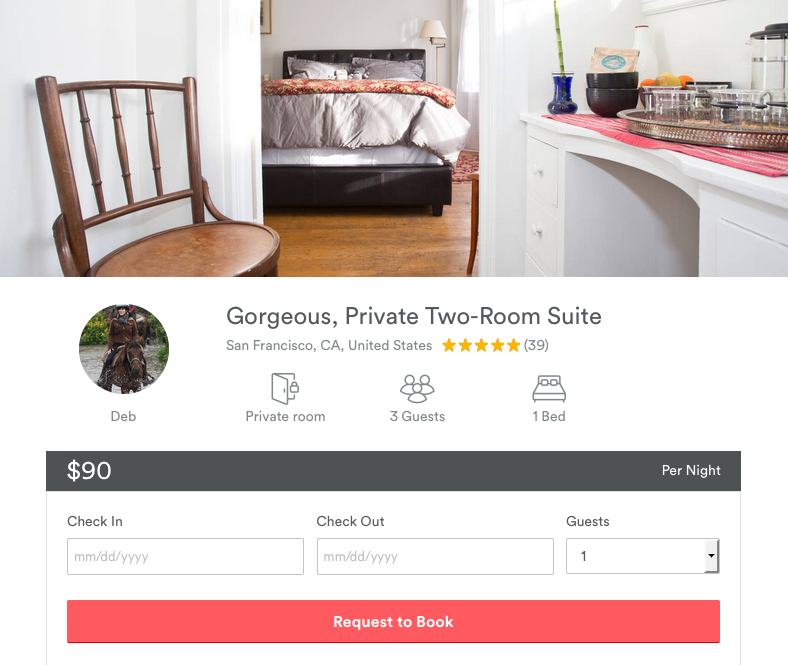
>> Further muddying the waters, it would appear that Neighbor Deb was sub-renting the apartment at 355 Bocana via Airbnb. It is unknown if the terms of her lease would have allowed this:

Screen Shot 2015-03-16 at 4.41.32 PM

The description of the space posted on Airbnb reads as follows:

I am being kicked out of my home of 11 years. Come celebrate my final months hosting wonderful travelers from all around the world, sharing interesting places to see, eat and enjoy in this beautiful city I have called home for 26 years. I have truly enjoyed my hosting experience and made many friends. My greedy new landlord wants market value for my home, and is forcing me to leave with some very shocking and unsavory tactics. But, I guess that’s life in the San Francisco BOOM town. Sadly, this not only means I loose my home but also loose my city, because I can no longer afford to rent here as an acupuncturist.

My rent controlled apartment has allowed me to have a guest bedroom for my friends and family to stay with me, have a wonderful acupuncture clinic and spa, host travelers who wanted a real San Francisco experience, and also have a place for my patient’s families to stay when their loved ones were in crisis. It has been a wonderful journey. Help make the end of this era a special and memorable one!

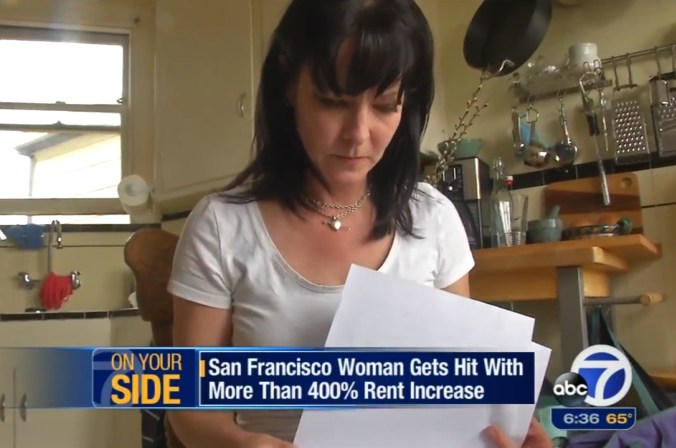
>> It’s an Official Media Frenzy! Cue the TV reporters:

abc7rentincrease

UPDATE 18 March, 2015: via the SF Chronicle, Denise Ledbetter, the lawyer representing property owner Nadia Lama, has released a statement on the matter:

The rent increase that has generated this controversy is actually an offer by the owner to rent a substantially larger home than was originally rented. In addition to the upper level (in which tenant currently resides), Ms. Follingstad will have access to at least 60% more space which can be used by the tenant to offset the rent increase through her existing Air BnB business. As interested parties are now aware, there are many sides to a story. Rent Control Ordinances create unreasonable expectations upon which tenants rely. In this case, rent control simply does not apply to this tenancy.

When a small property owner finally has an opportunity to increase the rent – via State law – the City gives almost no choice to the owner but to take the opportunity to increase the rent. If owners were allowed modest increases over time, we would not see this kind of dramatic rent increase required.

San Francisco’s promotion of Airbnb-type hotel use further reduces available housing to middle income residents. A comprehensive housing policy is required for San Francisco County residents – landlords and tenants. Commercial profit making use of a tenants rent regulated rental unit should be disallowed.

San Francisco County unfairly burdens small property owners with a societal problem that should be shared by all residents – not just those whose owners’ whose properties were built prior to June 13, 1979. Small property owners are not being subsidized by the government for what is truly a problem for all of society. An economically sound housing policy – fair to all – is required to avoid further displacement of our middle income residents.

PHOTO: 355 Bocana on March 15, 2015, by Telstar Logistics


Median Rent for 1BR Apartment in Bernal Hits $2800 (What a Bargain!)

MedianRentsfeb15E2

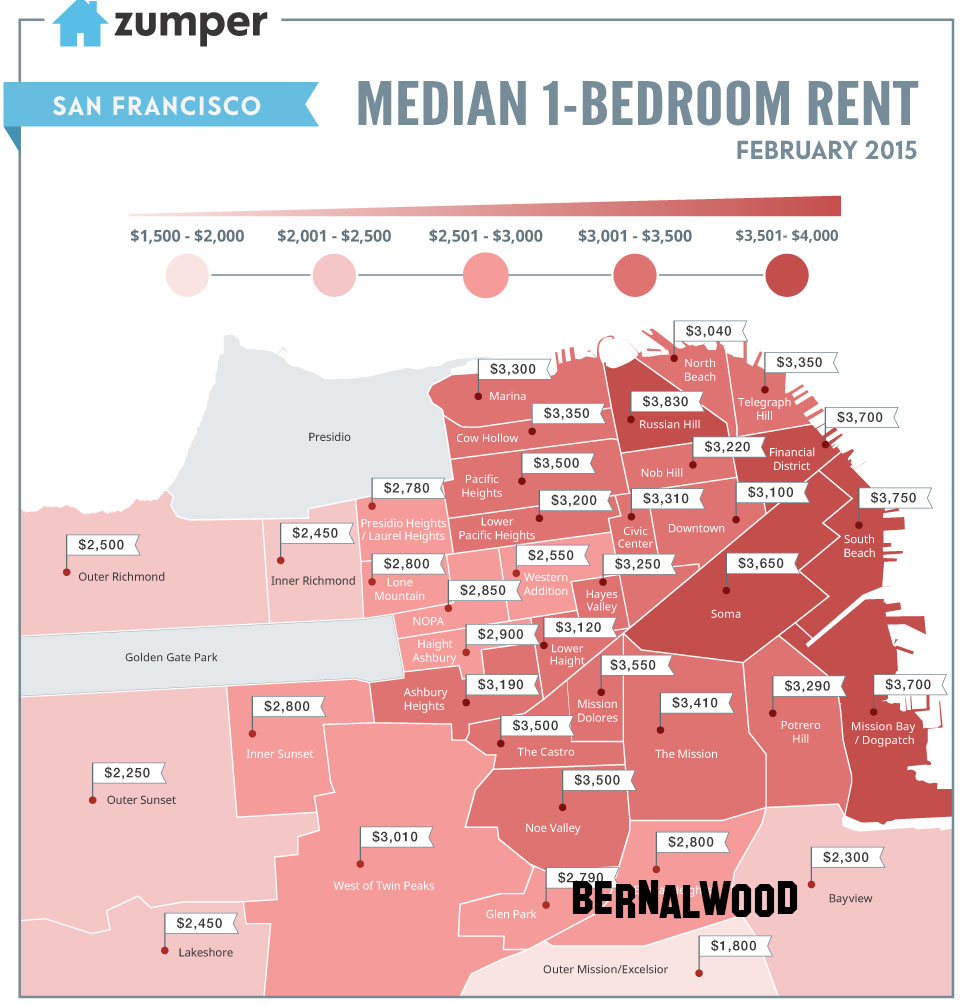
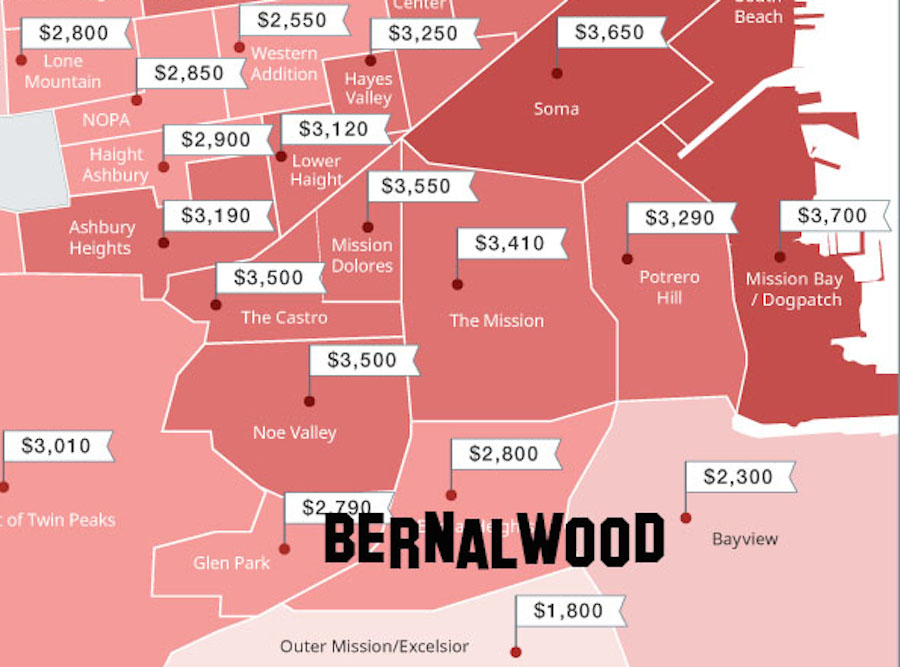
Time for a quick check-in on the state of Bernal Heights apartment rentals. The data geeks at Zumper just pulled together an overview of 1-bedroom apartment rental costs across town. Citywide, the rent is too damn high:

The San Francisco rental market continued to be the most expensive rental market in the country, reaching an all-time high of $3,460 for a 1-bedroom apartment. While prices in New York City remained largely flat at $3,000 last month, SF continued upwards, increasing 1.5% month over month and 3.3% over the last quarter.

That said, rental prices in Bernal are on the low-crazy side of totally insane, relative to many neighborhoods around us.

MedianRentsfeb15e

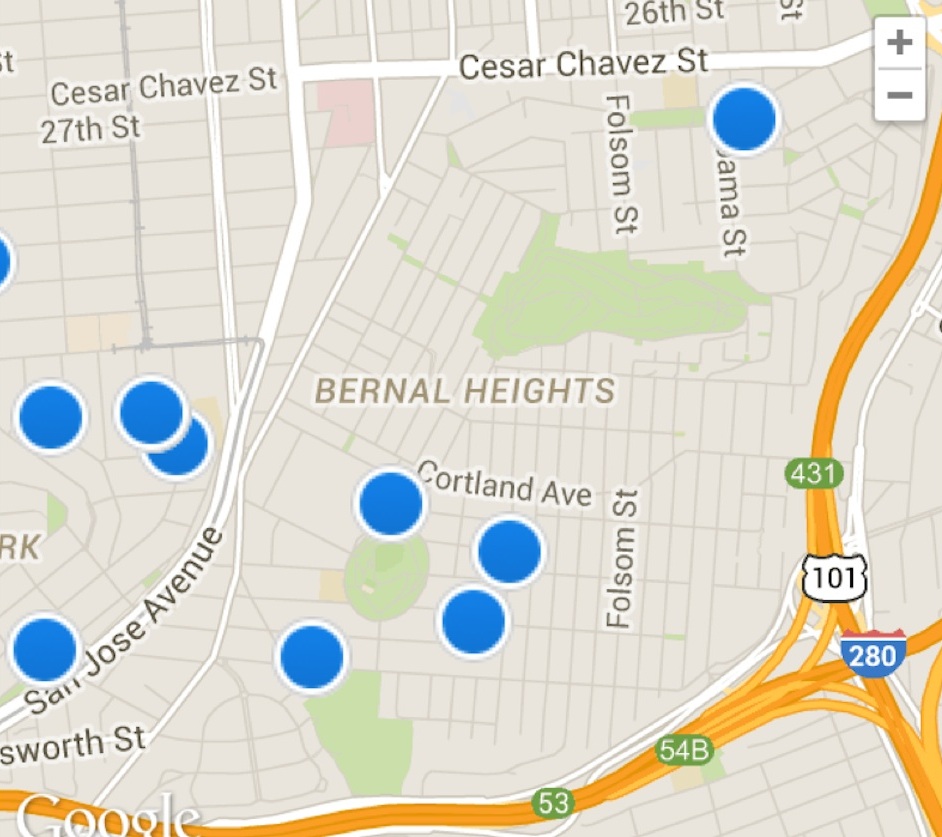
Of course, the thing about Bernal is that it doesn’t have a lot of 1BR inventory. Here’s Zumper’s map of 1 BR rental listings in the neighborhood right now:

bernalrentalsfeb15

MAPS: by Zumper

Bernal Architect Designs Affordable Housing That’s Beautiful

kennerlybldg2

San Francisco needs more affordable housing. Much more.

But affordable architecture gets a bad rap. It’s ugly. It’s too institutional. It’s too homogeneous. It’s visual blight.

Often, those generalizations are true… which has the very unfortunate effect of making San Franciscans (even more) resistant to new affordable housing projects. That’s super extra-bad, because San Francisco really needs more affordable housing. Much more.

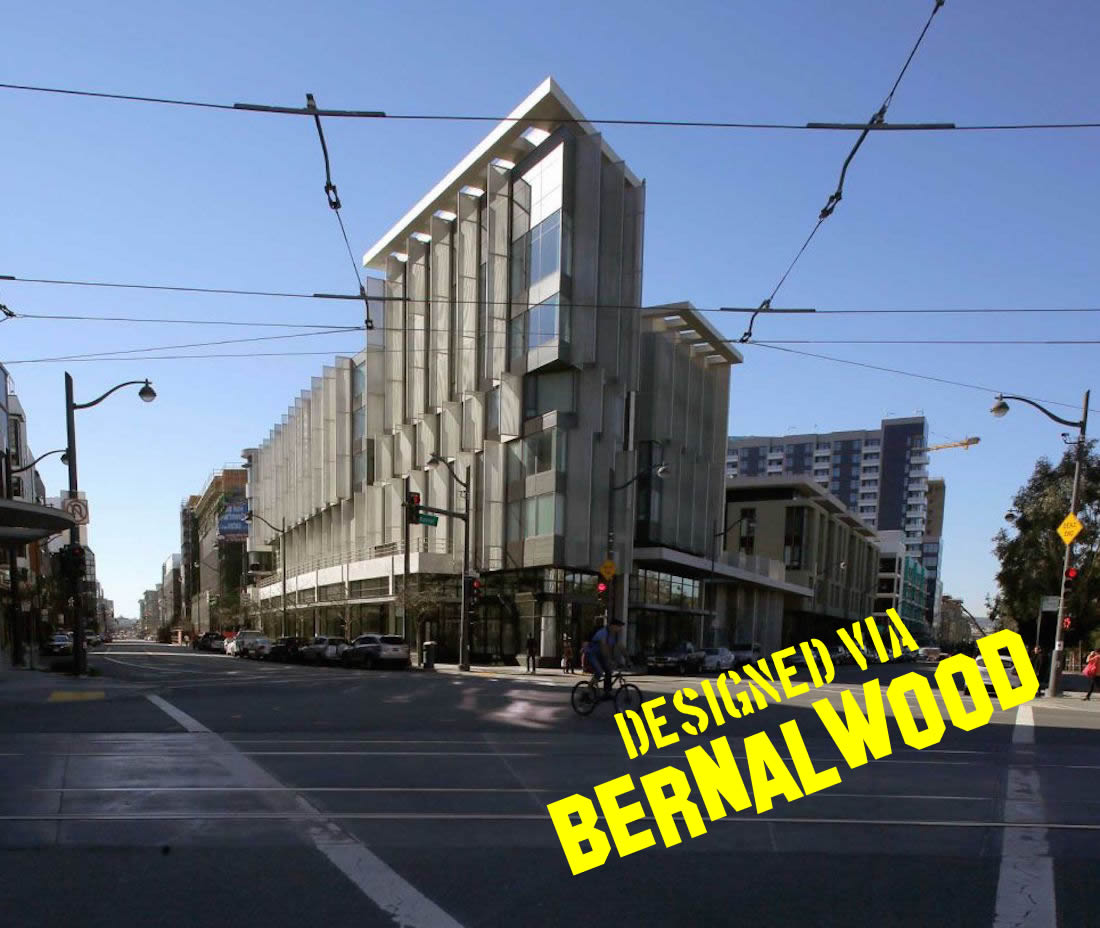
Architect Owen Kennerly is a resident of Holly Park, and he was the co-designer of a new affordable housing project in Mission Bay that’s so gorgeous it makes San Francisco Chronicle architecture critic John King swoon.

The building is 1180 Fourth Street, and here’s as taste of what The John King has to say about it:

Architecturally, the six-story wedge of 150 apartments adds an assertive spark in a young district with too many boilerplate buildings. At ground level it’s engaging, a pleasure even before the generous retail spaces are filled. There’s a social payoff as well: The units are reserved for low-income families, adding youth to the neighborhood scene.

None of this is by chance, and it shows how planning priorities can translate to good city building — especially when determination and creativity are added to the mix.

The first step was the decision long ago to reserve the site for affordable housing. It’s a prime location fronting a park where Mission Creek is crossed by Fourth Street, the entryway to the 200-acre-plus southern part of the Mission Bay redevelopment district established in 1998. Setting it aside for lower-income residents was a symbolic reminder that economic integration should be pursued when and where it makes sense. But a well-meaning gesture isn’t the same as a well-done piece of architecture. That’s where smart design comes in.

The architectural effort was led by Daniel Solomon and Owen Kennerly, whose relationship goes back to the 1990s when the latter was a UC Berkeley student and an employee of the former. Kennerly now has one of the most visually inventive small firms in the city.

This is not Neighbor Owen’s first rodeo. He’s created several cool buildings around San Francisco, including a gorgeous house that got the sexy treatment from The New York Times. Neighbor Owen’s design for the affordable housing at 1180 Fourth takes his work in a wonderful new direction, and it shows that his architectural kung-fu is extremely versatile.

Great work, Neighbor Owen, and thank you. Oh, if you have some spare time, could you please pull together some sketches for a mixed-use housing and supermarket retail project to go on the site of our managerially blighted Bernal Safeway? Mmmkay? That’d be great.

PHOTO: San Francisco Chronicle

Bernal Contractor Explains How to Remodel Your Home Without Going Broke or Insane

thedollhouse

Bernal neighbor Brian Streiffer is a former general contractor (and current construction supervisor) who lives on Winfield.

FULL DISCLOSURE: Neighbor Brian and your Bernalwood editor are old friends, and we played a lot of hacky-sack together during the 1980s.

Anyway, fast-forward three decades and several economic cycles, and Neighbor Brian now has many moons of experience building and remodeling homes in San Francisco under his belt. His talent and professionalism has been affirmed for us by his former clients, several of whom also now consider him a friend.

So when Neighbor Brian said he wanted to write something for Bernalwood, we suggested he share some precious wisdom on how to work with a contractor to do a home remodel without going broke, or insane, or both. Herewith are Neighbor Brian’s Pro Tips for would-be Bernal home improvers:

I’ve been remodeling homes since the early 1990’s. One of the things I love most about residential work is the unique insight it offers me into how people relate to their homes and the people who work on them.

Every client is unique in some way. Some people hate the mess and inconvenience. One of my clients was so distraught when demolition began that her partner forbade her from visiting the house until the drywall went back in. Other people think construction is cool, and can anticipate the finished product long before the work takes shape  My favorite client ever — when forced to live in half of her house with her husband and 2 small kids while we worked on the other half — said, “camping on a futon in the living room reminds me of being back in college. So cool!” What a client! She never uttered a sour word to me or my crew and we ultimately became good friends.

I’ve always found it fascinating to see how people react to construction, and how the Contractor/Owner relationship plays out. Working in people’s homes is very personal stuff. Some people cope well, and other people don’t really understand what they are getting into.

Amid all of the current real estate hubbub, I thought it might be interesting to share some remodeling advice for homeowners, from a contractor’s perspective. Here  are a few observations to keep in mind when planning a construction project.

The Golden Rule of Construction
There is a saying in construction that really rings true: “There are three types of construction: Fast, High Quality, and Inexpensive. You can pick any two.”

The point here is that you have to understand the fundamental trade-offs between quality, speed, and price. Remember this, always, and if you know which is most important to you, you can more easily select a contractor who fits best with your needs. I cannot count the number of times clients have asked me if I would consider an incentive to expedite their project. I always defer, explaining that fair payment is motivation enough. If they push the issue, I explain further that it typically doesn’t make financial sense to trade money for speed on a construction project. Construction is simple in many ways, but it is not easily done in less time than normal without risking quality or significant cost increases.Unless money is no object — and I have yet to find a client for whom that was true — it is ALWAYS cheaper to rent an apartment or take a vacation to get away from the mess, rather than to pay the contractor to knock a few weeks off of the schedule.

What to Look for When Looking for a Contractor
In slower economic periods ( such as from 2008 to 2013), homeowners can expect to get multiple bids and cherrypick the best deal from multiple contractors. But in hotter markets like we see today, you have to court your contractor as much as they need to sell you.

If you are at the beginning of the planning process for a larger project, defer to professionals for how and when to seek bids. It is fine to ask contractors for their impressions of a project early in the planning phase – contractors are generally happy to suggest potential budget ranges for you – but don’t ask seven companies to provide proper bids on a set of preliminary plans if the project is six months or more down the road. Preliminary numbers are not generally useful when making hiring decisions, so tread lightly when asking people to provide estimates. The point of early preliminary interviews should be to glean information about what lies ahead, and to begin to develop a rapport with people you might want to work with. But don’t ask too much of contractors too soon. Contractors don’t like putting bids together for no reason.

Indeed, anything you can do to save the contractor time and hassle while preparing your bid will be repaid tenfold when it comes time to work collaboratively during the project. If you don’t have a set of plans you can provide, write up a bullet-point list of everything you think the project entails. If you know what fixtures you want to have installed, don’t ask contractors to go through the trouble of estimating the same thing on their own. Contractors really appreciate simple steps like that, and they can pave the way for a more successful working relationship.

It’s About the Relationship
Just showing you are motivated and organized can be quite appealing to potential bidders. The flip-side, however, is that you don’t want to look compulsive about your project, or you will likely scare good people away.

Ultimately, you have to decide who to hire. I cannot say enough about the importance of getting along with your contractor. Construction is an inherently messy, invasive process that often takes longer than you or your contractor would prefer. So you might as well like the people you are working with! If you get a bad vibe from someone, heading in another direction might be wise. If someone seems a little too busy to you, hiring someone with more availability could be better. Signing a contract to remodel your kitchen or build out your basement might seem like a business or financial decision, but residential construction is ultimately a very personal process. Working with someone you like can make all the difference. Keep this in mind and don’t focus on costs alone when comparing bids.

Expect the Unexpected
“Life is Change” they say, and construction is no different. Residential remodeling projects of almost any size can change for any number of reasons. And they will. Termites, code changes, horrors hidden inside walls, neighbor complaints, even simple human error can send your project off in unforeseen directions. You can’t always know what to expect in the way of surprises, but you can prepare for them financially by including a contingency for additional costs in your personal budget. Especially when you need to stay within a specific overall cost, setting extra money aside is a wise thing to do. How much is right? Read on.

The Truth About “Change Orders”
Much has been said about the dreaded Change Order, those bills for additional work that goes beyond the scope of the original project bid. But Change Orders are a part of construction that you have to be prepared for, and they go hand in hand with remodeling.  In my years as a contractor, I never once had a project of more than $20,000 that didn’t involve a cost increase of one kind or another. Stuff happens. I think most contractors price Change Orders fairly.  Yes, they can be costly. And yes, there are unscrupulous souls among our lot who generate too many of them. (I have no doubt that there is probably is a contractor out there somewhere with a boat named Change Order and a dingy named Contract.)  But as a rule, contractors don’t get rich off changes in the scope of work.

If you can’t avoid extra costs, what can be done to avoid the stress associated with them? First, ask your contractor or architect to estimate a reasonable contingency budget  for your project. A kitchen might require a 5% contingency, but a lateral addition might merit 10% or more.  Whatever the case, budget this amount and consider the money spent.  You’ll sleep better. Much better.

Second, look beyond the construction contract cost and develop an overall project budget. What costs are excluded from the contractor’s scope of work? Will you have landscaping to do when the contractor leaves? Engineering or Special Inspection costs to incur during the project? And don’t forget about owner-supplied fixtures or furniture. Those things can really add up, and you need to be thorough and realistic about your project budget.

A Caution on Contractor References
If you think that checking your contractor’s references is a form of due diligence, think again. References are cherrypicked by the person you are checking up on, so take what you hear from them with a grain of salt. I don’t believe checking reference is particularly helpful, unless you want someone to help nudge you in a particular direction. If your decision comes down to two bidders, it might be more helpful to ask which contractor can start (or finish) sooner, or consider who has more experience with projects similar to yours, or which contractor might be willing to shave a few thousand dollars off the cost in order to win your business. (OMG, did I just say that!?!) Out-of-the-box questions along those lines might be more insightful than what you hear from references.

To Permit or Not to Permit… Is That Your Question?
I generally advise homeowners to get permits for as much work as possible, as it tends to pay off in terms of market value when it comes time to sell your house. Especially if you are plan to do work outside of your four walls, where just about anyone could call you in for doing work without a permit, paying permit fees makes good sense. However, it’s also worth noting that the SF Building Department has changed its policy concerning unpermitted work. Long gone are the days when inspectors were paid to snoop around on Saturdays looking for unpermitted work. If your budget is tight, and you trust your neighbors, and the work is all inside of the house, you have options.

Beware of the Lowball
If you receive bids which are vastly different, be careful before accepting the low bidder. If you know what you are doing and follow some of the advice I have given here, you should end up with an apples-to-apples set of bids where one bid stands out as a clear value. This IS possible! However, it’s also possible to get into trouble by hiring based on numbers alone. Carefully review bids to understand WHY the numbers are different. Talk to your contractor before signing on the dotted line as to his/her expectations for how changes to the price might unfold. No matter what the contract says, what’s not stated can be equally important. So understand where the low bidder is coming from by generating such a tantalizing price. One of the absolute worst things that can happen is for your contractor to get in hot water because of an under-pricing mistake made when bidding the project. What can seem like a great deal when work begins can easily unravel if your contractor gets into financial trouble because of it. (EDITOR’S NOTE. This is exactly what happened to me. See the photo notes below.)

Little Guys vs. Bigger Guys
Another thing to be wary of is very small contracting firms. Whether an unlicensed “Jack of All Trades” or a licensed contractor who performs many trades by him/herself, going with a very small company comes with very real risks you should understand. Yes, there are diamonds in the rough who do great work time and time again, but they are the exception to the rule when it comes to small construction companies. Most people who excel in construction tend to gravitate toward larger operations, where efficiencies of scale come into play and specialization can be leveraged. People who work alone have fewer resources to bring to bear on your project, which can be especially frustrating toward the end of the project, when you just want them to be done and gone. That said, the prices of smaller firms are sometimes unbeatable, so just make sure you understand exactly what is being promised in terms of time and cost before signing up with a smaller independent. Even if they come highly recommended from someone you know, they have to be the right person for YOUR job.
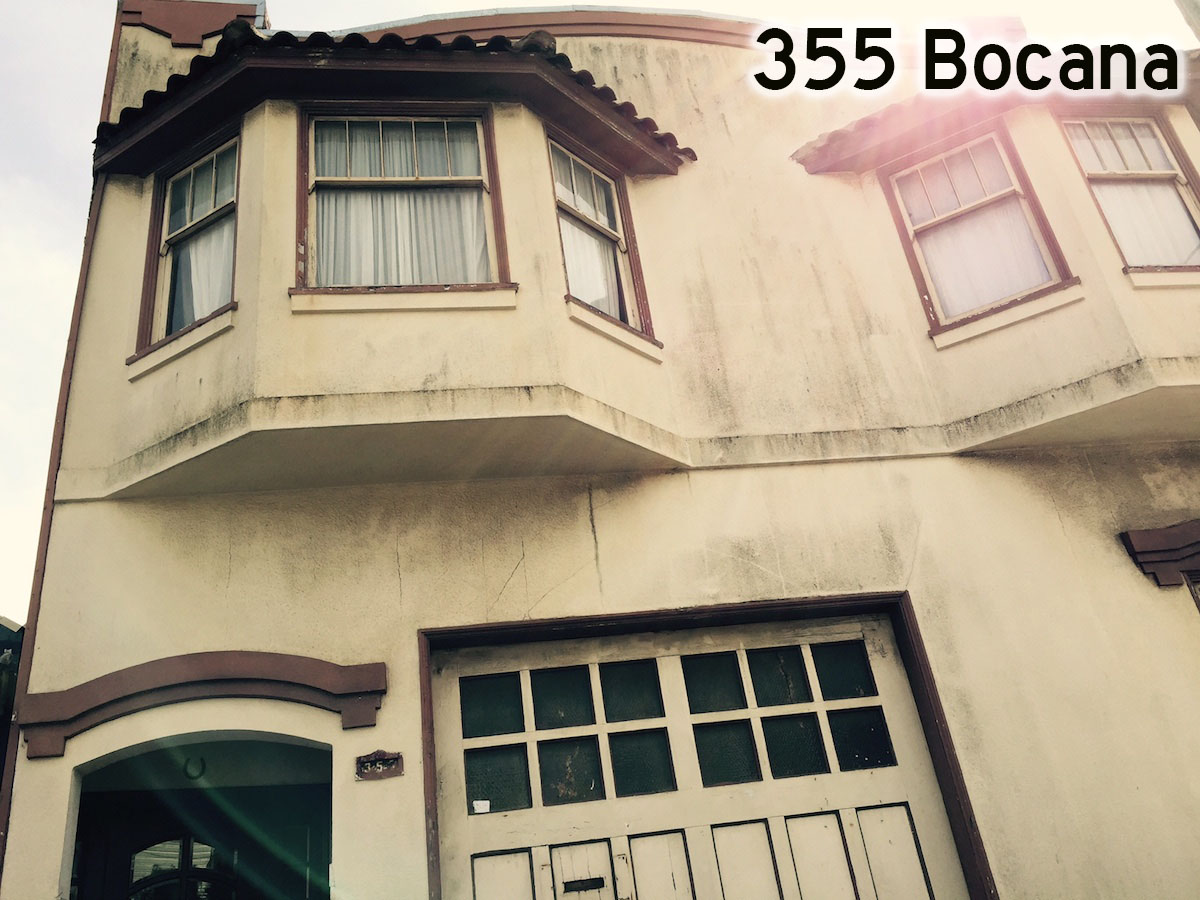
PHOTO: Your Bernalwood editor’s home on July 24, 2004, a few days after our lowball contractor announced that he planned to abandon our remodeling project to instead divorce his wife and begin a new career in marijuana cultivation. Photo by Telstar Logistics.

$3 Million Ripley Home Sale Sets New Bernal Price Record

OMFG171-Ripley

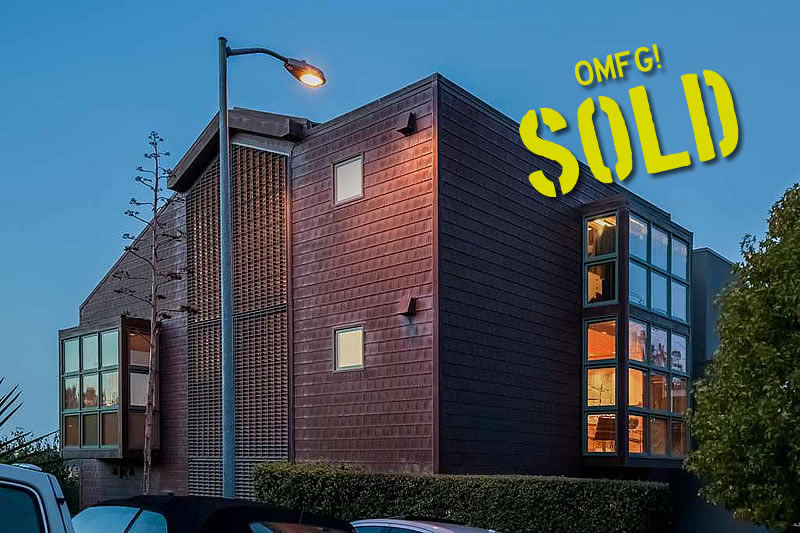
It’s official: The rather dashing home at 171 Ripley just sold for $3 million, instantly setting a new Bernal Heights sale price record — just a week after 152 Elsie had set a new record at $2.3 million .

SocketSite brings the gobsmacking news:

As we wrote when we first reported the record breaking sale of 152 Elsie last week, “the quiet sale of another Bernal Heights home which was never officially on the market is poised to blow away the $2.3 million record.”

And this afternoon, the sale of 171 Ripley was officially added to the MLS, “for comp purposes only,” with a record setting sale price of $3 million.  Measuring 2,313 square feet, that’s roughly $1,350 per square foot for the architect’s home which is faced in recycled copper and known to some as “the copper house.”

For whatever it’s worth, SocketSite adds “The seller was an architect at Gensler for over 30 years, and the firm’s President and CEO for over a decade.  And no, the buyers aren’t ‘techies’ nor are they from overseas.”

PHOTO: 171 Ripley

Extremely Graphic Infographic Visualizes 2014 Bernal Heights Microhood Real Estate Trends

bernal.microhoods.D

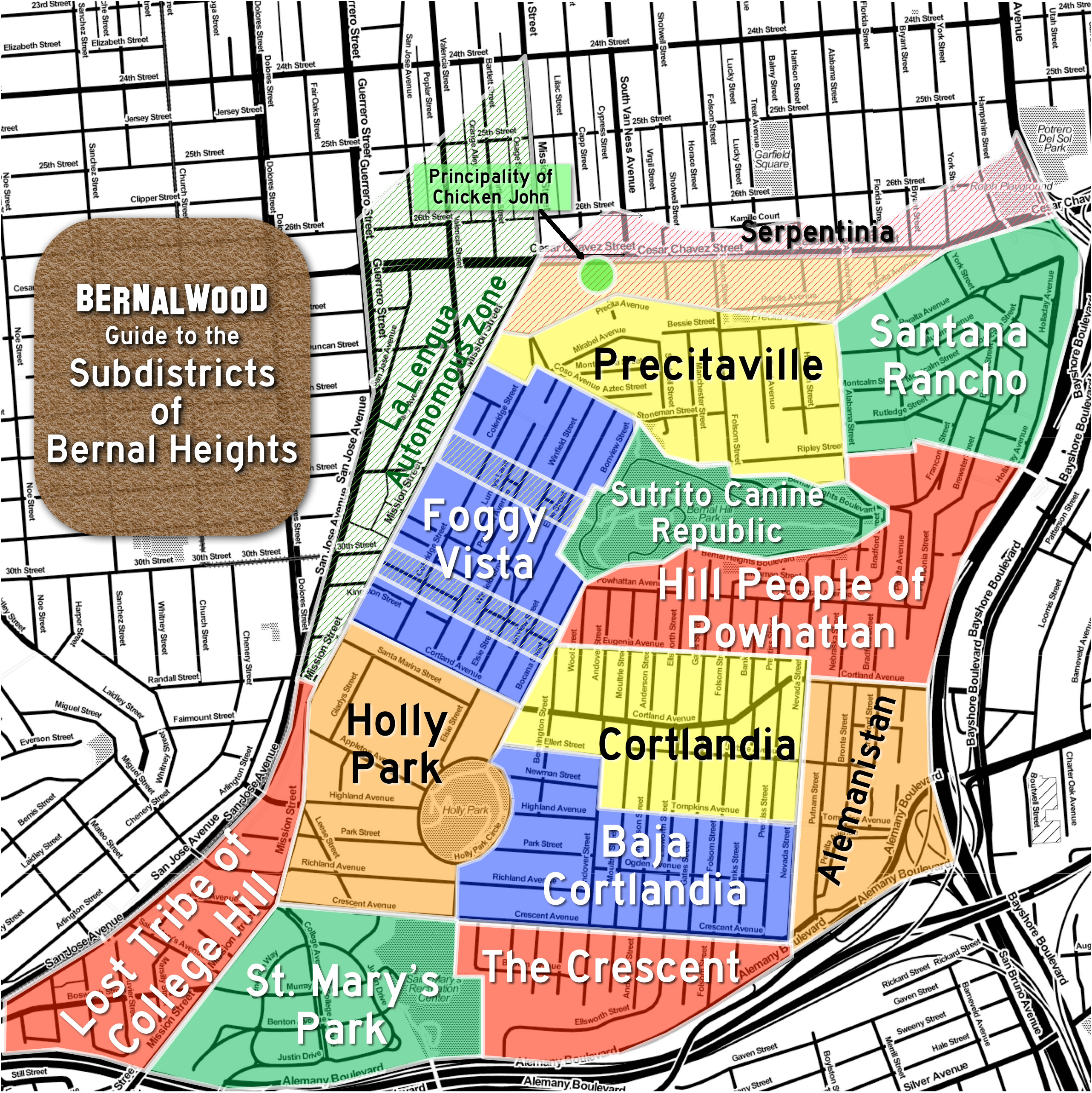
As you no doubt recall, Bernalwood’s 2014 Official Guide to the Subdistricts of Bernal Heights (shown above) was created to map the cultural and topographical geography of our neighborhood in a way that’s both tongue-in-cheek and also kind of somehow vaguely true. What you may not recall, however, is that the Official Subdistricts were specifically created as a playful response to a realtor who had attempted to create her own (less homegrown) sub-map of Bernal Heights.

Well, now that concept has come full-circle.

Neighbors Michael Minson and Danielle Lazier live in Bernal Heights, and they work as realtors. So when Neighbors Michael and Danielle approached Bernalwood seeking permission to use Bernalwood’s Official Subdistrict Map as a framework to analyze 2014 Bernal Heights real estate trends, we had to say yes. Because they are certified Bernalese. Because data. Because economics. Because morbid curiosity.

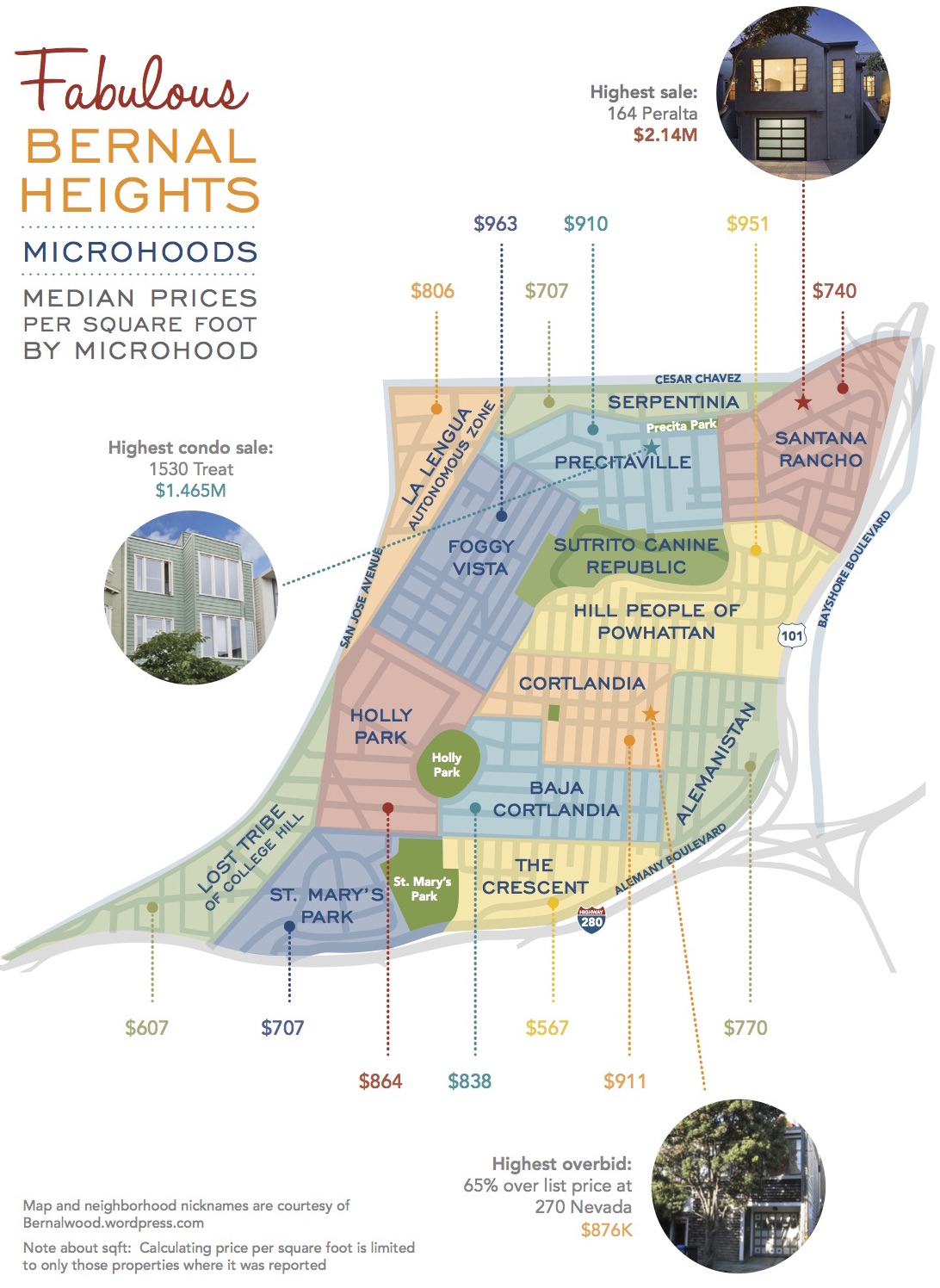
And what are the results? Well, when Neighbors Michael and Danielle mapped 2014 residential sales against the Official Microhoods of Bernal Heights, they got a year-in-review infographic that looks like this:

2014marketmicrohoods

They also offer this executive summary:

2014 was another banner year of double digit appreciation and record high prices for Bernal Heights. The median increase in sale price for single family houses in Bernal increased 21% from 2014 over 2013.

This followed a 23% median increase from the year prior.
The median sales price for a house was $1.16M this year.

Your intrepid real estate agents and data junkies analyzed the Bernal market using the infamous Bernalwood Microhood map as a way to further understand the market. Microhood names and designations are courtesy of our friends at Bernalwood.

Click here for the full Bernal Heights 2014 Market Recap Report. For the hardcore, you can also check out our raw data set.

Outlook–The view from the hill
> Bernal market is very strong–sellers remain in a great position
> As more inventory comes on market, prices are expecting to stabilize
> Expect $900+/sq. ft. or more to become the new median PPSF
> List prices will increase but overbidding will remain prevalent

Bernal Insights Overall – What did we see?
> Market is still very strong but may be cooling ever so slightly (21% increase in median price vs. 23% last year)
> Less inventory is keeping house prices high–10% fewer houses traded; median price is at an all-time high of $1.16M
> An increase in condo supply in 2014 may be the cause for the relatively more modest 10% median price appreciation in Bernal’s condo market
> Demand is still very high– 83% of houses and 73% of condos sold over asking, with an average of 18% and 11% over list price, respectively
> Median price per square foot for houses is $811/sq. ft., condos is $786/sq. ft.
> Overbidding is the norm: 83% of houses sold over the list price, at an average of 18% over. 73% of condos sold over asking, at an average of 11% over.

Real Estate Graphic: via MichaelMinson.com

Neighbor Meets Uber Driver Who Lives in Bernal Heights, Worries About Rent

Bernal Hill

Neighbor Jen lives in the La Lengua Autonomous Zone, and she shares this story about how she recently met another neighbor who drives for Uber to make ends meet:

The Uber driver who picked me up today turned out to be my neighbor. He lives literally 3 doors down from me on Mission and has lived there for nearly 35 years. I’d never met him before today, but he told me he pays $900 for a 3-bedroom apartment thanks to rent-control. However, the building just next to him sold, so he is nervous he will be pushed out by “Silicon Valley guy” who is buying a lot of properties on Mission St.

I had an amazing ride with him, and got to hear about how he put 3 kids through college (and good schools too) and worked 16-hour days at a bank downtown and now drives an Uber a few hours a day because it isn’t “trabajo duro;” it’s fun for him and he only drives in Bernal/Noe/Mission. Even if he gets a fare that takes him downtown (like I did) he just turns around and heads back to the hood because that’s where he likes to drive.

Who knew Uber, or all companies, would help me meet my neighbor? I’ll be looking for him on the street to say hello, or snag a ride, and am glad to know that there still are *some* rent-controlled units around, especially on a block where every other storefront has turned over in the past year. For context, the people on the floor below me are paying $4300/month for a 1000sqft 3bed 2bath.

Yours in real estate tales,

Neighbor Jen down in La Lengua

Illustration: Bernalwood

Your Autumn 2014 Bernal Heights Real Estate Summary: Historically Bonkers, with a Chance of Maybe Somewhat Less Bonkers

downingnov20142

Let’s review some fresh-squeezed real estate data, shall we? We begin with a summary of recent Bernal Heights home sales, compiled by Downing & Company:

October proved to be the busiest month of 2014 (so far) for home sales in Bernal Heights. Last month 20 homes traded hands, which was a spike compared to most months, where the number of transactions often register in the low to mid teens.

With cheap debt available (mortgage interest rates are hovering around 4%) home prices remain elevated. During October the average price in Bernal Heights clocked in at a $1,251,550 relatively close to the record high recorded in July at $1.3 million.

The market remains hot, yielding very quick transactions. The homes that sold last month in Bernal Heights were on the market for an average of only 20 days before going under contract.

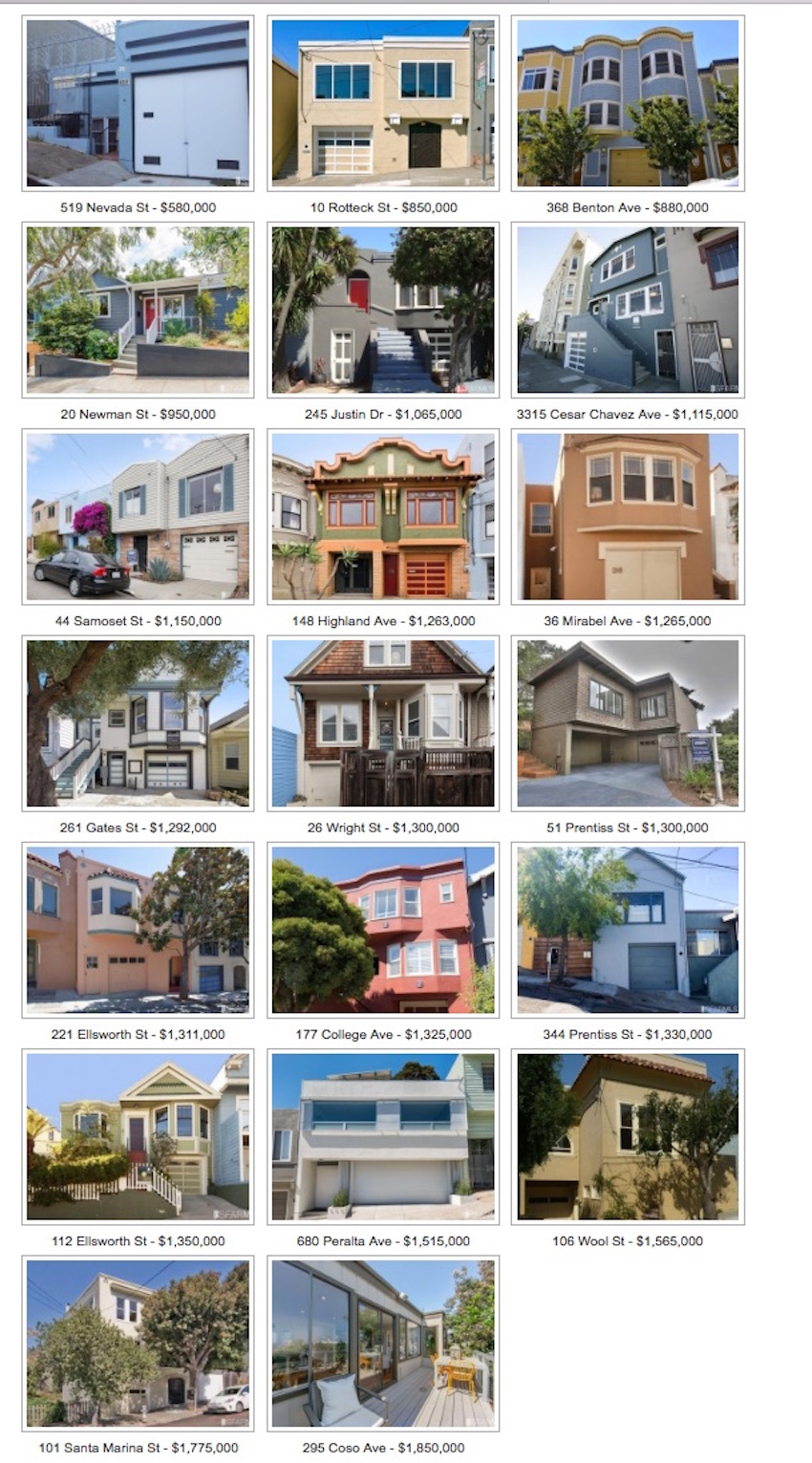
Visit the Downing website for more smutty detail on each of the homes in the stylish October 2014 Bernal Sales Mix mosaic, shown above.

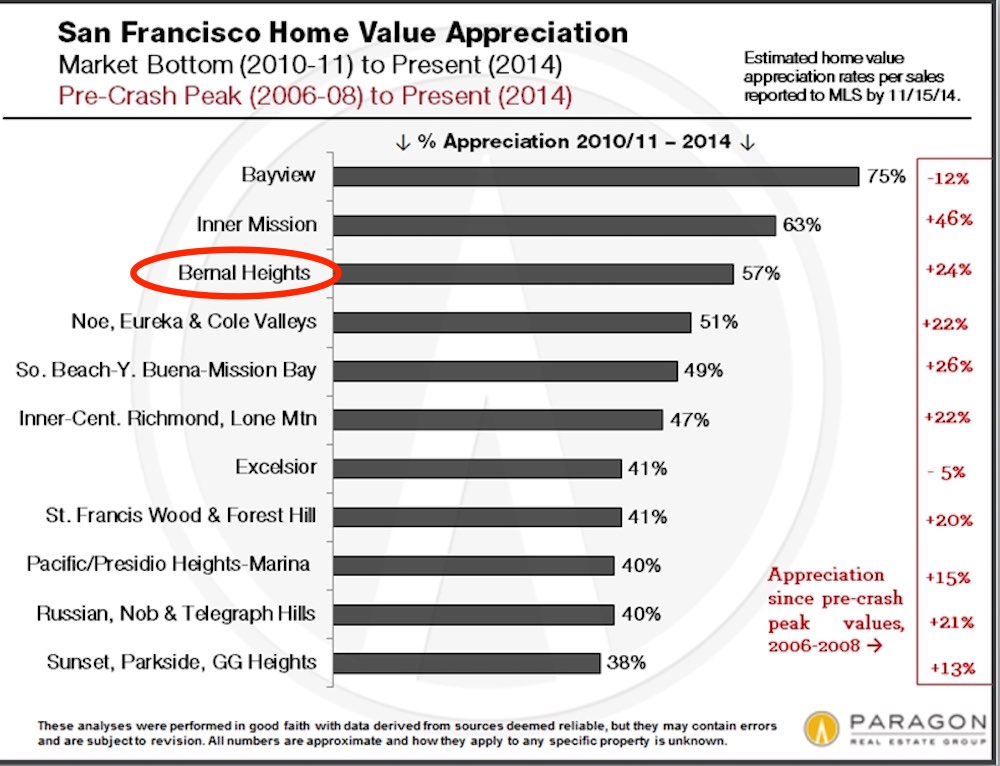
Meanwhile, the number-crunchers at Paragon have been thinking about how sparkly Bernal Heights looks right now, in the context of the overall San Francisco residential market. Paragon’s exceptionally smutty San Francisco Home Price Appreciation report reveals that Bernal has experienced the City’s third-highest rate of home appreciation since the crash, up 24% since its previous 2008 peak:

Appreciation-Percentages_by-Neighborhood

Paragon’s analysis:

Bernal Heights: Up 57% since market bottom; up 24% from its previous market peak in 2007. Bernal Heights has become one of the most popular, more affordable, go-to neighborhoods for house buyers who like the neighborhood ambiance of the general Noe Valley area, but were priced out there by its rocketing prices. Bernal Heights’ houses – with a median price about 45% lower than Noe Valley’s – have looked likeextremely good values in comparison. Buyer competition for new listings became particularly fierce in the past year or so.

That quest for the  “ambiance of Noe Valley” thing seems rather suspect, but your motivations may vary.

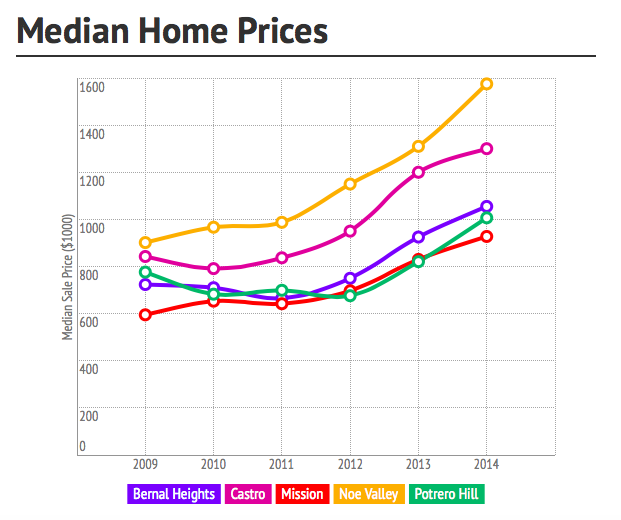
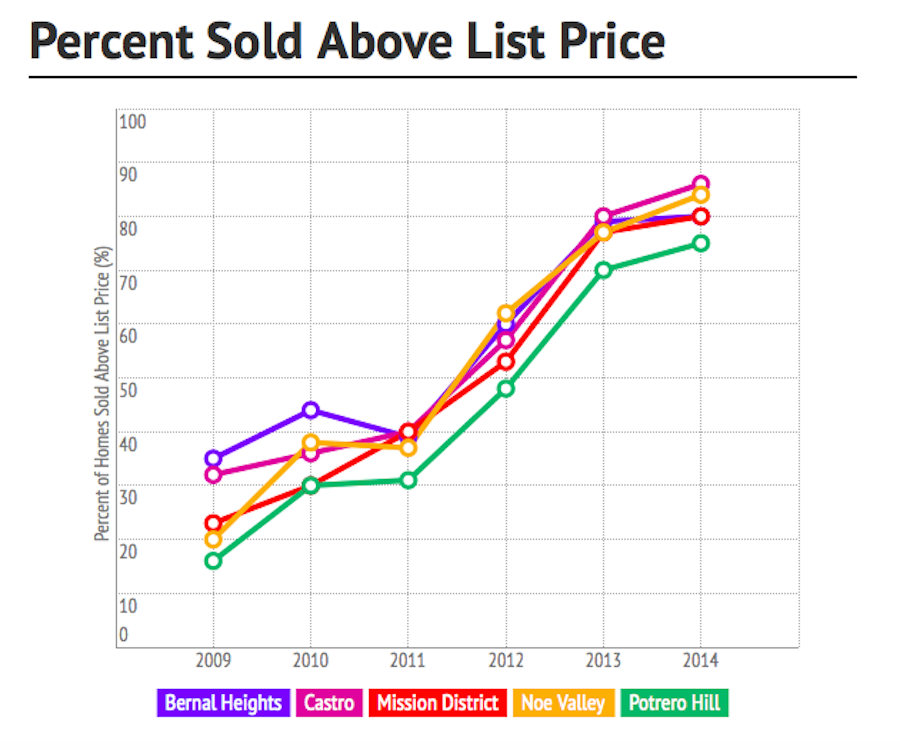
Our bloggy journo-friends at Mission Local pulled together some data from Redfin that puts Bernal real estate in neighborly context. Overall, Bernal has moved in line with overall trends, though we do appear to have gained a little bit of mojo relative to Potrero Hill:

Screen Shot 2014-12-01 at 10.53.18 PM

Screen Shot 2014-12-01 at 10.53.53 PM

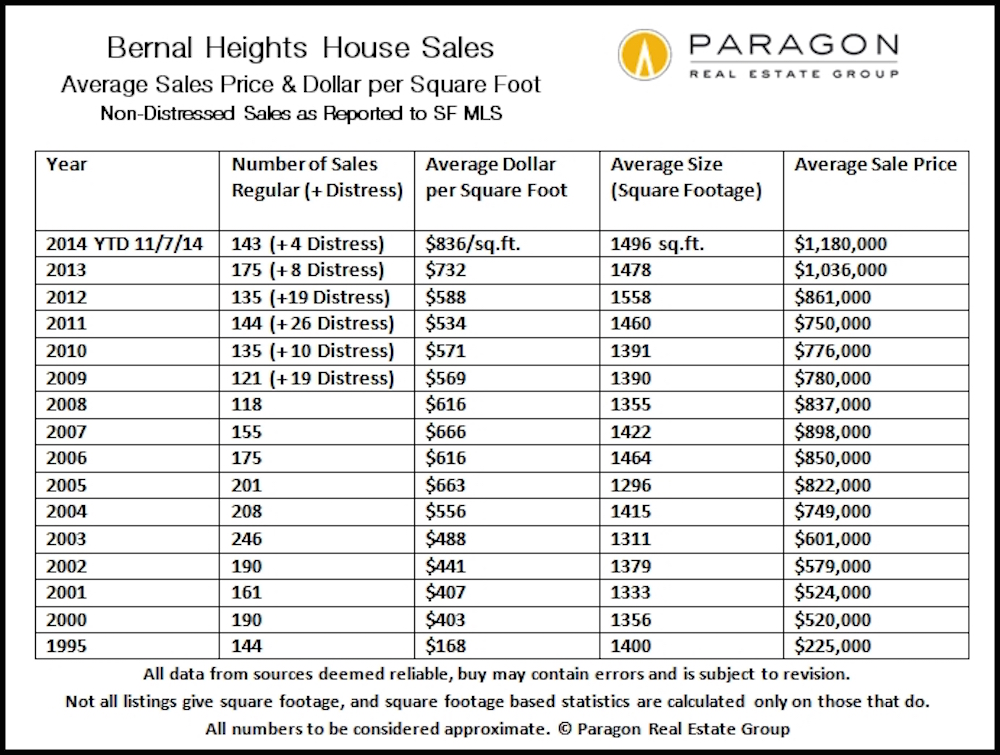
In another recent Paragon report, we spotted this longer-term snapshot of contemporary Bernal Heights real estate history:

Bernal_Non-Dist_SFD_Avgs_Numbers

Though no visualization was provided, some of the budding data scientists among us may notice a rather pronounced up-and-to-the-right trend in the historical data.

Yesterday, however, the SF Chronicle reported that things may be settling down somewhat. Maybe:

Listen up, beleaguered buyers. According to Paragon Real Estate, rationality may be returning to the San Francisco property market. “The San Francisco market definitely cooled after the overheated feeding frenzy of the first half of the year,” according to the real-estate firm’s November report. “The competition between buyers for new listings declined to more rational levels: Homes that might have received 5 to 10 offers earlier in the year received 1 or 2 or 3.”

While getting three offers is still something sellers in most other marketplaces can only dream of, in San Francisco it could be a sign that pricing has finally reached its peak.

IMAGE: Top. October 2014 Bernal homes sold, via Downing & Company

Midcentury Bernal Shoebox House Flips After 21st Century Makeover

boxthennow

Somewhere relatively high up on Bernalwood’s List of Things We Really Want to Cover Someday is an item called “What’s Up with Those Bernal Shoebox Houses?”

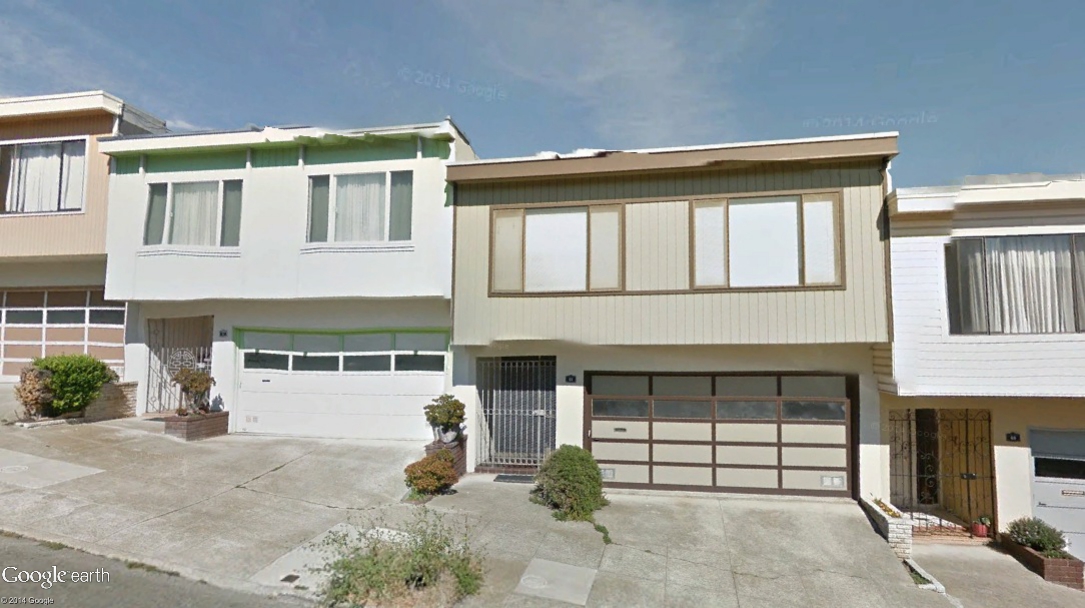
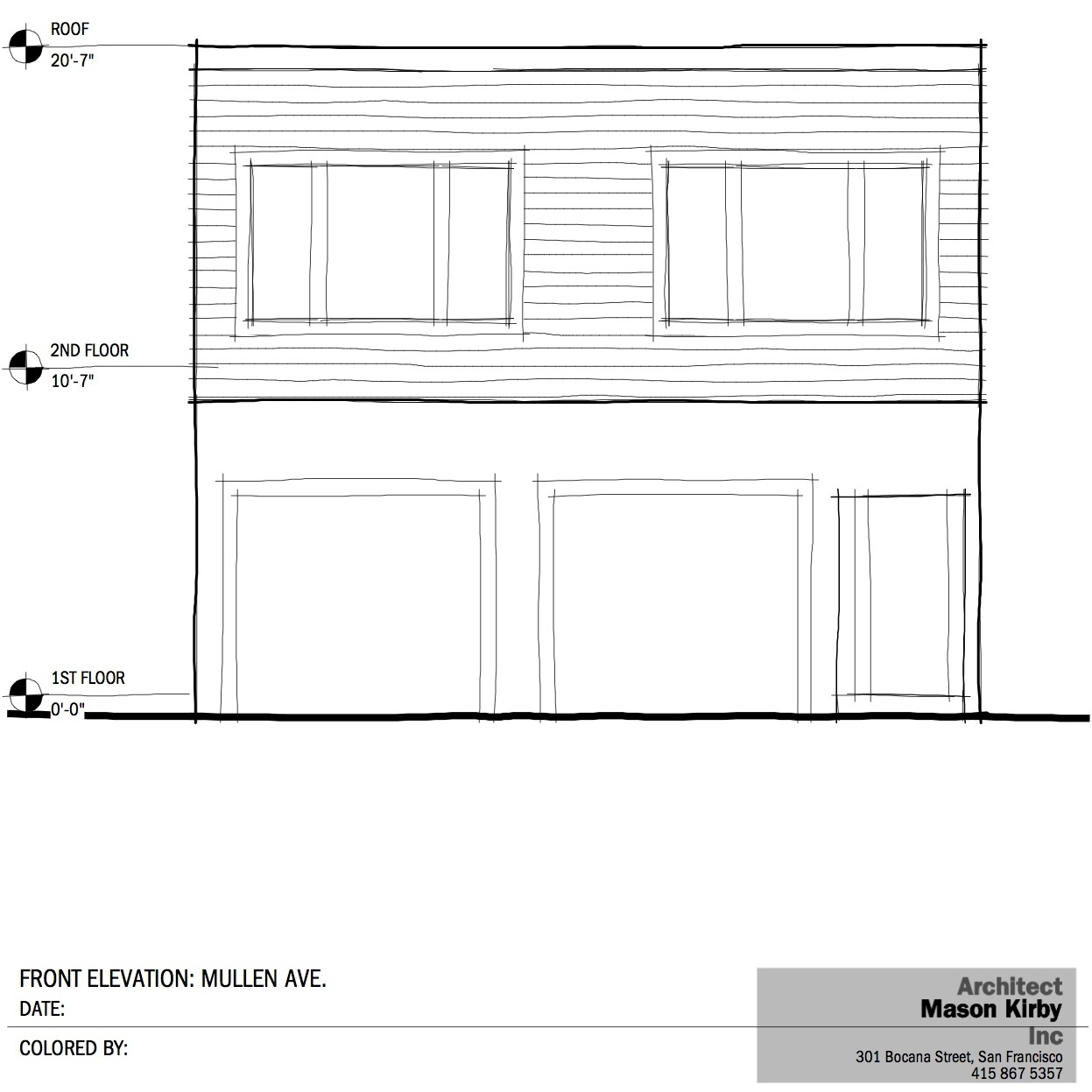
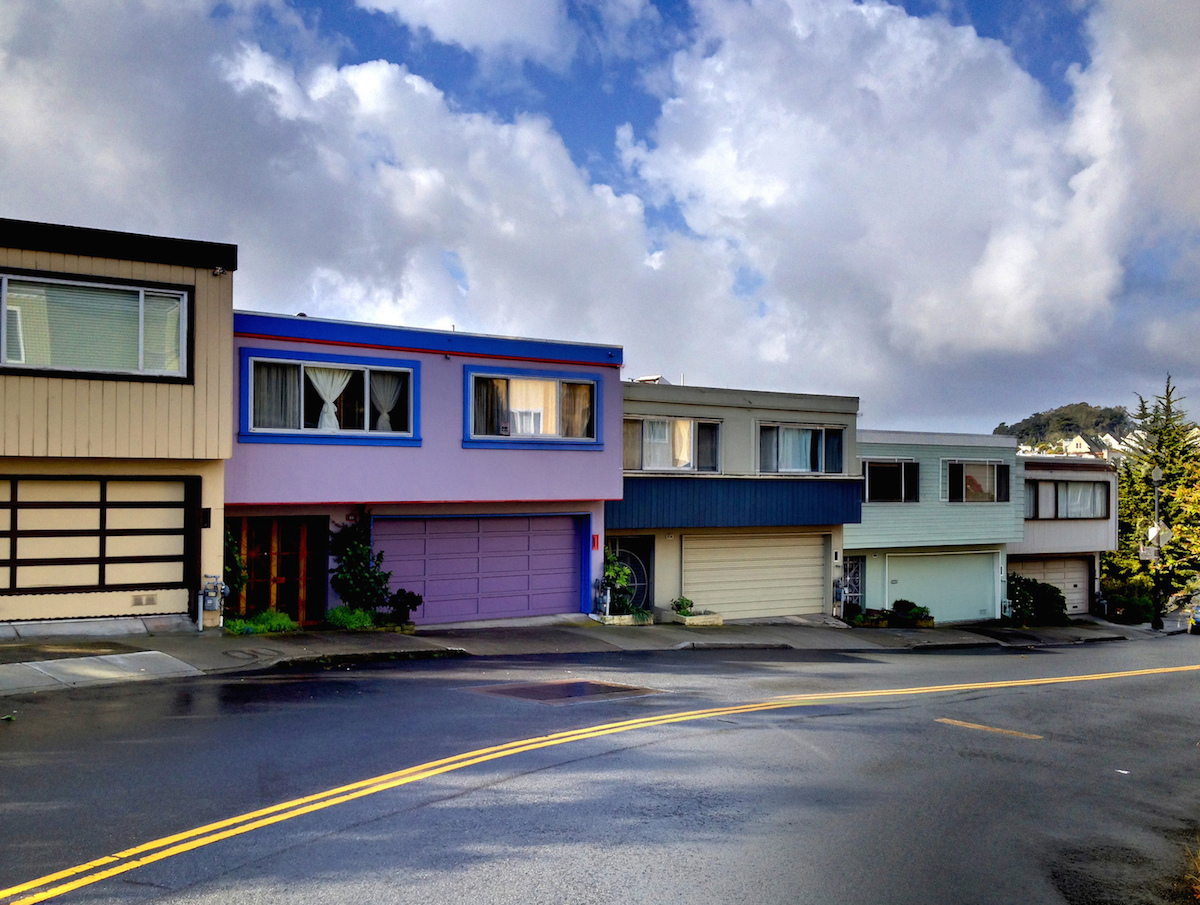
You know the type, because it is very common here. The Bernal Shoebox is what I call those vaguely modern inflill homes that were built all over Bernal Heights in the 1950s and 1960s. Rectangular shapes. Double-wide garage door on the bottom. Residential space above. Standardized construction. Raise and Repeat… all over Bernal Heights (and San Francisco’s southern neighborhoods) during those heady postwar years.

For example, here’s tony Nebraska Street, just north of Cortland, as seen through Google Earth Street View:

nebraskamodgmaps

As a genre, Bernal Shoebox houses are now found in various states of repair, upkeep, originality, adaptation, and/or disrepair. There’s even one in the Bernal Heights Architectural Coloring Book:

BernalArch.ColoringBook2014

Some Bernal Shoeboxes look rather Midcentury Chic…

bernalmod

…which is why clever graphic artists have even created new posters like this:

Painted-Ladies-2-01

Space Age grooviness aside, these types of houses have some notable advantages as a residential resource. They’re plentiful, they are structurally uncomplicated, they usually offer a generous amount of interior space, and they’re relatively easy to reconfigure and remodel to accommodate our fabulous 21st century lifestyles.

So someday, Bernalwood hopes to tell you more about this particular building type. Where did the basic design come from? Who did it? How were these homes built? And by whom? And for how much? And who bought them? That kind of stuff. Stay tuned. (Have insights on the topic? Share them in the comments or via email)

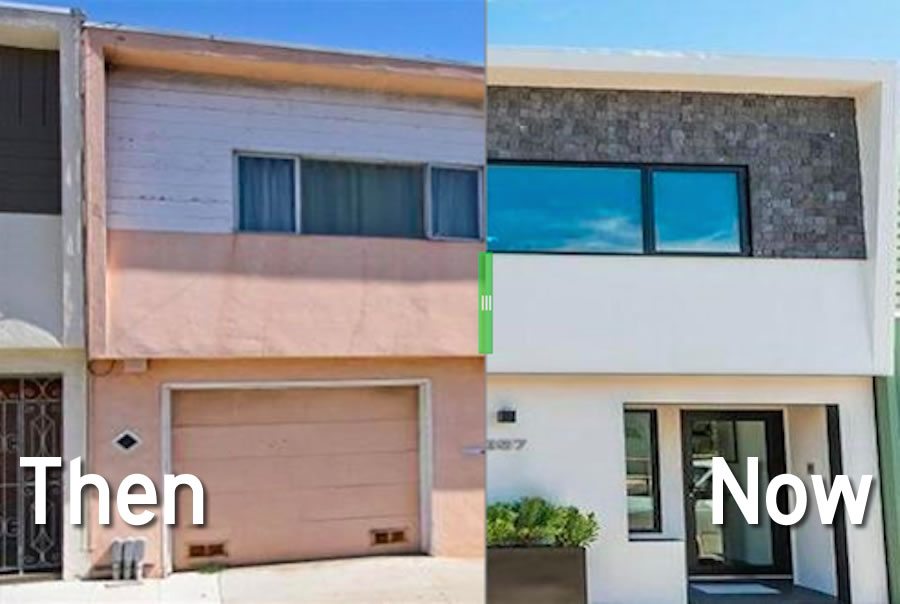
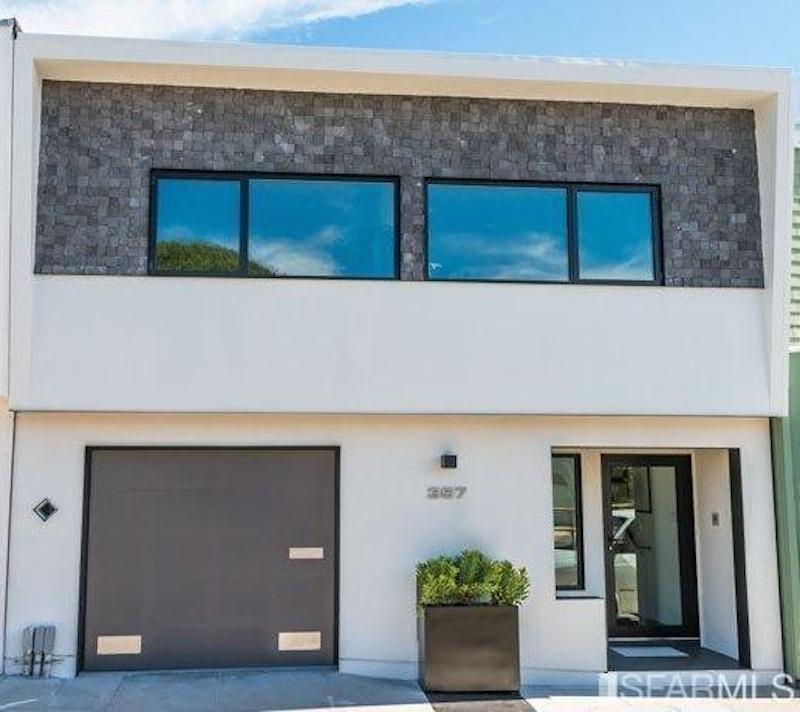
In the meantime, our cyberpals at the CurbedSF real estate blog recently found this example of a Bernal Shoebox for sale at 357 Franconia after a full makeover:

357franconia2

357franconia4

CurbedSF writes:

Back in March, flippers purchased a worn-out Bernal fixer for $770K and set about transforming it into a super-slick contemporary box. Out front, the forlorn white siding was switched out for a new stucco facade with lava stone cladding and black metal trim. Inside, the kitchen is all new, an unwarranted third bedroom seems to have gone legit, and a second bath was added, along with some welcome skylights. At $1.395M, the new ask is a more than 80 percent boost over the sale price eight months ago. Looks like the sellers are getting their money’s worth, too—the property went into contract after only five days on the market.

OK, so, that’s obviously a rather dizzyng bump in price. And yes, it’s obviously a reflection of our wacky-doodle, supply-constrained real estate market. Blah blah blah.

Yet it’s also, likely, a reflection of what will become of more and more Bernal Shoeboxes, and how many of them will evolve in the fabric of Bernal’s streetscape during decades to come. Shall we call them DwellBoxes?

PHOTOS: 357 Franconia via Redfin and CurbedSF. Bernal Shoeboxes by Telstar Logistics

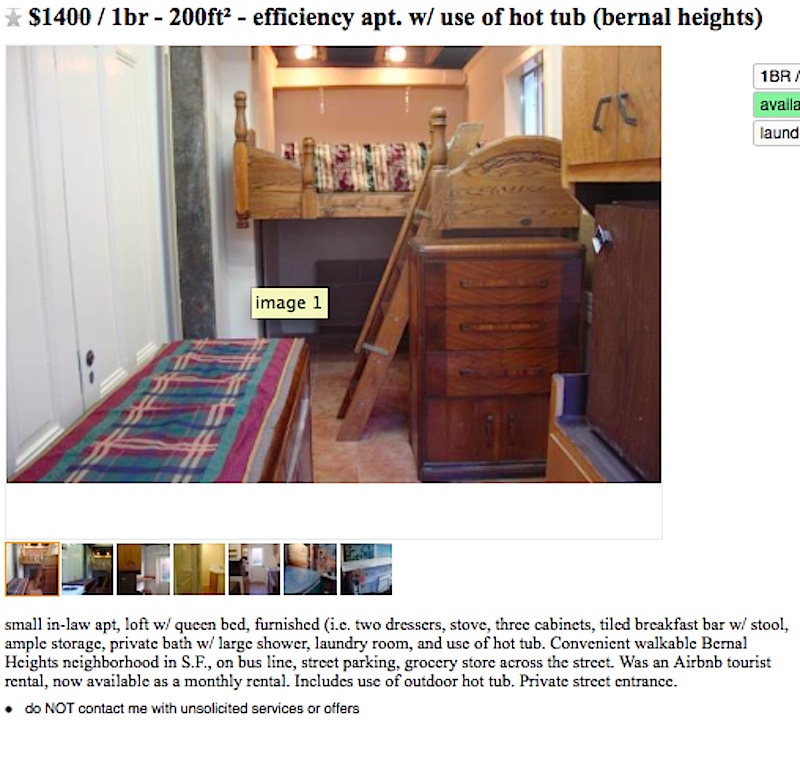
Tiny, 200 sq. ft. Apartment in Bernal Heights Asks $1400 a Month (with Bonus Hot Tub Access)

efficiencyview

Neighbor Ashley is morbidly entertained by a new Craigslist rental listing in Bernal Heights:

I wish there were a good portmanteau for when something is very fun and very sad at the same time. If there were, I would use it to describe this posting.

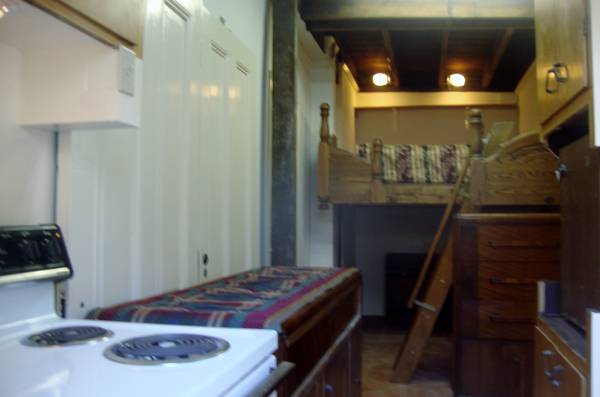
Yes, this is a listing for somebody’s 200 square-foot, half-finished utility room, with a stove and a bed for $1400 a month.

Thank *God* for the bit about the hot tub. That part pushes it into the comedic zone for me.

For the benefit of future historians, here’s a snapshot of the full post:

efficiencyrental

Call Me a YIMFY: New 160-Unit Housing Development Proposed for Full Block of Cesar Chavez at South Van Ness

NewHousingHere2

NOTE: This post has been updated to reflect additional detail about the properties involved (and not involved) in the Lennar housing proposal.

At a time of remarkable economic prosperity and intense housing scarcity, there comes a moment when even the most ardent urbanist must confront their own deepest and most self-interested feelings about change, development, and the clash of old vs. new.

For your Bernalwood editor, that moment would seem to be just about now.

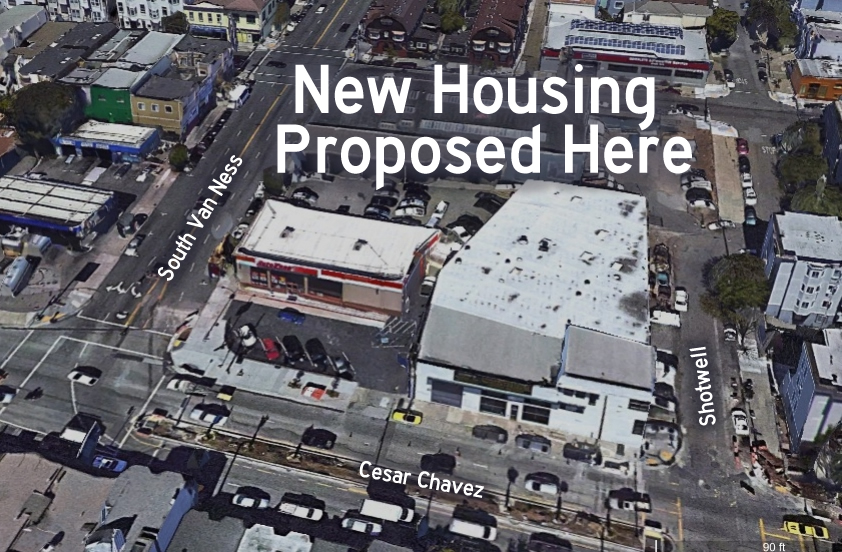
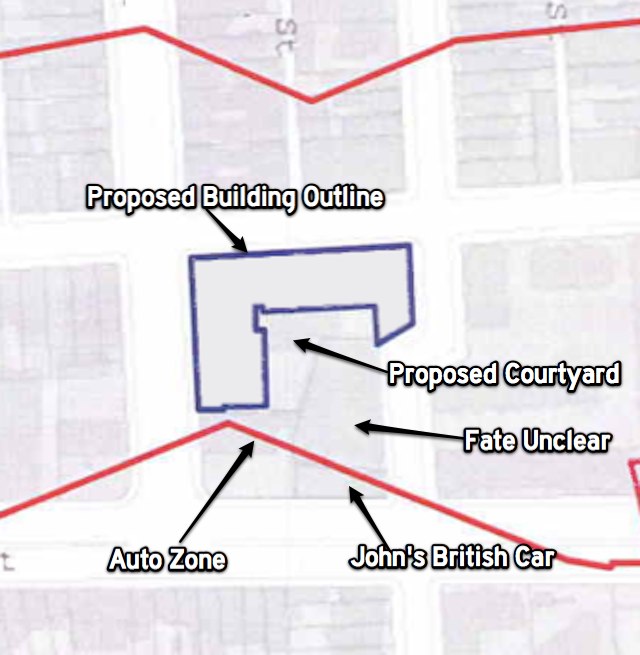
News has reached us that the gigantically impersonal Lennar Corporation has announced plans to develop an most of entire block of Cesar Chavez Boulevard, between South Van Ness, Shotwell, and 26th Street. Under the plan, the site will become the location for 160 units of new housing in a very large new residential development.

This block, which was once home to the former Lesher-Muirhead Oldsmobile dealership, is now occupied McMillan Electric, a few smog inspection shop, a private garage,  a rather glamorous Auto Zone, and John’s ridiculously charming British car repair businesses (though not all of these would be demolished; see update below):

John's Jaguar

Closer to home, this vast new housing complex will stand right between me and the beloved view of downtown San Francisco that Bernalwood’s Cub Reporter now enjoys from her bedroom window.

Here’s our current perspective on the proposed development site, as seen from my home:

lennarview2x

SocketSite broke the news late last week:

Lennar Urban has filed a proposal to raze the McMillan Electric building at 1515 South Van Ness Avenue, between 26th and Cesar Chavez, with plans to construct a 160-unit apartment building on the Inner Mission site which stretches to Shotwell.

As proposed, the six-story development would rise to a height of 65-feet along South Van Ness, stepping down along 26th Street to five stories and a height of 55-feet along Shotwell.  And twelve (12) percent of the 160 units would be designated as below market rate.

Aside from a proposed 1,740 square foot commercial space on the corner of South Van Ness and 26th Street, the rest of the development’s ground floor would consist of either apartments or programming for the project, including a leasing office, an amenities room for the residents and a private 7,803 square-foot courtyard.

An underground garage would provide parking for 90 cars and the average size of an apartment as designed is around 890 square feet.

Well, if this is the moment when my values and interests are tested, then sign me up me a YIMFY‚ as in Yes In My Front Yard.

I hope the new building doesn’t gobble up all of our view. But if it does, well… so it goes. That view wasn’t mine in the first place, we desperately need more housing supply, and this is an ideal location for it.

There are no proposed designs yet, but you can read the Preliminary Project Assessment (PPA) on file with with the Planning Department right here to get the details of the proposal.

Will there be quibbles? Things to dislike? Details to revise and improve? Of course. But overall, my personal sentiment is… BUILD IT!!

Neighbor Rachel wrote to Bernalwood about this proposal, and she has more specific concerns:

I’m not opposed in principle to development and this lot is pretty disgusting right now. I just think that developers who are proposing a project of this size with huge profit potential, which will take up scarce parking spaces, block views (or the sky in my case), cause noise and disruption for years, spew toxic chemicals into the atmosphere (maybe), and otherwise tax the neighborhood resources and patience, need to include lots of give-backs in their plans that will help the neighborhood.

These give-backs must go beyond the bare minimum. The commercial space should serve the hood by providing needed retail outlets and space for local businesses. The street-scaping should beautify the whole area, not just the sidewalks adjacent to the building. The set-backs should be appropriate for the neighborhood. A good solution for parking for all of the new residents should be found that doesn’t cause more strain on the existing neighbors. And more. If we just let the project go ahead without making any noise, then the developers will give no more than they are required to give by law, if that. They are counting on the neighborhood remaining ignorant and apathetic.

No doubt, there will be much to discuss about this in the weeks and months ahead. Still, until further notice, you may count me in the YIMFY camp.

UPDATE AND CLARIFICATION: It seems that the proposed development may not occupy the entire block after all. Bernalwood received this note from Dan Simpson, the manager at John’s British Car Specialist:

I read your blog post about the proposed apartment complex to be constructed at the McMillan Electric building. I hope you will be happy to hear, as it stands, the John’s British Car Specialist (formerly John’s Jaguar Service) building shall remain at the face of Cesar Chavez and Shotwell St. The planned development would knock down the 3 units behind our building. These units have already been sold to the city, our building remains with the original owner. So we hope to stay here as long as we can!

To further clarify: The AutoZone parcel is not part of the proposed development, nor is the building that contains John’s British Car Specialist. This latter detail is confusing, because while the big building that contains John’s looks continuous, it is actually two structurally separate buildings united by a common roof. So while John’s building would stay, the garages north of it would become part of the Lennar development.

And lo, hidden in plain sight at the very end of the PPA document, Dan steered us toward this diagram of the proposed building configuration (shown in blue outline). The proposed courtyard would sit in the southeast corner of the site, along Shotwell right behind John’s British Car Specialist:

SVNsiteplan2

Still unclear, however, is the question of whether the City plans to do a separate bel0w-market-rate development on the site of the garage spaces behind John’s British Car, or if that land is somehow tied up with the Lennar proposal.

IMAGES: Top, Google Earth Pro. Below, view from the bedroom, by Telstar Logistics 

Your Bonkers Bernal Heights Real Estate Report for Early Autumn 2014

benal.july14realestate

Let’s check in on the state of our residential real estate market, shall we?

The data-trackers at Downing and Company did one of their occasional Bernal Heights home sales roundups for July 2014, and this is what they found:

Home prices in Bernal Heights continued to soar during July. Last month 19 homes traded hands at an average price of $1,321,805 setting a new record high for this neighborhood.

Prices were up across the board including rehab properties. Fixer uppers in Bernal Heights are now selling in the $800K to $900K price range (see 43 Bache Ave, 44 Azterc St, 671 Peralta Ave, and 45 Richland Ave). Previously rehab properties were trading between $600K to $750K. Post rehab developers are now looking to sell north of $1.5 million in Bernal Heights.

Sellers clearly remain in control of the market as evidenced by the pace of sales. Buyers put on their running shoes, moved quickly, and scooped up homes in an average of only 26 days last month.

Woa. The image above illustrates those July 2014 sales; if you’d like a more detailed breakdown, visit the Downing and Company website.

Over at Bernal neighbor (and realtor) Michael Minson’s blog, Ann Cervantes summarizes the year so far:

San Francisco’s Bernal Heights neighborhood experienced a 19.7% increase in estimated home value from August 2013 to August 2014.

The median estimated home value in Bernal Heights was $1.06M. The median home value in San Francisco was $927K.

Double woa.

Meanwhile, two Bernal properties have been attracting some attention in the last few days.  On Friday CurbedSF highlighted a “quirky Bernal bungalow” on Highland with a backyard pool that just hit that market with a $990K asking price:

highlandpool

Hiding behind an ugly green facade in Bernal Heights is a Craftsman masterpiece filled with period details and surprising touches. And in the backyard is an even bigger surprise: a heated saltwater pool built by the current owner, a New Zealander who loves to swim. Flowers and greenery surround the pool, which includes four exercise jets and was built in 2008. Inside, the home’s Craftsman details are almost entirely intact, with dark wood everywhere, box beam ceilings, and a brick fireplace.

Tiki lanterns sold separately.

Then, if you picked up a copy of last Sunday’s San Francisco Chronicle, you might have noticed this brand-new home on Elsie on the cover of the real estate section:

152Elsie

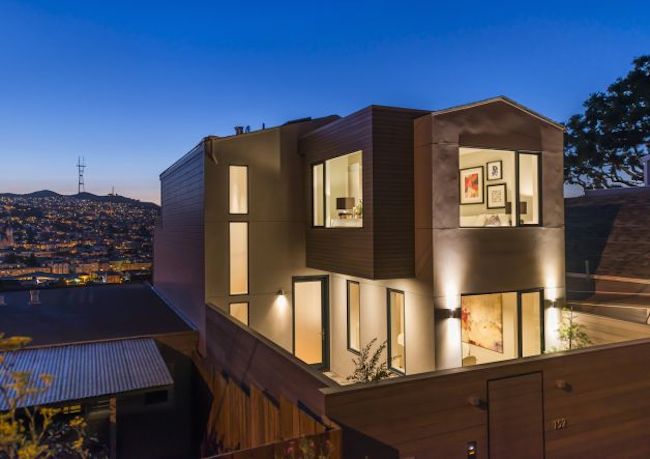
152 Elsie has four levels, 4 bedrooms, 3.5 baths and an asking price of $2.2 million. The Chron gushes:

A staircase made of glass, steel and hardwood connects all four levels, and the ground floor includes a family room with bar area and art niches. Sliding glass doors open to the rear garden, a space with planter boxes and high privacy fences. The lowest level also hosts two bedrooms and bathrooms, as well as the laundry room.

Crowning the home is a master suite with view deck, walk-in closets and a spa-quality bathroom with soaking tub and separate shower. The oblong tub is oriented beneath a window to maximize views of San Francisco’s rolling hills.

Sutro Tower sold separately.