Seriously?! Bernal Child Baffled by Bumbling Sidewalk Blunder

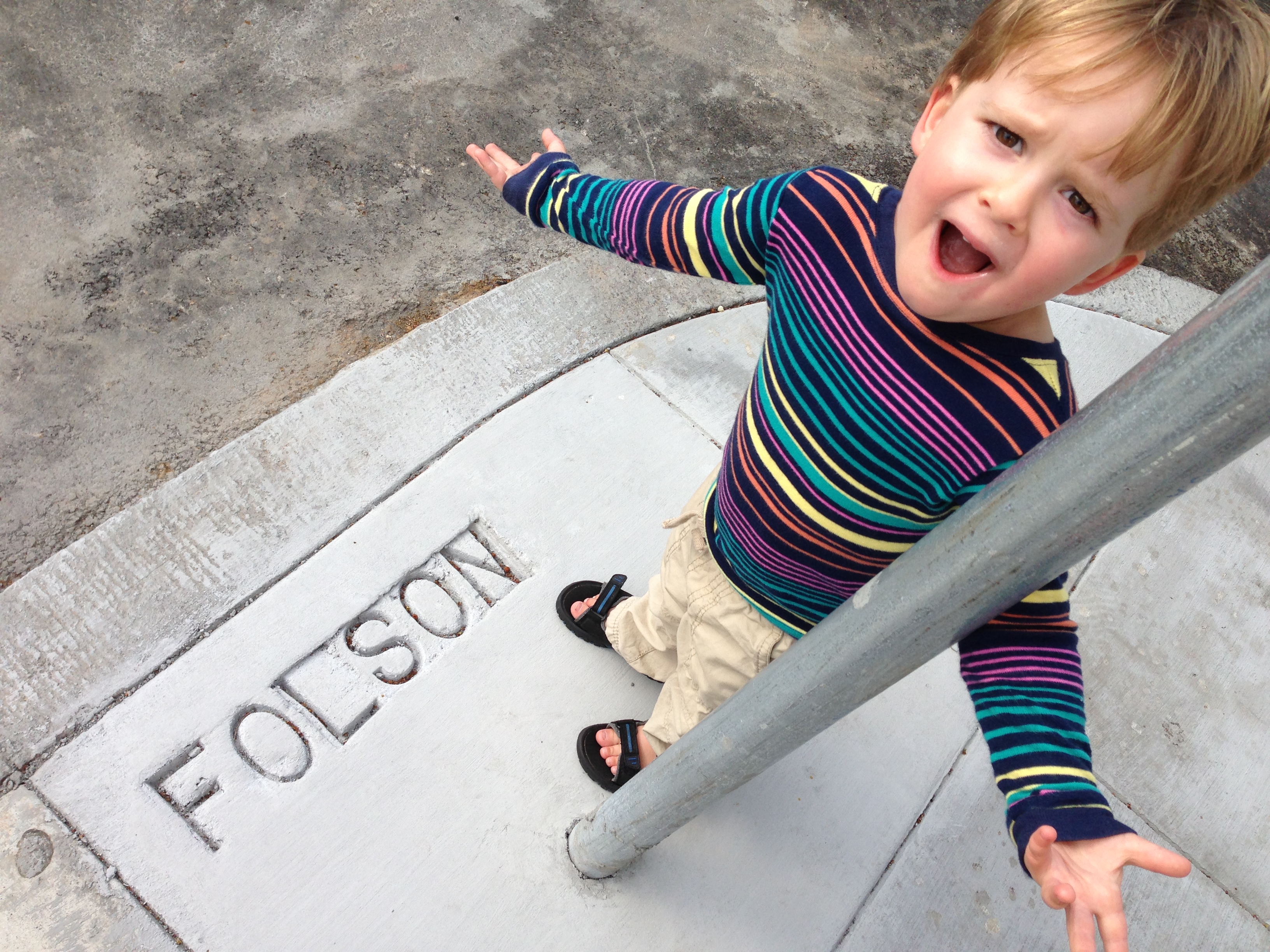
Folsomtypo

Neighbor Rebecca shared this photo of her young son learning a formative lesson about civic incompetence and the perils of not giving a shit about how you get the job done.

Neighbor Rebecca’s only comment about the experience came in the form of a rhetorical question:

Seriously?!

Yes, seriously.

This glaring typo cast in concrete on “Folson” is not at all unique; Urban infrastructuralist Eric Fischer has amassed a darkly entertaining collection of photos documenting similar concrete sidewalk typos all over town.

PHOTO: Neighbor Rebecca

Ye Shall Walk These Bernal Streets, And Know They Are (Still) the Steepest

bradfordsteepsx2

Waaaaaaay back in 2011, Bernalwood posted an item about an independent researcher who had concluded that, despite some “official” lists which claim that the steepest streets in San Francisco are in Nob Hill and Noe Valley, the actual data indicates that four of the City’s eleven steepest streets are right here in Bernal Heights.  As we concluded at the time:

Bernal Heights may not always be the smartest, or the prettiest, or the most popular neighborhood in the world. But we may rest secure in the knowledge that we will always be the steepest.

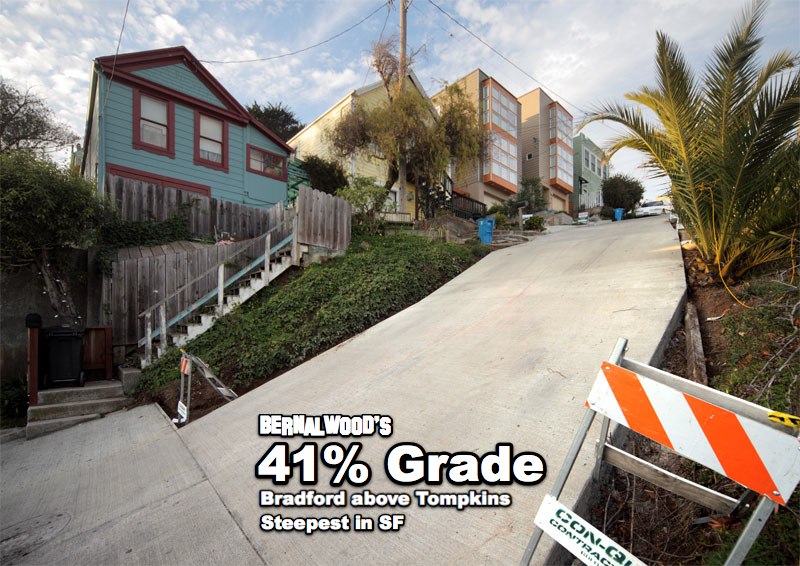
Well, it’s two years later, and now 7×7 Magazine has taken another look at the data to determine which City streets are the steepest. And once again, according to writer David LaBua, the streets of Bernal Heights are the steepest in town, capturing the number 1, 3, 4, and 6 slots:

bernalhillslope

So Bernal’s reign of urban verticality continues. But what’s it like to actually live at the top of Bradford, which is now reaffirmed as the steepest of the steep streets in all of San Francisco? Neighbor Lupe tells it:

As the owner of the last house on Bradford, both my legs and my car brakes can attest to the cliff-like steepness of the street. Most of my friends have “mastered” coming up the hill, and a few have learned to drive up in reverse to simplify getting back down. I marvel at Recology, UPS and FedEx rambling up and down with nary a care. Some of the postmen appear as if they are ready to have a coronary, some are clearly athletically inclined, barely breaking a sweat after reaching the “summit”. Not sure how the Chronicle finds its way here, but the paper sits on my doorstep every weekend, neatly wrapped in its bag. The foot traffic increases on Saturdays and Sundays, and it is easy to see who has not ventured up the hill in the past – the lenghty pauses and wide-eyed look on the faces of these virgins is easy to spot.

IMAGE: Top, Bradford’s 41% grade. Photo by Data Pointed

Bernal Isle Resort: A Modest Proposal for the Future of Bernal Heights

bernalisle

bernalisle.plan

This week, the New York Times reports that scientists believe global warming could cause up to three feet of sea-level rise by the year 2100.

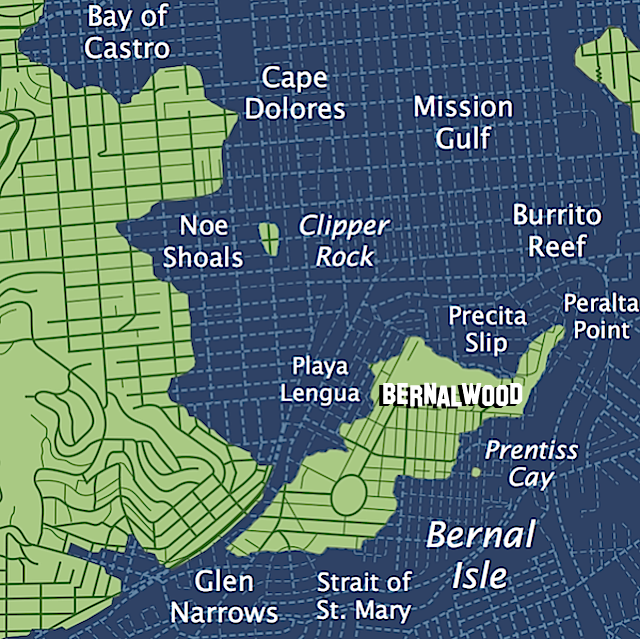
With sea levels rising, we must look forward… many, many, many years forward, to envision a future in which the oceans have risen 200 feet and reclaimed much of San Francisco — except for Bernal Heights, which will enjoy many natural advantages as a post-urban island with wonderful beachfront real estate.

It may take centuries for Bernal to attain its island destiny. Yet whenever that future arrives, we, the residents of Bernal Heights, should ourselves be the architects and authors of our shared destiny. Which is why — aided by detailed maps of Bernal Isle created by La Lengua rebel leader Burrito Justice — Bernalwood has developed some conceptual mockups to demonstrate how we might leverage Bernal’s prime beachfront location overlooking Mission Gulf… for the benefit of posterity.

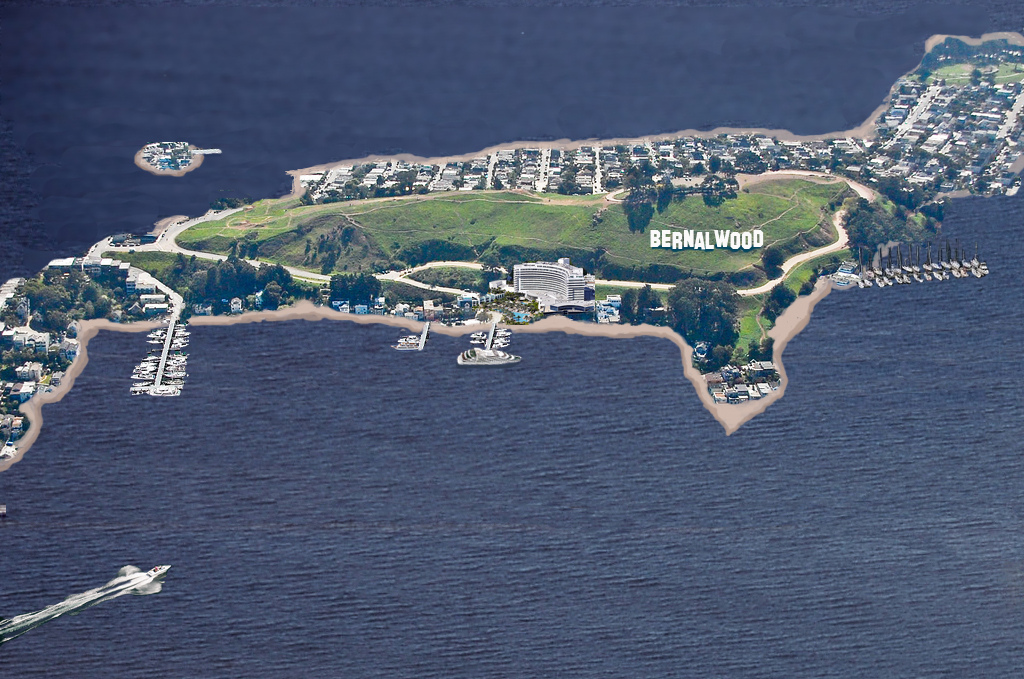
As you can see, the central element of our proposal is the development of the luxurious Bernalbleu Hotel and Resort near the site of present-day Folsom and Ripley Streets:

Bernalbleu3

The northeast end of Bernal Isle will be the ideal location for a premium residential enclave, with convenient access to watercraft and prime views of San Francisco’s majestic Submerged Skyline. With its own on-demand ferry service, Prentiss Island just off Bernal’s South Shore could be an exclusive haven for a select group of high-value homeowners:AlabamaYC2-1

On the west side, the gated community of Hipster Vista will serve a younger clientele that prefers a more active lifestyle. The Cortlandia Shopping District will be a thriving retail corridor, with merchants specializing in the sale of fudge candies and resusable hemp-fiber shopping bags decorated in the local style. Localsonlyville will be where many year-round residents live, and it shall nurture the spiritual core of Bernal identity.BernalIsleWest

Of course, Bernalwood understands that change is difficult.

We also understand that dramatic change is even more difficult, especially when it comes in the form of 200′ sea level rise and the redevelopment of Bernal Heights as a Catalina-style island resort destination.

Yet change is coming — whether we like it or not. That’s why we propose to look change right in the eye, pour it a stiff drink, and give it a big, wet minty-fresh kiss. Let’s begin to prepare for tomorrow… today! All ideas are welcome.

A Brief History of How Cesar Chavez/Army Street Became So Damn Awful in the First Place

chavez2008

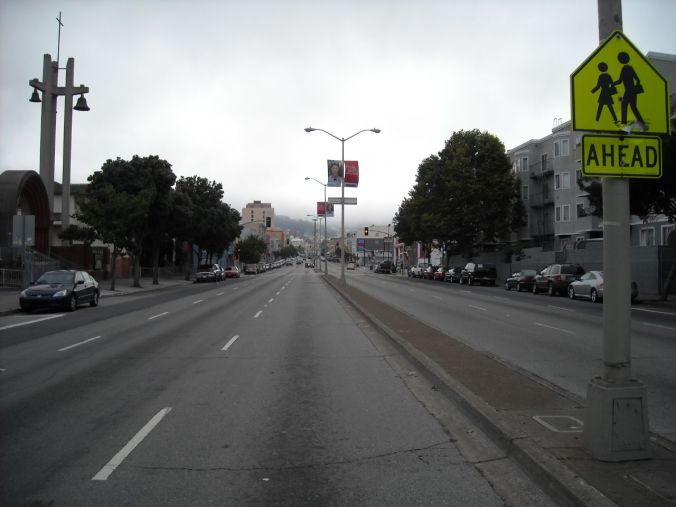
The photo above (Thanks Mark!) shows a view of Cesar Chavez Boulevard looking west from Folsom in 2008, a few years before the current/ongoing sewer and streetscape improvement project got underway. As you can see, it is very unlovely.

In the comments to Monday’s item about the removal of the ugly-ass, freeway-style road sign across Cesar Chavez Boulevard, Neighbor Andy was prompted to wonder how Cesar Chavez Boulevard became so awful and so highway-like in the first place.

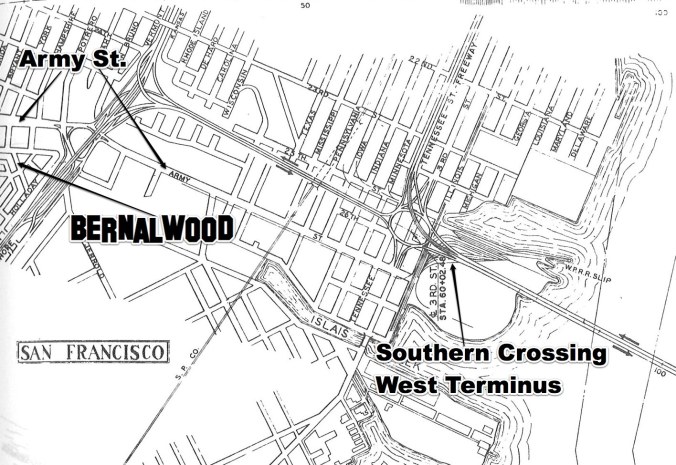
The short explanation is simple: Cesar Chavez — formerly Army Street — WAS designed to be a highway. Sort of. The wide thoroughfare as we now know it was carved out in the 1930s and 1940s, with the intention of using the road as a major east-west route to carry automobile traffic, first to the US101 Bayshore Freeway (which was built in the early 1950s), and eventually to the Southern Crossing, a second transbay bridge that was planned to terminate in the area around Army/Chavez and Third Street.

Wait. A second transbay bridge??? At the foot of Army/Chavez?? WHAT??!!

Follow along as we take a quick survey of Army Street history, give-or take a few years here and there:

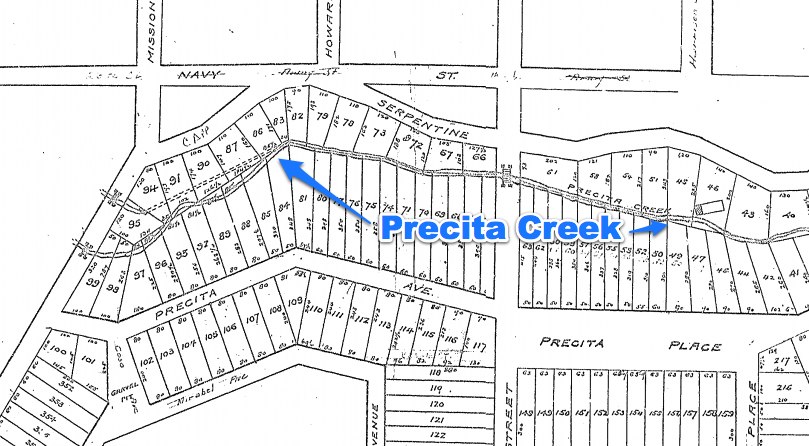
1859: Here, Precita Creek runs unfettered down the present-day Cesar Chavez Boulevard corridor, providing a primary route for water drainage for the eastern slopes of Twin Peaks. It also functions as a sewer. Present-day Precita Avenue shadows the route of the former Precita Creek. Army Street not created yet, but Navy Street ran parallel:

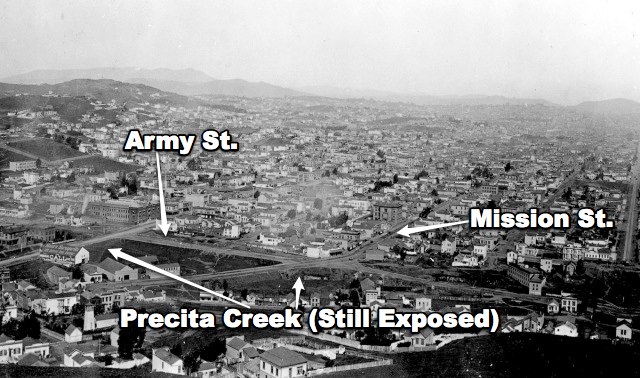
1888: Precita Creek still a creek. Army street is a jankey east-west road that runs alongside it:
mission-army-1888jpgx

Circa 1900: Precita creek channeled underground, Army street built on top

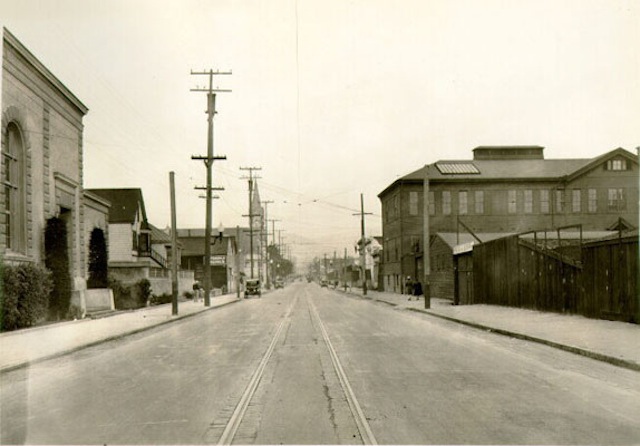
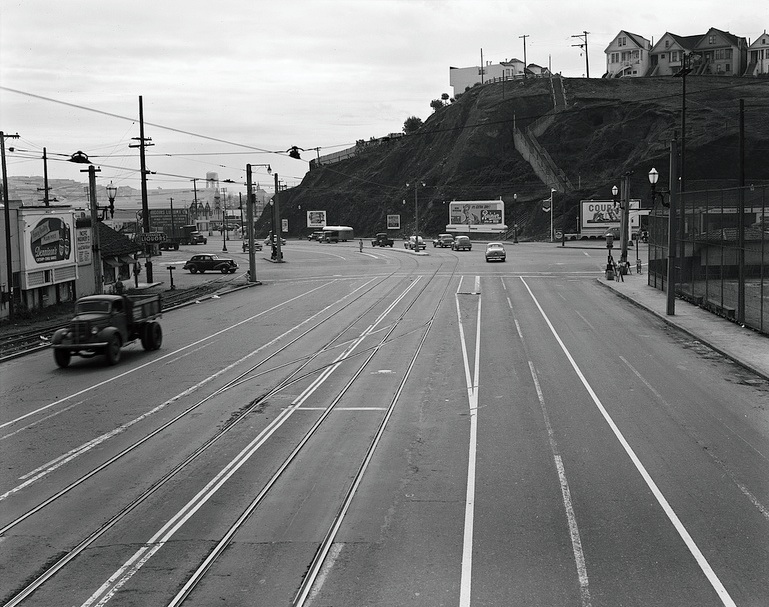
1931: Check out this amazing view of Army Street, looking west from Harrison, when it was a relatively normal San Francisco City Street (with a streetcar line!). That’s Le Conte Elementary School (now, Leonard Flynn) on the left, with the St. Anthony’s church steeple behind it. The church burned in the 1970s.

armyatharrison-1931

1936 and 1937: Bay Bridge and Golden Gate Bridge open to traffic.

Late 1930s: Army Street widened from a normal 4-lane city street to an 8-lane surface throroughfare. This is why many of the houses on the street are so close to the curb, with no front yards. Eminent domain is a bitch.

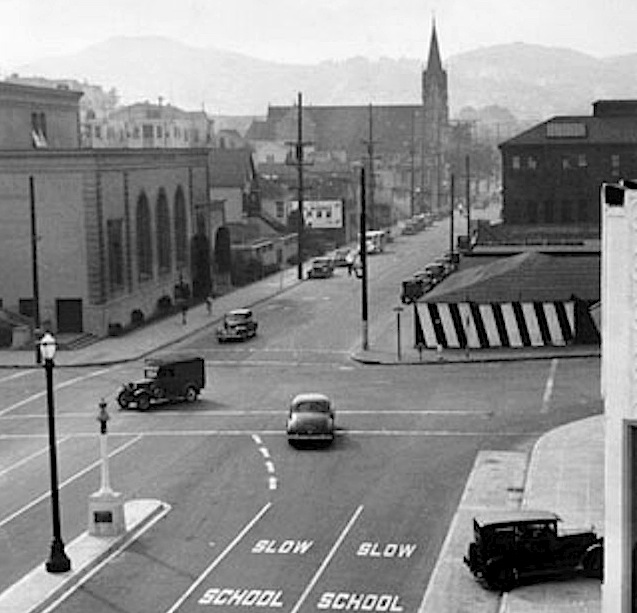
1940: View west on Army at Harrison again, showing both widened and unwidened portions. The caption on this photo hopes “the city soon may have the money to finish the widening.” Good times.

AAB-2898

1940s: Flush with bridge-building ardor and postwar can-do, Southern Crossing bridge proposed.

1947: Here’s a view looking south from Potrero Avenue at the Army Street intersection. That’s Bernal Heights in the top right, with the stairs leading up to Holladay. The US101 freeway was built here 10 years later.

potrero.army.1947

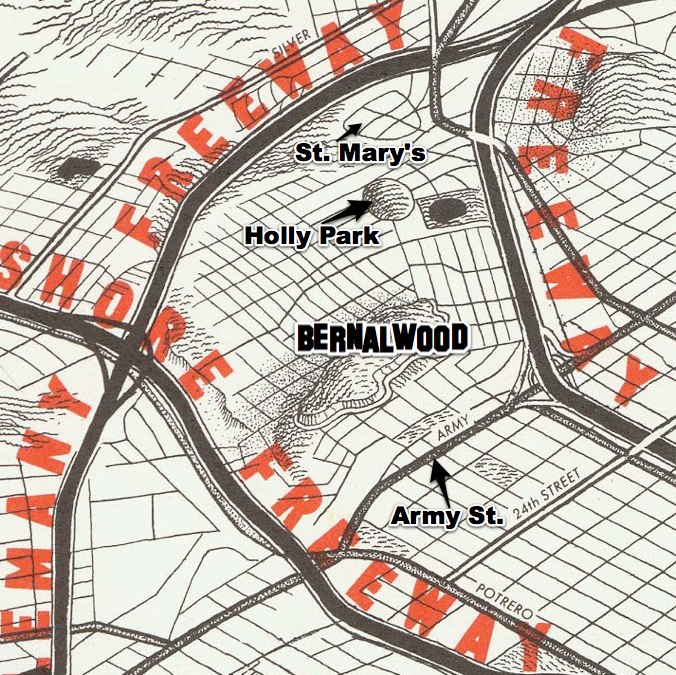
1948: A Southern Crossing was envisioned as part of an urban freeway network that would have encircled Bernal Heights in a maze of concrete viaducts, including one that followed Mission Street:

1948_San_Francisco_trafficwaysplanx

This scenario is so grim that we must zoom and enhance to see how bleak it really was (while also admiring the map’s realistic attention to geographic detail). Note the Army Street interchange on the proposed Mission Freeway, at the western end of Precita Avenue. Oh my:

1948_San_Francisco_trafficways_Bernal

1948: Here’s another view of the City’s proposed freeway network, showing more clearly how Army Street would have played an important role as an east-west artery to the Southern Crossing (and how thoroughly all of this would have sucked for Bernal Heights):
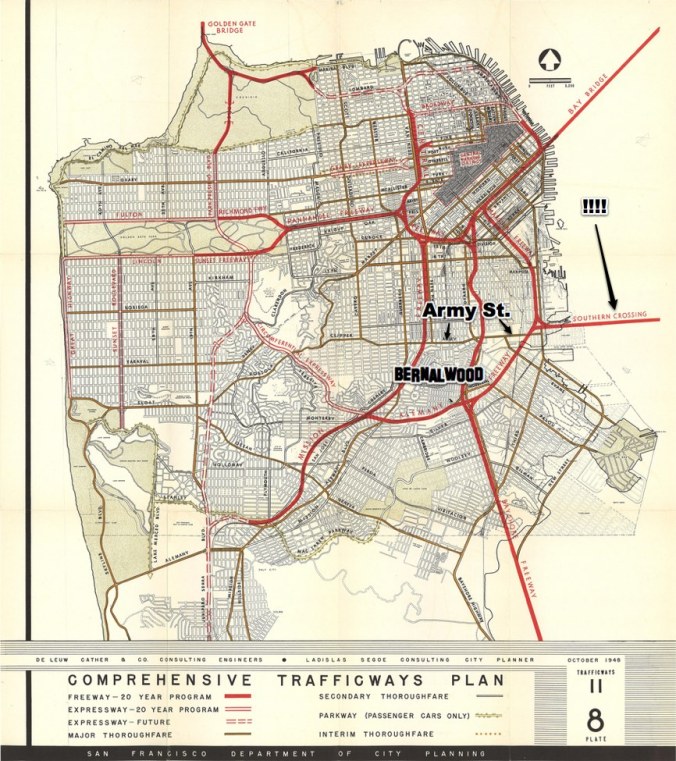
trafficwaysplan.1948x

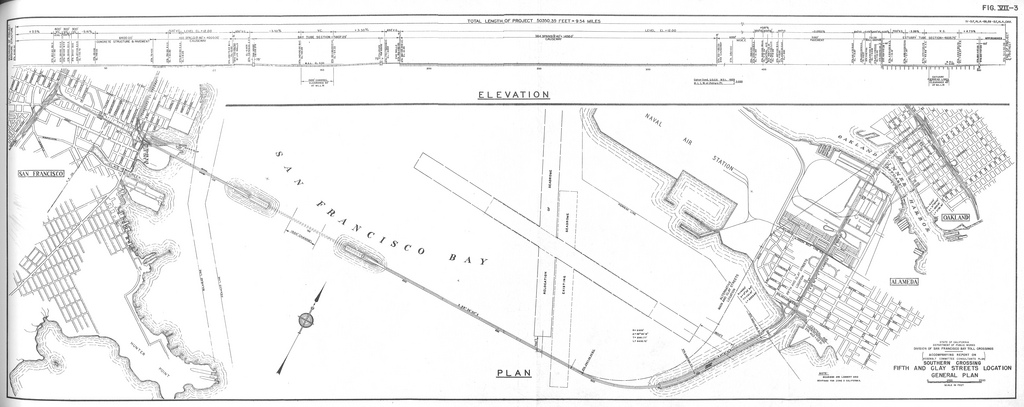
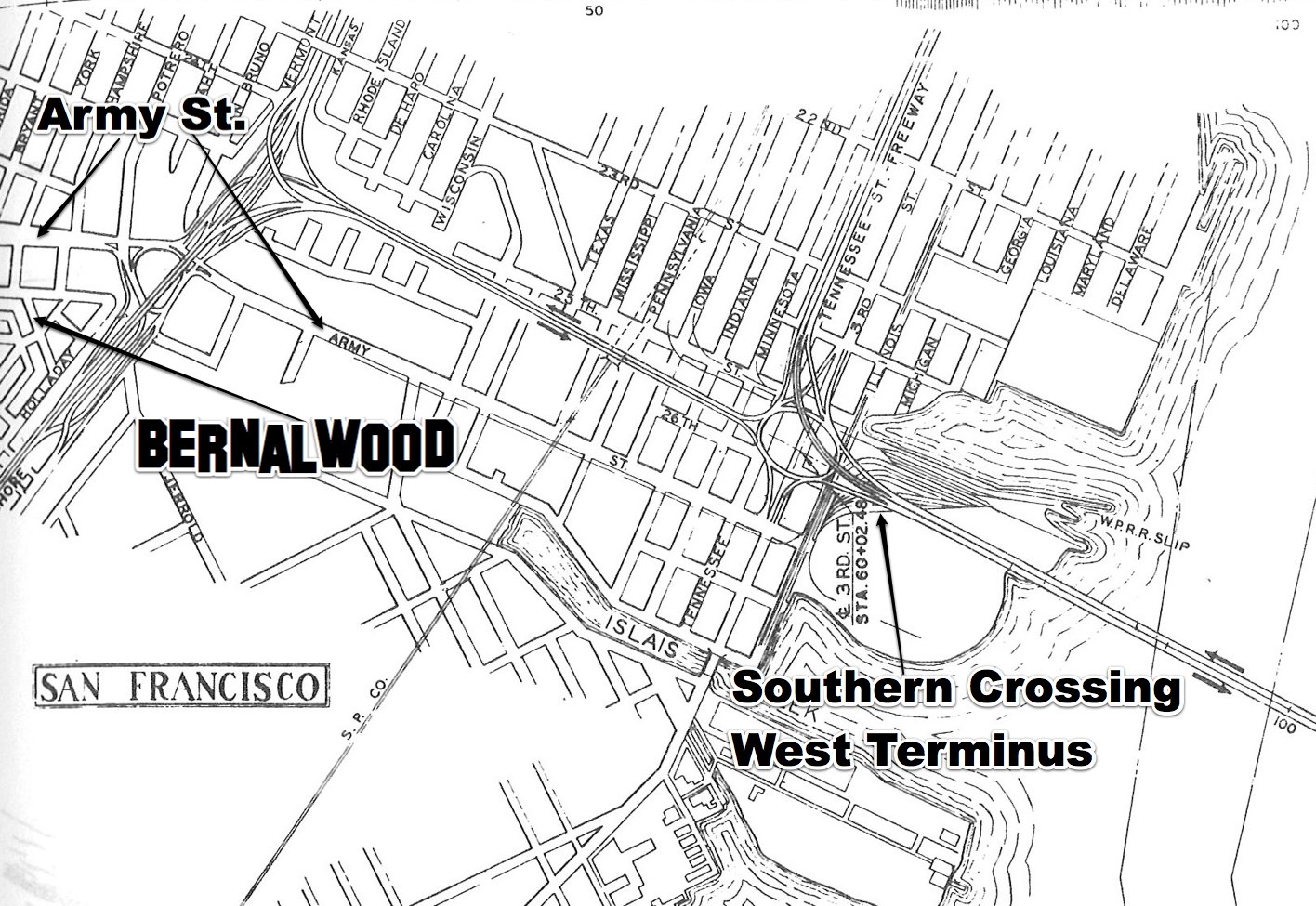
1949: California Department of Public Works map shows the Southern Crossing linked to the Bayshore Freeway via a dedicated highway, with Army Street feeding southwestern San Francisco
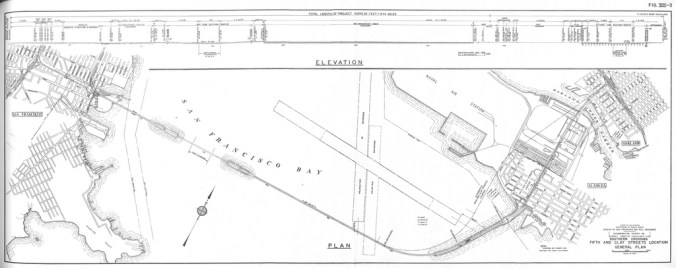
SouthernCrossing.1949

Check out the Army Street detail:

1949.SCdetail 2

1950: Shortly before US101/Bayshore Freeway construction begins, aerial view shows the now-complete Army Street widening, and the undeveloped approach to the proposed Southern Crossing:

bernalhill1950x

1953: Army Street, shown from street-level at South Van Ness, a few years after the Army Street widening was completed. Notice how then-and-now photos reveal that today’s nasty-ass Army St. streetscape design is basically unchanged from this time:

Then and Now: South Van Ness at Army Street, 1953

1950s: US101 converted from Potrero Avenue/Bayshore Blvd. routing to the elevated limited-access freeway. A roundabout under the Freeway connects Army, Potrero, and Bayshore.

1960s-1970s: I-280 constructed in San Francisco

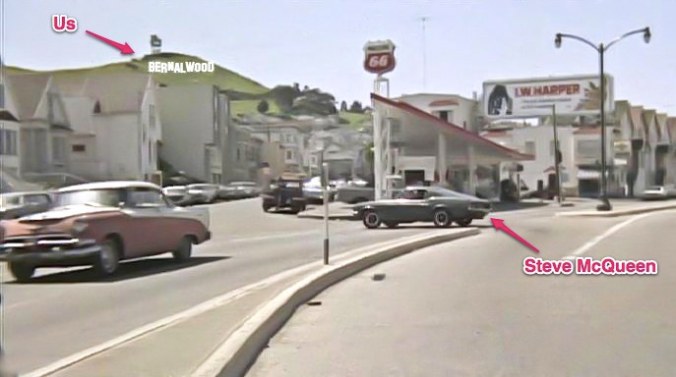
1968: Steve McQueen begins iconic “Bullitt” car chase on Army Street at Bryant in Bernal Heights. Location looks just as unpretty then as it does today.
1970: San Francisco Chronicle declares “Southern Crossing Should Be Built,” arguing in favor of a “missing link the Bay Area’s traffic system” that would carry 36 percent of all transbay traffic to San Francisco, diverting 45,000 vehicles a day from downtown.

1971: Even after most other San Francisco freeway projects have been abandoned, California Freeway Planning Map still shows proposed Southern Crossing:
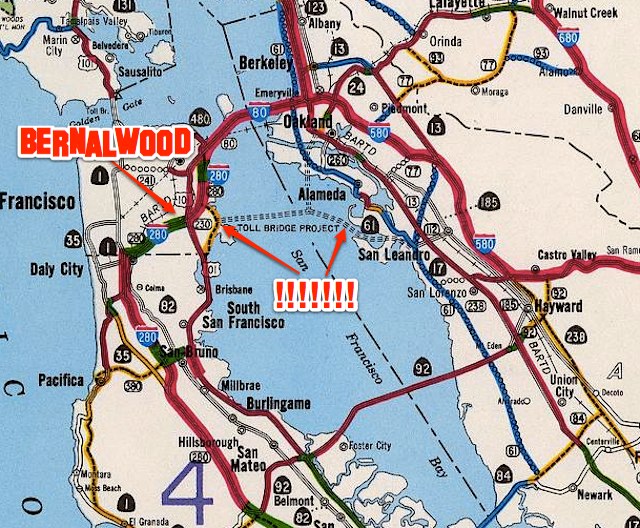
sffreeway1971-1

1972: Sierra Club freaks out over proposed Southern Crossing. Voters reject a bond measure to build a Southern Crossing bridge terminating in Hunter’s Point.

1973: Army Street/US 101 Spaghetti Bowl interchange built, replacing the roundabout that previously linked Army with Potrero Ave. and Bayshore Blvd. The new interchange was intended in part to serve traffic coming from and going to a future Southern Crossing:
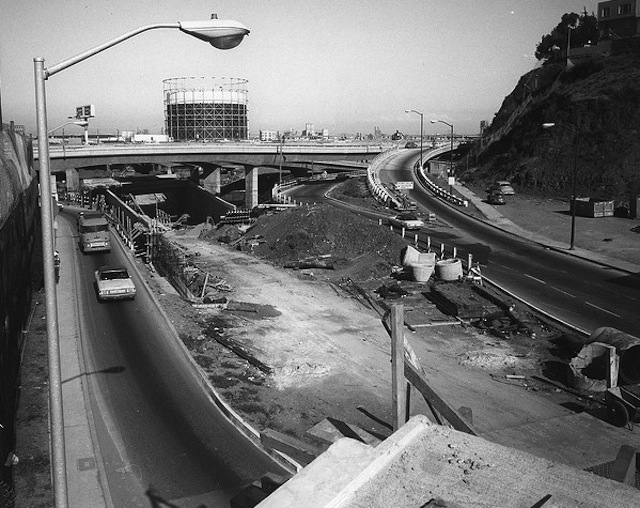
army1011973

Late-1980s: No means no. Another proposal to build a Southern Crossing dies amid widespread opposition from environmentalists.

1995: Amid much grumbling, Army Street renamed Cesar Chavez.

1995-2010: Southern Crossing proposals basically dead in the water, although Diane Feinstein advocated the idea yet again in 2000. Cesar Chavez Boulevard remains very ugly.

2012: Big, sexy new sewer main installed under Cesar Chavez:

chavezpipe

2013: Work begins on Cesar Chavez Streetscape improvements intended to strike a better balance between cars, pedestrians, bikes, and adjacent neighbors (not necessarily in that order). When finished, the basic configuration will look something like this:

CesarChavezPlanview

So there you have it.

Looking back on the last 80 or so years, the unifying thread in Army/Chavez history is that, first and foremost, the street was intended to serve as a high-volume route within a regional transportation plan that envisioned freeways and a future transbay bridge as its core elements. Like Precita Creek that runs underneath it, Army/Chavez was designed to carry traffic flowing from Twin Peaks eastward toward the shoreline of the Bay.

In that sense, the conspicuous ugliness of Army/Chavez is simply part of its function, because it was designed serve as a backbone of a car-centric vision of what San Francisco’s future required.

For a whole host of reasons, that’s not quite how the future turned out. So now — at last! — Cesar Chavez is being reimagined around a different vision for a different kind of future; a future in which Chavez continues to serve as an important artery, while also doing more to serve the neighbors who use it and live near it.

Of course, that may or may not be how the future actually turns out. So check back with again us in 80 years for another retrospective.

UPDATE: Let the bonus photos begin!!

Neighbor Joel dug into his photos archives and pulled up some more Army Street gems.

Here’s a view of Army Street during the street widening, circa 1940. Looks to me like Army at Harrison, shortly after the properties on the north side of Army were condemned and removed. (This block then became a rather notorious public housing project.) I believe the building visible just to the left and behind the (now-demolished) school-like building is the northwest corner of Army and Shotwell; that’s the same garage workshop space that’s now home to John’s Jaguar Repair:

ArmyStreet.Harrison

Google Street View confirms the location; notice the two houses on the far right:
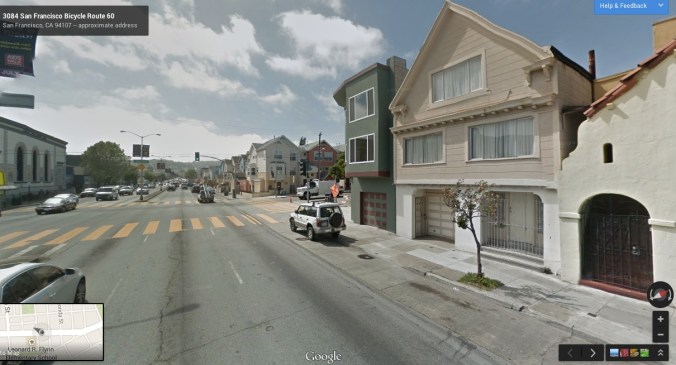
chavezharrisonstreetview

Neighbor Joel also sent a clean aerial shot of the Army-Potrero-Bayshore roundabout under the 101 freeway, probably sometime during the 1960s.

Army and 101 interchangeX

Ugly-Ass Roadsign Across Cesar Chavez Removed (At Last!)

chavezsign1

chavezsign2

A milestone of sorts was reached recently as part of the ongoing (and steadily advancing) Cesar Chavez Boulevard streetscape improvement project. Actually, a milestone was removed. Which is also kind of a milestone unto itself. The milestone of the removal of a milestone, that is. Or something.
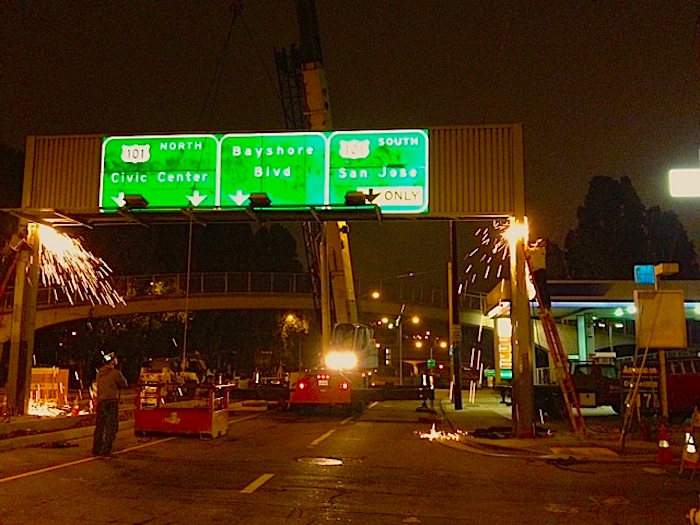
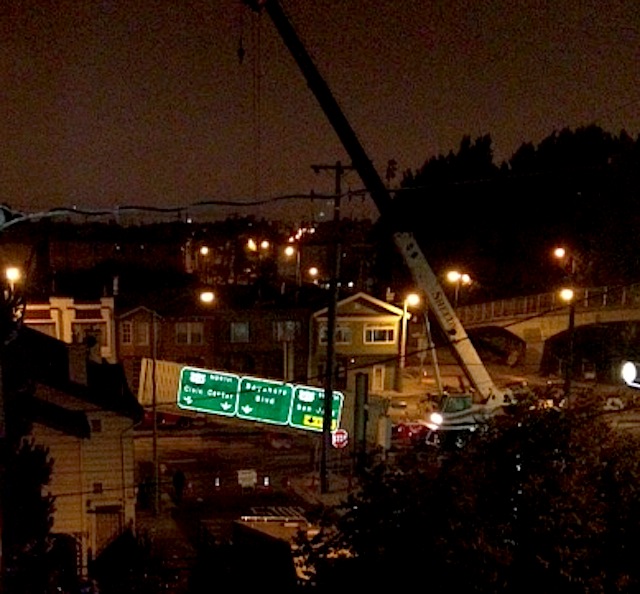
Anyway, Neighbor Lynn wrote to say that the very old, very ugly freeway onramp directional sign that spanned Cesar Chavez eastbound near Hampshire Street was unceremoniously removed late last week, under the cover of darkness:

We have lived on Hampshire Street for twenty-five years. At about 2 a.m. on Aug. 9, workers took out the eyesore sign that bridged Cesar Chavez. My wife, Margo, shot these photos with her iPhone. It shows guys on ladders cutting the steel posts with acetylene torches. In the background is the giant crane that soon would grab the sign and lower to it the pavement.

… and good riddance.

PHOTOS: Neighbors Lynn and Margo

Alemany Farm Raising Funds to Build Outdoor Kitchen

alemanyfarmkit

kitchensite2

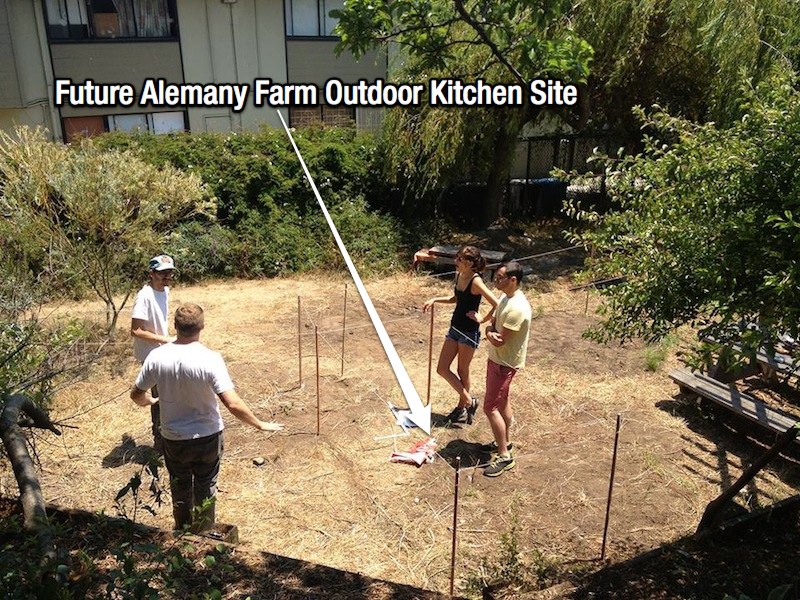
There’s some tasty infrastructure news coming out of the Alemany Farm that overlooks scenic I-280 along Alemany Boulevard. Plans are afoot to build an outdoor kitchen on the site, and  former Bernal resident Aaron Mckenzie from the California College of the Arts is spearheading involved with the design effort. Aaron writes:

A team of artists, architects and designers from California College of the Arts is working with the Alemany Farm to design and construct an outdoor community Kitchen on site. The team has been awarded a $10,000 grant though the IMPACT Social Entrepreneurship Awards to execute this collaborative, community-based project.

Meanwhile, a Kickstarter campaign got underway yesterday to complete funding for the project:

Our set goal is to raise $5,000 to help cover the cost of permitting fees, contract labor, an ADA accessible walkway, as well as some finishing touches to the kitchen. With the additional funds, we anticipate to finish construction by the end of September. But with this minimum goal, we can only give the farm the bare essentials. So we’re hoping to raise more than just $5,000. The hope for us is to build the farm a fully functional kitchen, complete with natural gas line and stove. This will allow the farm to conduct proper cooking classes in the long run.

Here’s the video:

The fund drive ends on August 19. You can find more information about the project on the Facebook, or visit the Kickstarter page to make a contribution.

PHOTOS: Alemany Farm Outdoor Kitchen

ParkletMania Sweeps Cortland as Vino Rosso Seeks Parklet Approval

vinorossoparklet

parkletMap2

Is it a fad? Or is it… the fuuuuuuuuuuuture?

Suddenly, Cortland is awash in Parkletmania.

It started at Neighbor Mutsumi Takehara’s restaurant at 903 Cortland, where construction of a new parklet is now underway following a successful Kickstarter fundraising campaign.  Now several neighbors alerted Bernalwood that the VinoRosso wine bar — just two blocks away from 903 — has posted notices that it too would like to install a parklet out front.

Is this a sudden shower of new-urbanist awesome? Or too much of a good thing? Or is it like one of those “End of the Universe” situations where you’ve got a Starbucks across the street from another Starbucks? Discuss.

PHOTO: Neighbor Sarah. Hat tip: @HurleyMcDingus

Free Wi-Fi Coming Soon to Cortlandia

CortlandWifi

San Francisco is moving ahead with a program that will install free WiFi networks at 31 locations around the City, and the Bernal Heights Recreation Center just off Cortland was selected as one of the free hotspots. If all goes according to plan, the service will be operational by Spring 2014.

The free service comes courtesy of Google, and the San Francisco Chronicle provides the background:

Six years after a deal to blanket the city fell apart, Supervisor Mark Farrell and Google will announce a plan Wednesday to bring public wireless Internet access, on the technology company’s dime, to parks, recreation centers and plazas across San Francisco. The $600,000 gift from Google will cover the costs of the equipment, installation and maintenance of wireless capabilities for two years.

It will allow residents to work from Mission Dolores Park, let visitors download information to their mobile devices in Civic Center Plaza and make it easier for parents to sign their children up for recreation programs at centers from the Excelsior district to Bernal Heights, Chinatown, the Marina and the Sunset District. In some of those areas, it may be the easiest place to find Internet access, Farrell said.

Bernal Photographer Shows Awesome Images of New Bay Bridge Construction

blum.bridgebuilder1

bridgebuilder2

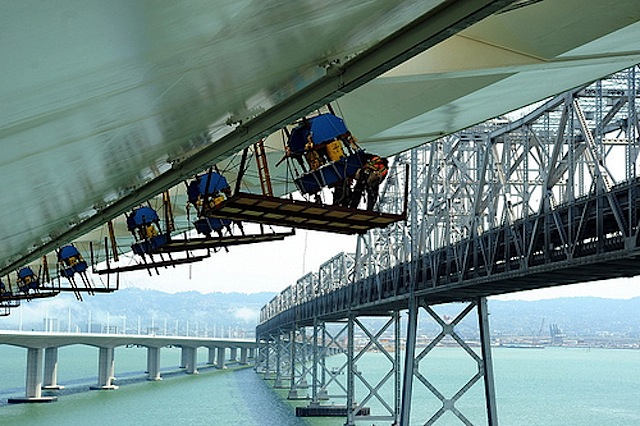
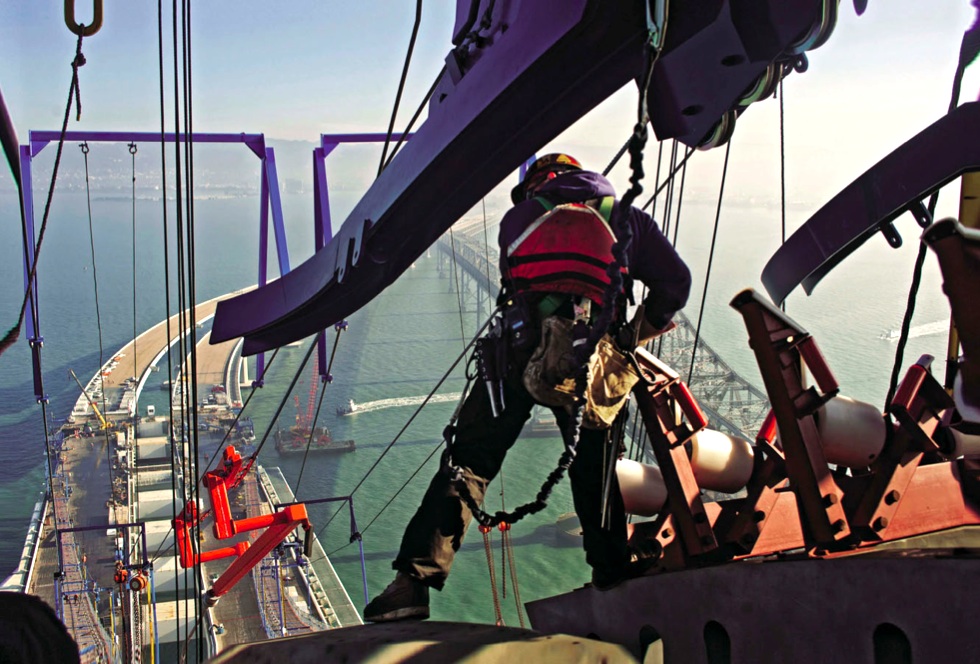
Speaking of Bernal celebrities… Neighbor Joseph Blum is a professional photographer who lives on the north side of Folsom Street. He was a boilermaker and welder for 25 years before he took up the camera, but his roots shine through in his photos, which capture the technical craftsmanship required to build large-scale, industrial infrastructure.

Fortuitously, then, Neighbor Joe has worked with Caltrans for more than a decade to document the construction of the new Eastern Span of the San Francisco Bay Bridge. His photographs of the project are stunning, yet they are also intimate and iconic in a way that will be treasured by historians and infrastructure geeks for many decades to come.

That’s why we beamed with neighborly pride when Neighbor Joe sent us a note to invite all Citizens of Bernalwood to come see his Bay Bridge photos:

I have two exhibits now which honor and document the workers who have built the new East Span of the Bay Bridge.

I have lived on Bernal since 1975 and I have been photographing the construction of the new bridge since 1998. I have spent a lot of time out on the bridge, and it is always great to look out from top of the new tower at our beautiful Bernal Hill, where I often walk to renew and relax and view the rising of the moon.

(SIDE NOTE: Bernal does look rather glamorous from that angle, doesn’t it?)

Anyhow, you can see some of Neighbor Joe’s Bay Bridge work online, and here the details on the exhibits where you can see his mind-blowing photos in person.

He has a show up right now in City Hall (!!!), with an artist reception happening tomorrow, July 11:

The Bridge Builders by Joseph A. Blum
Exhibition Dates: June 24 through September 27, 2013
Artist Reception: Thursday, July 11 5:30-7:30 pm

San Francisco City Hall, ground floor
1 Dr. Carlton B. Goodlett Place
San Francisco, CA 94102
Free and open to the public.

Then, in August, his second show will open:

A View from the Bridge:
Documenting the Construction of the Skyway and Foundations of the New East Span of the Bay Bridge 1998–2005
Black and White Photographs by Joseph A. Blum

August 3 – October 3, 2013
Opening Reception, Harvey Milk Photo Center
Saturday, August 3, 1 p.m. – 4 p.m.

Harvey Milk Photo Center
50 Scott St San Francisco, CA 94117 • (415) 554–9522
Tuesday – Thursday: 6 p.m. – 9 p.m. Saturday: 11 a.m. – 4 p.m.
*Please call ahead for viewing. Gallery is closed on Sunday, Monday & Friday.

PHOTOS: Joseph Blum Photography

Community Feedback Wanted on La Lengua Streetscape Improvement Proposals

Valencia_Render_cropped_BW2

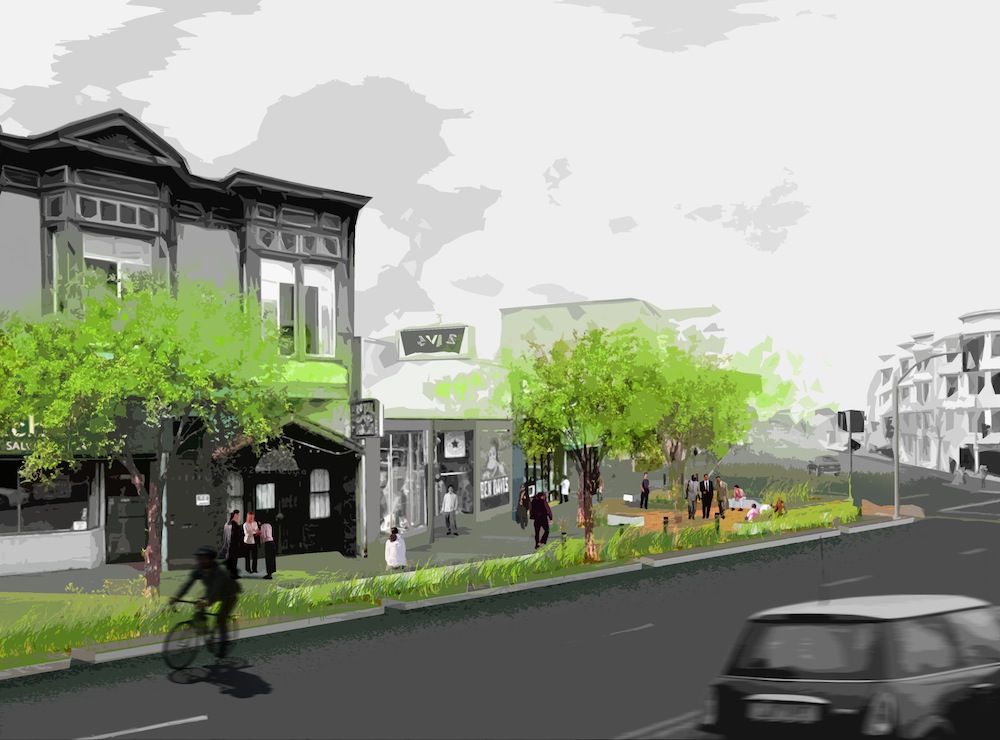
Plans are afoot to beautify the La Lengua homeland by redeveloping the streetscape around Valencia Street between Mission and  Cesar Chavez Boulevard, as well as Tiffany, 29th, and Duncan Streets.

The effort has been undertaken by SFPUC, the SF Planning Department,  and SF Department of Public Works. The project website is here, and there’s a community open house scheduled for this  Tuesday, July 9, to review proposals. Here are the deets:

We want your input on the SFPUC Mission and Valencia Green Gateway! Join us anytime during the Community Open House to provide your feedback on the project design and review the expanded project area to bring more stormwater benefits and streetscape improvements from Valencia to neighboring streets of Tiffany, 29th, Duncan, and San Jose.

What: Mission and Valencia Green Gateway Community Open House #2
When: Tuesday, July 9, 2013, 4:00 to 8:00pm 
Where: Mission Cultural Center for Latino Arts, 2868 Mission Street, San Francisco, CA 94110
More Information: www.sfwater.org/mvgreengateway

Contact: Teresa Young – tyoung@sfwater.org  or 415-554-3274.

Our doors will be open between 4:00 – 8:00pm, and the project team will be giving 10-15 minute presentations every 30 minutes (4:30pm, 5:00pm, 5:30pm, 6:00pm, 6:30pm, 7:00pm, and 7:30pm) to briefly summarize public feedback and discuss the expanded project site and design concepts.

See how the public input from the first open house and online helped to shape the project concepts.

  • Provide feedback on the design concepts and green infrastructure for streetscapes and plazas at Mission & Valencia and Valencia & Tiffany.
  • Help shape planning for the expanded project area to neighboring streets: Tiffany, 29th Street, Duncan and San Jose.
  • Speak one-on-one with the project team – a partnership of the San Francisco Public Utilities Commission, SF Department of Public Works, SF Municipal Transportation Agency, and SF Planning Department.

IMAGE: Rendering of proposed Mission/Valencia intersection improvements, via SFPUC

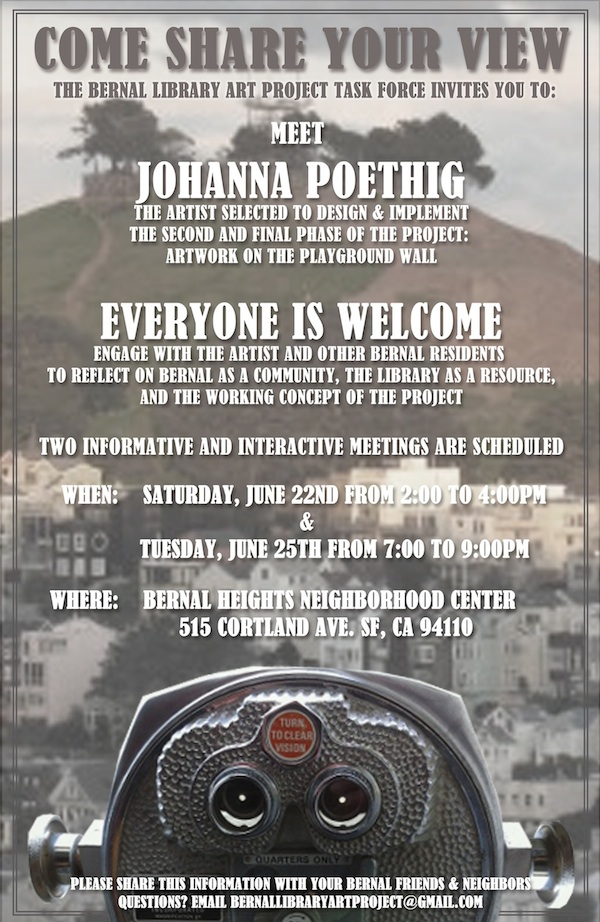
Meetings Announced to Discuss Bernal Library Southern Facade Artwork

eastMural

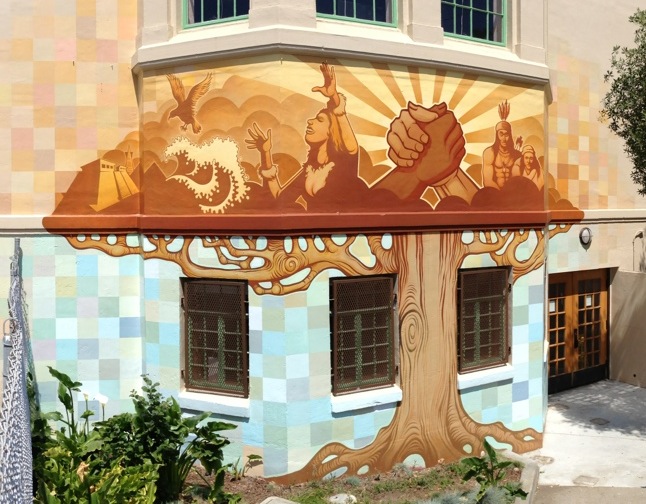
There’s been a lot happening with the Bernal Heights Library art project of late. The mural on the eastern side of the library was recently completed (check it, above), and yesterday there was a raffle to raise funds for the artwork proposed for the library’s southern, playground-facing side.

But wait…. What will they do with that raffle money? And what will the proposed artwork look like?

Neighbor Brandon is a member of the Bernal Library Art Project Task Force, and he invites all interested Bernalese to participate in a set of meetings that start this weekend to discuss the proposal for the library’s southern facade:

BERNAL LIBRARY ART PROJECT: PHASE 2 — Playground Wall

COMMUNITY MEETINGS – EVERYONE IS WELCOME!

The second and final phase of the Bernal Library Art Project is being launched this summer.

The Bernal Library Art Project Task Force invites you to:

Meet Johanna Poethig, the artist selected to design and implement the project. This is Johanna:

Poethig

Engage with the artist and other Bernal residents to reflect on Bernal as a community, the library as a resource, and the working concept of the project.
The meetings will be both informative and interactive. The first meeting happens on Saturday, with the second following quickly on Tuesday:

MEETING #1
Saturday, June 22
2:00 – 4:00 pm

MEETING #2
Tuesday, June 25
7:00 – 9:00 pm

Location: Bernal Heights Neighborhood Center
515 Cortland Avenue

Questions? Email bernallibraryartproject @ gmail . com

Communityposter4x6

PHOTOS: Courtesy of Bernal Library Art Project Task Force

These Bernal Heights Streets Are Barely Streets at All

joyst

rosenkranz

mayflower

faithst

Neighbor Craig has been admiring some of the feral streets of Bernal Heights; streets so small, or so wonky, or so disjointed that it’s dubious whether they deserve to be called streets at all. Take it away, Neighbor Craig:

I’ve been thinking about the least Street Streets of Bernal Heights.  Here are my current favorites:

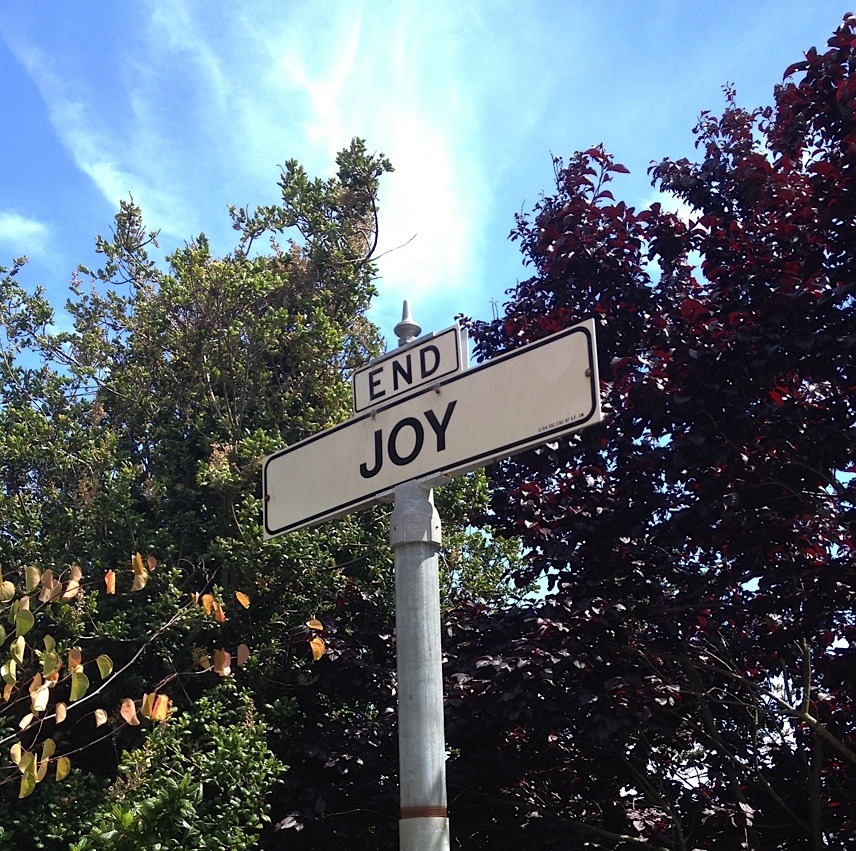
Joy – one block long, only stairs, but many lovely cottages on those stairs. Next street over is Faith. Paradoxically, the rest of Joy was eliminated when the 101 freeway was built.

Esmeralda – About three blocks – not connected, mysteriously runs between Lundy’s and Prospect, then Winfield and Elsie on the Northwest Slope, mysteriously reappears on near the top of the northeast slope for one block connecting Alabama and Franconia with barely a curve to signal the start and end. At one point the street turns into a SLIDE.

Waltham – basically a driveway for 2 houses near the top of Alabama, one of which is listed on VRBO.

Emmett Ct – A sliver of an alley with 3 houses off of Precita

Heyman Ave – 5 houses between Coleridge and Prospect. It’s a SMALL block, but a real street
Rosenkrantz – Famous for being a random sign with no apparent street or even stairs on the southern stretch of Bernal Heights Blvd. However, there are legitimately 5 houses on this street once you dive over a guard rail and dirt road to find it.

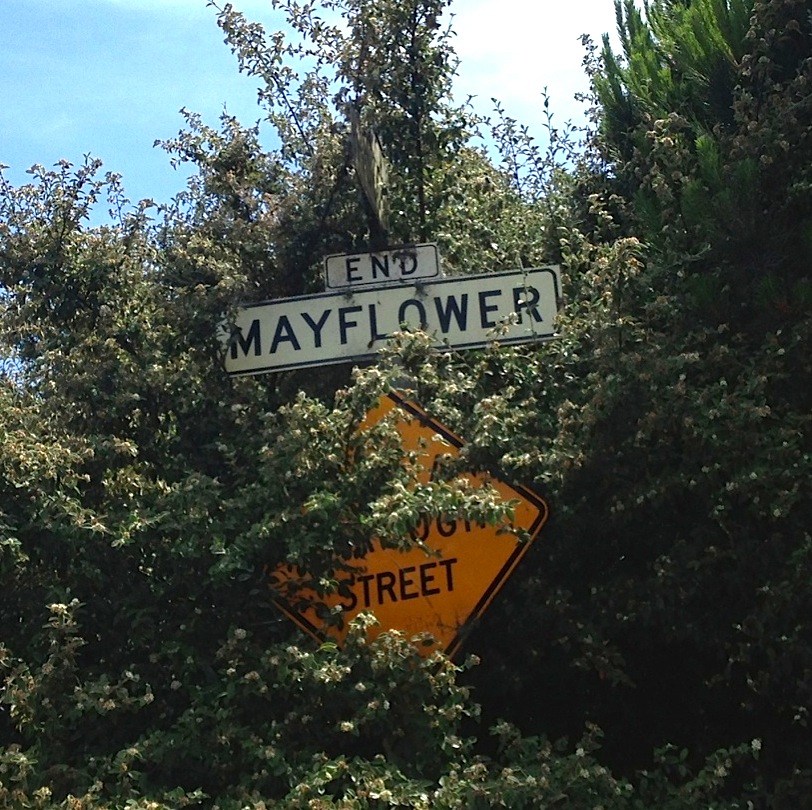
Mayflower – I dare you: Just try to find it. ONE house in all of Bernalandia has this street address, but the place where the street possibly lies is actually about 4 short blocks long!

Special recognition goes to Peralta for holding the title as the least contiguous street in Bernal, breaking six times over its course as it winds from the Alemany Farmers Market and ends in a scary stairway 50 feet directly above the Cesar Chavez/101 Hairball.

PHOTOS: Craig Sakowitz