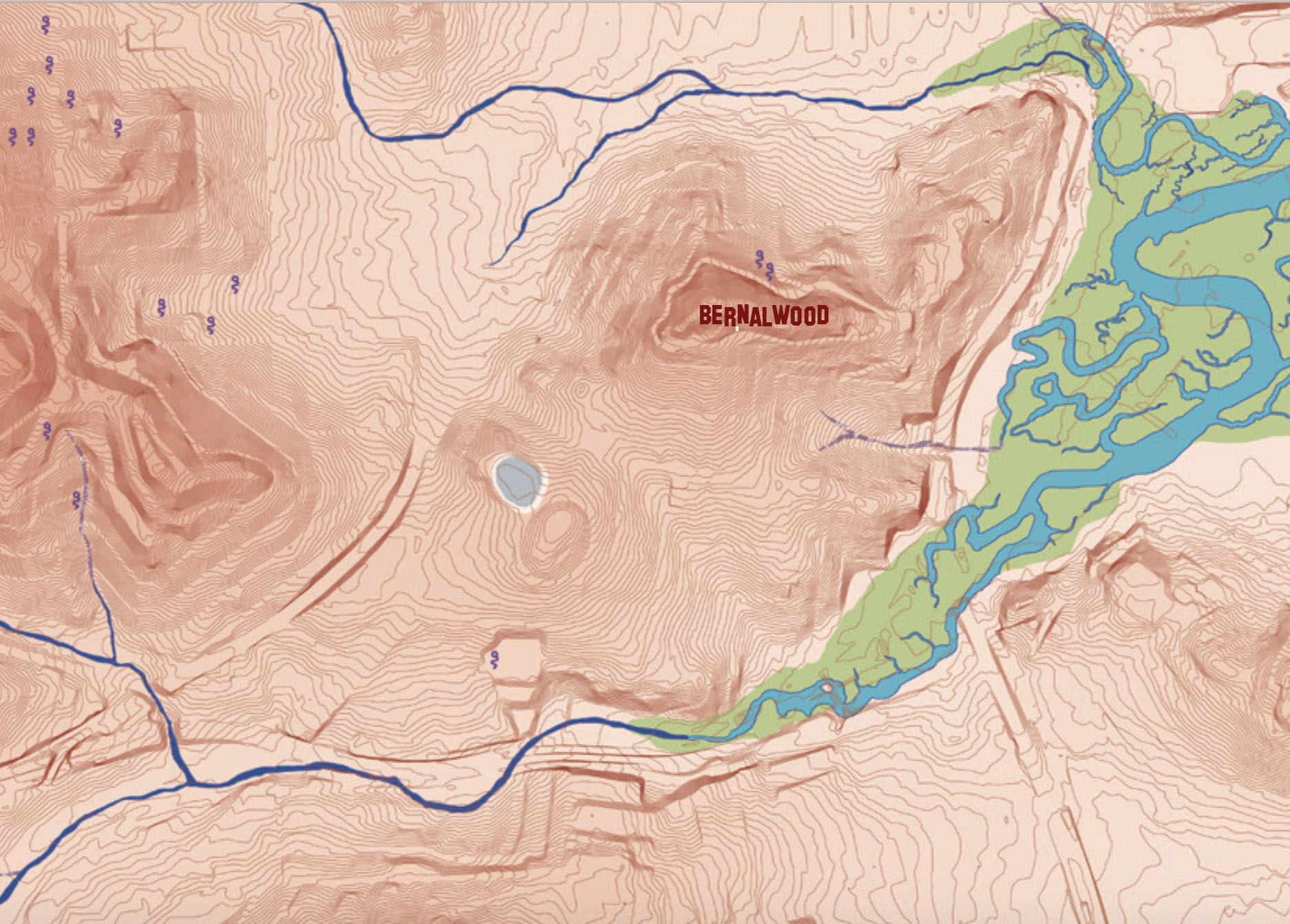
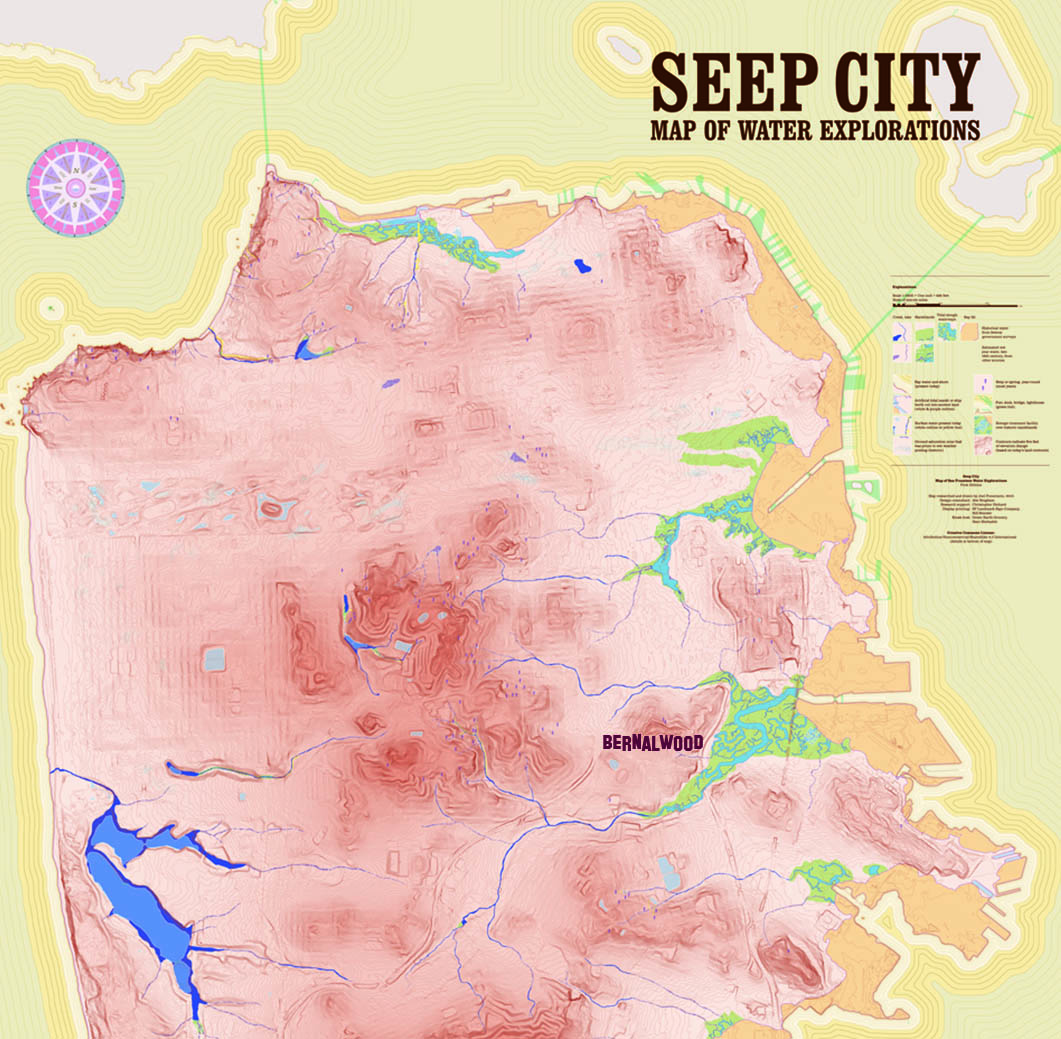
In his amazing new Seep City map of San Francisco’s lost creeks, springs and waterways, natural history researcher Joel Pomerantz reveals the places where groundwater once flowed in Bernal Heights.
[On the map] today’s land forms are shown with 5-foot-interval contour lines. At this level of detail, we can easily see where human activity has filled extensive portions of the bay and where streets, highways, reservoirs and railroad grades cut into hills.
Our city had significantly more water before it was developed. Consequently, most of the water shown is from historical sources. The purple squiggles are bedrock springs found today. Natural and artificial lakes present today are outlined in white. Creeks of today are highlighted yellow.
Only a couple creeks still flow on the surface today. Finding them can be a challenge without this map. Some are virtually unknown.
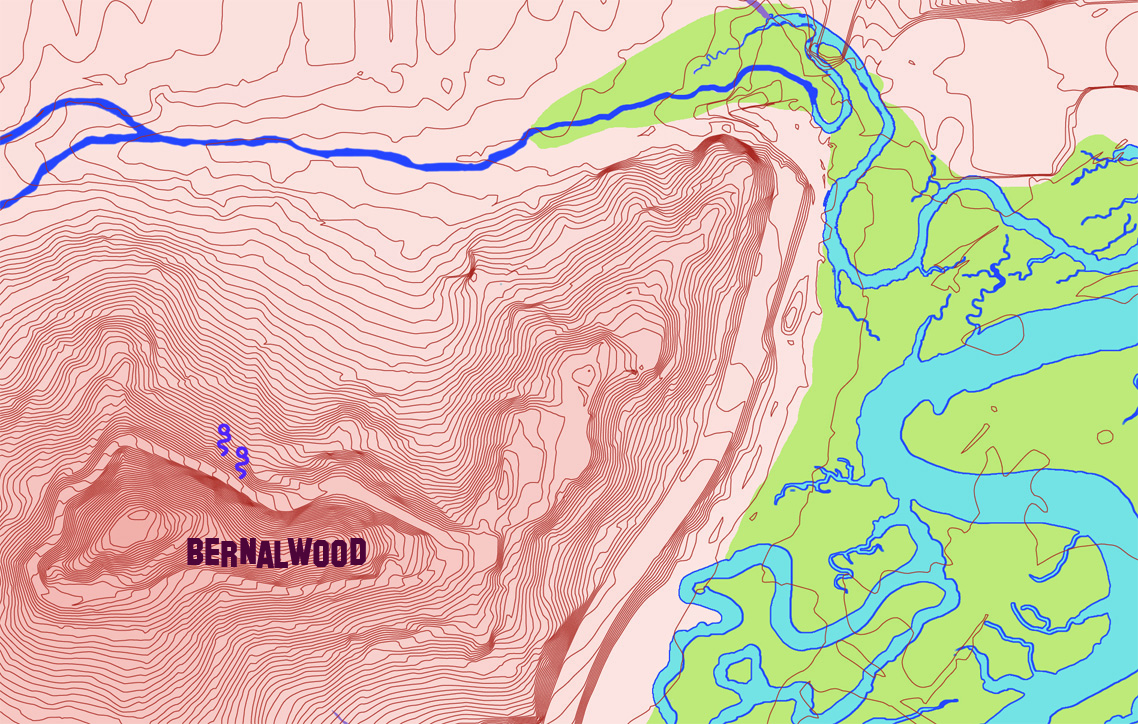
The detail is remarkable. Here’s a close crop of northeast Bernal, with Precita Creek running along the upper part of the map and draining into the intricate Islais Creek watershed (where Bayshore stands today). Notice also the two active springs on the northern slope of Bernal Hill:
And when you pull back to look at the city as a whole, you see how Bernal fits in to a much larger ecosystem:
Want a copy of Joel’s maptastic creation? Visit his Kickstarter page, where you can order a map in your favorite size.
We are thrilled to report that we were able to secure funding for replacement of the Trellis through the City’s budget process. Thank you so much for bringing this issue to our attention. It has been a pleasure to see to the neighborhood so united over a common treasure and we really appreciate your advocacy. DPW has assured us that as soon as the funding is allocated to the department, it will replace the Trellis. The original structure is set to come down next week. The final City Budget is approved on July 21st. We will be working closely with DPW to make sure the replacement structure is built as soon as possible.
That’s fantastic news, so let’s all join hands for a collective woo-hoo:
Wooooo-HOOOOOOOO!!!!!
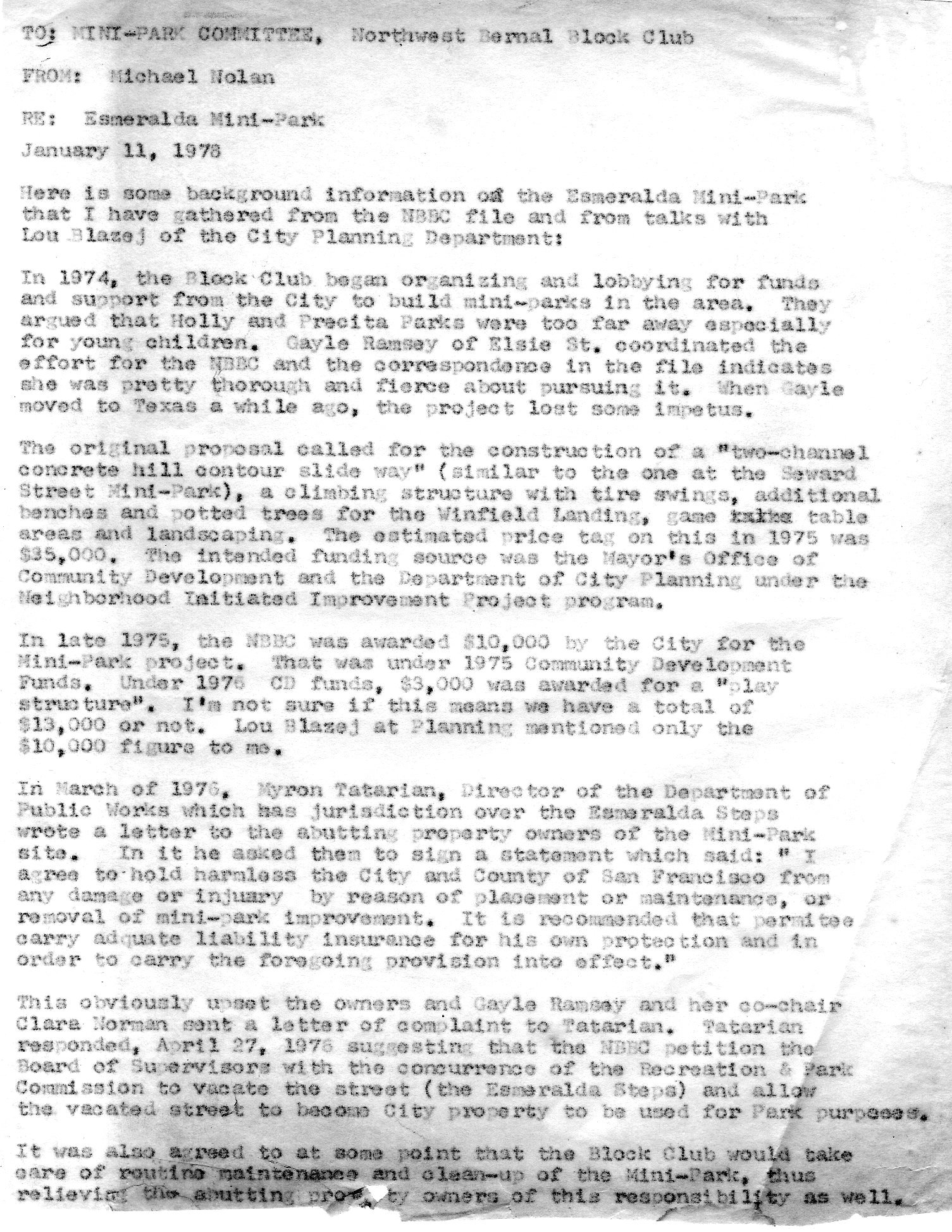
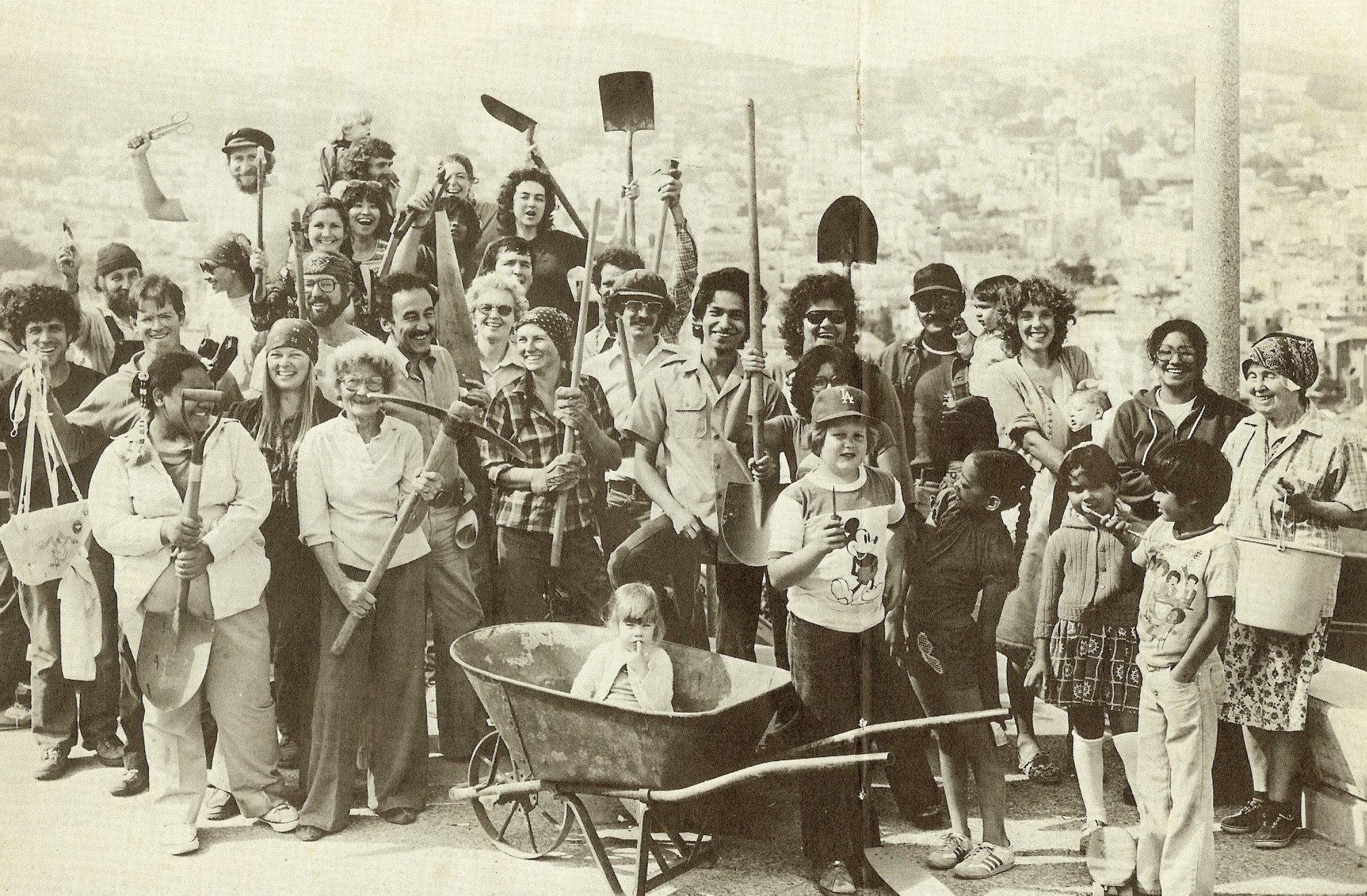
This is also a fitting tribute to the scrappy group of Bernal neighbors who rallied to build the trellis (and the secret Esmeralda slides!) in the first place, almost 40 years ago.
Many Bernalese will recognize the photo, because to this day it stands as a defining symbol of Bernal Heights activism, engagement, volunteerism, and neighborly solidarity. The image is a magnificent time-capsule, so Bernalwood encourages you to zoom and enhance it at your leisure from the safety and comfort of your own computer screen to explore all the wonderful details it reveals.
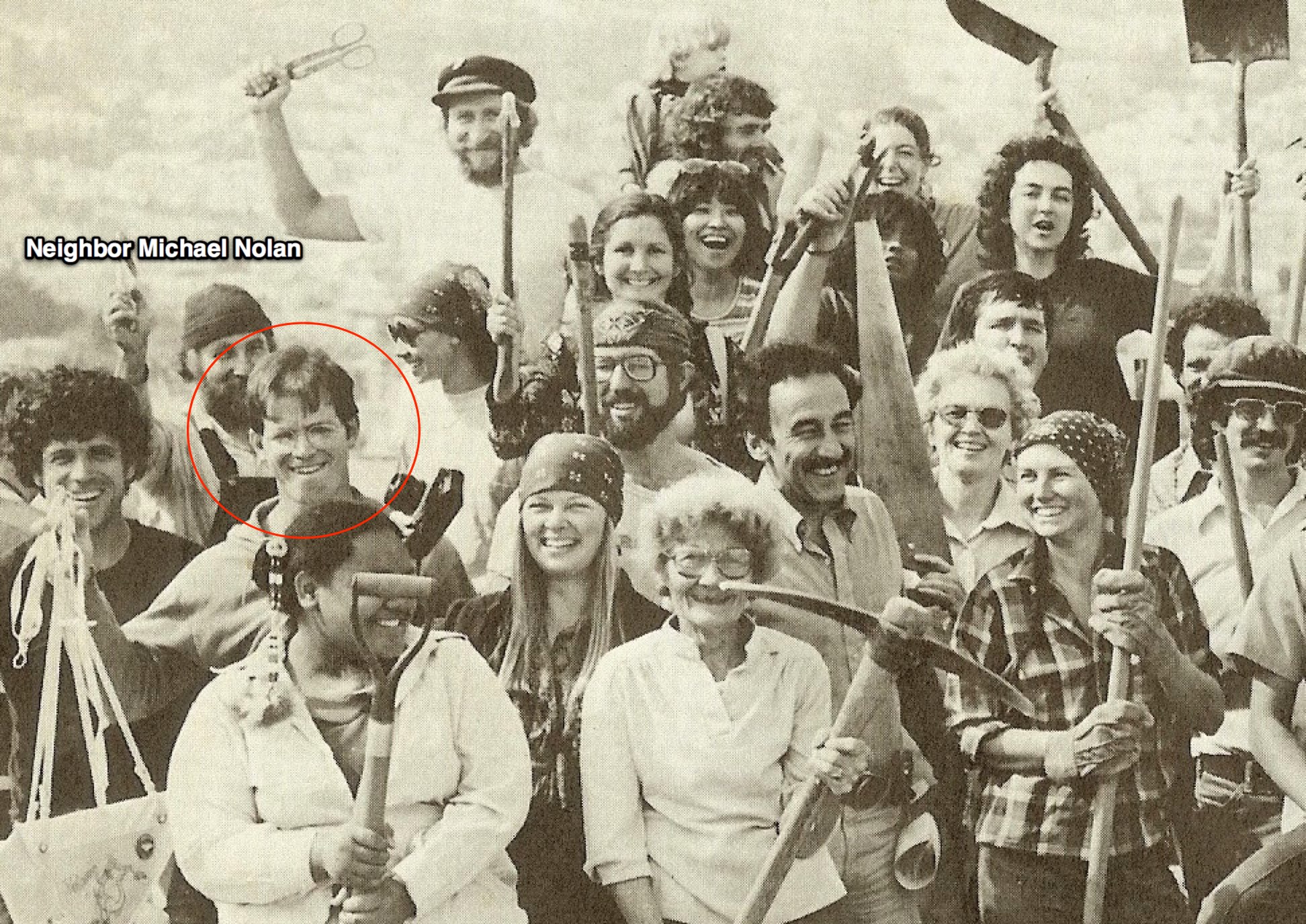
The photo was taken in 1978, just as work on the slide and mini-park was wrapping up. Back then, Neighbor Michael Nolan was one of the chief organizers of the project, and you can see him in the photo on the far left:
To help modern-day Bernalese understand all the dedication and bureaucratic wrangling it took to create the Esmeralda Mini-Park in the first place, Bernalwood nagged asked Neighbor Michael to give us a behind-the-scenes view of the project’s creation-story:
In the wake of a fun-filled though unsuccessful run for District Supervisor in 1977, I threw my surplus civic energy into making the Esmeralda Mini-Park happen.
I won that campaign. The Northwest Bernal Block had worked mightily for years on the project, believing that between Precita and Holly Parks, there was no area for children to play. But various bureaucratic and legal snafus had stymied the project, even though there was sufficient city funding and support.
Getting the Board of Supervisors to “vacate” what was still officially a “street” and turn it into a park was crucial, because that’s what was required to limit the potential liability of adjoining homeowners and win their okay.
I convened a dedicated crew of nearby neighbors who worked with landscape architect Andrew Butler and Planning Department liaison Lu Blazej . Tom Chiosso of DPW brought tools, materials, and community development grants from the City.
Bernal neighbors volunteered to prepare the land, build the double slide, erect a play structure, and install the planter boxes and trellis on the Winfield Landing.
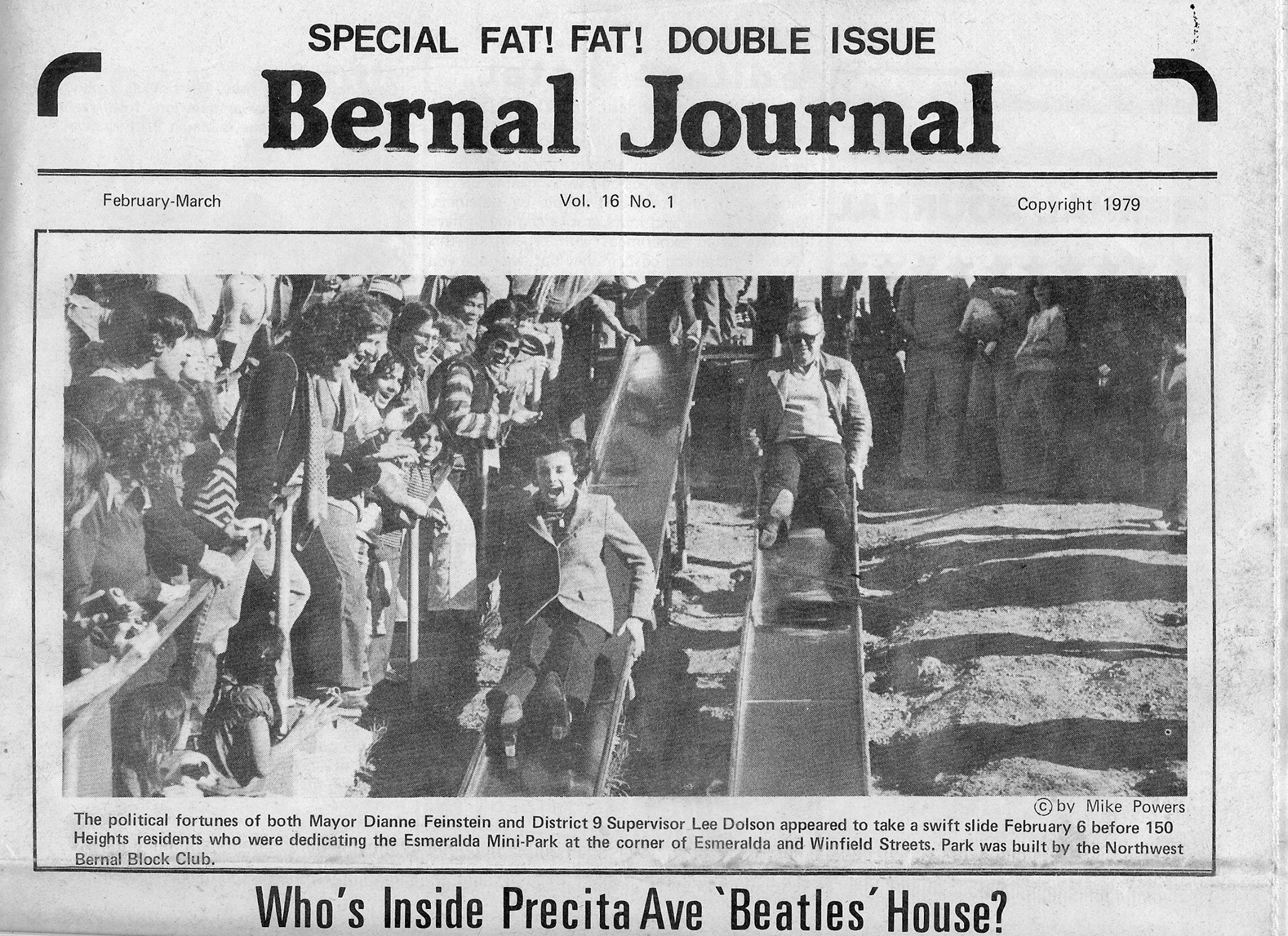
We’d hoped that our popular Mayor George Moscone would inaugurate the double slide, but we lost him and Harvey Milk in the tragic assassinations of that fall. In early 1979, Mayor Dianne Feinstein and District 9 Supervisor Lee Dolson did the honors.
Though our funds are (fingers-crossed) secured, we still have a ways to go until the Esmeralda-Winfield Mini-Park is restored to its proper glory. Let’s stay focused, let’s stay engaged, and let’s do whatever it takes to make sure this mini-park remains glorious for another 40 years.
The delightful Esmeralda/Winfield Mini Park is suffering from old age, and an indifferent City bureaucracy has no plans to keep the mini-park in proper order. In fact, the City plans to tear down part of the park in coming days. Eeek!
This will be a great loss for Bernal Heights, so Neighbors Nancy and Joan catch us up on what’s happening, and how you can help:
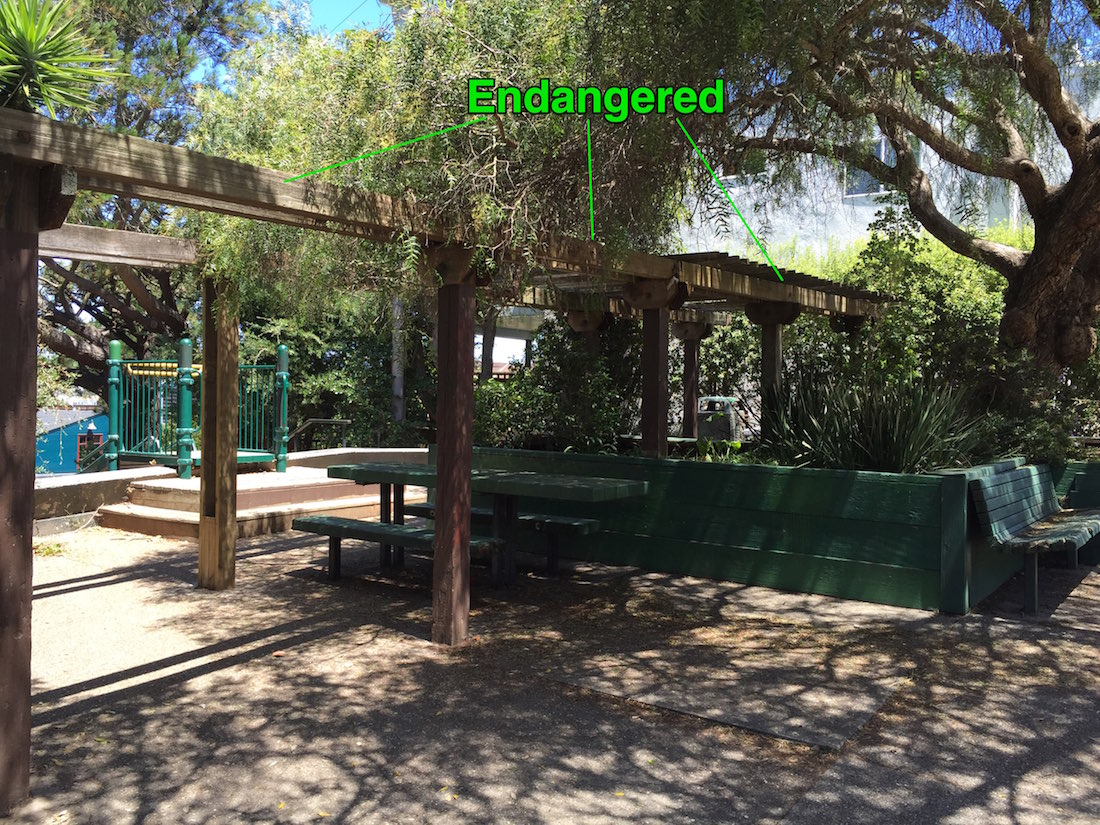
The wooden structures at the MiniPark were built with community input in the late 1970s. The structures haven’t been maintained, leaving them to deteriorate into their current state.
Now the trellis is slated to be removed within a week! The planter box surrounding the big pepper tree is also due to be removed, timeline unknown. The remaining picnic table and benches haven’t been mentioned as part of the takedown, but they have rot as well.
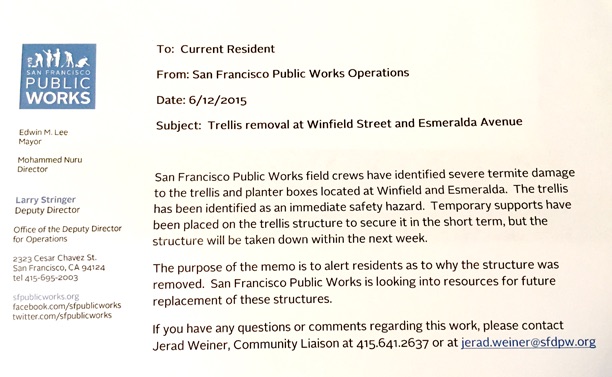
With a kick-ass slide, a stairway that goes up to Bernal Hill, and a place to sit, rest and hang, the MiniPark is a real gem in our neighborhood. It needs a serious upgrade, but the City hasn’t committed any funds or created any plans other than a piecemeal teardown. SF Public Works sent out a memo to the neighborhood saying:
Without our pressure on the City to make the rebuild a priority, the plaza will slowly disappear or be fixed in a haphazard fashion.
Please send an email NOW, to Supervisor David Campos at David.Campos@sfgov.org telling him his office needs to look into funding the replacement of the deteriorated structures at the Winfield/Esmeralda MiniPark.
Look for future Bernalwood posts to let you know how to stay involved.
This is sad and bad.
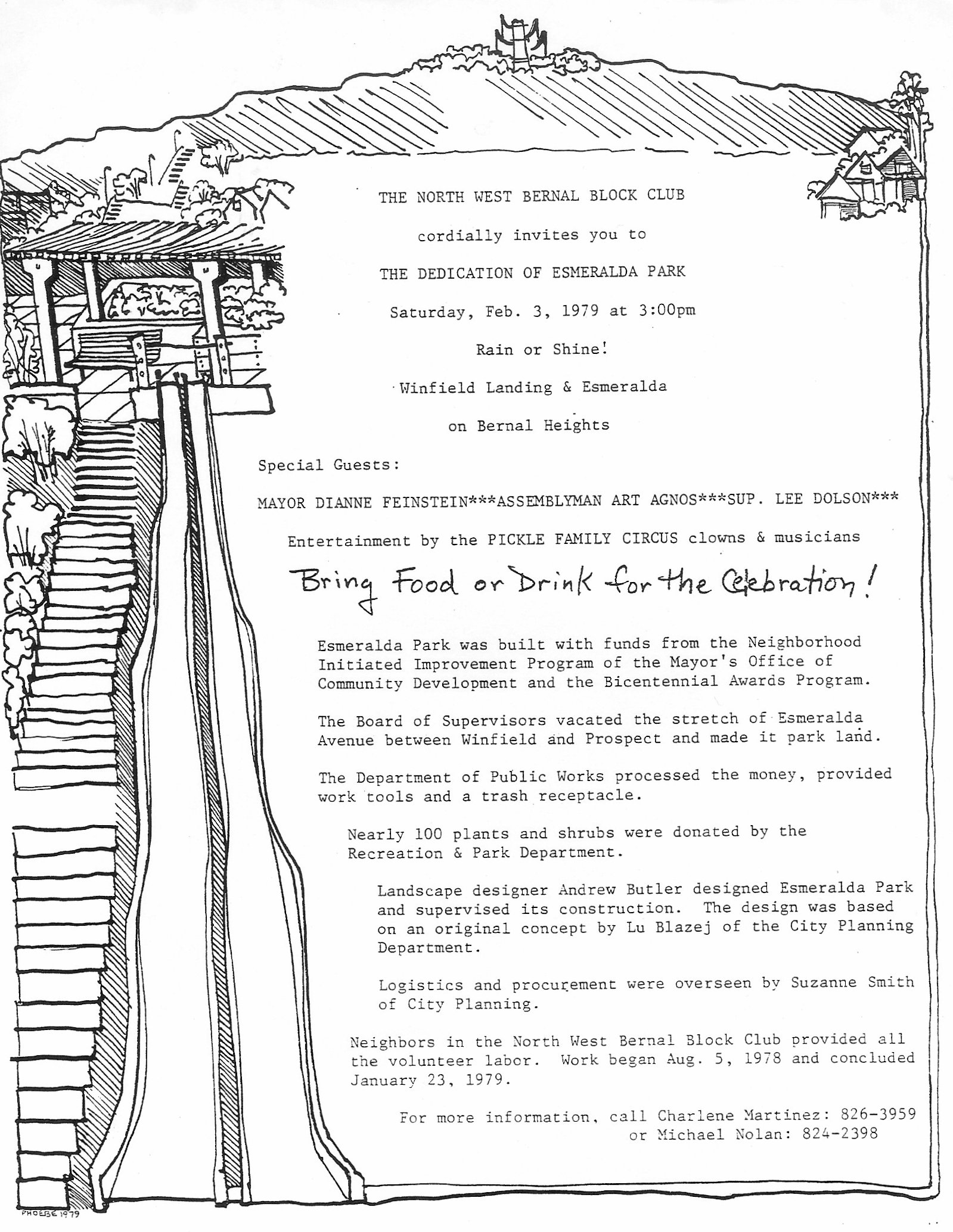
As a historical reminder, this announcement from 1979 tells us much about the community origins of the Winfield Mini-Park, and how the City once paired with Bernal neighbors to help make the park so lovely. Let’s hope that can happen again:
If you’ve already picked out the outfit you’re planning to wear for tomorrow’s Summer Stroll (PRO TIPS: boas, seersucker, vintage Mork & Mindy rainbow suspenders), then here’s a perfect way to get in the strolling spirit …
This month’s Bernal History Project meeting is a joint presentation with the good folks at our Bernal branch library. It’s a special evening dedicated to sharing the history of Cortland Avenue. We’ll be showing a selection of photos, ads, and news articles about Bernal’s main shopping thoroughfare. (Sorry, Precita and North Bernal neighbors — we promise we’ll do a slideshow about you very soon!)
We invite you to attend and bring your own memories of shopping and living on Cortland. If you’d like to say a few words on the night, please drop us a line beforehand — maybe we can get a real live show-and-tell going. Audience participation is positively encouraged!We’ll have volunteers from SFPL on hand to record your Cortland-related stories and memories. If you’d like to bring photos and news clippings to share, we can get those scanned for our archives, too.
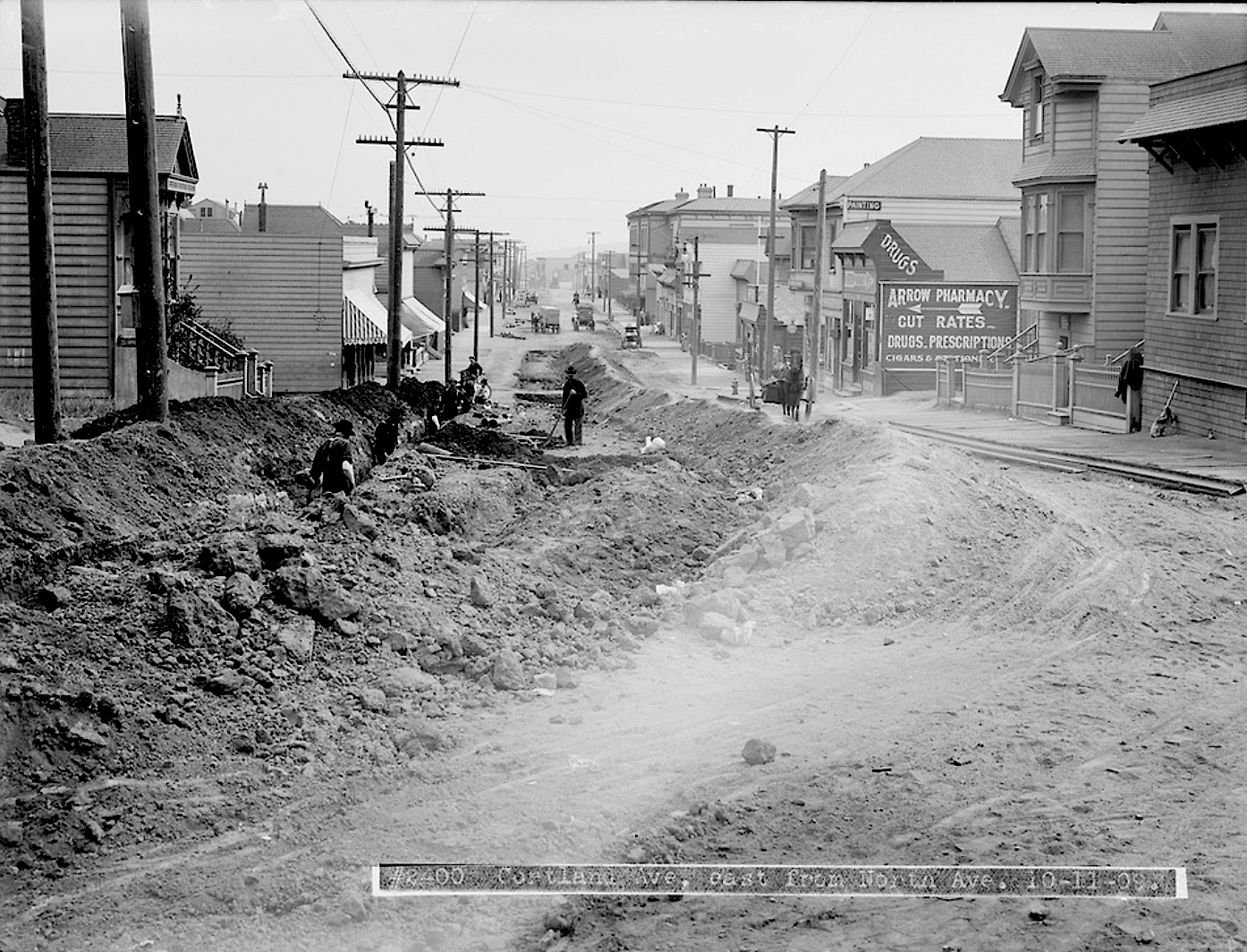
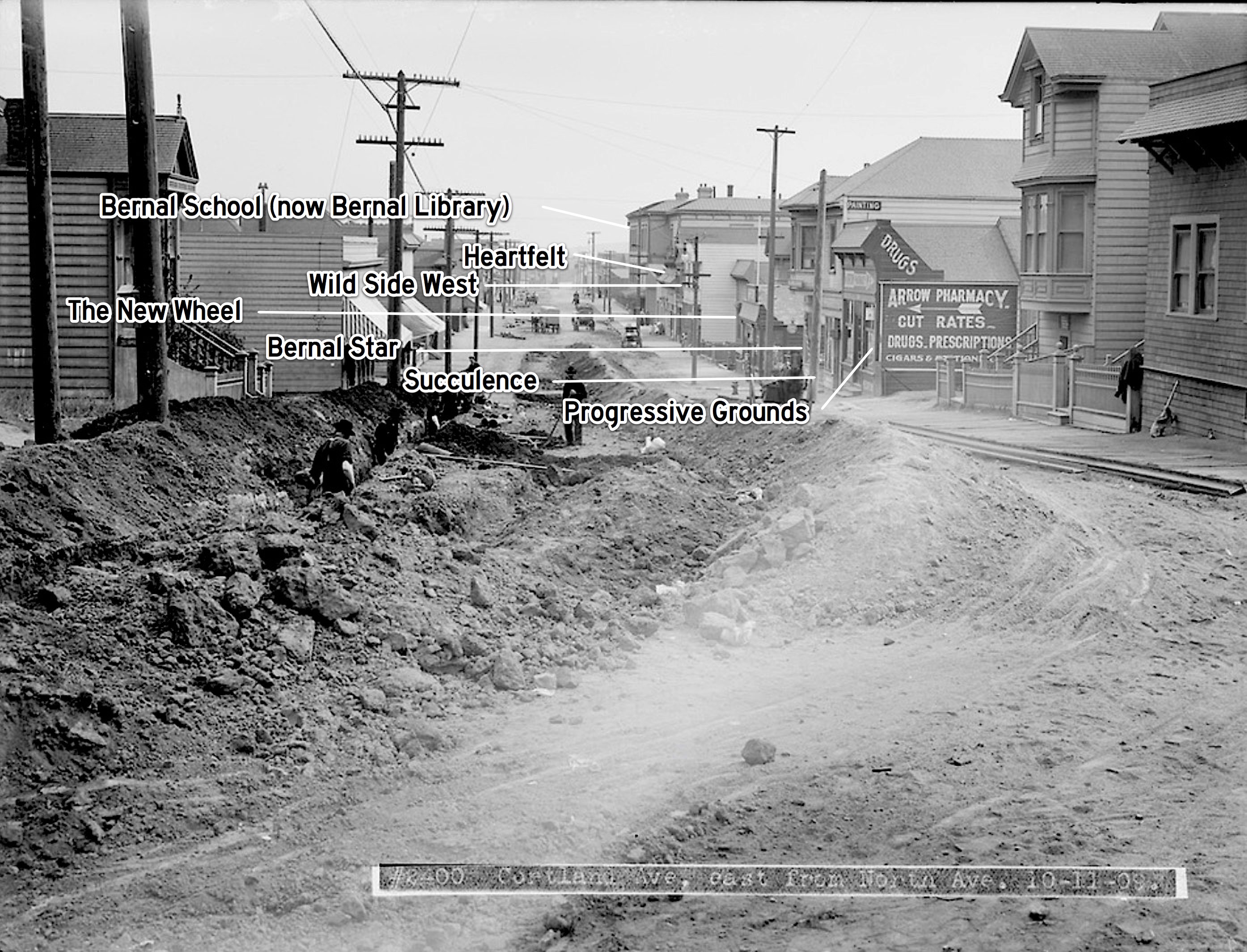
Oh, in case you’re having a hard time getting oriented to that photo up top, it’s a pitcture of Cortland avenue on October 11, 1909, looking east from Bocana. Here’s an annotated guide:
Recently, when Bernalwood mentioned a proposal to add streetscape trees to our southern stretch of Mission Street around College Hill, we mentioned in passing that it wasn’t all that long ago when most San Francisco streets and open spaces were barren and treeless.
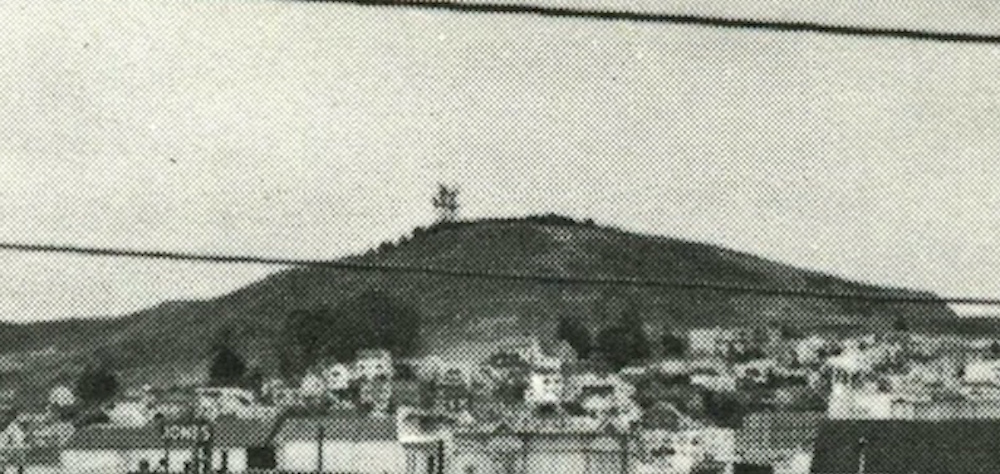
Take a close look at the view from Bernal Hill 1969, for example, and you’ll notice that Folsom Street is missing the graceful, willowy trees that now do so much to define its character. Likewise, the photo shown above is a view of Bernal Hill taken at about the same time, and it allows us to visualize how awkward our hill looked before all the trees were planted around Sutrito Tower.
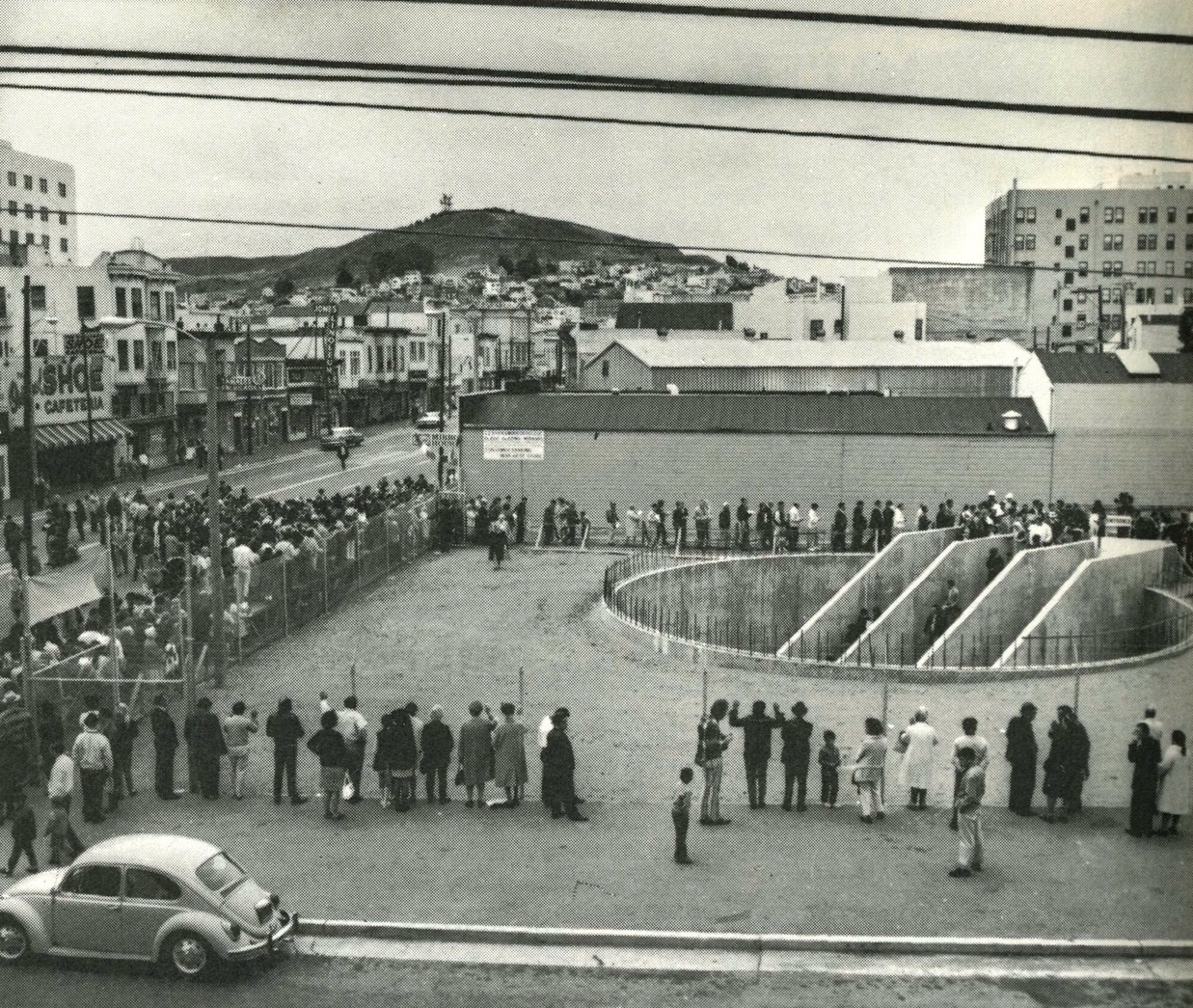
The scene in today’s photo is a special day in August, 1970 when Mission District neighbors were invited to take a sneak peek at the just-completed, but not-yet-open 24th Street BART station. The long lines reflect the intense curiosity that surrounded the opening of BART after many unpleasant years of cut-and-cover construction chaos and disruption along Mission Street.
Ah-HA! Upon closer inspection, it looks as if the big trees that now pair so gracefully with Sutrito Tower were actually present at the time, though just-planted. So in this photo we see the genesis of today’s glamorous Bernal Hill beautification, at the very moment when the trees were just taking root. Hurrah!
We’re sure a few Bernalwood readers had a hand in that tree-planting, so hopefully they’ll tell us more about how that happened in the comments.
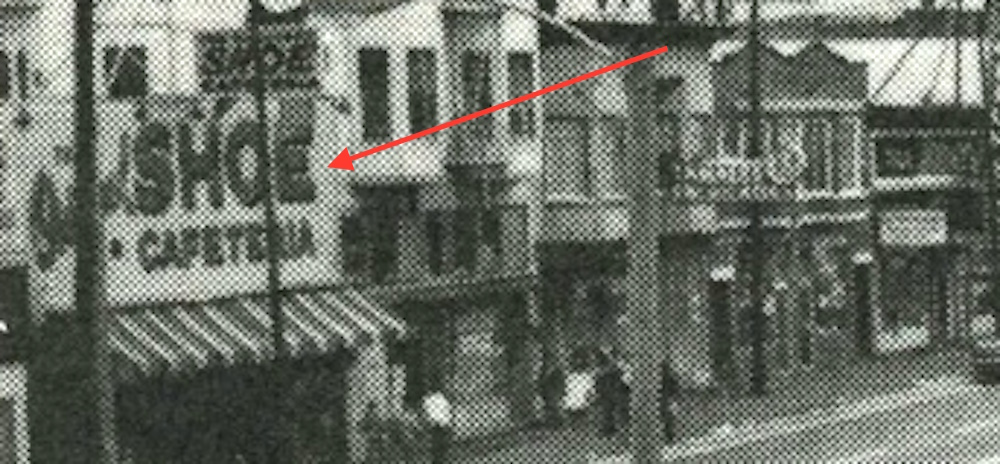
In the meantime — and far more strangely — this photo also reveals that there was a fad for footwear-inspired cuisine on Mission Street in the dawning years of the 1970s:
The Shoe Cafeteria?? Shoes??? As food??? Presumably served in a wide range of styles, with various a-la-carte sauces? Ugh. Goddamn hipsters, ruining the Mission — even back then.
There’s been a lot of thinking about flag design lately: What are the elements of a good flag? What’s wrong with bad flags? How great a really great flag can be, and how sad and useless a bad flag is.
Much of the current thinking about flag design traces back to celebrity audio person and design aficionado Roman Mars, who recently introduced us to the very geeky subculture of vexillology (the study of the history, symbolism, and usage of flags) in a very geeky episode of his 99% Invisible podcast. You can check it out here.
The key lesson from Roman’s crash-course in Vexillology 101 is that good flag design follows five basic rules:
1. Keep it simple
2. Use meaningful symbolism
3. Use two to three basic colors
4. No lettering or seals of any kind
5. Be distinctive
That kicked off a national conversation about flag design; a conversation that grew even more urgent when Roman Mars was invited to give a TED Talk on the subject:
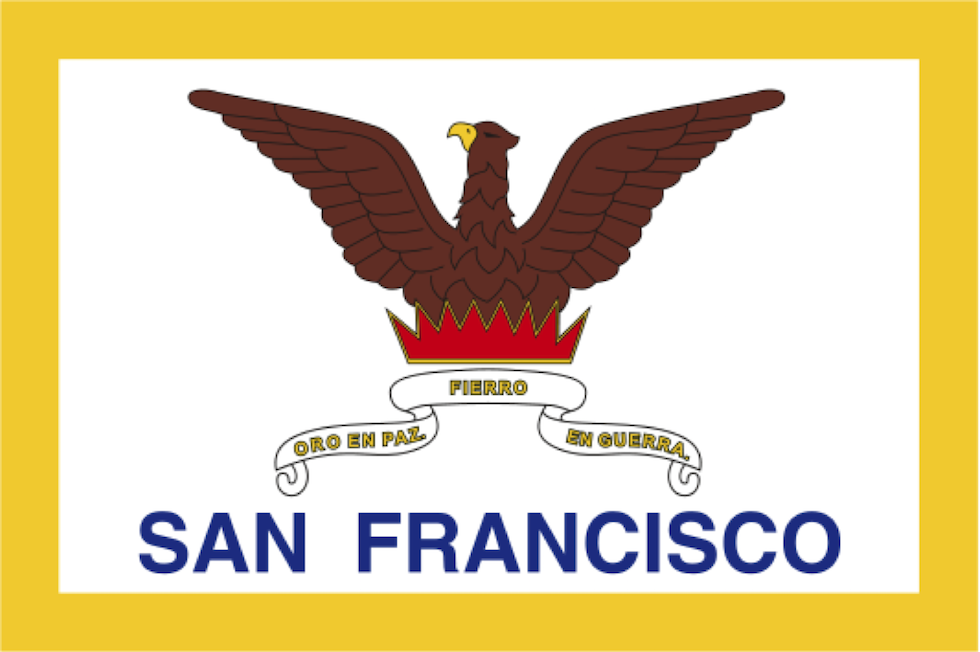
The crux of his TED Talk was that the flags of American cities are generally rather terrible, and San Francisco is a clear case in point. Very few people are familiar with San Francisco’s flag, because San Francisco’s flag is a hot steaming mess that breaks all the rules of vexillological good taste. It looks like this:
In the spirit of civic improvement, Roman Mars has kicked off a new effort to redesign San Francisco’s flag. But in the meantime, that got your Bernalwood editor thinking: What about a flag for Bernal Heights? Don’t we deserve a flag too?
Of course we do.
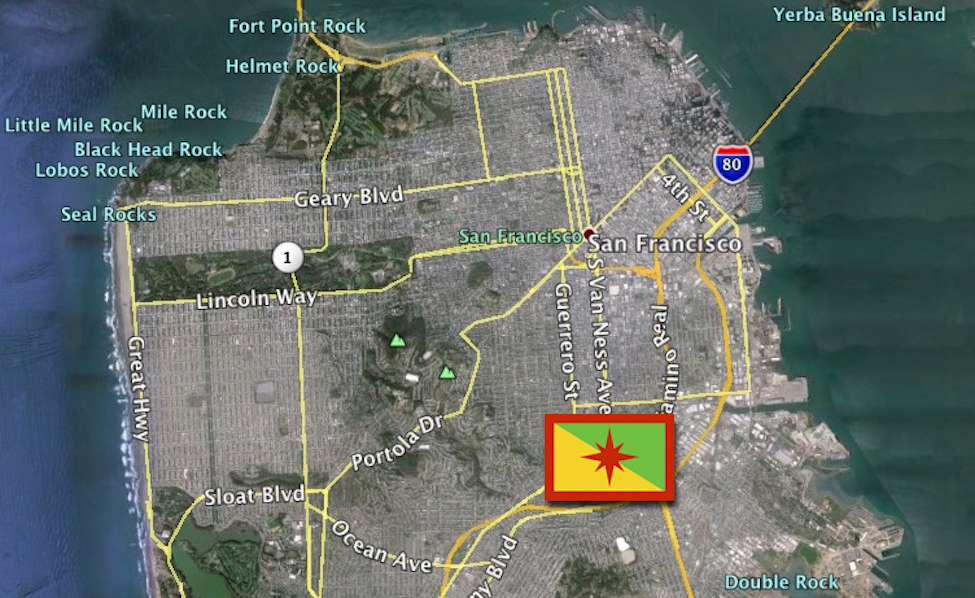
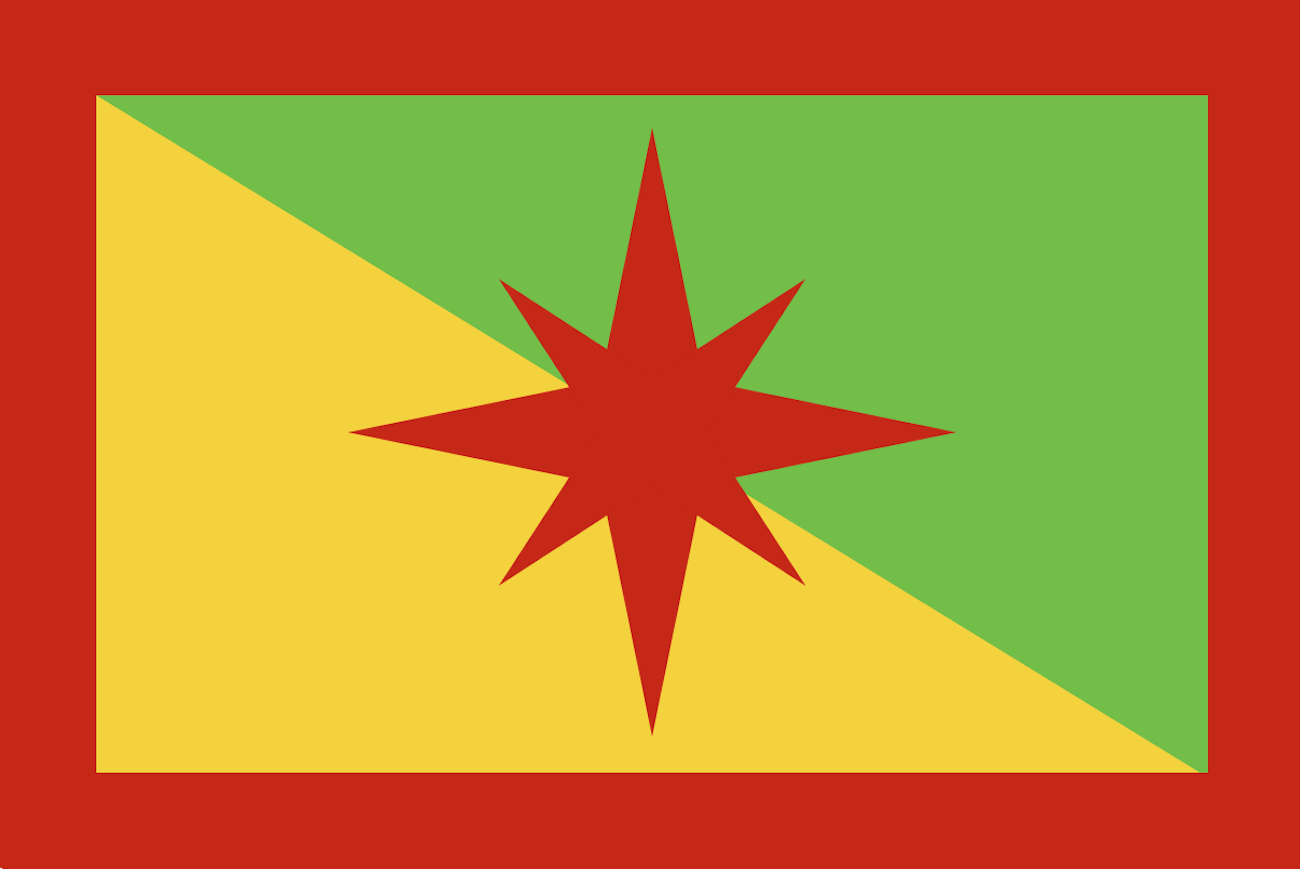
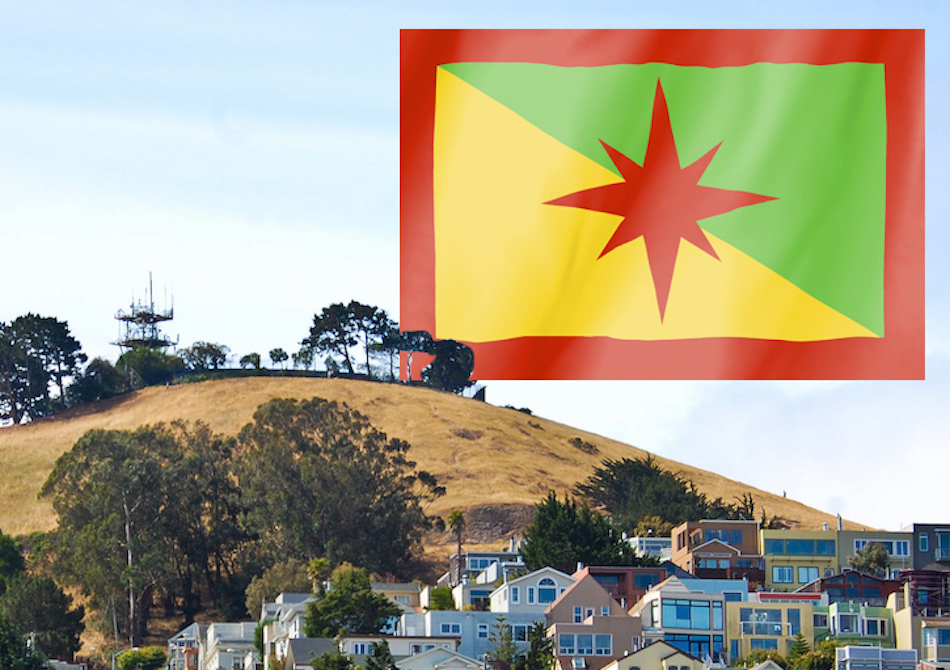
So after internalizing the design rules recommended by vexillologists, I took the liberty of developing a flag for Bernal Heights. I hope you might entertain the idea of rallying around it. Fellow citizens, I propose that all Bernalese should live in peace under this banner, the (Proposed) Great Flag of the Dominion of Bernal Heights:
Rather sporty, eh? Dynamic! Bold! Distinctive! Let’s walk through its symbolism:
The diagonal fields of green and yellow represent the two annual phases of Bernal Hill: green (winter wet) and golden yellow (summer dry).
The four sides of the red border represent the four roads that define the boundaries of our Bernal territory: I-280, San Jose Avenue, Cesar Chavez Boulevard, and US 101.
The star at the center is of course Bernal Hill, shown as a compass rose to represent the 360-degree views of San Francisco visible from the summit. The red color symbolizes both the beloved chert which stabilizes us, and the long tradition of social activism which is an important part of our neighborhood history.
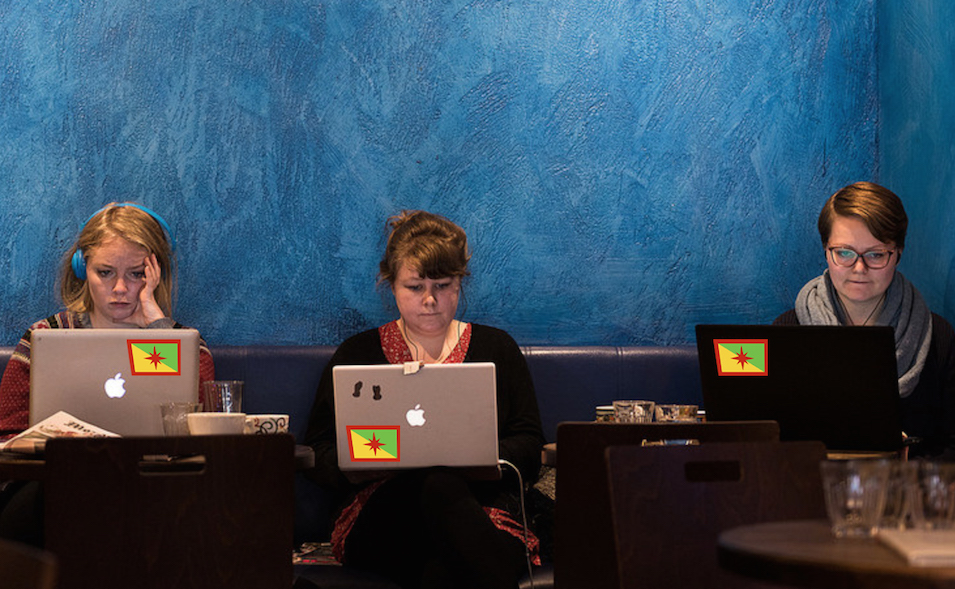
That’s my proposal. I think it’s not too shabby, at least as a first stab at a flag for Bernal Heights. Plus, it would do the trick if you wanted to quietly represent Bernal in your workplace or favorite coffee shop:
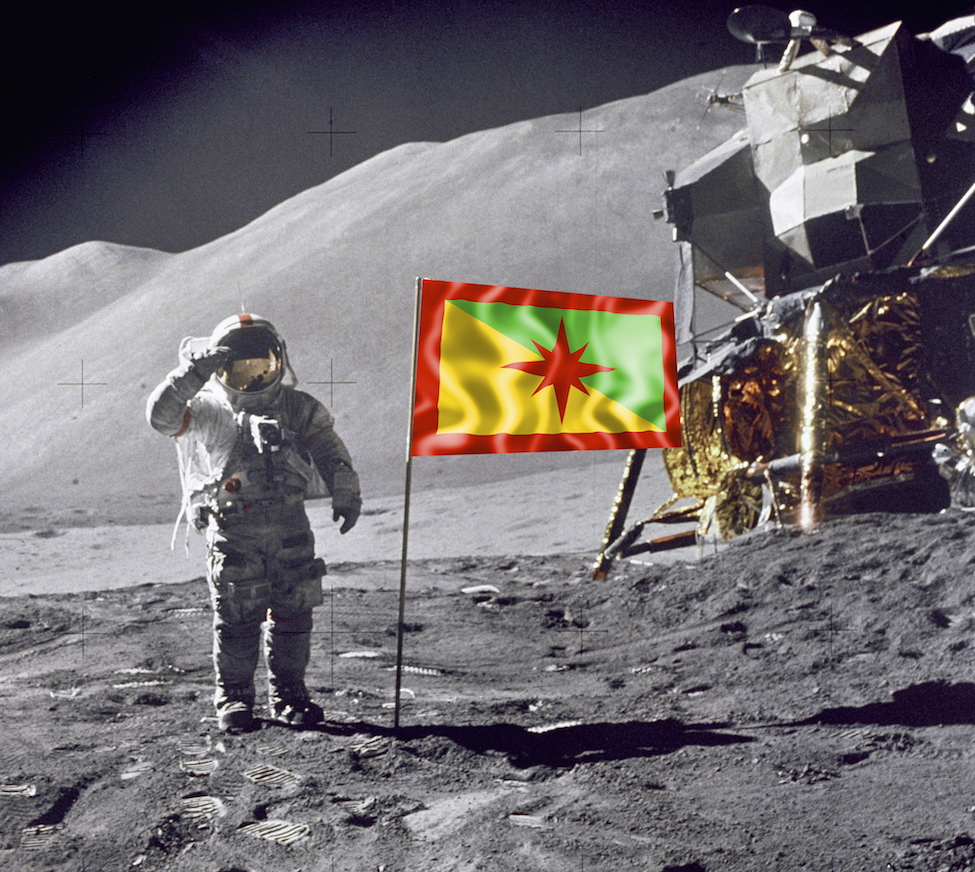
This design travels well too. No matter where you go, or whatever distant lands you conquer, you can take your Bernal Heights pride with you:
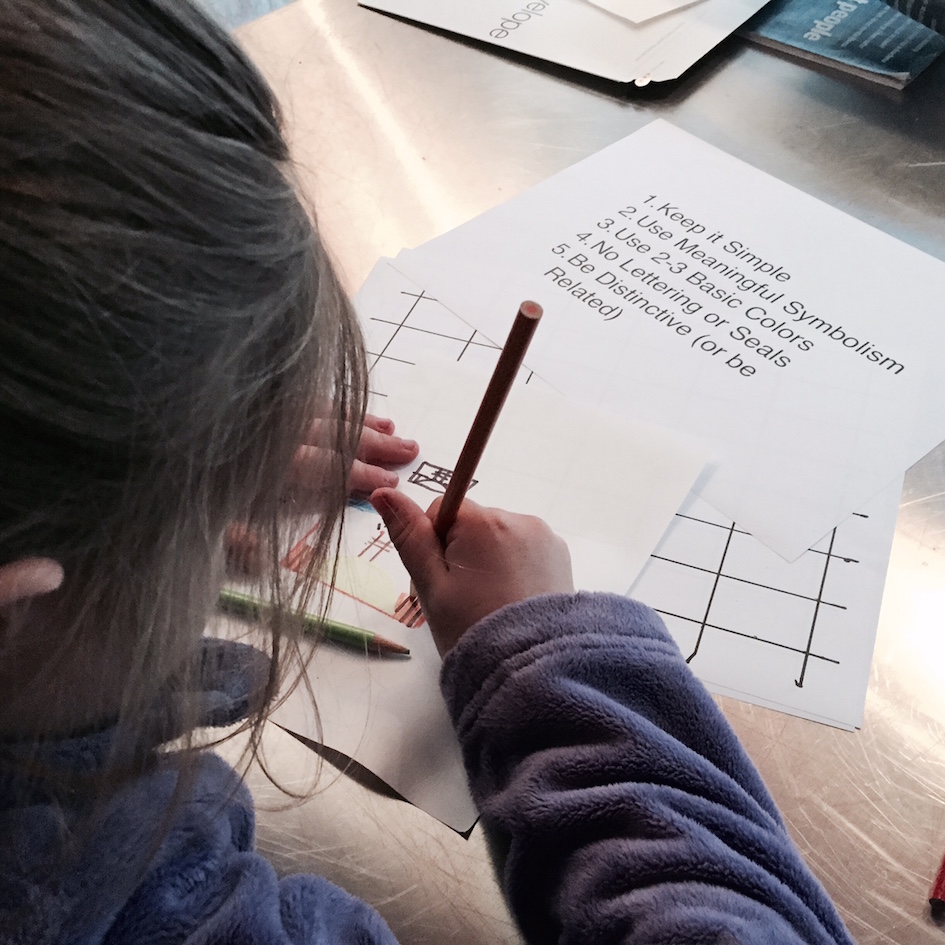
That said, there are some other designs to consider. Bernalwood’s Cub Reporter rose to the challenge, beginning with some small-scale drawings (which are recommended as a starting place to simulate the view of a flag from a distance):
Bernalwood’s Cub Reporter developed two designs. The first is a simplified view of Bernal Hill and Sutrito Tower, with tiny houses nestled along the slopes:
Her second concept is more bold. It’s a colorful interpretation of a perspective she loves; the view looking toward the sunset as you stroll west along the north side of Bernal Heights Boulevard toward Folsom in the evening:
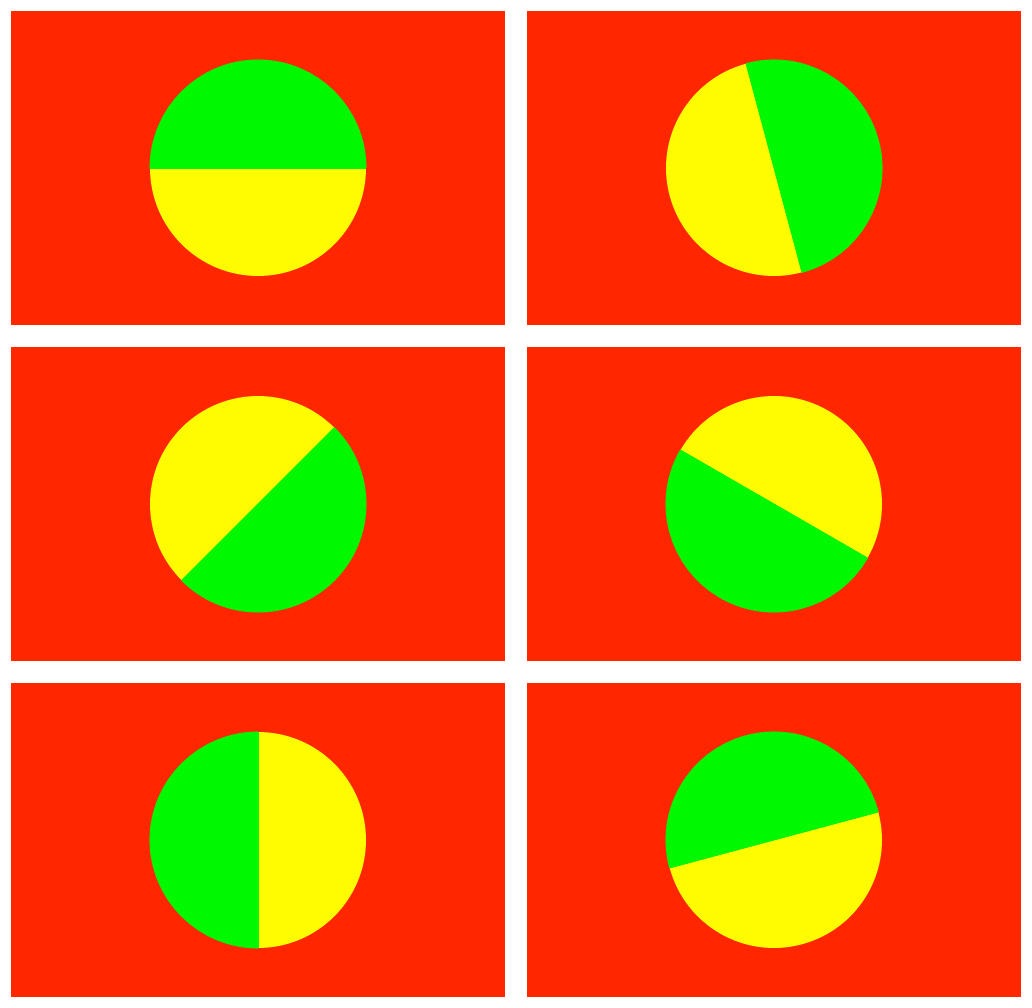
Always game for a goofy graphic design problem, Burrito Justice, rebel spokesblogger for the La Lenguan separatists, also rallied to embrace the Bernal flag design challenge. Picking up on some of the themes in my design, he came up with a clever interactive concept:
The symbolic logic? Burrito Justice explains:
Green hill, yellow hill, chert background… You turn the flag over depending on the season.
Nice! To bring some further innovation to the idea, Burrito Justice then proposed the world’s first animated GIF flag:
Burrito Justice calls it “a flag for all seasons.”
Your Bernalwood editor called it “hard to sew.”
Burrito Justice explained, “Yeah but imagine the sales, people would need a new one every two weeks!” (Which is actually rather diabolical and brilliant.)
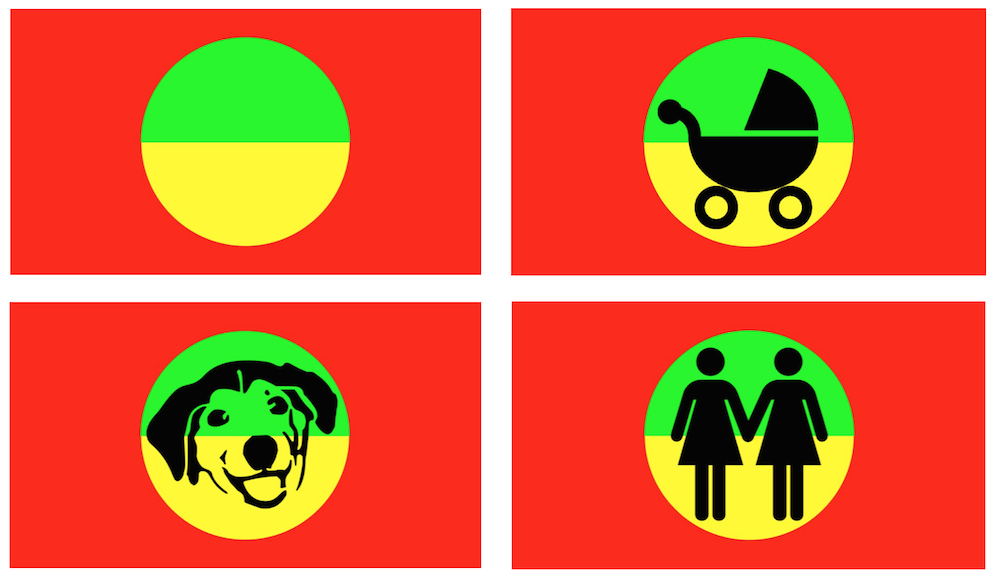
But of course, he couldn’t stop there. Next, Burrito Justice created a few more versions of his flag to celebrate Bernal’s most iconic residents:
Sigh.
Bet hey, maybe you have a better idea for a Bernal flag?
If so, send it to us here at the Bernalwood Office of Vexillological Research or drop it in the comments, and we’ll share any additional ideas for Bernal Heights flags with the Citizens of Bernalwood soon.
IMAGES: Bernalwood Office of Vexillological Research
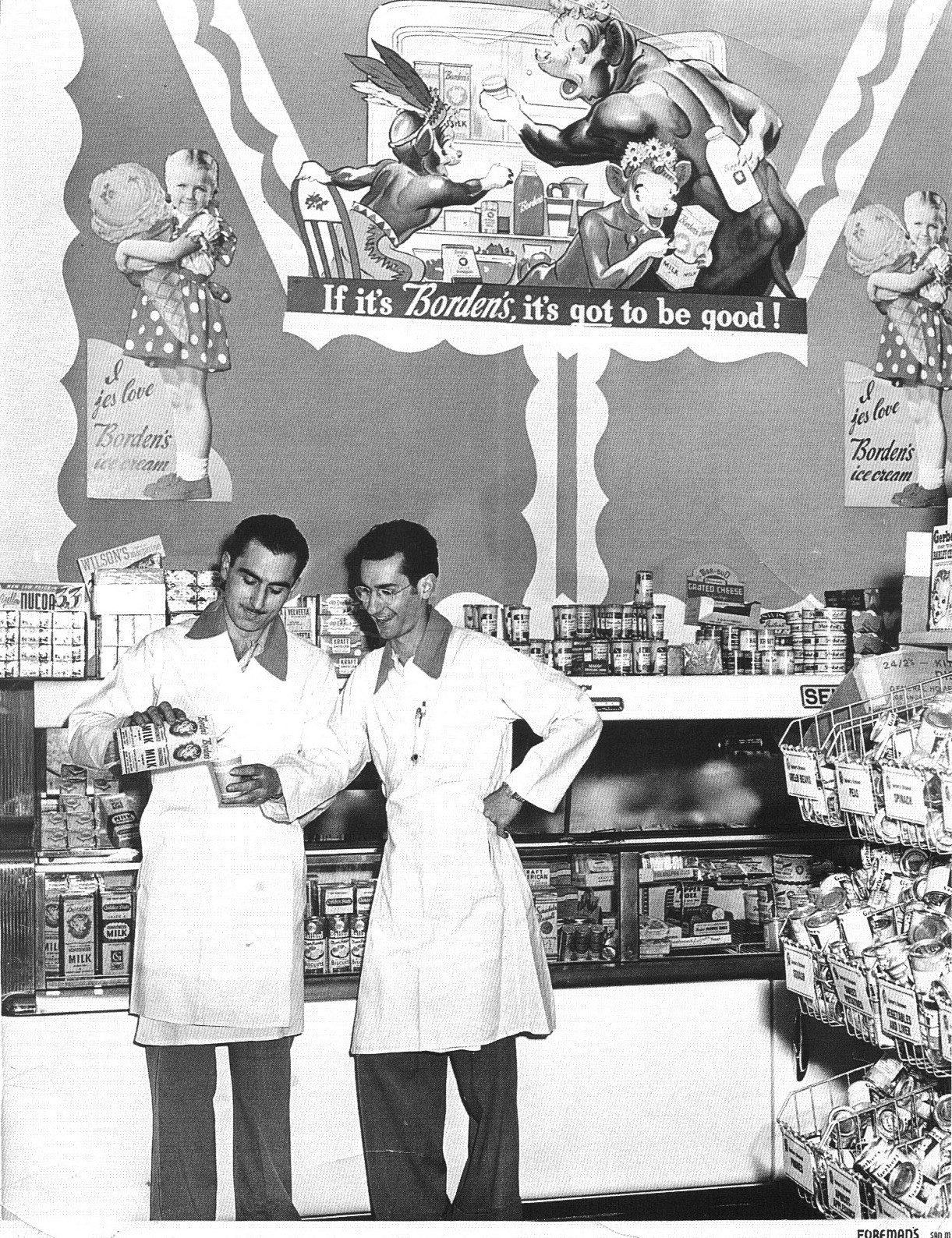
Recently, Scott Frisner shared a photo with the San Francisco Remembered group on Facebook. It was taken on the western end of Precita Avenue just off Mission in the 1940s. Scott writes:
My late father-in-law, Orlando Colosimo, on the left, and his brother Don at their recently purchased market in 1949. They kept the original name, Baireuthers Market and from what I can find, it was located at 29 Precita near Bernal Heights. Anyone remember it?
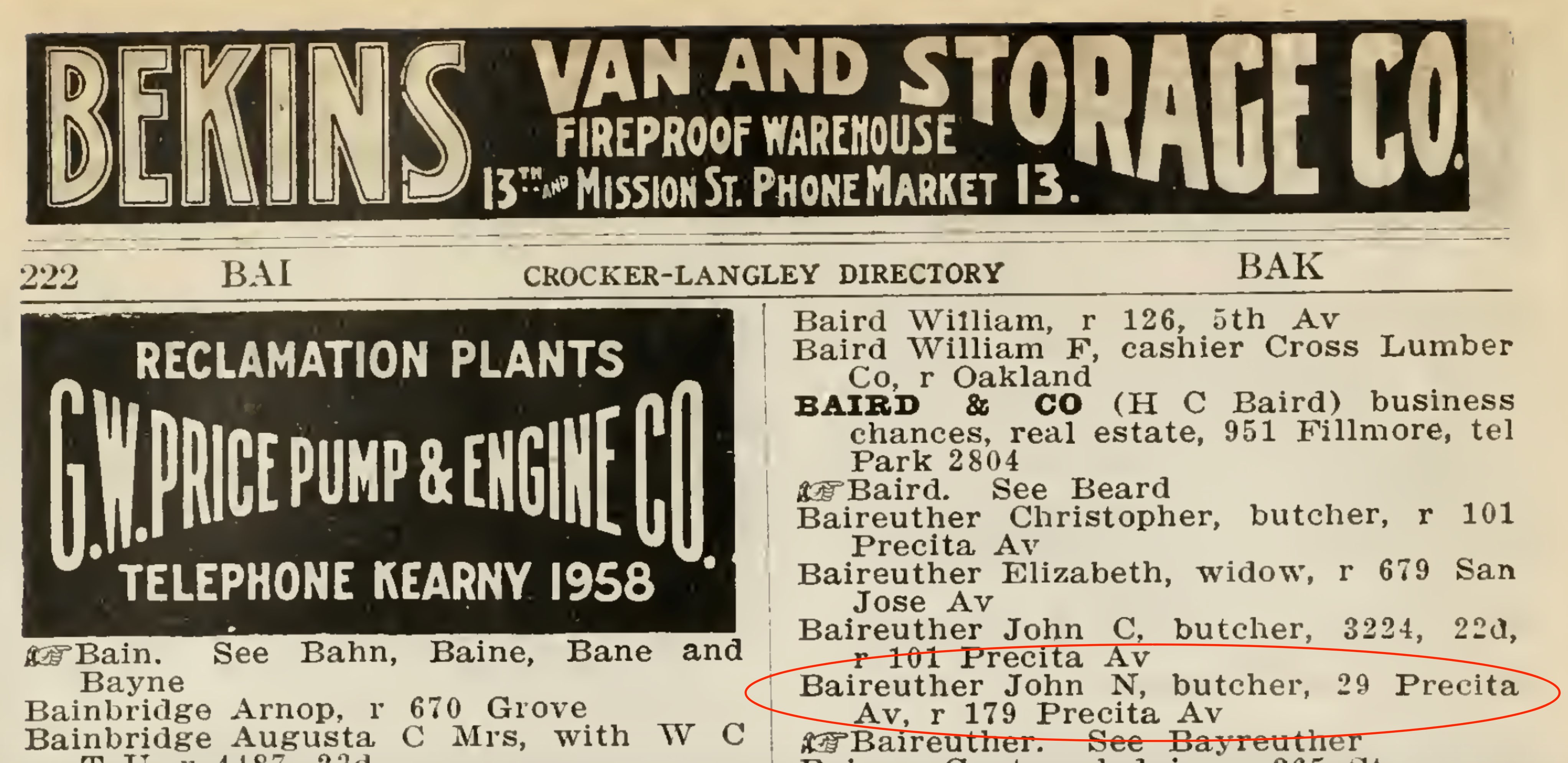
Baireuther’s Market opened in the early 1900s, and it was operated as a butcher shop by John N. Baireuther, who lived nearby for a time at 179 Precita. Here’s a detail from a 1908 San Francisco Directory:
Orlando and Don Colosimo took over the store some 30+ years later.
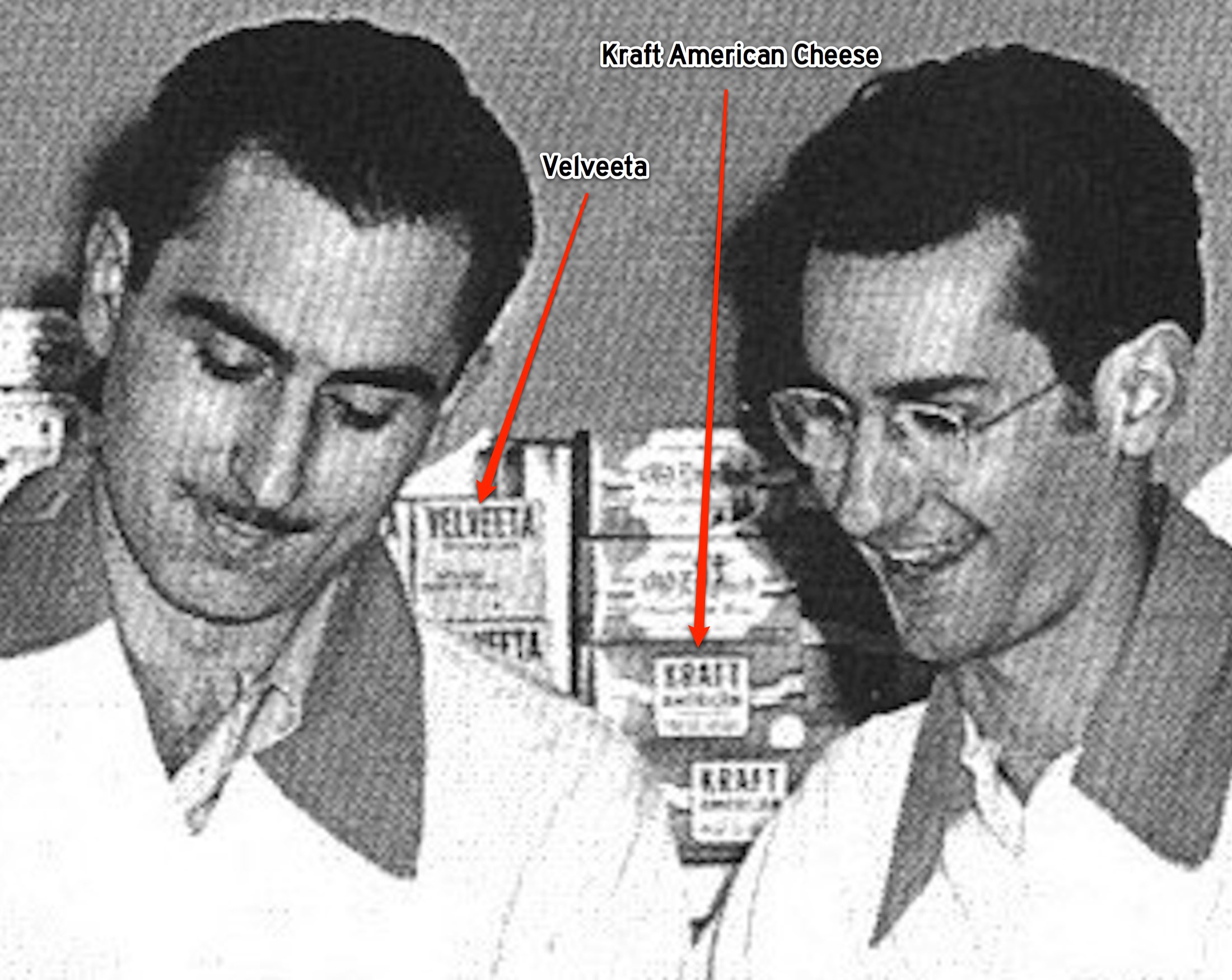
This a wonderfully vivid photo of them, and it contains some great details of mid-century packaged food. For example, when we zoom and enhance the image, we can see the meticulously curated selection of artisanal cheeses perched between Orlando and Don:
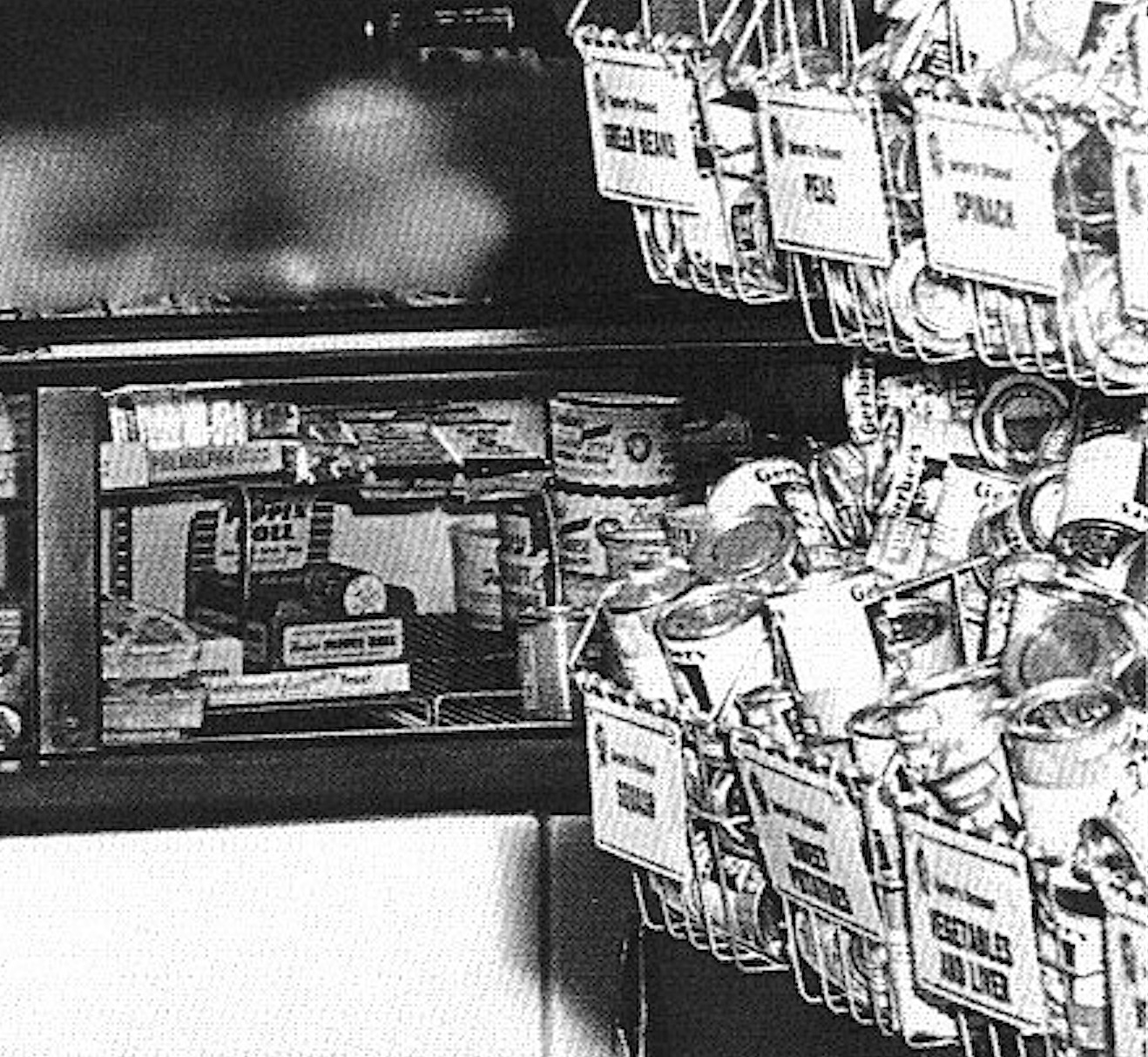
The selection of Gerber baby foods at bottom right was equally twee, with wholesome goodness freshly canned in tasty flavors such as green beans, peas, spinach, squash, sweet potatoes, and vegetables and liver. Yum!
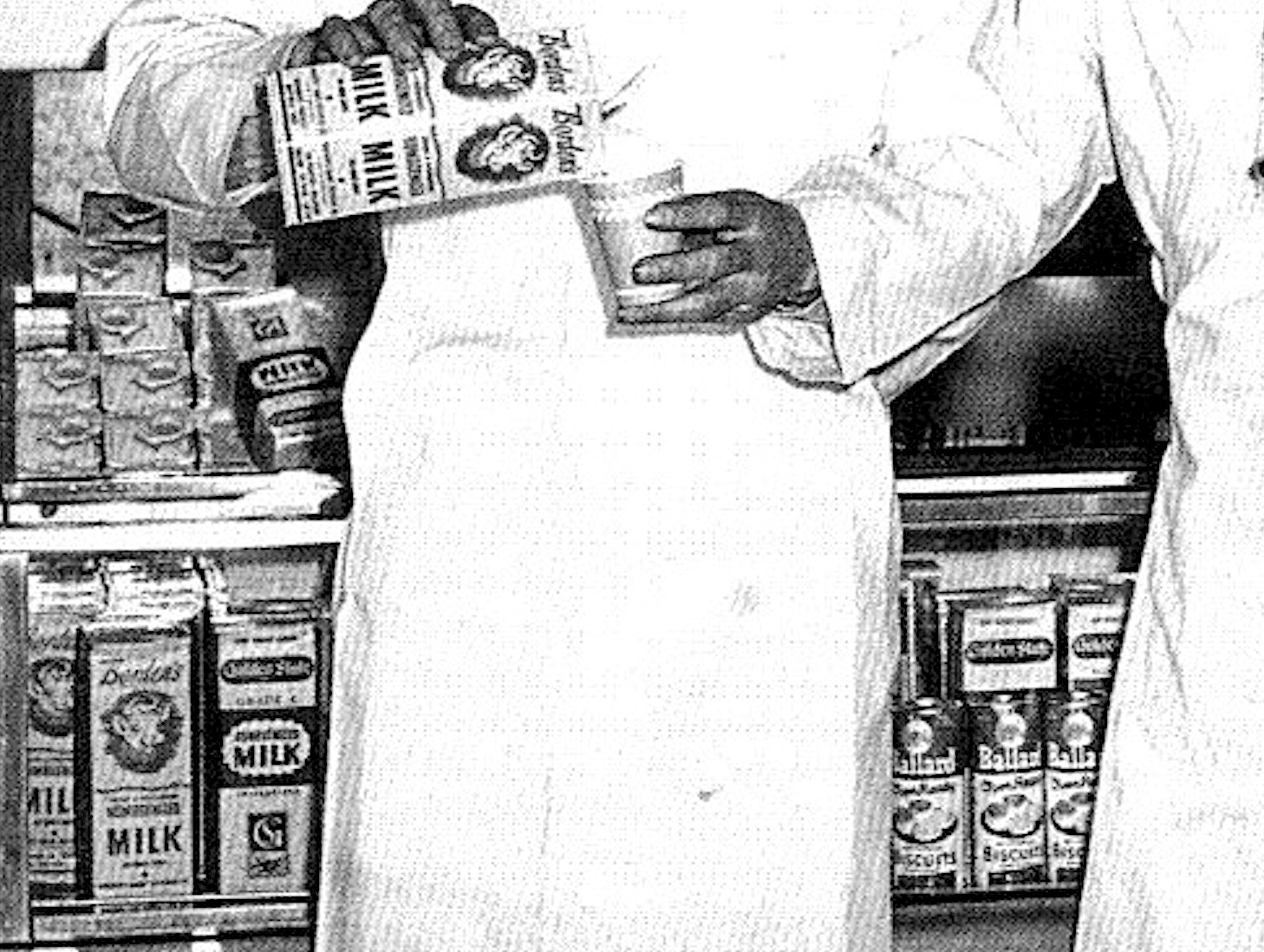
In the refrigerated case we find cartons of Borden’s milk on the left, featuring the smiling bovine visage of Elsie the Cow:
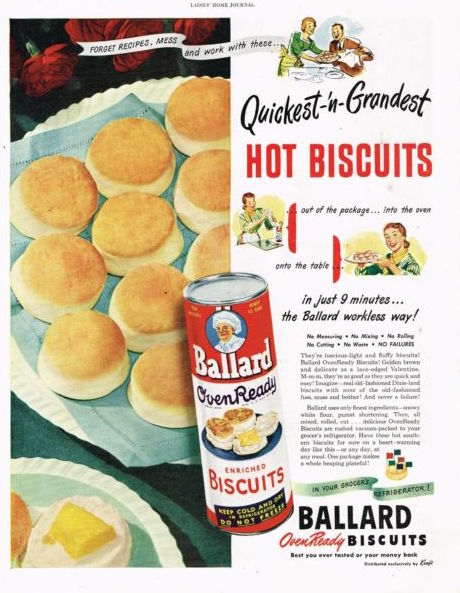
On the right, just between Orlando and Don’s hips, we see a few tubes of Ballard Oven-Ready Biscuits, ready to bake in your very own home. If you had a copy of Ladies Home Journal in your sitting room back then, this 1949 advertisement might have sent you running to Baireuthers Market to get some biscuits to make “the Ballard workless way”:
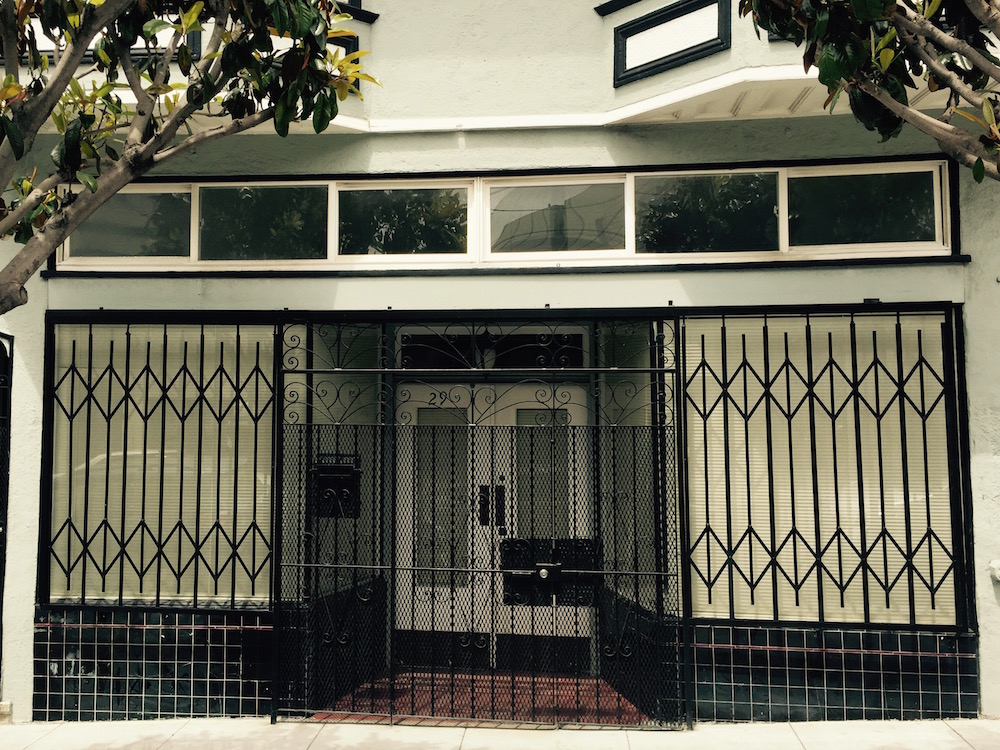
Today, Baireuthers Market is no more, and the space it used to occupy has been converted to all-residential use. Yet the facade at 29 Precita hasn’t changed much from the Baireuthers days, and it still looks like a neighborhood market from the outside:
So even now, it’s not hard to imagine walking inside to say hello to Orlando and Don, pick up a few groceries, and talk about the weather a little bit before you rushed home to bake those Ballard Biscuits, which would be ready to eat just nine minutes later.
In case you missed it, there was a fun article in the fashionable Home and Garden section of last Sunday’s San Francisco Chronicle celebrating Bernal Heights, and the local tribe of enthusiasts from the Bernal Heights History Project who bring our neighborhood’s past into the present.
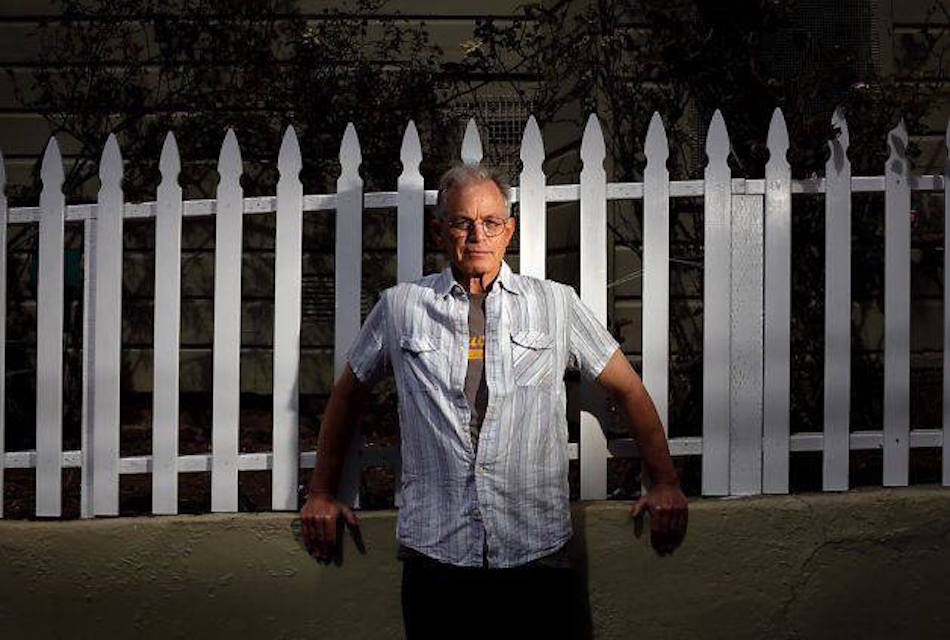
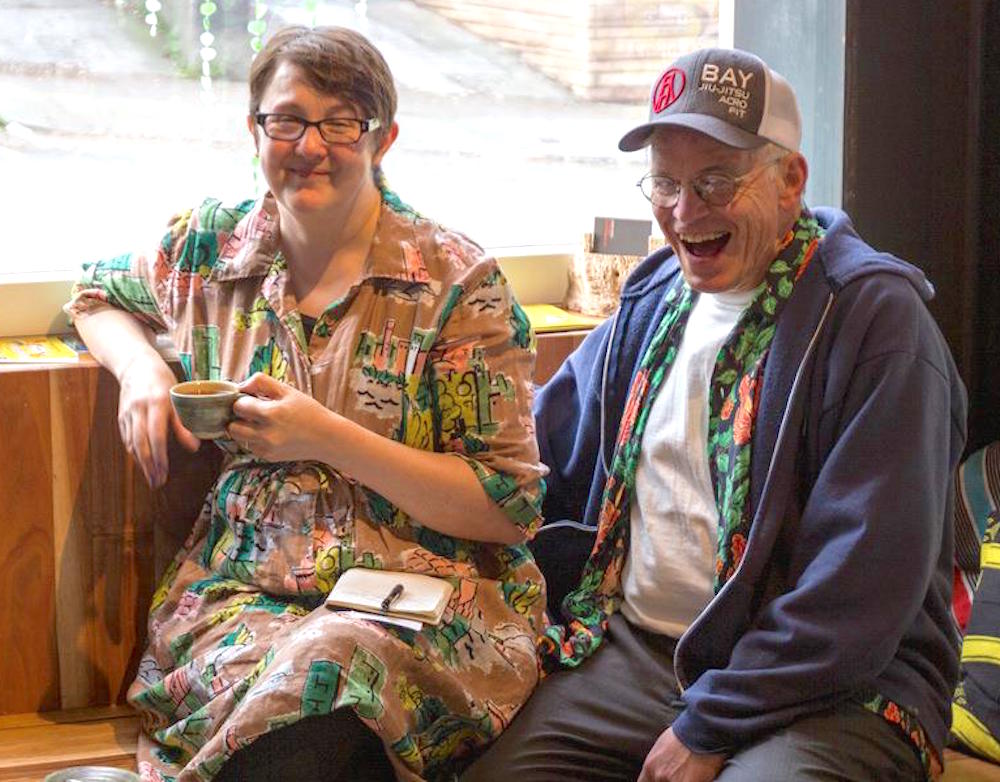
Michael Nolan’s home on a rolling block in San Francisco’s Bernal Heights is filled with the past. Black-and-white photos from his youth hang on the walls and family keepsakes sit on shelves, but they’re mixed in with neighborhood artifacts, like railroad tools from the late 1800s found buried in Nolan’s backyard.
A passionate genealogist and the convenor of his family reunions, Nolan is now focused on building a different kind of family tree: the genealogy of his house.
Nolan, 73, is one of many Bernal Heights residents hooked on recording the history of their homes and the neighborhood. Some homeowners might conduct this type of research during a renovation, to replicate the design features original to the property. But these self-made historians want to connect the present with the past, when neighbors were close friends and felt a strong sense of community.
“We’re pretty tight on this block,” said Nolan, who helps organize annual block parties and regular potluck dinners. “We try to support one another in times of celebration and need. It’s not easy to do. … People lead very busy lives. We do what we can on this little piece of earth.”
Bernal Heights lies between highways 101 and 280 near San Francisco’s Mission District. More than 24,000 residents live in this colorful community filled with coffee shops, restaurants and views from every hilltop. The area contained few homes until the 1906 San Francisco earthquake, when many were drawn to build on its stable bedrock. Now a dozen earthquake shacks, which were used as temporary housing after the 1906 quake, sit near modern, contemporary homes interspersed with updated Victorians and smaller, old cottages built in the late 1800s.
Later in the piece, we meet Neighbor Vicky Walker, high priestess of the Bernal Heights History Project, who was thrilled to learn that her home came with a spookiness pre-installed:
Walker lives on Ellsworth Street just a few blocks from Nolan […] and she’s equally immersed in learning about her home. Walker has traced the name of every owner of the Ellsworth Street residence, which was built in 1927. Her first bit of data came in 2003 on the day she moved into the home. Her husband, Wade Walker, was unloading the moving van when a neighbor came by and shared an unexpected gruesome detail: The property was the site of a 1976 husband-wife murder-suicide.
Vicky Walker was fascinated. “I’m kind of a gore hound, and I’m interested in ghosts and crimes and stuff,” she says. She later visited the library where she researched The San Francisco Chronicle archives and located stories about the crime. She learned that the wife, Lovera “Jodie” Satava, was fond of cats, just like Walker. “I’d be talking out loud to Jodie and saying, ‘I hope you like the cats.’ It’s like having ghosts you can talk to.”
PHOTO: Above, Vicky Walker and Michael Nolan at Pinhole Coffee last February, via Michael Nolan. Below, Holly Park Meat Market at 231 Cortland Ave, current site of Pinhole Coffee, date unknown.
If you’re planning to attend the fashionable Bernal Heights history show-and-tell tonight, you’ll likely hear mention of the SFMTA Photography Department & Archive. That’s the wonderful, searchable online photography collection that documents various infrastructure and public works projects in San Francisco dating back to the earliest years of the 20th century. It’s a gold mine.
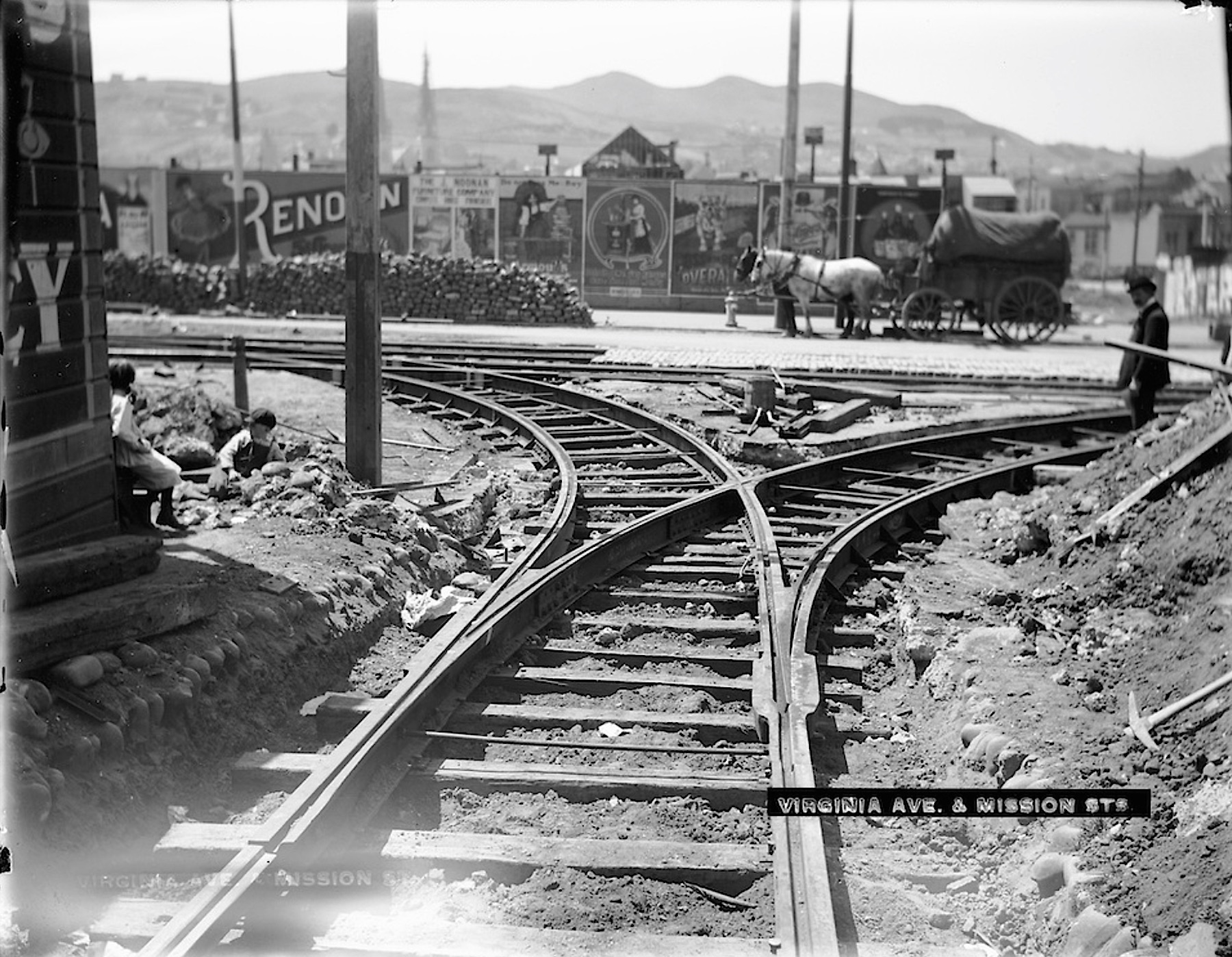
The photo above is a sample from the SFMTA archive, and it’s a gem. It’s a view of Virginia Avenue at Mission, looking west, as it looked on June 8, 1904. To help you get oriented, today, this is the view looking toward the Bernal Safeway. The old Emmy’s Spaghetti Shack would be on the left, and the Pizza Hut-that-shall-not-be-spoken-of is on the right.
But in this photo, all that was still a century away. In this photo, we can clearly see the spires of St. Paul’s church off in the background, along with the pre-Sutro Tower nakedness of Twin Peaks:
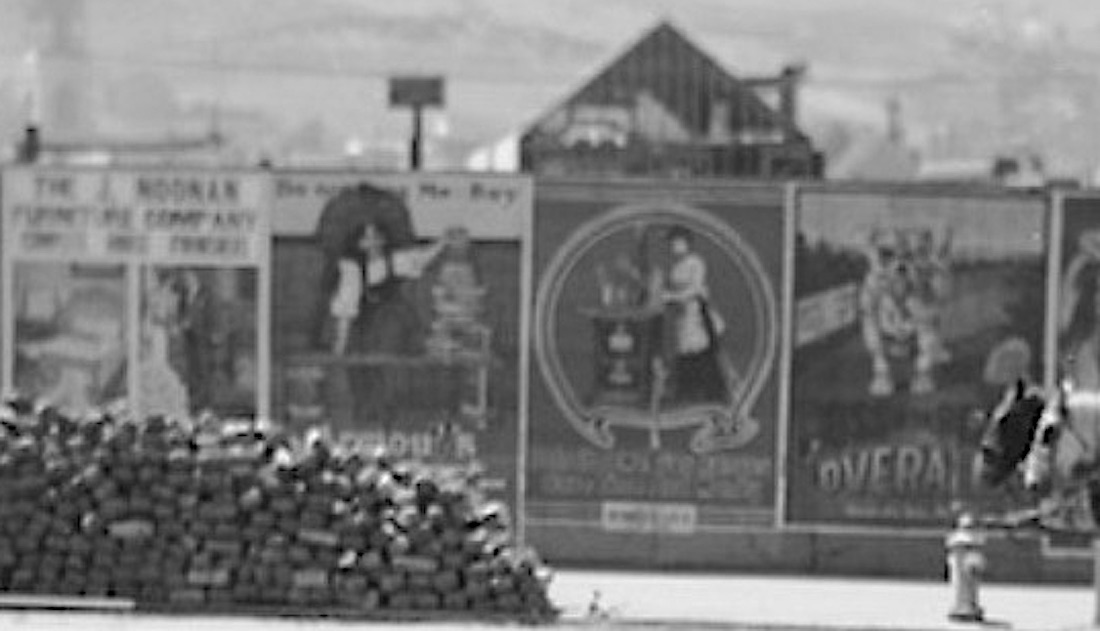
Let’s take a closer look at those fantastic advertising billboards on the fence:
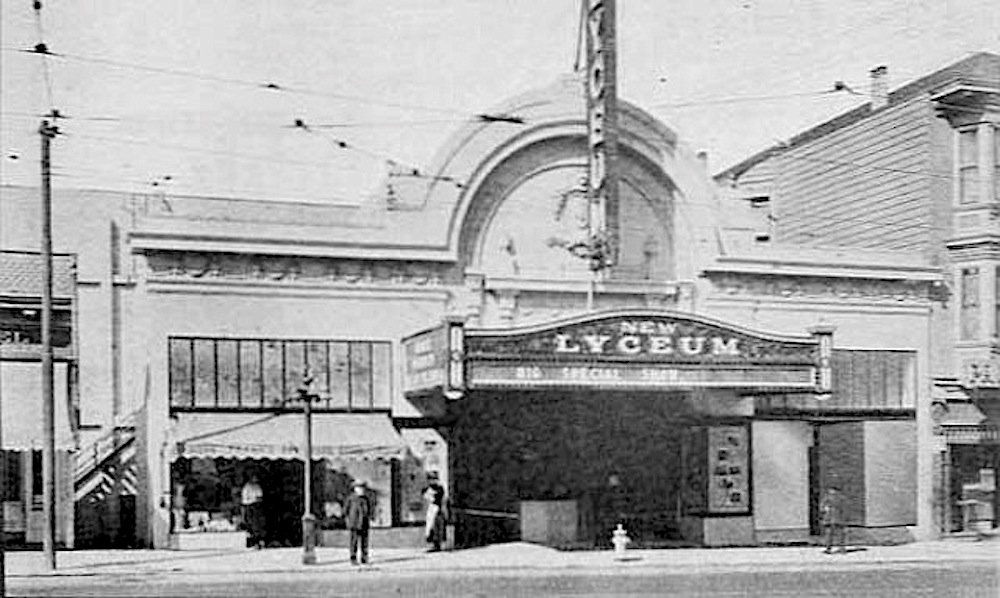
The photo above was taken in the 1920s, and a brief history of the 1400-seat Lyceum lives on at the Cinema Treasures website:
The Lyceum Theatre opened in mid-1907, with vaudeville and motion pictures. By the late-1920’s it was featuring Vitaphone Talking Pictures, and remained a popular low priced, late run house for patrons of the outer Mission district for the next twenty-five years.
Like so many other secondary houses, it was one of the first to feel the impact of television in the early-1950’s, and, after several closings and re-openings, became the temporary home of the San Francisco Revival Center [church], before they moved to the former State/Del Mar (q.v.) which they then made their permanent home.
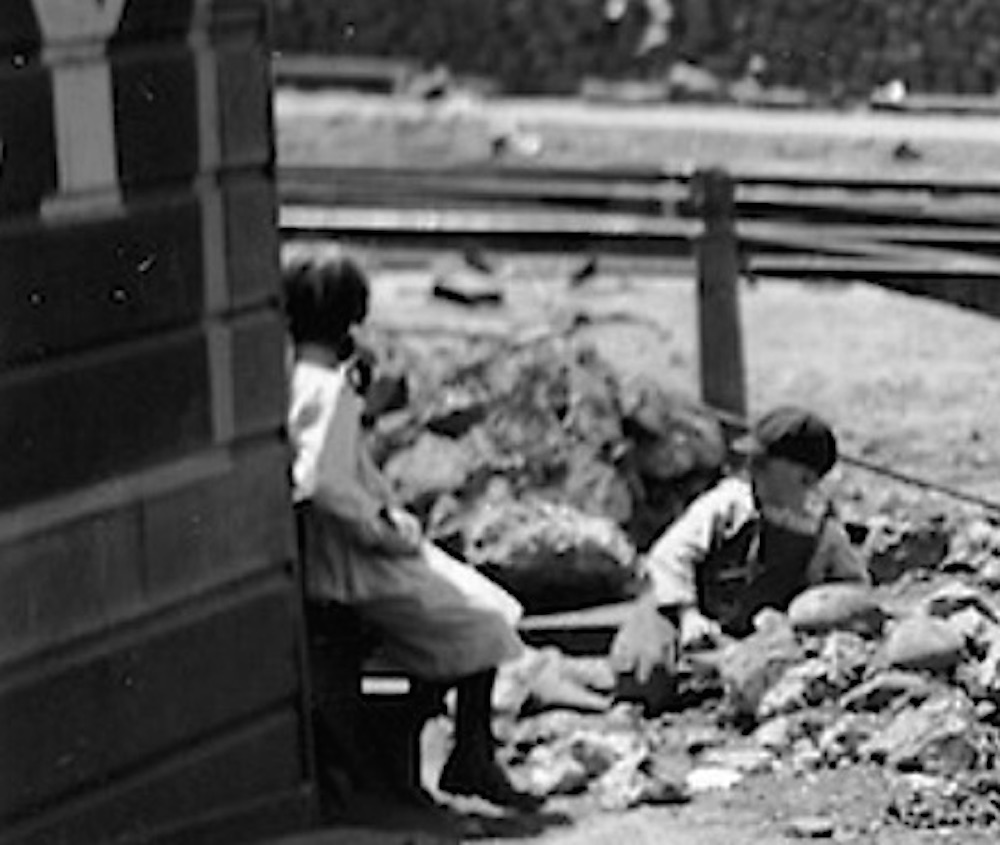
Notice how much parallelism there is between then and now. We can still see the spires of St. Paul’s church. Twin Peaks are still there, of course, having now sprouted a Sutro Tower. Fortuitously, they were even doing some work on the street last weekend — although that laborer kid has now been replaced by a tracked mini-excavator. After 111 years, this is what progress looks like.
PHOTOS: Top, Virginia at Mission, June 1904 via SFMTA Photography Archive. 2015 photo by Telstar Logistics
Your time-sleuthing neighbors from the Bernal Heights History Project are having an open-mic night for history geeks at the Bernal library tomorrow night, and you should geek-out with them:
Our regular monthly show-and-tell meeting is on Wednesday, April 15, at 7 p.m., downstairs in the Bernal library meeting room. Bring your photos and stories to share.
We’re hoping to have a mini-slideshow of our latest finds, including details on the artist who painted the mural at the Cherokee bar (now The Lucky Horseshoe) and some more Bernal Mystery Project pictures via the SFMTA Photography Department and Archive. If you have pics you’d like us to include and talk about, email them to us at info@bernalhistoryproject.org.
My husband and I just recently bought a home in Bernal (Elsie St.) after living 11 years in the Haight. We absolutely love it here… the people, the sense of community, the weather, and the great restaurants are just some of the things that make us happy to now call Bernal Heights our home.
While my husband and I are new to the hood, the hood isn’t new to me. In fact, some of my life’s happiest memories were made right here in Bernal. My grandparents owned their home on Holly Park Circle for nearly 60 years. My grandmother (Mercedes) was from El Salvador and my grandfather (Donald) was a San Francisco native who served in the Navy and worked as a house painter, a taxi driver and finally a longshoreman. My great aunt (Rosita), also from El Salvador, lived on Coleridge for nearly as many years.
My mom (Sylvia) and her siblings grew up here, and in many respects so did I, along with my brothers and cousins. Grandma’s house was where we made our Christmas tamales. It was where we spent our summer, winter and Easter breaks… where we celebrated holidays, birthdays, and other important milestones. It was where we all came to truly understand the importance of family. When we sold my grandparents’ house in 2009, I never imagined that I would ever be back in the neighborhood that meant so much to me.
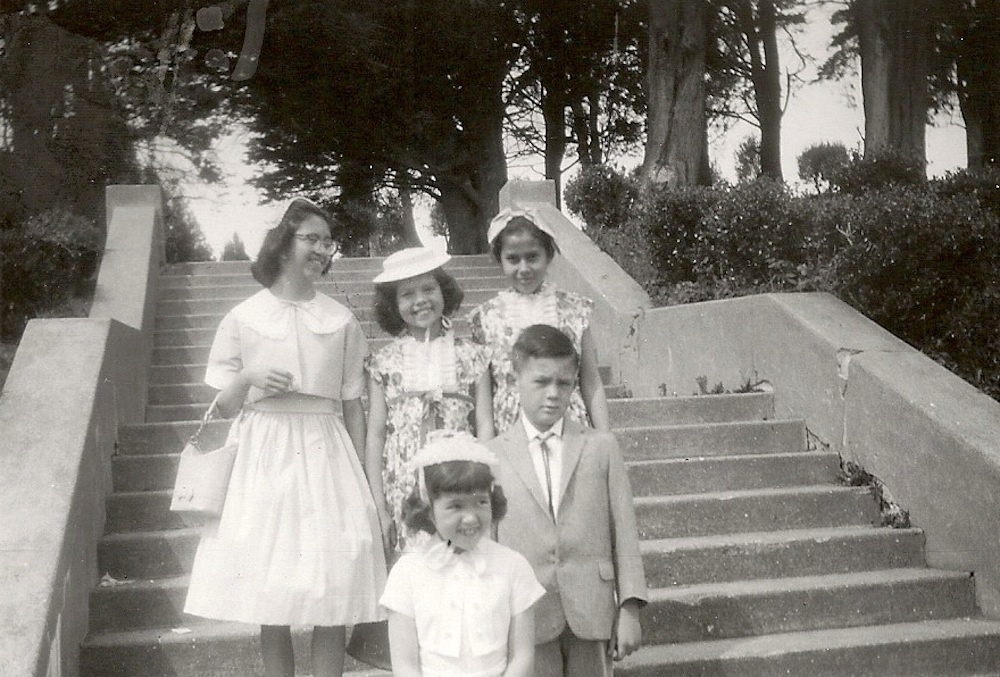
With Easter coming up, I thought I would share a photo of my mom (center) and her siblings on Easter Sunday 1959. The photo was taken on the steps of Holly Park at Highland across the street from their house. Another Easter friendly fact: Each of these smiley-faced kids received their first holy communion at St. Kevin’s on Cortland.
Neighbor Michael Nolan, team captain of the Elsie Street Glee Club, brings some cool news about a new photo exhibit opening this evening at the fabulous Pinhole Coffee on Cortland:
Why Worry About the Future When You Can Wallow in the Past is my mantra for March.
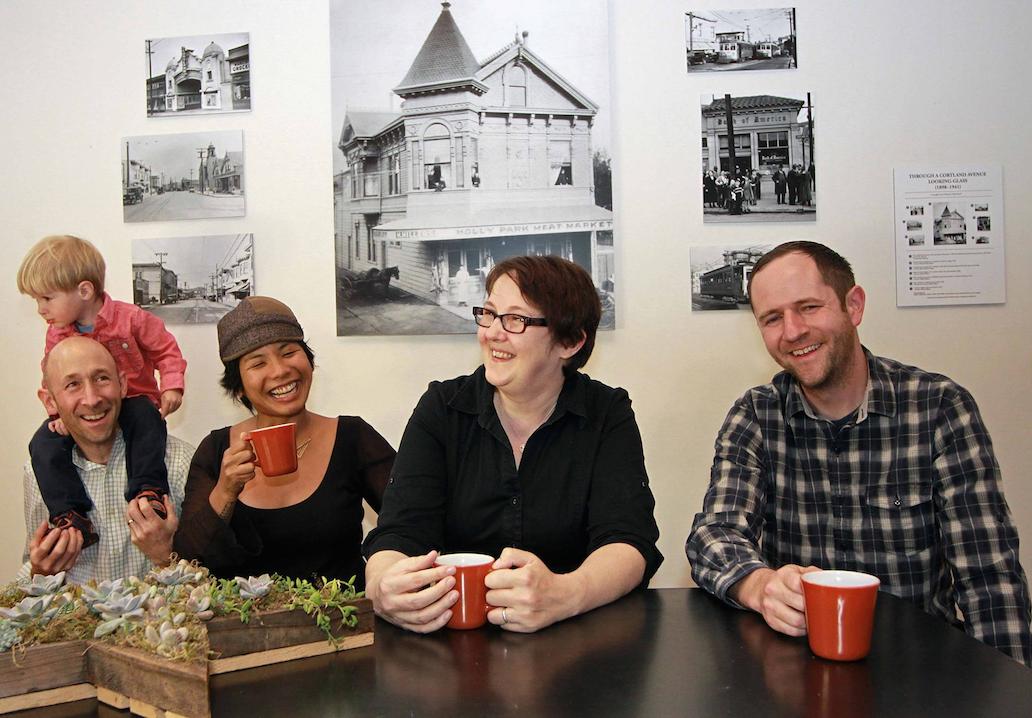
Please join me for the Grand Opening of “Through a Cortland Avenue Looking Glass (1898-1941)” photo exhibit this Friday, March 20 from 5:30pm to 8pm at Pinhole Coffee, 231 Cortland Avenue, corner of Bonview (nee Buena Vista). It’s been a delight to work with the Bernal Heights History Project in selecting the historic photos, and with Mullen Brothers Imaging who donated their printing, mounting and installation services.
Just Added!: The World Premiere of “What Ruthie Hoarded” a 2005 video portrait of the interior of 231 Cortland made by neighbors Edward & Amy Huson that shows the former owner’s amazing collection of junk.
Editor’s Note: I’ve seen that What Ruthie Hoarded video, and it is truly jaw-dropping. Don’t miss it.
PHOTO: By neighbor Jack Pitts. From left: Tim Mullen with son Marnix, JoEllen Depakakibo, Pinhole owner, Vicky Walker of the Bernal History Project, and Mike Mullen.






 Bernalwood