House Portrait: Did Patty Hearst Sleep Here?

Did Patty Hearst Sleep Here?

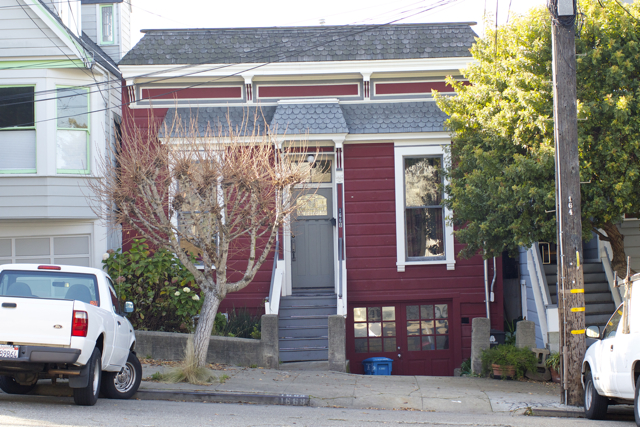
During her unfortunate “Tania” phase, did Patty Hearst hole up in this house on Precita Aveneue? Perhaps. In court, she later testified that she’d visited this house at 288 Precita once.

In 1975, during the Patty Hearst kidnapping, this was one of two San Francisco safe houses used by the Symbionese Liberation Army. (The other was 625 Morse Street.) Here’s  how Time magazine described the scene in the Sept. 29, 1975 issue:

Charles Bates, head of the FBI’s San Francisco office and the man directing the overall search for Patty, ordered a watch to be kept on both dwellings. On Precita Avenue, four agents sat in a light green Ford LTD parked at the curb, and three more waited in a yellow and white camper just down the block. The agents wore sandals, beards and beads, hoping to blend in with the inhabitants of the area. Still, neighbors spotted the stakeout and watched with considerable interest to find out who was being trailed. No one appears to have suspected the athletic and pleasant young couple who had just moved into an apartment in the neo-Victorian structure at 288 Precita.

At 1:15 p.m. last Thursday—a clear, cool day that was perfect for running—the couple from No. 288 came down the stairs and went loping off to nearby Bernal Park. The agents thought they knew who the two were from sightings the day before, but they still were not sure. “Our pictures of them were almost two years old,” says an agent. But when the pair came jogging back home, there was no longer any doubt. The four agents leaped out of the LTD, and the other three came sprinting from the nearby camper. They were armed with pistols, a sawed-off shotgun and submachine guns. One watching neighbor later recalled, “They [the agents] seemed very nervous and shaky.” The woman tried to get away, only to be caught within 20 ft. But the man calmly put up his hands, says another witness, “like a little kid who had been caught doing something wrong.” His attitude seemed to be, she adds, ” ‘Well, I’m caught.’ ” Swiftly, the FBI agents handcuffed William and Emily Harris.

Then, as city police cars closed off both ends of the block, some agents hurried into the apartment; while others, guns drawn, burst into a few of the neighboring houses to look unsuccessfully for Patty Hearst. In the Harrises’ apartment, the FBI found 40 pounds of black explosive powder, three .30-cal., fully automatic carbines, two shotguns, two pistols and a substantial amount of ammunition.

Patty Hearst was found less than two hours later at the house on Morse Avenue.
A Historic Tale of Art and Total Elation on Alabama Street

A few years back, I went to the Bernal Heights Outdoor Film Festival. On that particular night the location was on Bernal Heights Boulevard, on the slope leading easterly towards Folsom Street. I remember it being extremely cold and uncomfortable. The other thing I remember, apart from the fact that it was kind of a crappy place to see a movie, was a film called “Yield To Total Elation” (by Pat Ferrero). It told the story of a reclusive draftsman who lived and worked for more than 50 years in a tiny house on Alabama Street in Bernal Heights.

From 1935 to 1944, A.G. Rizzoli produced a large body of architectural drawings of fantastical buildings — some of which were symbolic representations of friends and relations, most notably his mother. The drawings from this period are all part of a larger environment loosely based on the 1915 Panama-Pacific Exposition, a world’s fair based in what would become San Francisco’s Marina District.

In 1935 Rizzoli began exhibiting his work, The Achilles Tectonic Exhibit, on the walls of the Alabama Street home he shared with his mother. Patrons included friends, relatives, and neighborhood children. Overall, it was kind of like the Open Studios of today.

The First Achilles Tectonic Exhibit

The book, A.G. Rizzoli: Architect of Magnificent Visions provides a detailed schematic look at the Achilles Tectonic Exhibit of 1940, with a 10′ by 13′ room crammed with over 50 artworks.

Rizzoli died unknown in 1982, 5 years after a debilitating stroke necessitated moving from the Bernal Heights home he’d lived in since 1933. His works were “discovered” in 1990 and his life has captivated people ever since.

A.G. Rizzoli on the Internet:

The Ames Gallery – Berkeley

A. G. Rizzoli: Architect of Magnificent Visions. by Jo Farb Hernandez, John Beardsley, and Roger Cardinal.

Yield to Total Elation, a film by Pat Ferrero

Then And Now: What Became of Those “Working Class Houses” on Hampshire Street?

Bernal Hill, San Francisco

Last week Bernalwood introduced you to Dave Glass, a wonderful San Francisco photographer who has amassed a continuous body of work that dates back to the 1960s.

Now it’s time for another installment of the Dave Glass Bernal Heights Then-And-Now Comparison Show. This week, we again travel back to 1982, to take a look at the corner of Hampshire and Peralta, on Bernal’s north side, where Dave photographed what he calls “working class housing.”

So what does it look like now? Dave says that today “these are expensive little homes with modern upgrades and city views.” Judging from this photo I took on December 24, 2010, it sure seems that he’s right:

Peralta at Hampshire (2010)

Photos: 1982, Dave Glass. 2010, Telstar Logistics

If It Snowed On Bernal Hill, I Would Bring My Powder Skis

Snow Towers

I was in Tahoe last weekend, teaching my daughter how to ski at Alpine Meadows. (Cuuuuuuuute!) While she was in ski school, I managed to sneak off for a few hours to make some turns with the grown-ups.

At the summit of Alpine, I saw this microwave tower, and I thought: “Wow, this is pretty much what Bernal Hill would look like if we got a big dump in San Francisco.” It was so easy to visualize.

I then commenced fantasizing about an epic powder run from the top of the hill down to my house on Precita. Mmmmmmmm.

I Love This View

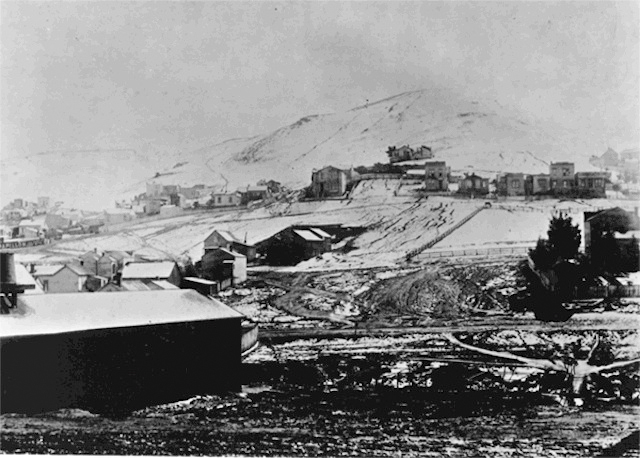
Yes, yes… I know, it has snowed here before! Check out this view of the north slope after a dusting in 1882:

There wasn’t enough snow for a powder run, alas — even on rock skis. But as this photo makes clear, Bernal Hill is otherwise so skiable! Think snow, people. Also, think ski lift!

Photos: Alpine summit by Telstar Logistics. Bernal 1882, via Bernal History Project

Then and Now: The Subtle-Yet-Significant Evolution of Peralta at Rutledge, 1982 vs. 2010

Screen Shot 2016-04-04 at 9.00.56 AM.png

Dave Glass (aka Dizzy Atmosphere on Flickr) is a San Francisco photographer who has been at the game since the 1960s. His work is excellent, and he probably has more great photos tucked away in his film archives than many of us will ever amass on our hard drives.

Dave spent some time wandering around Bernal Heights over the years, and he recently contributed a few of his older photos to our Flickr Bernalwood group. (HINT! HINT!)

The image above was taken in 1982, and it shows the intersection of Peralta and Rutledge on Bernal’s east slope. It says a lot about how Bernal has evolved over the years from a rougher-at-the-edges working class neighborhood to the quirky-at-the-edges middle class ‘hood we know today.

There’s no better way to demonstrate this than to revisit the scene of Dave’s 1982 photo, to show how it looks today. So allow me to present the corner of Peralta at Rutledge, as it looked on the afternoon of December 24, 2010.

Peralta at Rutledge (2010)

What a difference one Honda can make.

Photos: 1982, Dave Glass. 2010, Telstar Logistics

Space-Time Rupture Reveals San Jose Boulevard In 1929

Bernal Cut Bridges

Bernal Cut Dig
Through the miracle of Photoshop, Bernal resident Craig Butz has created a series of images that superimpose historic photographs over contemporary shots.

These depict the Bernal Cut — a major infrastructure project completed back in the days when we still attempted major infrastructure projects. The Bernal Cut lowered the grade of the southwest corner of Bernal Hill to make way for the San Francisco and San Jose Railroad — effectively opening up the Peninsula to routine transit. The cut was first carved out in the 1860s, but in 1929 it was widened to make room for an automotive roadbed — and today’s San Jose Speedway Boulevard.

The 1929 project is what Craig shows us here, via his spooky time portal that combines then-and-now photos in a single view. In an email to me, Craig explained how he does it:

Creating the montages requires finding the exact spot the original photo was taken, observing how tiny details line up in the scene, and ideally getting the camera within a few feet of where the old camera was situated. Then it’s photoshop layers and masking. The biggest thing I’ve noticed in taking these shots is how many more trees there are today. Several photos I wanted to recreate were impossible because the current view is just a lot of branches and leaves.

Images: Craigiest

This Old Tree Is Actually the Most Unpretentious Bernal Heights Native You’ll Ever Meet

San Francisco natives like to talk about the fact that they were born here. It’s like they’re a rare species threatened by invasives on their little peninsula. If trees could talk, this blue elderberry (Sambucus mexicana) would probably give you an earful about it, too.

“The tree is believed to be a genetic remnant of San Francisco’s original flora, pre-(European) settlement,” explains Mei Ling Hui, the Urban Forest Coordinator from San Francisco’s Department of the Environment. “People think the seed it grew from was unearthed and sprouted after the road was cut around Bernal Hill as part of a WPA project.”

Okay, so it’s not a majestic-looking tree — it kind of looks like a big bush. But it’s an important one to the City. In fact, it’s one of San Francisco’s landmark trees. The Landmark Tree Program protects the city’s old, interesting, or special trees. We have lots of nice trees in San Francisco, but like many of our nice humans, most of them aren’t from here.

Bernal’s blue elderberry is like a time capsule. When you look up at it — it’s in the tangle of blackberries where Folsom dead-ends into Bernal Heights Blvd. on the north side of the hill — narrow your vision a little. Ignore the eucalyptus, and the radio tower, and the airplanes going by, and treat yourself to a glimpse of really old San Francisco.

Ribeltad Vorden: Bernal’s Most Notorious Spelling Mistake

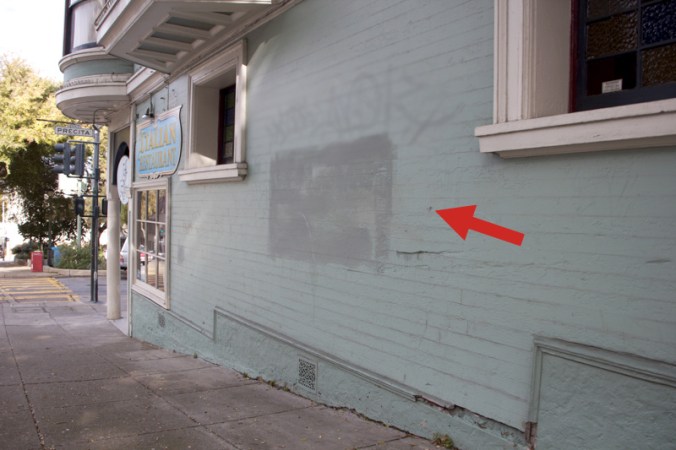
Arrow Indicates Possible Bullet Hole

Arrow indicates possible bullet hole from earlier shenanigans at Precita and Folsom

In 1996 when Brady and I moved to an apartment on the 3200 block of Folsom street just up from Precita Park, my brother-in-law immediately said we were right across the street from an old hang-out from his biker days.  I heard him call it was, “The Ripple Tap.”  As an armchair historian, I did all I could to determine anything about this bar which sat at the location of today’s Caffe Cozzolino. (TIP: order the pesto chicken pizza to pick up.)

My search was fruitless. I searched the Internet, old phone books, and city directories, I asked every old-timer I could find, and I came up with nothing about The Ripple Tap.  All I knew was that my brother-in-law and sister and their motorcycle-enthusiast friends used to start their evenings there back in the day, and that many shenanigans ensued.

Then about 5 years ago, while working with Vicky Walker of the Bernal History Project, I discovered a wonderful history written by longtime Bernal Resident Jerry Schimmel who shed some light on this elusive story:

Around 1968 when Peter Cancilla (of Cancilla’s Market) acquired the property across the way at 300 Precita Avenue, among the odds and ends he acquired was a medium-sized cloth or banner bearing an applique version of the Colombia national arms.

The amusing thing was its completely garbled motto, apparently perpetrated by a Japanese seamstress. The normal spelling of the Colombian Spanish motto is Libertad y Orden (Liberty and Order) which somehow became Ribeltad Vorden… the bungled phrase inspired the name of his new watering hole.

Ribeltad Vorden banner

The original banner of the Ribeltad Vorden Doyle McGowan now has the framed cloth on his apartment wall after tracking it down through a circuitous trail of ownerships. Courtesy of Jerry Schimmel/Bernal History Project

Thus all became clear, sort of. Jerry’s account of life at the Ribeltad jibed exactly with my sister’s stories, right down to the shenanigans. And now we know the real name of the place, sort of.

Read Jerry Schimmel’s full story of the Ribeltad Vorden at the Bernal History Project

For Sale on eBay: A Super Souvenir of the San Francisco Naval Shipyard

Although no contemporary realtor would ever use the words “Bernal Heights” and “Hunter’s Point” in the same sentence, the fact of the matter is that the history of the two neighborhoods are closely intertwined. That’s because once upon a time, the now-abandoned San Francisco Naval Shipyard at Hunter’s Point employed tens of thousands of San Franciscans, and many of those workers lived in Bernal Heights.

Right now there’s a super souvenir of the San Francisco Naval Shipyard for sale on eBay, with hilarious typos included in the auction listing at no extra charge:

WW2 San Francisco NAVEL ShipYard U S NAVY DUTY OFFICER BOARD, What great slice of San francisco Navy history……. maybe a gift to someone who worked there,,,,????

The item is offered by some guy in Martinez, and the auction starts at $9.99, plus ten bucks for shipping. Place your bids!

PS: Don’t worry about competition from me; I’ve already got my wall-size slice of the shipyard, so I don’t need another.

Breaking News, 1969: A House Explodes in Bernal Heights

The remains of 1540 York after the explosion in 1969

The remains of 1540 York after a gas explosion in 1969

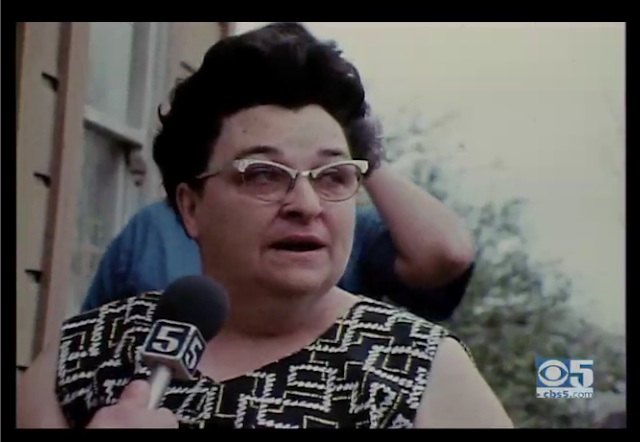
KPIX Eyewitness News report from October 23rd 1969 by Ben Williams in San Francisco featuring the explosion of a residential house, caused by a gas leak. Includes interviews with witnesses, the fire service and views of property wreckage.

Sad to say, we can’t embed the video with the raw footage, but you can watch it here.

Local TV news coverage of this mundane 1969 disaster in Bernal Heights comes to us today by way of the excellent San Francisco Bay Area Television Archive,  hosted by San Francisco State. This segment is a story about a bad day in the neighborhood, but one which has since been largely forgotten.

The house in the story was on the on 1500 block of York, just up from Cesar Chavez (Army) Street. On October 23rd 1969, it blew up. An occupant  —  they were “a Spanish family,” a neighbor says — was taken away unconscious.

The neighbor is freaked out.

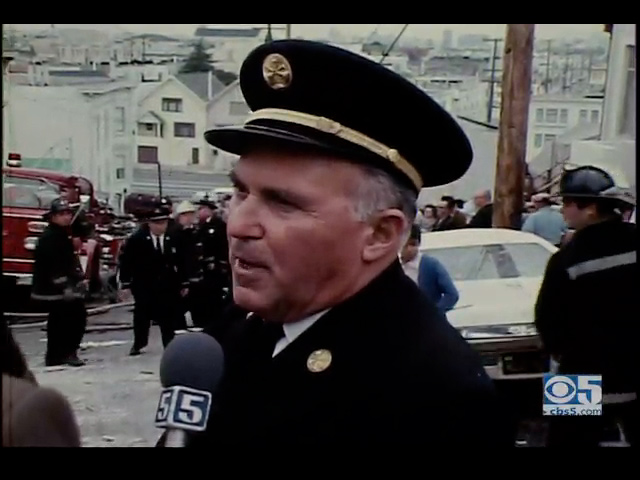
The neighbor was visibly rattled by the experience. But a street-savvy fire chief restored order, matter-of-factly, because a house blowing up due to a gas leak is just one of those things he deals with sometimes in the city. How bad was the damage? “At least $30,000,” he estimates.

1969 Fire Captain discusses York Street House Explosion

The SFFD battalion chief discusses the explosion

The location of the blast, at 1540 York, is now occupied by a two unit apartment building built in 1985. The neighborhood has moved on.

The new home at 1540 York

Yet that’s also the reason why you should check the original video footage from that day in 1969.

Then explore more of the San Francisco Bay Area Television Archive. But clicking the link may lead to hours of viewing locally produced video from the collections of KQED, KPIX, KRON, KTVU as well as topics such as the San Francisco State Students Strike and the Native American Occupation of Alcatraz. Addictive stuff.

Then and Now: Bernal Hill As Seen from Army/Chesar Chavez

Then and Now: South Van Ness at Army Street, 1953

I stumbled across the photo above a few years ago. It shows the corner of South Van Ness Avenue at Army (Cesar Chavez) as it looked in 1953, shortly after the completion of the now-infamous widening that turned Army into a major east-west thoroughfare.

Since I just happened to be just a few blocks from that very spot when I first saw the 1953 photo, I wandered over to see how the scene changed after all these years. Behold, the same view, as it looked on August 12, 2008:

Then and Now: South Van Ness at Cesar Chavez (Army), 2008

In a way, the most impressive thing is how *little* has changed, overall. Gas used to cost 25 cents a gallon, but in 2008 it sold for $4.17. (It’s cheaper now, unfortunately.) Notice that the microwave tower that sits atop Bernal today was just a little sproutling in 1953. It took a long time for it to grow so big and tall and beautiful.

Otherwise,  Bernal Hill look very much as it  did 50 years ago. My favorite detail is the Golden Gate Cleaners, visible at center left. The shop is still there, and with the same neon signage. Like a bug in amber.

The 1953 photo came from the Cushman Collection at Indiana University, which, for reasons unknown, maintains an excellent online collection of vintage color photographs of San Francisco. PROCRASTINATION WARNING: Do not click this link to the Cushman Collection website unless you have at least an hour to burn in blissful Technicolor historic reverie. You have been warned.