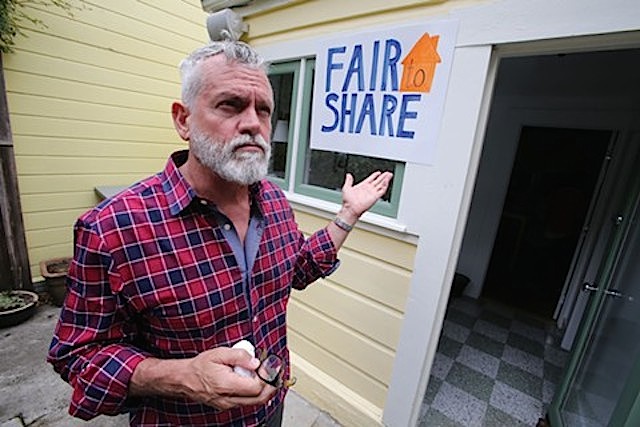
Neighbor David Talbot is a progressive writer and editor who lives just off Alabama Street in Bernal Heights, and (among many other things) he’s also the author of “Season of the Witch: Enchantment, Terror, and Deliverance in the City of Love,” a seminal history of San Francisco during the turbulent, activist years of the 1960s and 1970s.
In a speech that receives a big thumbs-up on Bernal neighbor Tim Redmond’s 48 Hills online news site, Neighbor David Talbot explains why he disapproves of San Francisco’s tech industry, and how he views its impact on Bernal Heights:
Here’s the cold reality today. There is a raging war in San Francisco between long-time residents of the city and the new elites. A younger Ed Lee, when he was a Chinatown activist, would have called this a “Class War” – because that’s what it is. A war between the 1% and the 99% over the future of San Francisco’s precious turf.
My own neighborhood – Bernal Heights — has become a frontline in this class war. Not long ago, Bernal Heights was a funky mix of blue-collar workers, lesbian starter-families, counterculture artists, community organizers and Latina grandmothers. But Bernal Heights had the misfortune of being blessed with affordable housing, verdant backyards and parks – and being conveniently located next to the hipster-infused Mission, and even worse, to Highway 101 – the Google bus route to Silicon Valley. Suddenly, this unusually mixed San Francisco neighborhood was transformed into what one real estate web site recently crowned the hottest zip code in the country. Now, if you stand at the corner of Precita and Alabama – the main checkpoint for the neighborhood — instead of seeing battered Subaru Outbacks and Hondas, you see a steady stream of new-model Teslas, BMWs and Uber limousines. A rapid, seamless flow of gleaming, luxurious metal that never slows down – not even for the children and dogs who come spilling into the street from the nearby park. These Silicon Valley movers and shakers can’t afford to slow down – time is money.
In the old days, the neighborhood’s celebrities were people like Terry Zwigoff — the independent filmmaker who made “Ghost World” and ”Bad Santa” — and underground cartoonists like Robert Crumb and Spain Rodriguez, creators of the most cutting-edge comics in America. These luminaries often retouched the neighborhood in their own inimitable style, building new turrets on their odd castles or painting murals of busty action heroes on their walls. But they didn’t tear down the whole place and start over. The new hot-shots are different, however. They’re knocking down the neighborhood’s ramshackle houses right and left — and replacing them with cold, futuristic mega-mansions. With every new slate-gray exterior that pops up, there goes the warm and oddball neighborhood.
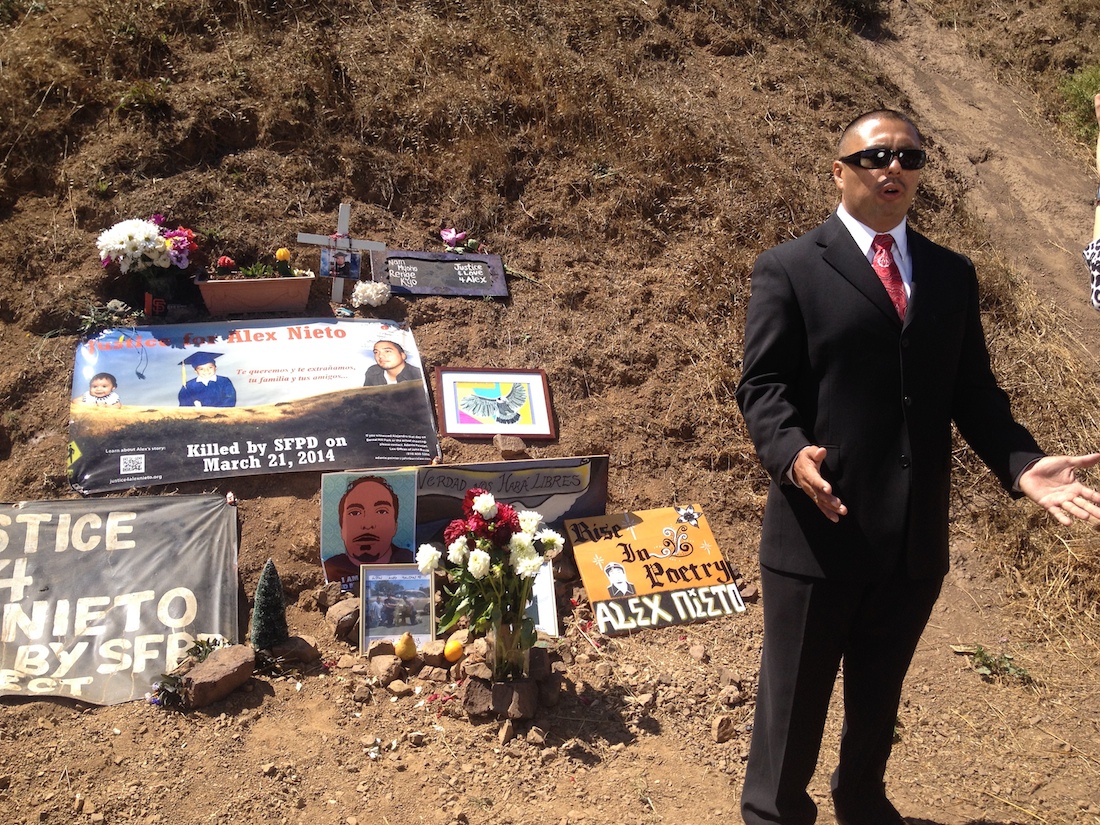
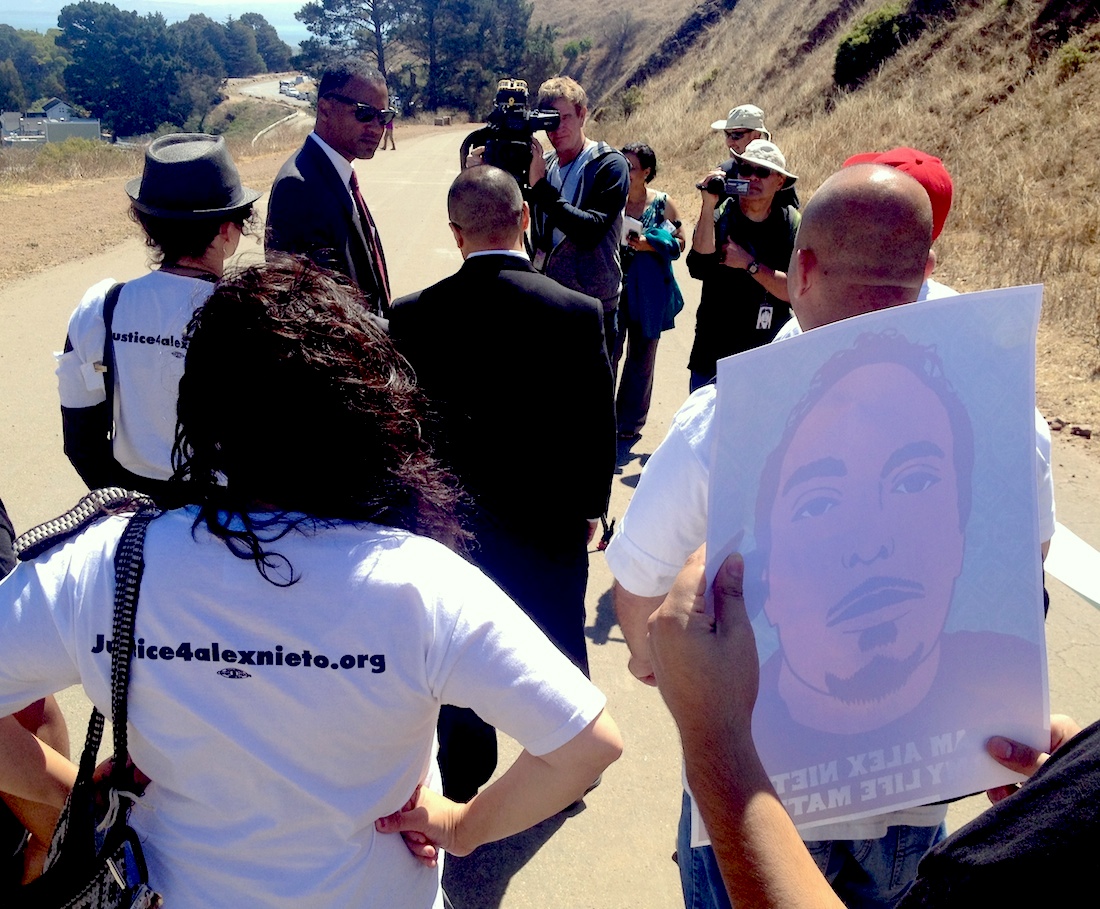
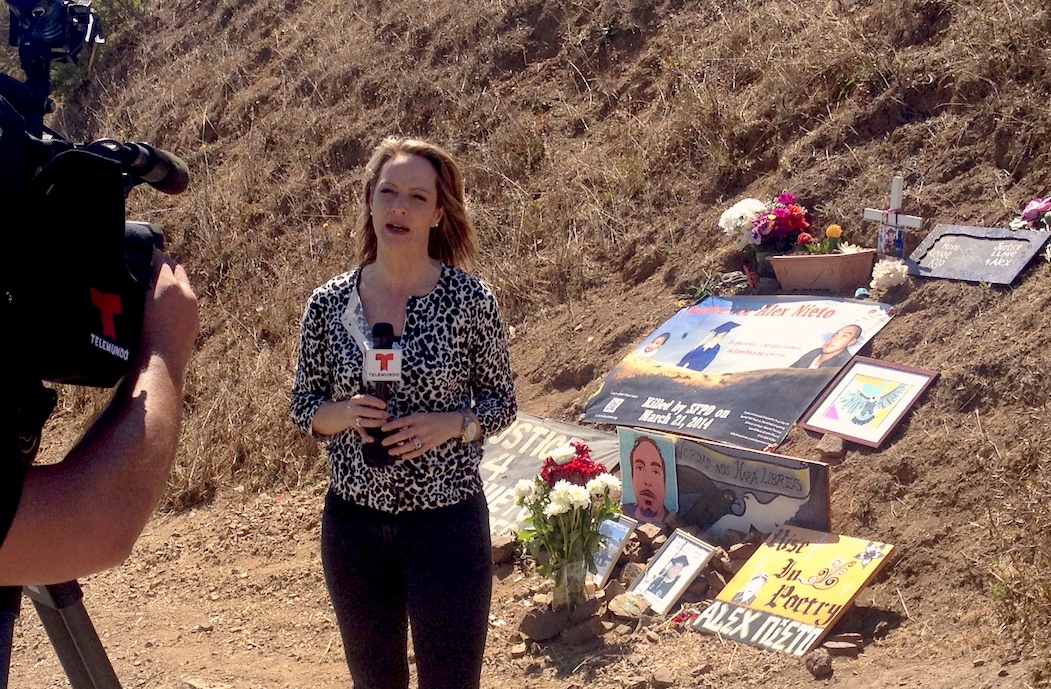
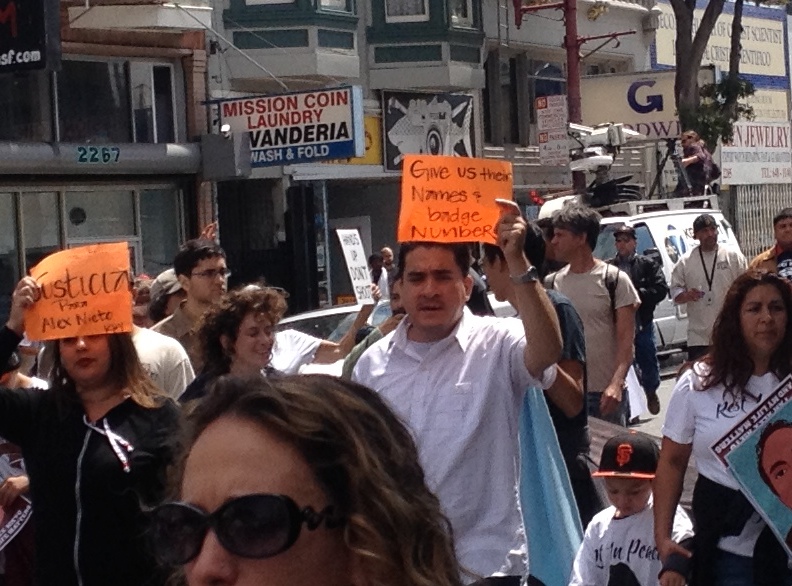
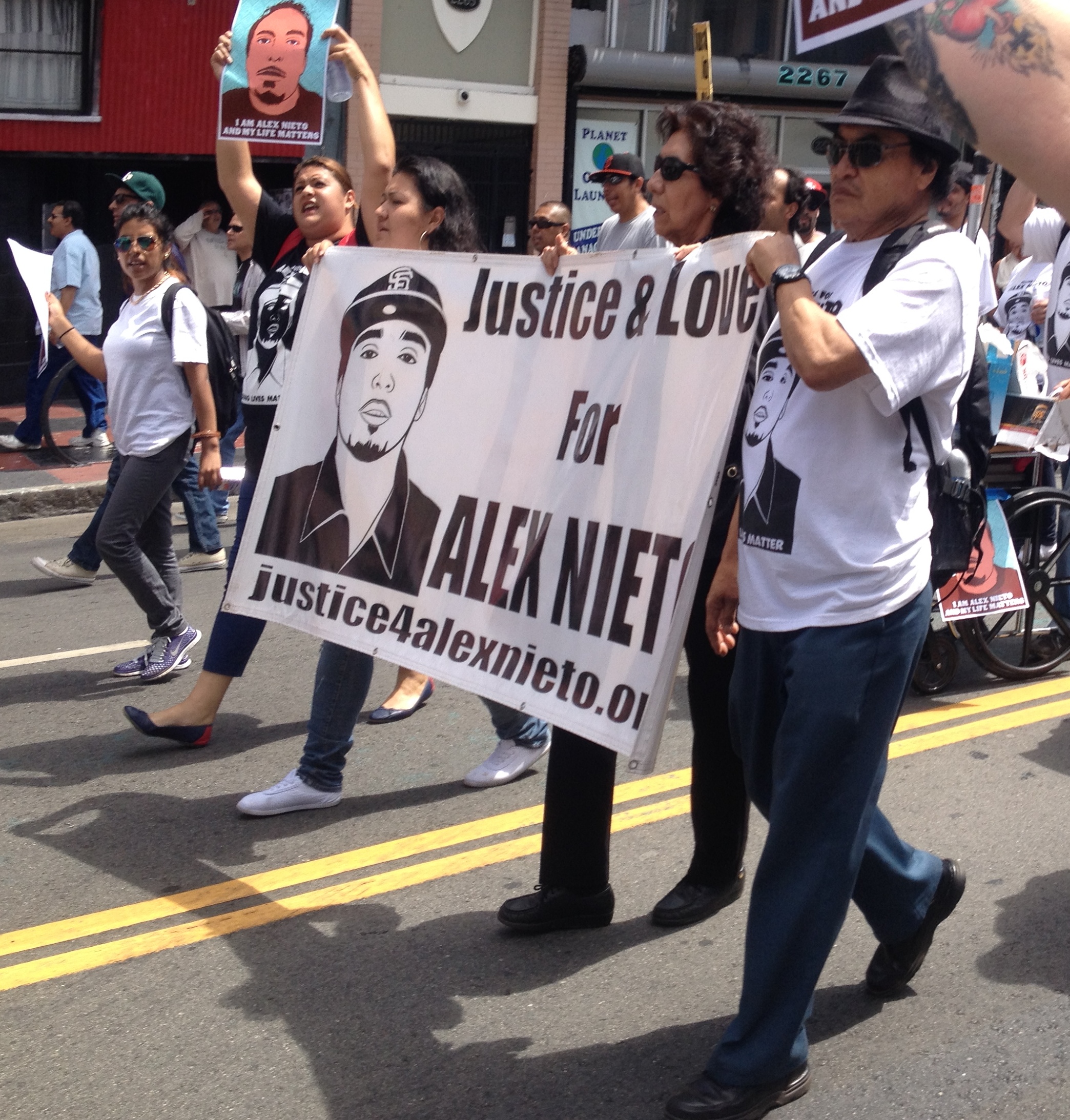
Last year, a young, Latino man named Alex Nieto was shot 14 times and killed by police near my house, on top of Bernal Hill, a scenic area where people like to stroll and walk their dogs. Someone had reported that Nieto, a 28-year-old security guard who grew up in the neighborhood, didn’t look right. These days, fewer and fewer of us long- time residents look right, look like we still belong in our own homes. Sooner or later, if we’re not removed by force, we’ll be moved by the invisible hand of the market.
The strange thing about the new digital rich is that they don’t want to live among their own tax bracket – in traditional enclaves of wealth like Pacific Heights or Hillsborough. No, they want to live among the people — the ones they’re displacing — in Noe Valley, the Castro and the Mission. Take Mark Zuckerberg, please. For the past two years, the Facebook zillionaire and his wife have upended a once-quiet, middle-class neighborhood overlooking Dolores Park, as Pharaoh-like construction teams erect a massive $10-million, six-bedroom palace to house the royal couple. Zuckerberg is dying to live in the heart of the city, even though he apparently despises its San Francisco values. His corporate lobby, fwd.us, has championed a laundry list of conservative issues – from anti-labor legislation to the Keystone pipeline – that would make Harvey Milk and George Moscone spin in their graves.
So…where does Stanford fit into this tale of bitter urban struggle? As a breeding ground for the new elite, the Farm is seen by many in San Francisco as the enemy camp, as part of the problem.
My sons — who are 19, 20 and 24 and who grew up in San Francisco – have a name for the new wave of people moving in. The ones who proudly wear their Ivy League hoodies as they jog and hydrate around Precita Park or line up for artisanal chocolate tastings on Valencia Street, forking over enough cash to feed an entire family in the Mission for two or three days. “Stanford dicks.” That’s what my sons call them. Or Stanford douchebags, or Stanford tools.
Ah. Well then.
That’s just an excerpt, so by all means you should read all of Neighbor David’s speech on Neighbor Tim’s blog. The core of it seeks to explain why today’s tech San Franciscans are generally a less worthy bunch than the left-activist San Franciscans of the 1960s and 1970s.
Your Bernalwood editor read all of Neighbor David’s speech, and I found it very hard to square with what I learned from Neighbor David’s book. Because I read “Season of the Witch” over the summer, and I confess to being somewhat confused by his assessment of why Then was so much better than Now.
For example, one very big take-away I got from reading Neighbor David’s book was that many of the people involved in the “liberation battles” of the 1960s and 1970s were much bigger douchebags, assholes, and narcissists than the douchebags, assholes, and narcissists of today — if only because they generated a much, much bigger body-count (though that’s not the only reason).
This came as a big surprise, because I’d always admired that era for the same values and reasons Neighbor David celebrates in his speech. My surprise came not just from the staggering number of shattered lives and dead bodies that generation left behind, but from the remarkable arrogance, bad behavior, and self-delusion that apparently animated so much of San Francisco’s alternative culture during those times.
What I learned from Neighbor David’s book is that the hippies were massive dicks when it came to their relationship with San Francisco. To say that many of them treated San Francisco as their public toilet is to be unfair to many of our city’s hard-working lavatories. A few of the rest went on to become San Francisco’s proto-gentrifiers. It’s a credit to the depth and honesty of Neighbor David’s reporting that all of this is so well documented, but I do have his book to thank for the revelation.
What I don’t think Neighbor David properly acknowledges is that both the hippie crowd from the 60s & 70s and todays tech generation both partake heavily of San Francisco’s “49 square miles surrounded by reality” mythos that he celebrates so rapturously in his speech. All that reinventing, reimagining, liberating, and Not Taking No For An Answer stuff… the same spirit is very much present today, even if some (but not all) of the objectives are different. What’s the difference between the Merry Pranksters and Uber? Apparently, much less than some might like to believe.
So I get that Neighbor David (and Neighbor Tim) don’t like what’s happening in San Francisco right now, and that’s legit. But today’s San Francisco is very much contiguous with the change the 60s/70s generation sparked and, unfortunately, this kind of back-in-the-day criticism comes across as ossified and self-aggrandizing.
Meanwhile, a tip for new Bernalese: Please try to play it cool if your next encounter with Neighbor David in Precita Park feels a little awkward. And whatever you do, don’t jog or hydrate.
UPDATE 27 January: Bernalwood has received a message about this post from an expert source: The Esteemed John Law, author, sign-maker, sage, and San Francisco culture-jammer.
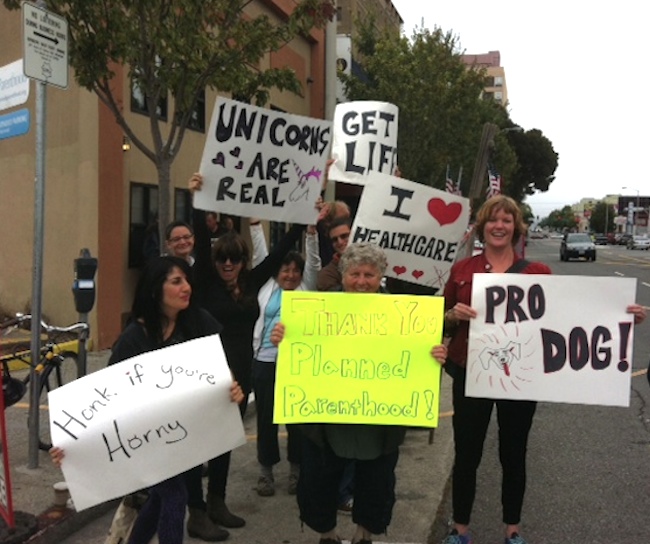
John’s credentials on these matters are impeccable, as he has long been at the forefront of so many of the things that make San Francisco unique (Cacophony Society, Burning Man, Doggie Heads, and about a zillion more things you probably take for granted). Here’s John’s perspective on Bernal, change, time, Talbot, and San Francisco:
I’ve been following the Talbot thread, and have very mixed feelings. Here’s my 2 cents for what it’s worth.
“When I moved to Frisco (g’head – take that one on!) in 1976 as a California born, Midwest raised 17 year old juvie runaway living on the streets and crashing at Haight Ashbury Switchboard referred beds, Bernal (as most neighborhoods at that time) was a very different place. Though I never actually lived on the Hill, I’ve lived all around it – Bayview, Mission, Portola, as well as a half dozen other hoods. I’ve hiked, hung out at and slept (not always with the same people) on Bernal off & on for over 3 decades. The hippies I met back then, some toothless drug addicts, some gentrifying householders, all told me the same thing: “Party’s over kid, ya missed it.” Well, they were full of crap on that one. The story of this town as with all towns is one of constant change.
I worked at the York Theater (now the Brava) in 1979/80. The Mission, parts of Bayview, North Beach etc., were cauldrons of crazy energy and underground experimentation for me and my crowd. Each Saturday, Mission Street from 14th to Army was bumper to bumper low riders of the most astonishing detail exquisite paint jobs imaginable. La Raza was feeling it, murals and street art starting to pop up everywhere. The old neighborhood townies bitched incessantly about the hippies, cholos (and later the Punks and Gays) and how they were destroying San Francisco.
Well, in a sense they were right. The new waves were washing away the old, and the old that was being supplanted was far from valueless. l’ve worked in the trades with many of those old townies for years. I would get hints of this past world from the old timers still in the trades when I started. Their world was one of drag racing at Ocean Beach, Irish wakes and marriages at Mission Dolores (yes, the Mission was largely Irish before the wave of Latino immigration and white flight in the 60’s) or St. Paul’s up the hill, diving off Lefty O’Doul Bridge, working the docks, machine shops and produce markets or, as juvenile delinquents, pinching stuff from those markets…
I stopped at Reds Java Hut with my forman at Ad-Art Electrical Sign Co, George Edwards for lunch a few times in the mid-80’s. Red, at that time in his 70’s, was a big man with a ready laugh and short temper. He would loudly, but good naturedly berate George, also a big tough guy, when we came in: “HEY KID!! whaddaya want? A free burger! Ya ain’t gonna get it here, boy!” Evidently my boss and his Irish street gang would try and swipe candy bars at Reds back in the 50’s!
This was the world buried by the new waves over the 60’s and 70’s. And the factories closed, shipping left and by the time I arrived, much of the city was abandoned commercial buildings, boarded up neighborhoods and a great deal of street crime and ingrained poverty.
To me it was a wonderland. Very cheap rent and restaurants made living and creating here easy. All sorts of bizarre and compelling things were growing in that beautiful wasteland. Even so, you’d be mugged for certain in Precita Park if you traversed it regularly. Cortland was a dangerous street and you simply did not go near Garfield Park at night. The gangs owned it. In 2 years of selling popcorn at the York Theater (24th at York St, 1979/80) I witnessed two full on gang fights, saw the aftermath of dozens of serious assaults, and watched as patrons of the theater lost, on average 3-4 cars a week to auto theft. Hampshire at 24th shared the honor of most auto thefts for several years with some street in Newark NJ.
I read Talbot’s book and quite enjoyed it. I remember first-hand much that he recounts therein. He is right in his Bernal reverie on one count for sure: The new wave on average, are wealthier. I know many in the tech scene. I’m a partner in Laughing Squid, one of the very early internet “social media” experiments that has gone on to some notice. The “techies” have their own creative wonderland they are building here – much of it is hard for those not initiated to see or understand. I can’t fairly be mad at them for their enthusiasm for MY town….
Many of my closest long time friends ARE being pushed out by the new wave, and they are rightfully as pissed off about it, as the Townies were before. I am very sad about that and we are losing some very important things as that tide recedes and leaves the artists, working class and poor immigrants beached (some for the better) in Oakland and beyond. With a few wrong breaks, I would be pushed out too.
San Francisco is not a place that I would hitchhike to nowadays, couch surf and live cheaply in as I met other broke newbies who want to shake things up. I would end up in Oakland. But for the people that do come and can afford it, I think Frisco is still a pretty awesome place. And for those of you lucky or smart enough to have dug in on Bernal, my congratulations.



 Bernalwood