Midcentury Bernal Shoebox House Flips After 21st Century Makeover

boxthennow

Somewhere relatively high up on Bernalwood’s List of Things We Really Want to Cover Someday is an item called “What’s Up with Those Bernal Shoebox Houses?”

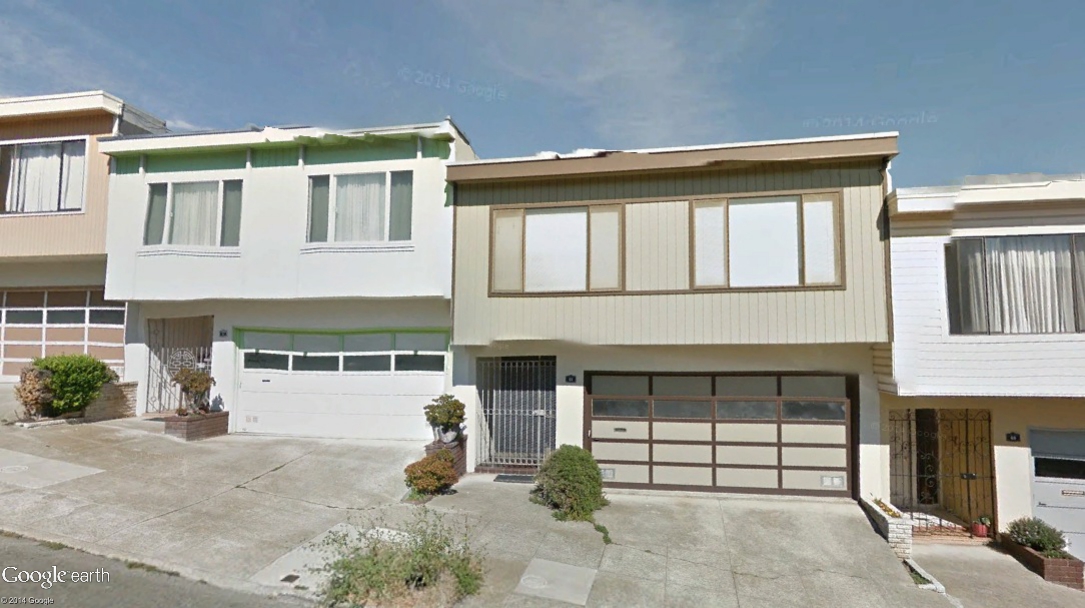
You know the type, because it is very common here. The Bernal Shoebox is what I call those vaguely modern inflill homes that were built all over Bernal Heights in the 1950s and 1960s. Rectangular shapes. Double-wide garage door on the bottom. Residential space above. Standardized construction. Raise and Repeat… all over Bernal Heights (and San Francisco’s southern neighborhoods) during those heady postwar years.

For example, here’s tony Nebraska Street, just north of Cortland, as seen through Google Earth Street View:

nebraskamodgmaps

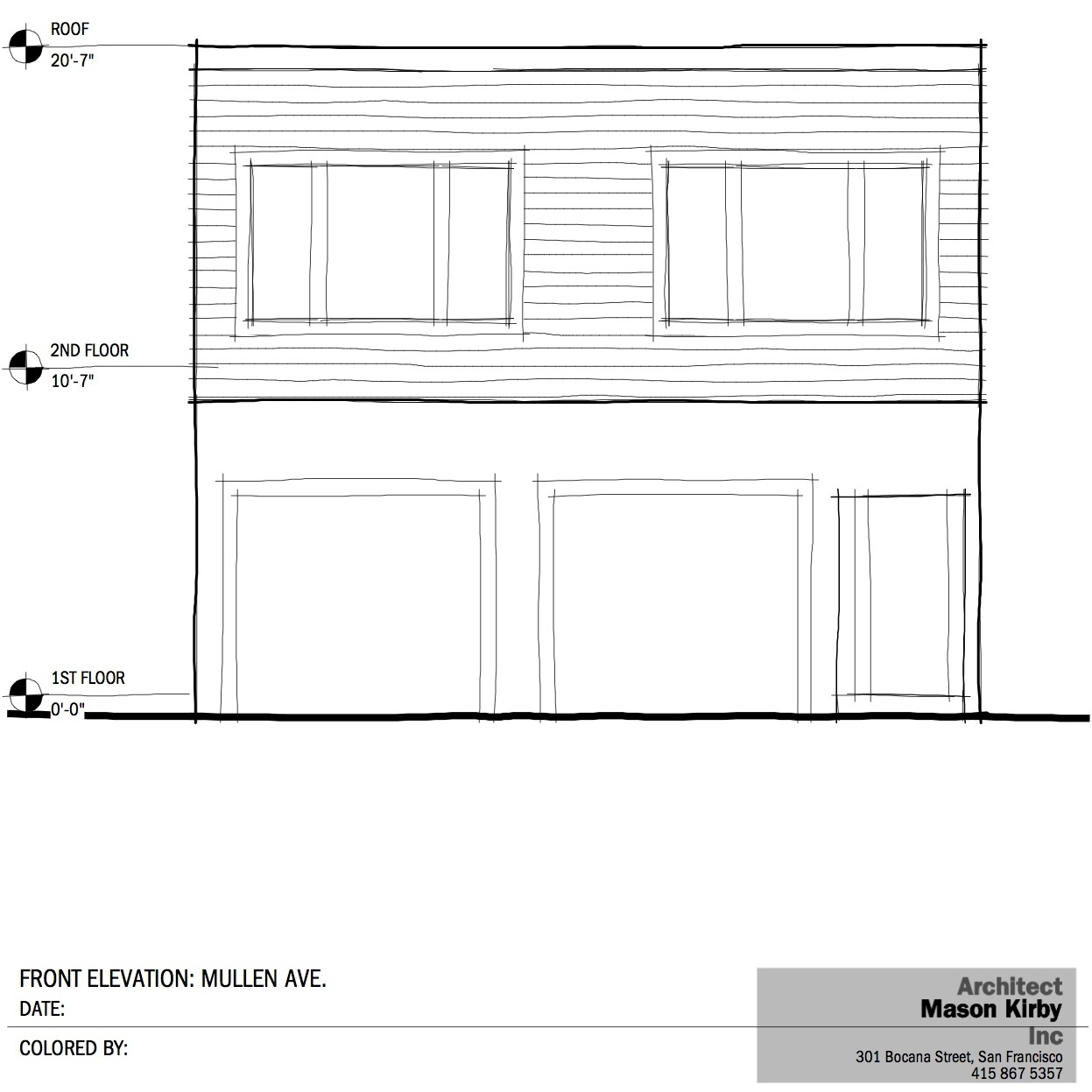
As a genre, Bernal Shoebox houses are now found in various states of repair, upkeep, originality, adaptation, and/or disrepair. There’s even one in the Bernal Heights Architectural Coloring Book:

BernalArch.ColoringBook2014

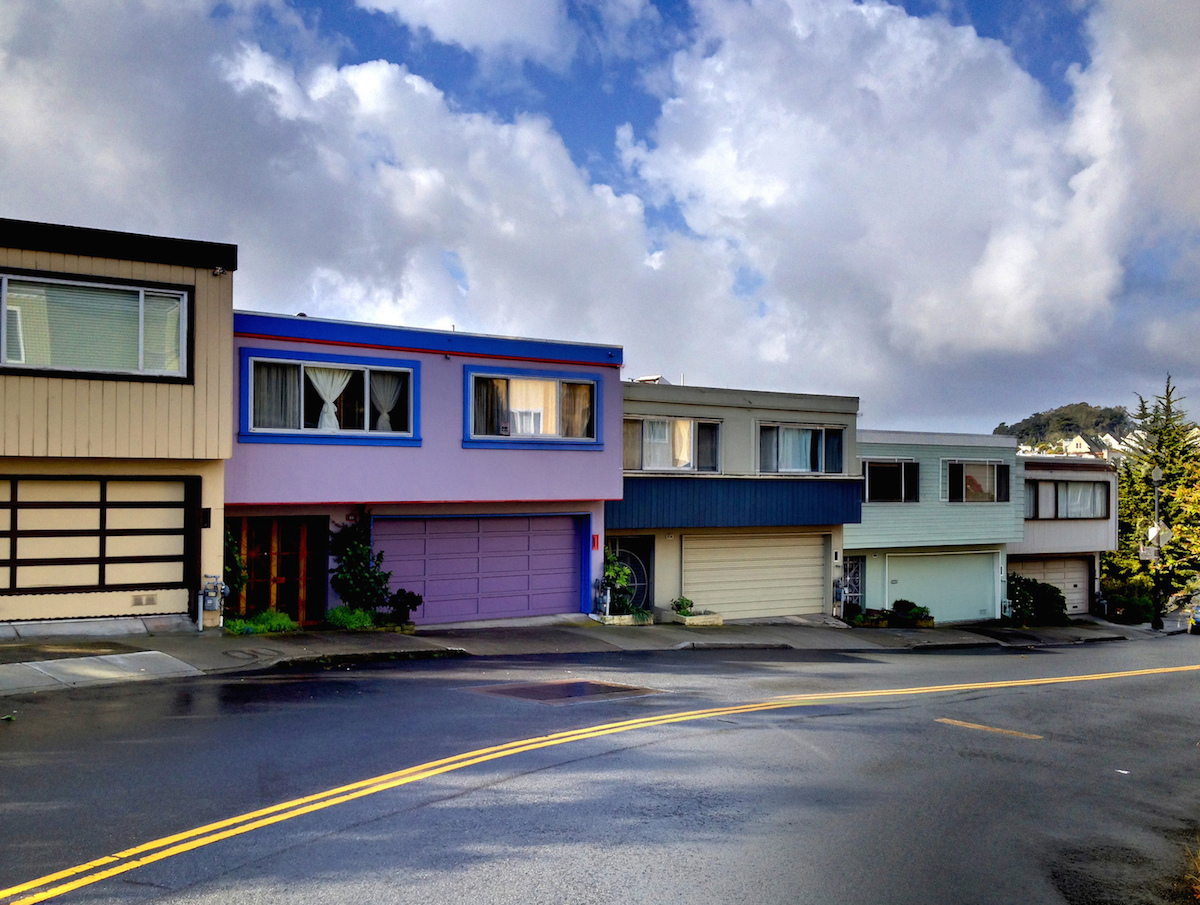
Some Bernal Shoeboxes look rather Midcentury Chic…

bernalmod

…which is why clever graphic artists have even created new posters like this:

Painted-Ladies-2-01

Space Age grooviness aside, these types of houses have some notable advantages as a residential resource. They’re plentiful, they are structurally uncomplicated, they usually offer a generous amount of interior space, and they’re relatively easy to reconfigure and remodel to accommodate our fabulous 21st century lifestyles.

So someday, Bernalwood hopes to tell you more about this particular building type. Where did the basic design come from? Who did it? How were these homes built? And by whom? And for how much? And who bought them? That kind of stuff. Stay tuned. (Have insights on the topic? Share them in the comments or via email)

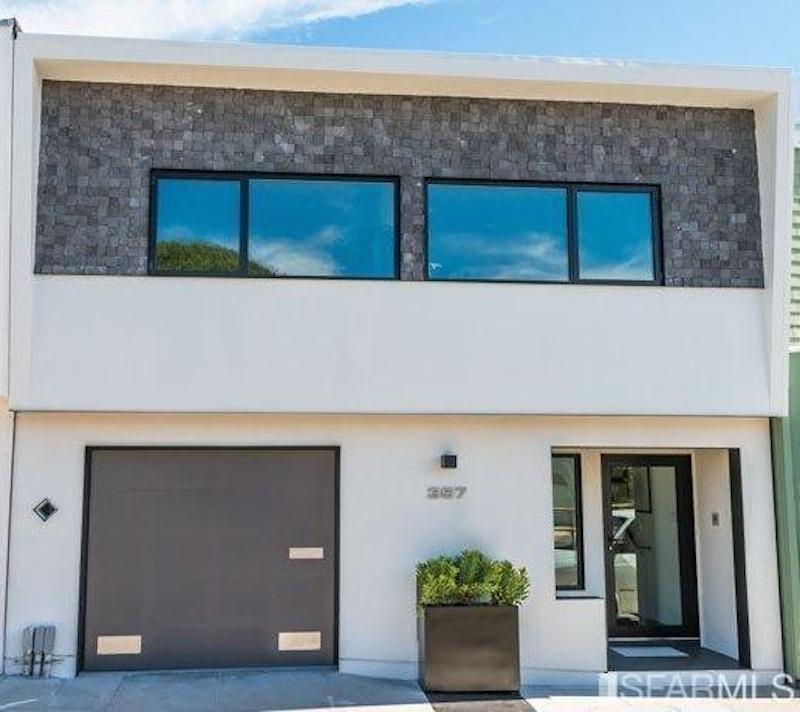
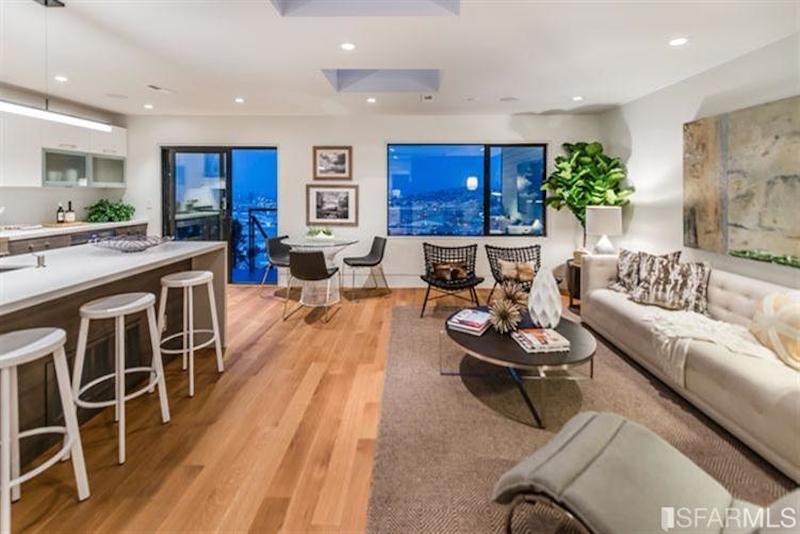
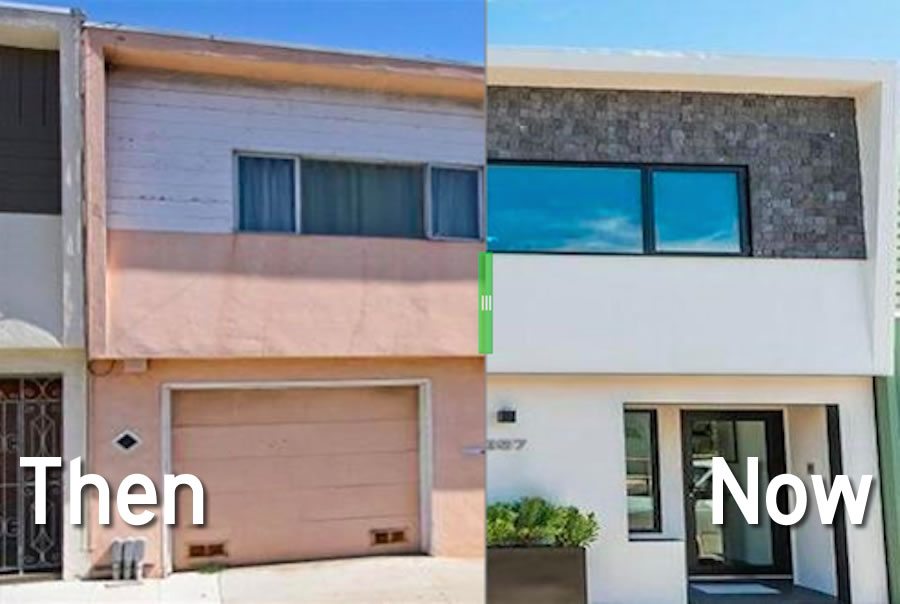
In the meantime, our cyberpals at the CurbedSF real estate blog recently found this example of a Bernal Shoebox for sale at 357 Franconia after a full makeover:

357franconia2

357franconia4

CurbedSF writes:

Back in March, flippers purchased a worn-out Bernal fixer for $770K and set about transforming it into a super-slick contemporary box. Out front, the forlorn white siding was switched out for a new stucco facade with lava stone cladding and black metal trim. Inside, the kitchen is all new, an unwarranted third bedroom seems to have gone legit, and a second bath was added, along with some welcome skylights. At $1.395M, the new ask is a more than 80 percent boost over the sale price eight months ago. Looks like the sellers are getting their money’s worth, too—the property went into contract after only five days on the market.

OK, so, that’s obviously a rather dizzyng bump in price. And yes, it’s obviously a reflection of our wacky-doodle, supply-constrained real estate market. Blah blah blah.

Yet it’s also, likely, a reflection of what will become of more and more Bernal Shoeboxes, and how many of them will evolve in the fabric of Bernal’s streetscape during decades to come. Shall we call them DwellBoxes?

PHOTOS: 357 Franconia via Redfin and CurbedSF. Bernal Shoeboxes by Telstar Logistics

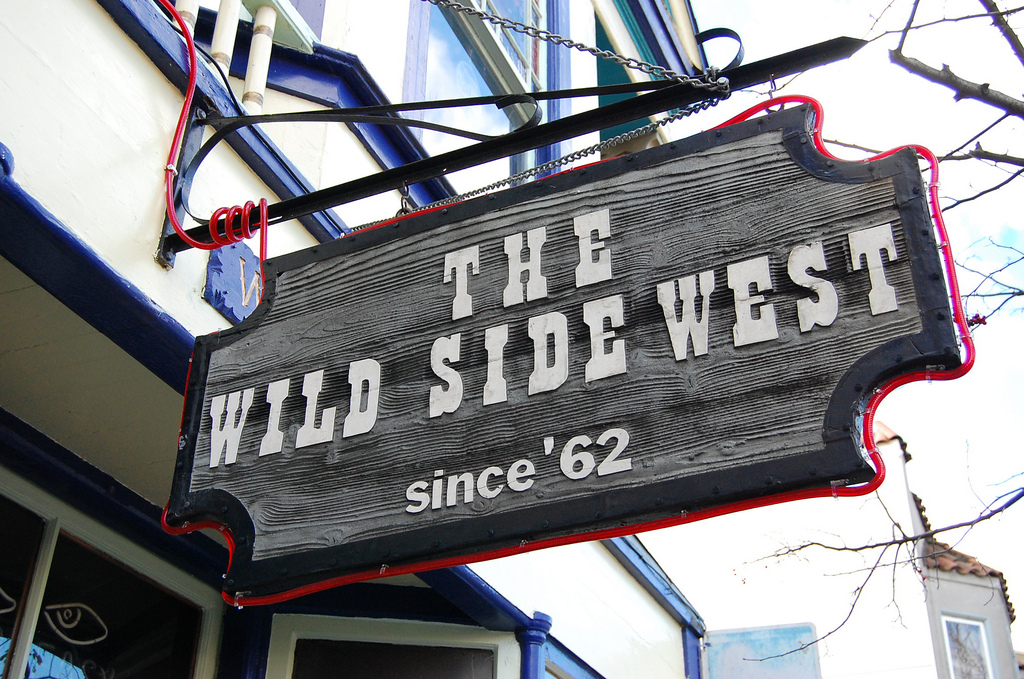
Is Wild Side West Now San Francisco’s Last Lesbian Bar?

Wild Side West

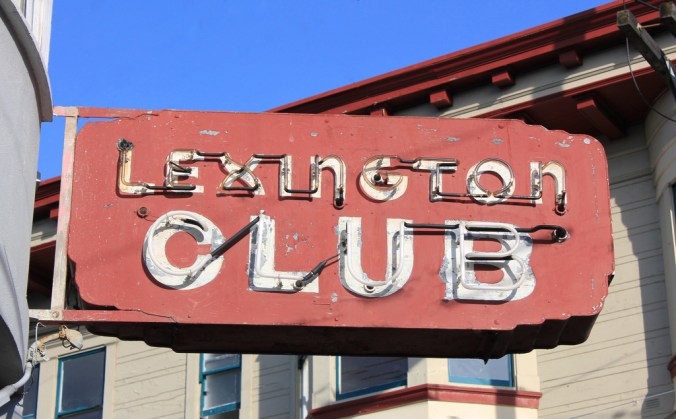
Last week, the operators of the Lexington Club on 19th Street in The Mission announced that the bar will soon shut down. High rents and changing demographics were cited as the causes for the Lexington’s demise.

The announcement triggered some earnest soul-searching around San Francisco, because the Lexigton was, arguably, The City’s last true lesbian bar. Writing for the HuffPo, Jen Jack Gieseking says:

The only bar dedicated to serving lesbians in San Francisco, the Lexington Club, announced that it is closing after 18 years. You may be shocked that the bar is closing and/or that there is only one lesbian bar in that gay metropolis. As a researcher of lesbian-queer spaces and economies, I am not surprised at all.

lexsign

But wait! Is that true? Is the Lexington Club San Francisco’s last true lesbian bar? Or, is it the case, as a wise Jedi once said, “No. There is another.”

The Bold Italic points to Bernal Heights:

[The Lexington] has been a Mission staple for almost two decades, and when it goes so goes one of the city’s last lesbian bars in the city (Wild Side West in Bernal still stands, but it’s arguable whether it’s actually a “lesbian bar” anymore)

Journalist-about-town Steve Silverman is on the same page:

SFist replies, Yes but only sort of and not really so much:

Some may argue the case for Wild Side West, which remains a LGBT-friendly neighborhood bar in Bernal Heights, open since 1962, with a historic link to the lesbian community, but anecdotally we understand it is more of a mixed bar these days.

Bernalwood has considered this question of Wild Side West’s sexual credentials before, in the context of a larger discussion of the changing political economy of the Bay Area lesbian community.

Yet with the closure of The Lex, the subcultural role of Wild Side West is now a bit more of an urgent question. Please discuss.

PHOTOS: Wild Side West by Telstar Logistics. Lexington Club sign by Vintageroadtrip on Flickr

Saturday: Share Your Memories of the 1989 Loma Prieta Earthquake

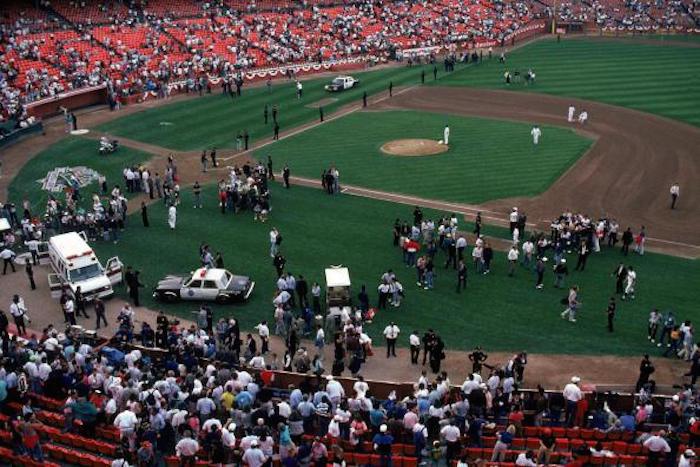
Crowds in Candlestick Park after the earthquake

Where were you when the last big earthquake struck?

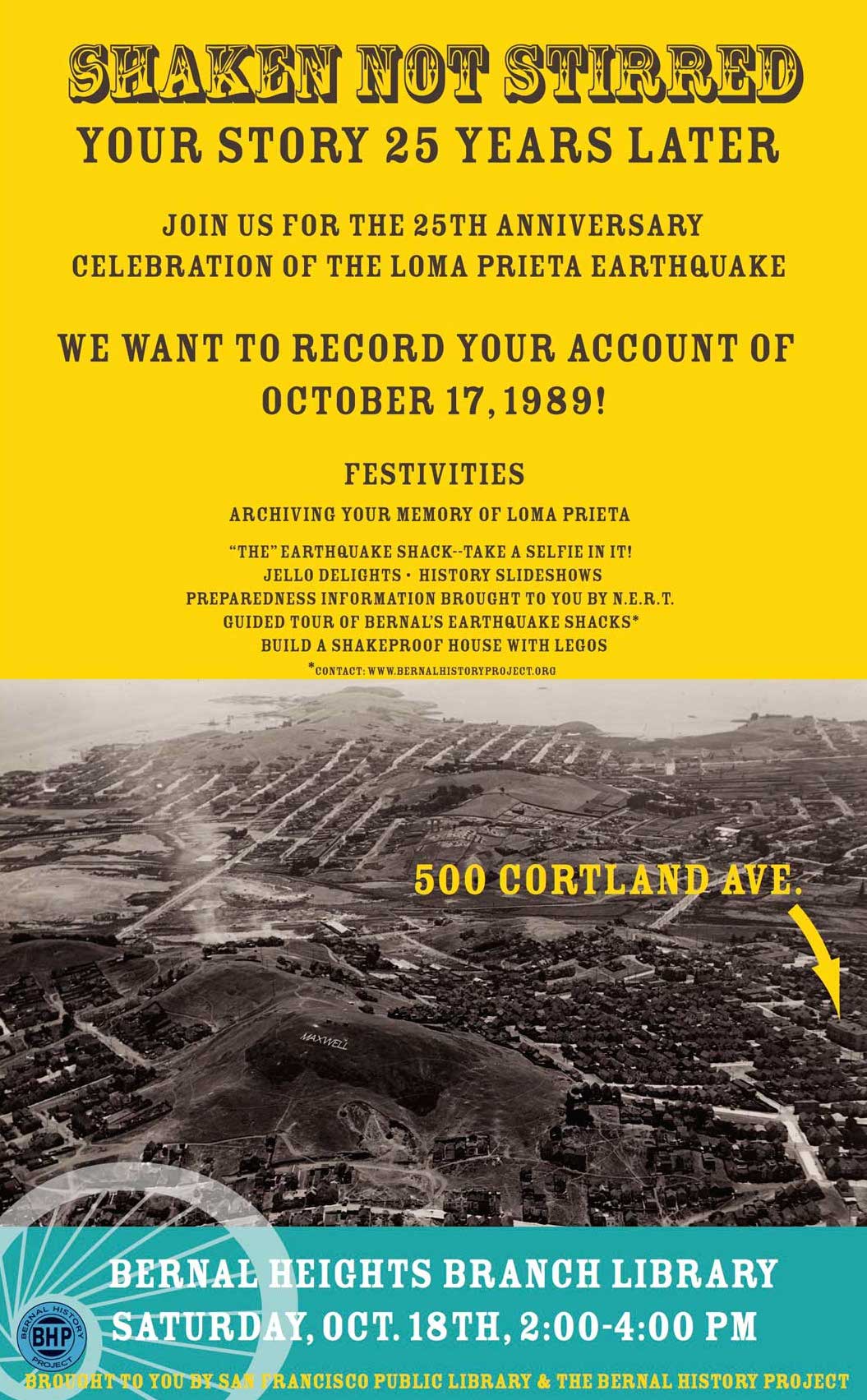
On Saturday afternoon from 2 – 4 pm at the Bernal Heights Library, the Bernal Heights History Project and the SF Public Library are hosting a jello-fueled earthquake event called “Shaken Not Stirred: Your Story 25 Years Later”

It’s a neighborly remembrance of the October 17, 1989 Loma Prieta Earthquake. Share your earthquake stories. Learn how to prepare for the Next Big One. Talk about your deep fondness for chert in a supportive, like-minded environment.

The Bernal History Project brings this announcement:

In tandem with our friends at the Bernal Heights Branch Library, we’re proud to present “Shaken But Not Stirred: Remembering the 1989 Loma Prieta Earthquake”on Saturday, October 18. We want to hear what you remember about the earthquake that hit the Bay Area on October 17, 1989!

Come to the library at 2 p.m. for an extended slideshow of historical images of San Francisco earthquakes and earthquake refugee cottages (a large number of which survive in Bernal) in the downstairs meeting room.

We’ll give you a replica Red Cross meal ticket you can exchange for a Jell-O treat (our favorite shaky quakey snack!), and then you can visit a “ghost” refugee cottage and take a shelter selfie. We’ll be inviting kids of all ages to build shake-proof houses out of Legos. Meanwhile, SFPL volunteers will be standing by to record your memories of the Loma Prieta earthquake for our archives. We’ll have representatives from San Francisco Fire Department Neighborhood Emergency Response Team (NERT) on hand to talk about earthquake preparedness and what you need to do to be ready for the next big quake — because you know it’s going to come someday.

Shaken-not-Stirred-final

PHOTO: Top, Candlestick Park on October 17, 1989, shortly after the earthquake. 

Victorian NIMBYs Were Very Annoyed by Stinky Stockyards in Bernal Heights

Salomonsstockyard

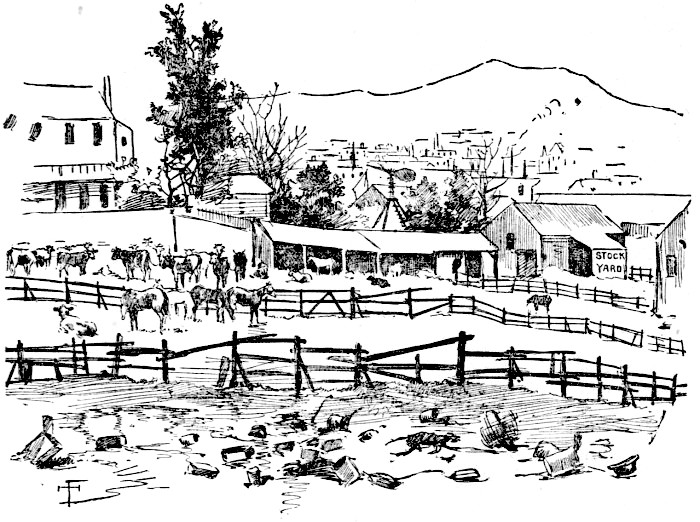
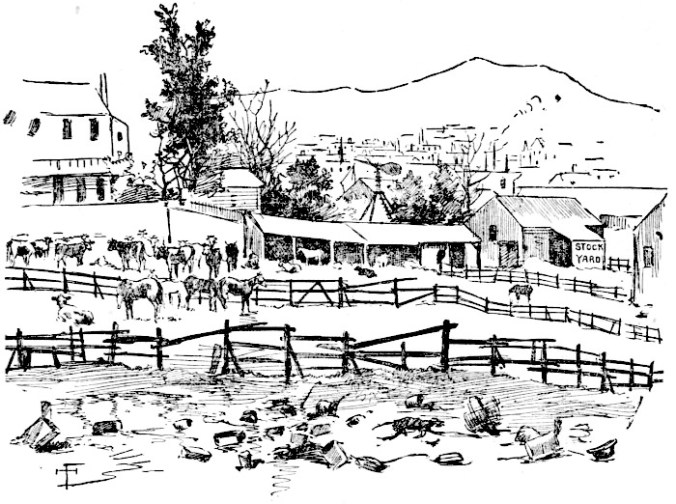
Solomon’s Stockyards, as illustrated by The San Francisco Call, 1893

Neighbor Vicky Walker from the Bernal Heights History Project shared this gem with Bernalwood. It’s an 1893 tale of angry Bernal neighbors, forlorn cows, miserable horses, “foul smells,” and “noxious odors.” Oh, and lots and lots of health code violations.

The story catches Bernal Heights at an awkward moment in the late nineteenth century, as the neighborhood is completing its transition from livestock pastureland to proto-gentrified residential enclave.

At the time, neighbors along present-day Coledridge Street (then called California Ave) were rather annoyed that several legacy property-owners nearby were continuing to operate livestock businesses, in clear violation of prevailing laws which, at the time, allowed no more than two cows to reside on any property in Bernal.

It’s sort of a Victorian version of squabbling over street parking etiquette and illegal sublets or soccer fields, only with lots more animal manure and rotting offal.

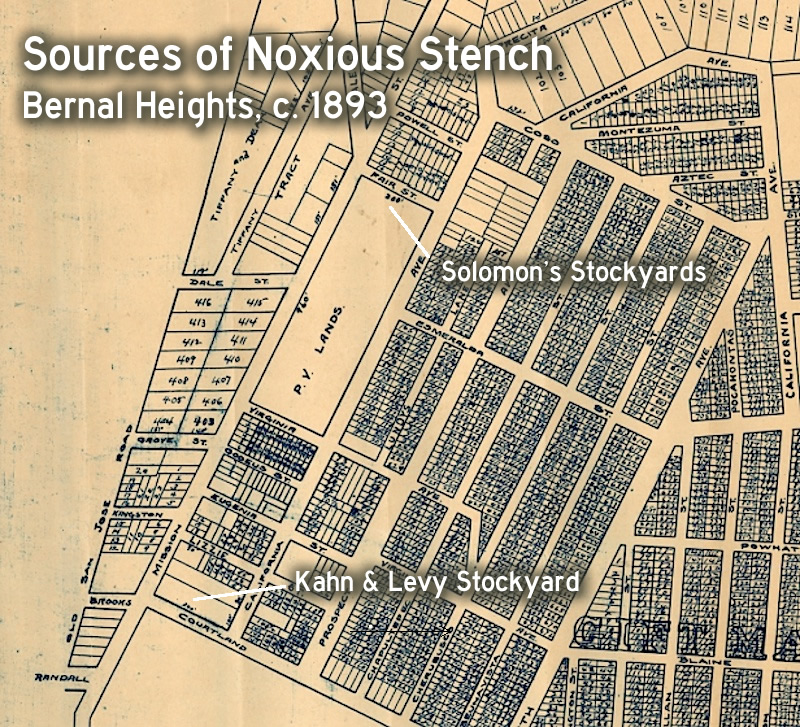
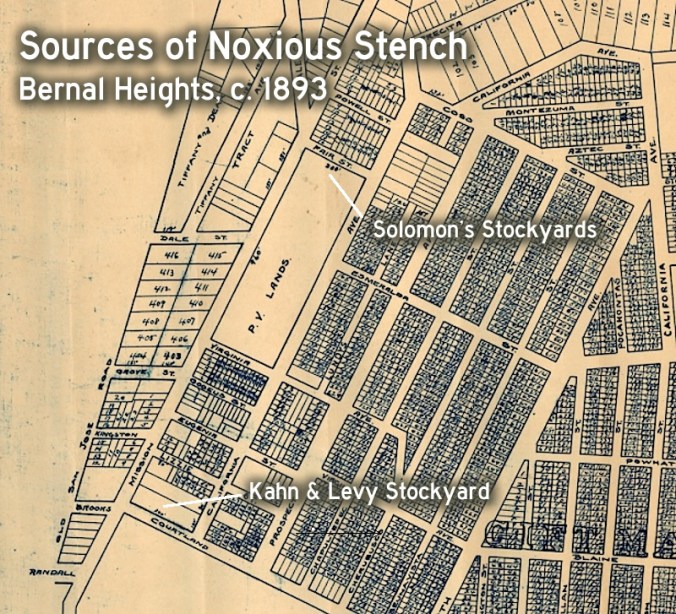
The noxious-smelling properties in 1893 were Solomon’s Stockyard on Mission at Fair Street (roughly the site of today’s Taqueria Cancun), and the Kahn & Levy stockyard at the corner of Mission and Cortland (approximately the site of Zante’s).

To help you get oriented, here are the approximate locations,  annotated on an 1889 map of Bernal Heights:
bernalstockyards1889edit

And here’s the tale of “A Real Nuisance,” as it appeared in the Saturday, July 29, 1893 edition of the San Francisco Morning Call.

It’s an awesome read with some wonderful characters (viva Neighbor Seculovich! You go, Precita Valley Improvement Club!!) so… enjoy:

thecall1893banner

A REAL NUISANCE

Salomon’s Stockyard at the Mission
ITS INDEFINABLE STENCHES
The Owner Arrested Three Times for Violating a Provision of the Board of Health

The Board of Health is determined to check the nuisance in the Western Mission known as Salomon’s stockyard. The proprietor has been arrested three times on the charge of menacing the health of the neighborhood, but still the foul smell place spreads its noxious odors itbout, and offends the nostrils of residents. The stockyard in question is situated on Mission street, and runs back along Fair avenue to California avenue. It has a frontage of about 200 feet on Mission Street, and presents an unbroken line on Fair avenue.

The large space is divided into corrals, and partially occupied by rickety sheds, while forlorn cows and distressed-looking horses wauder about the little spaces. Goats scramble over the fences and join in the general search for something to eat.

There are great piles of manure in the enclosures, and the contracted stalls are damp and odorous. In one of the small stables there were four cows crowded, while others ambled about the lot. The horses were confined in the lot that corners on Fair and California avenues, but the cows are directly on the Mission street front, nearly opposite the turn-table of the Valencia street cable road.

In spite of the unhealthful surroundings Mr. Salomon denies that the place is a nuisance, though he confesses that he has been arrested on such a charge. “It is all spitework,” he said, “and is caused by this man Seculovich, who lives right next my cow stables .”

An inspection of the premises of Mr. Seculovich showed that the rear end of Salomon’s cow stables was within a few feet of his kitchen door, and the stench of the offal was almost unendurable. Seculovich has a comfortable though unpretentious home, and his yard is filled with flowers and fruit trees. He says that the odor from the lining cowsheds has caused him no end of annoyance and that he proposes to insist upon the abatement of the nuisance.

Dr. Kseney, the nominal head of the Board of Health, said that Salomon was arrested the last time on the 26th inst., the charge being that he maintained a nuisance. “This is the third time Salomon has been arrested,” continued Dr. Keeney, “and we propose to continue our tactics, as defined by the health laws and the Board of Supervisors. The law very plainly prescribes that no person is permitted to maintain more than two cows within the city limits. There are exceptions to this law, inasmuch as the prohibitory district is not carefully defined. Its inner limits are far beyond the corner of Mission street and Fair avenue, and it is upon this definition of the law that we propose to make Mr. Salomon abate the nuisance created by his stockyard.”

The first time Salomon was arrested he’ was fined $100 by Judge Low. He appealed from this decision, and the case was carried to the Superior Court, but it has not yet been placed upon the calendar. Pending the appeal Salomon was again arrested, He was to have been tried on the 4th prox., but there was some question as to the legality of the complaint, and, upon the advice of our attorney, the case was dismissed. However, another complaint was properly drawn and he was arrested on the 4th inst.

“I have personally visited the premises and I am convinced of the justice of the complaints made against the place. The Precita Valley Improvement Club has also entered a protest against the nuisance, and we have received numerous complaints from individuals other than Mr. Seculovich.

“The slope of Salomon’s stockyard is a particularly bad feature. It drains directly into Mission Street and befouls the cellars and yards on the lower side of the street. On damp, foggy days the stench of the stockyards clings closely to the ground, and the breezes carry it directly into houses, to say nothing of offending the nostrils of every person within a radius of a mile or more. The place is a counterpart of the Seventh street dumps, though there is no occasion for its existence. The enforcement of the local health laws is all that is necessary to cause Solomon to seek other quarters, and we propose to compel him to vacate.”

I.L. Salomon, the son of the proprietor, said: “We only keep cows here occasionally. We buy ana sell and the stock is never here more than a day or two at a time.”

“But then you get fresh stock in its place, don’t you?”

“Oh yes, that’s our business. We buy and sell and use this yard as a place of inspection for purchasers. Our plane is no worse than lots of others, and I am going to fight the law in the Superior Court.”

Kahn & Levy, another firm of stockdealers, have a large yard at the corner of Mission street and Cortland avenue, about three blocks above Solomon’s place. It has precisely. the same slope of drainage and sends its filth and slime down to the residence portion of the Western Addition. Yesterday the yards were fairly filled with horses and cows, in plain violation of the sanitary laws. A sickening stench pervaded thn atmosphere, and the animals in” the corrals tramped about with a hungry air.

Dr. Keeney was asked about trie Kahn & Levy place, and he replied: “The owners have decided to lenve there, and in about two weeks the stock and buildings will all be removed. This course will practically abate the nuisance. That portion of the Mission is not very thickly populated, and consequently the complaints against this particular yard were not very numerous. However, we took prompt action when the first notice was served, and the owners at once concluded that it was to their interest to remove from the neighborhood. We will compel this man Salomon to reach the same conclusion.”

“Is there any special law against the I maintenance of stockyards in the city?” was asked of Dr. Keeney.

“No, not aside from the ordinance which I says that no person shall maintain more than two cows within certain limits. Residents at the Mission have been long enough annoyed by infractions of this law, and we propose io arrest and fine every person who continues such a course after a warning has been served. There are no exceptions inside the limits, and any person having a grievance in this respect should at once notify the Health Office.”

The hearing of the third charge against I. L. Salomon will be set this morning in Judge Low’s department of the Police Court.

ILLUSTRATION: Top: Solomon’s Stockyards, from the The Call
Then and Now: 90 Years of Auto Biz at the Former Mission Chevrolet Dealership

oreilleyavail

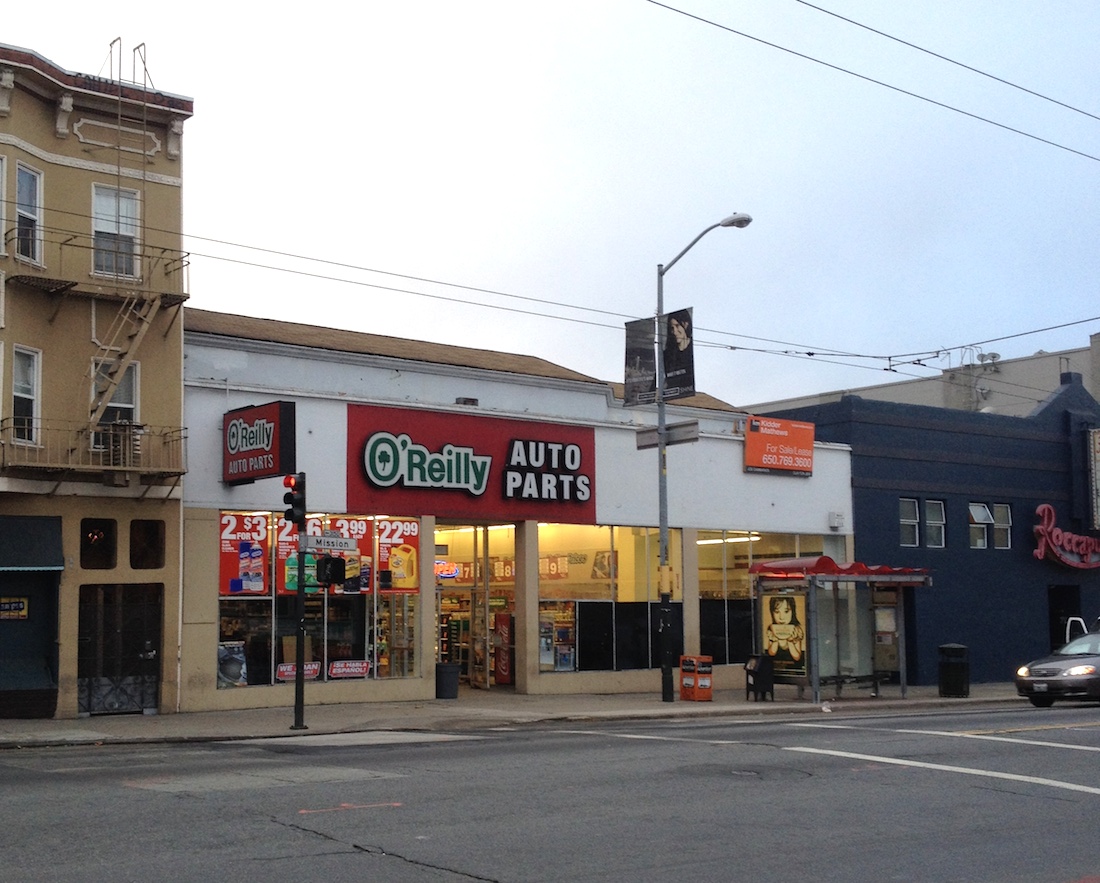
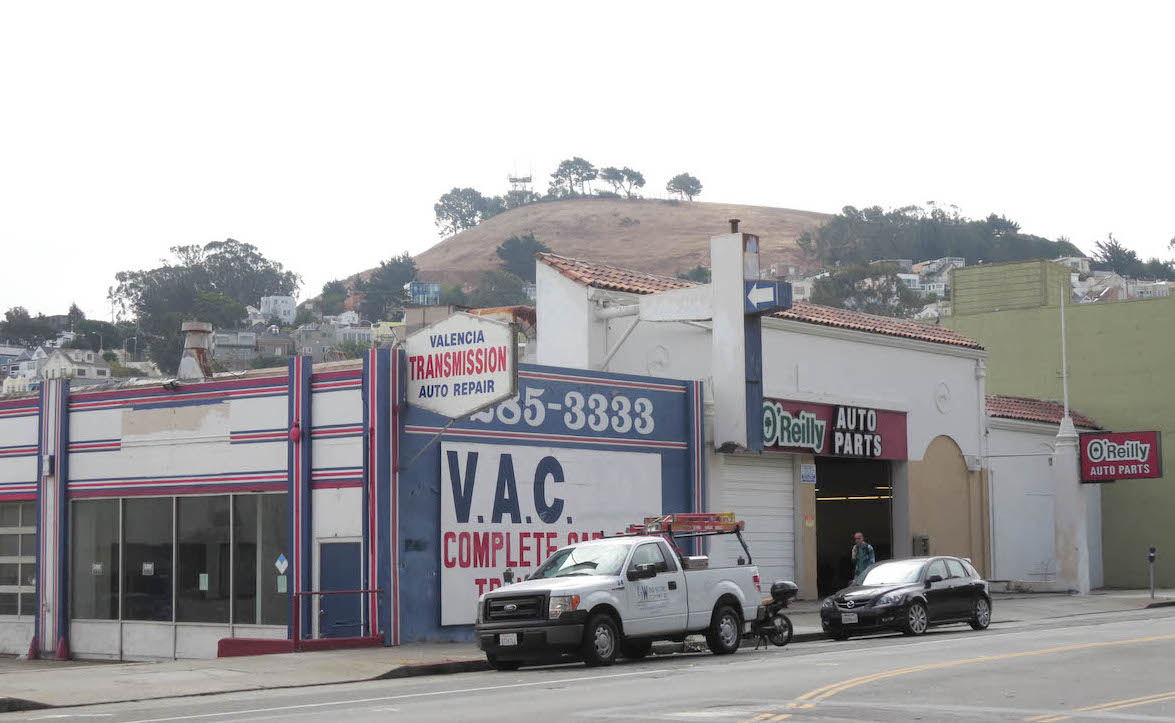
Recently, Bernalwood noticed a big For Sale/Lease sign on the facade of our locavore auto partsmonger, the stylish O’Reilly store on Mission at Precita.

More changes, afoot?  Perhaps. Eventually. Inevitably. Because change is the only constant.

Come what may, the thing to remember about this particular building is that it was originally constructed in the late 1920’s as the showroom for Mission Chevrolet, an automobile dealership established during the early years of the motorcar revolution, at a time when this corner of Bernal Heights was making a dramatic transition from equine industries to internal combustion.

Here’s the location of today’s O’Reilly store, as seen in 1927 on Mission Street looking north at Precita:

MissionChevrolet2

Mission Chevrolet was still under construction in left-center of the image, so let’s zoom and enhance to take a closer look at the facade. The Chevrolet bow tie sign is clearly visible, just to the right of the Delicatessen Grill (which is now home to Virgil’s):

MissionChevrolet2x

It’s nifty to see the front of the old Chevy dealership. But the back side of the building was way cooler.

The front door to the Mission Chevrolet showroom was on Mission Street, but the Service entrance was on Valencia, just south of Army/Cesar Chavez. This contemporary aerial photograph from the Bernalwood Intelligence Agency makes the building’s configuration clear to see:

MissionChevroletAerial

Now, here’s what Mission Chevrolet’s Valencia facade looked like in the late 1920s, courtesy of a photo from the Bernal History Project:

missionchevrolet

Again, let’s zoom and enhance:

missionchevrolet.detail

First. OMG! Look at Bernal Hill in the background. So naked and soooo cuuuuute! No Sutrito Tower. No trees. No party hat!

In the 1920s photo of the Valencia side, some of the architectural details are a little hard to distinguish. But they’re easy to visualize… because they’re still there today! Here’s the same spot, in 2014:

missionchevy2014

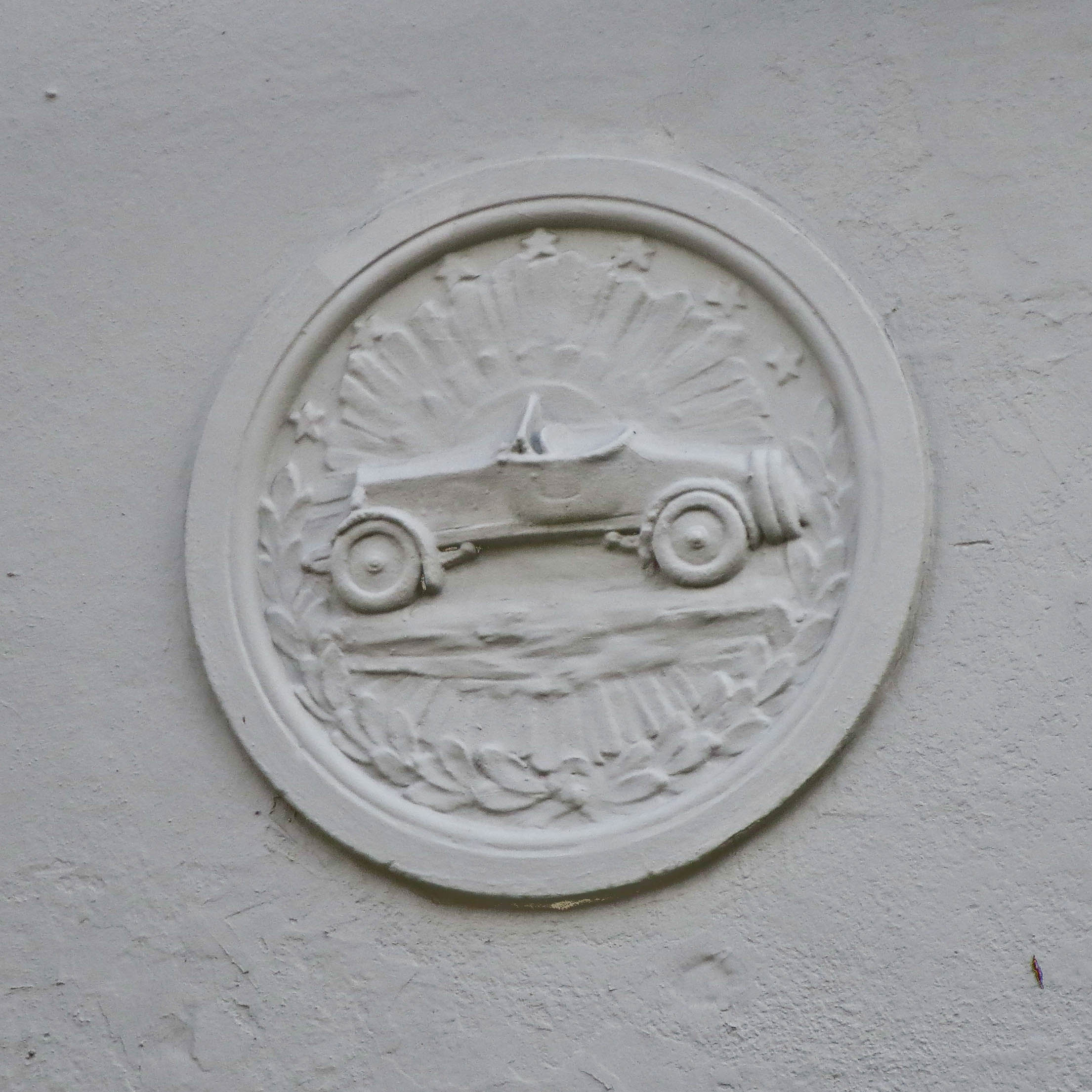
The flagpole remains on the far right side of the building, as well as the Spanish-style roof, and the arches from the original entrances. But the coolest detail is the bas–relief roundel right above the arches. The reliefs are still there, and if you look closely, you can still see a Chevrolet from the late 1920s embedded in the facade:

chevdetail

It’s a fun element, because it’s a representation of a late 1920s Chevrolet that’s baked into the building facade, rather like a bug in amber.

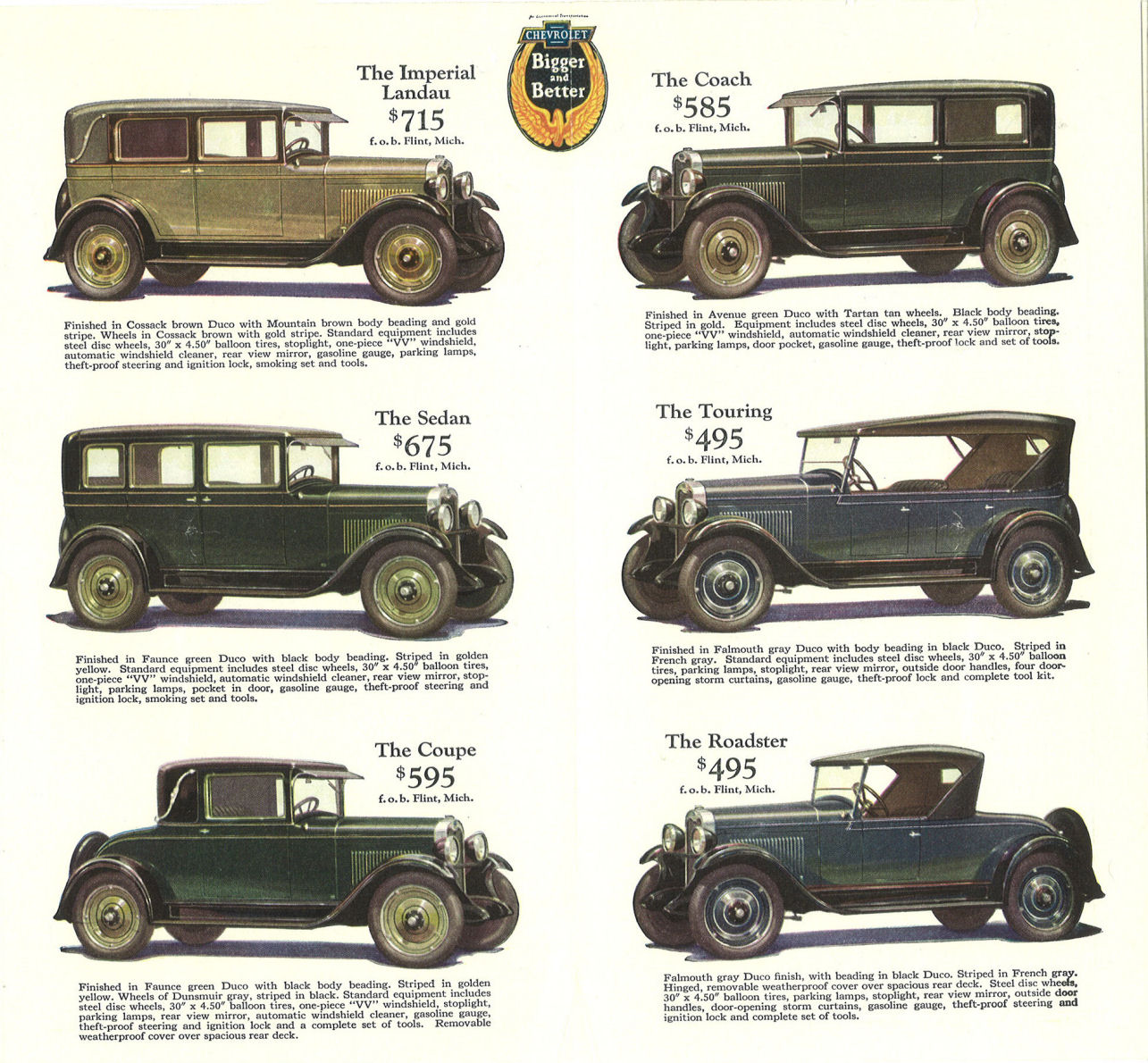
Picture it: Here’s what you’d get for your hard-earned Bernal dollars if you wandered down to Mission Chevrolet in 1928.

1928 Chevrolet Ad


Jack London Lived in Bernal Heights Before He Was Cool

Jack-London.bernalwood2

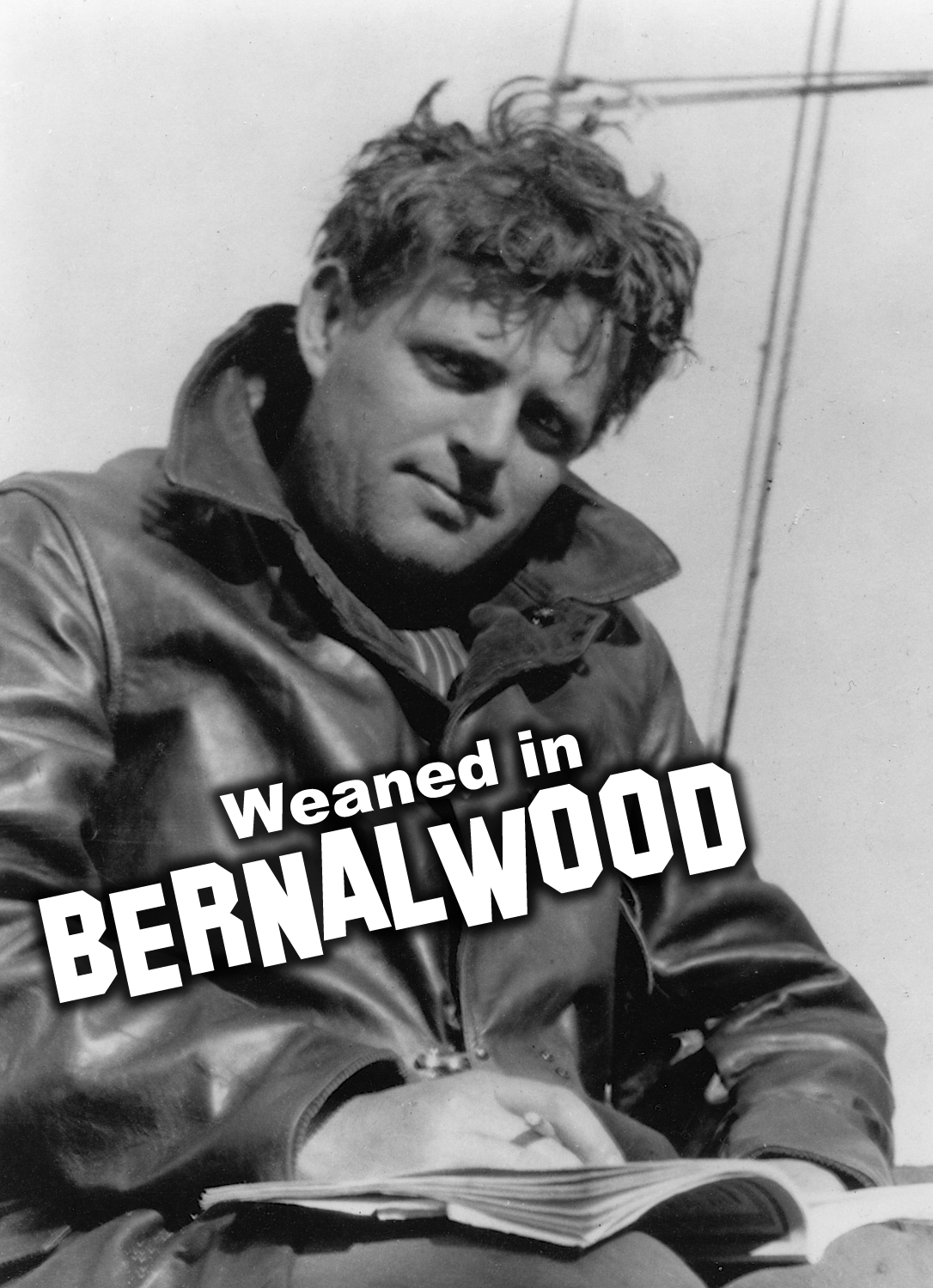
You might have noticed that Bernal Heights is today home to a rather impressive roster of fabulous writers and authors. All Bernalese can feel justifiably proud of our rich literary landscape, but Bernal Heights has been fertile ground for writerly genius for well over 120 years. For example, thanks to some impressive new research published by La Lengua’s rebel propagandist Burrito Justice, we now know Jack London once lived in Bernal Heights.

Yes, you read that correctly: Jack London once lived in Bernal Heights.

Okay, so Jack London was just one year old when he called Bernal home, and he didn’t live here for for long. Nevertheless, his later success provides clear proof that there’s something in the air in Bernal Heights that nurtures literary excellence.

Burrito Justice points to an excerpt from Irving Stone’s 1903 biography of Jack London:

londonexcerpt2

(Side Note: Jenny Prentiss does not appear to be the namesake for the Prentiss Street in Bernal today. That Prentiss was likely the Civil War hero General Benjamin Mayberry Prentiss.)

Anyway, if Jack London lived in Bernal Heights, Burrito Justice moves on to the obvious question:

But where in Bernal? Jack London was born on January 12, 1876, and John London married his mother either in September 1876 or February 1877.

The 1878 SF city directory gives a potential answer:

1878-john-london-precita5

Jack’s adopted father was John London, a Union veteran who married Jack’s mother Flora after Jack’s birth. But there are two John Londons! Which one? Also, how does 27th meet up with Harrison? And where is Gunnison Ave and Precita? And how does 28th have anything to do with Precita?

After some further sleuthing, we learn that Gunnison Avenue in Bernal Heights was a short stretch between Precita and Ripley that was contiguous with Harrison Street — until  1895 when it was renamed Harrison. But in this 1889 map, for example, the street was still called Gunnison Ave:

1889-bernal-gunnison2

So baby Jack London lived somewhere just south of Precita Park, along present-day Harrison Street, which today maps out like this:

moderngunnison

That’s just a quick summary of the evidence, but Burrito Justice dug up lots of fun stories and maps and historical geekery to identify where Baby Jack London lived when he lived in Bernal Heights. It’s fascinating stuff, and he did all the homework, so you absolutely must read the entire story on the Burrito Justice blog.
And from here on out, whenever you see some snot-nosed toddler being pushed around Precita Park in a stroller, just remember: That kid might just might turn out to be Bernal’s next Jack London.

IMAGES: Historical maps and text excerpts via Burrito Justice

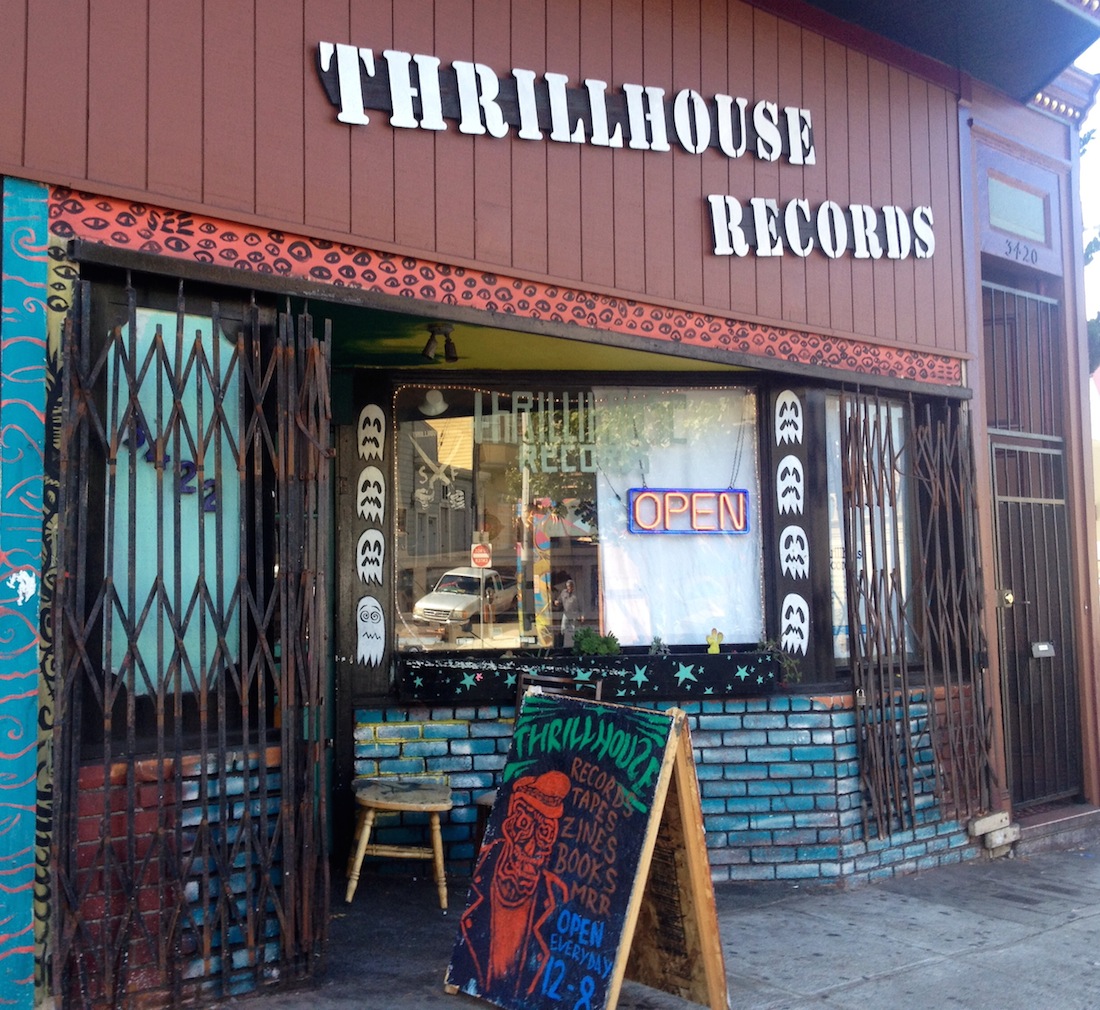
San Francisco of the Early 1990s Is Alive and Well and Open for Business at Thrillhouse Records

thrillhouse2

Amid all the current whinging about gentrification, The Change, tech buses, and coffee boutiques, it’s good to know the “real” San Francisco of bohemian memory is alive and well — if you know where to look for it.

Thrillhouse Records is such a place. Hiding in plain sight on Mission Street at Kingston right here in Bernal Heights, Thrillhouse is an enduring monument to underground San Francisco, circa 1991.

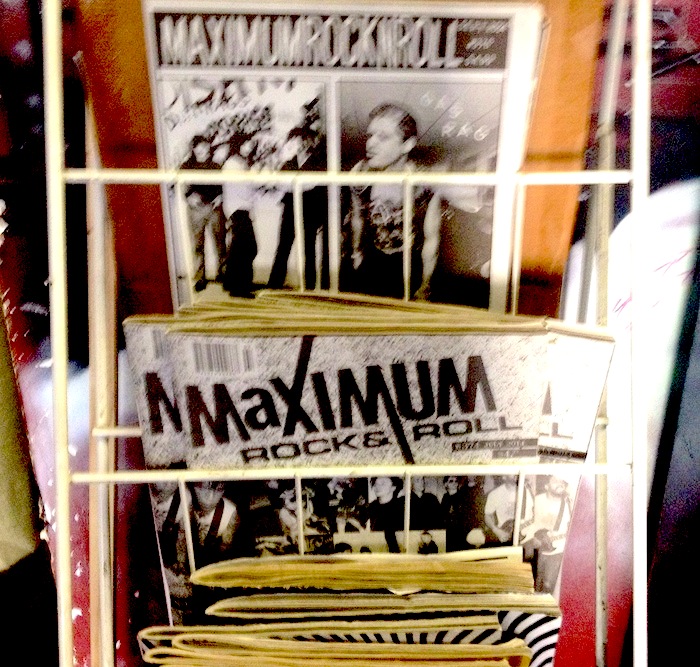
Want to know what counterculture looked like in the analog days before Tim Berners-Lee unleashed his Prometheus on our unsuspecting planet? What were the sensibilities of a young and alienated generation in an age of ascendant Reaganism, cassette tapes, and desktop publishing euphoria? What were the totems and signifiers of this edgy, halcyon time?

thrillhouse5

What did it look like?  What did it smell like??

Wonder no more: It looked and smelled exactly like Thrillhouse Records.

thrillhouse3

BONUS: This is what Reddit looked like way back then:

thrillhouse1

A woman named Caitlin was behind the counter when Bernalwood visited Thrillhouse on a recent afternoon, and she told us that the place is run by volunteers. They’re open from noon to 8 pm on most days, unless things are really really slow, in which case they may close a little earlier.  Stop by soon, before the 21st century reasserts itself.

PHOTOS: Telstar Logistics

After That Earthquake, Have You Hugged Bernal’s Chert Today?

chertislove2

Last weekend’s dramatic 6.0 earthquake was centered around American Canyon, but it caused substantial damage in the nearby town of Napa. Get well soon, drinky Wine Country neighbors!

But did you feel the quake here in Bernal when the earth shook at 3:20 am? The answer to that question seems to vary depending on a) the precise location of your home, and b) how heavy (or light) a sleeper you are, and c) if you have dogs.

Regardless, this earthquake provided a vivid demonstration of the importance of personal earthquake preparedness, and even better, NERT training.

It also provides yet another opportunity for all Bernalese to give thanks for the blessed chert that has endowed our neighborhood with such a stable foundation of earthquake-resistant bedrock. As Julian Lozos, our Senior Seismologist, previously explained:

Geologically speaking, Bernalwood is actually closer to the San Andreas than downtown, but the solid chert bedrock that makes up Bernal Hill didn’t shake nearly as hard as the soft sediment and artificial fill of the Financial District, Mission, or SoMa. That same chert explains why Bernal residents often miss smaller quakes that rattle people in other parts of the City.

(SIDE NOTE: If you’re not following Julian on Twitter, you’re missing his awesome guided tour of last weekend’s quake.)

But what exactly is this blessed chert, for which we all should be so grateful? Where did it come from? And how did it end up in Bernal Heights? Here’s a basic 411 on chert from Gelology.com:

Chert can form when microcrystals of silicon dioxide grow within soft sediments that will become limestone or chalk. In these sediments, enormous numbers of silicon dioxide microcrystals grow into irregularly-shaped nodules or concretions as dissolved silica is transported to the formation site by the movement of ground water. If the nodules or concretions are numerous they can enlarge and merge with one another to form a nearly continuous layer of chert within the sediment mass. Chert formed in this manner is a chemical sedimentary rock.

Some of the silicon dioxide in chert is thought to have a biological origin. In some oceans and shallow seas large numbers of diatoms and radiolarians live in the water. These organisms have a glassy silica skeleton. Some sponges also produce “spicules” that are composed of silica. When these organisms die their silica skeletons fall to the bottom, dissolve, recrystallize and might become part of a chert nodule or chert layer. Chert formed in this way could be considered a biological sedimentary rock.

Bernal’s chert is a local type called (…wait for it...) Franciscan chert, and Franciscan chert comes from compacted sediments formed by zillions and zillions of  tiny protozoa critter skeletons. Over the course of zillions and zillions of years, these sentiments hardened into layers on the bottom of the ocean, and today those layers are clearly visible in the cross-section of our chert.

The Wikipedia page for Bernal Hill explains how our chert became our hill, and why it’s that stylish reddish color:

Bernal Hill, along with the other hills in the San Francisco area, is a folded hill, created by the “wrinkling up” effect of the Pacific plate subducting under the North American plate, when the North American and Pacific plates were converging, around 150 million years ago. Near the summit you will find folded layers of very hard rock called radiolarian chert. It is a sedimentary sillicate rock which gets its sillica content from the shells of microscopic creatures called radiolaria. The red color comes from iron oxide.

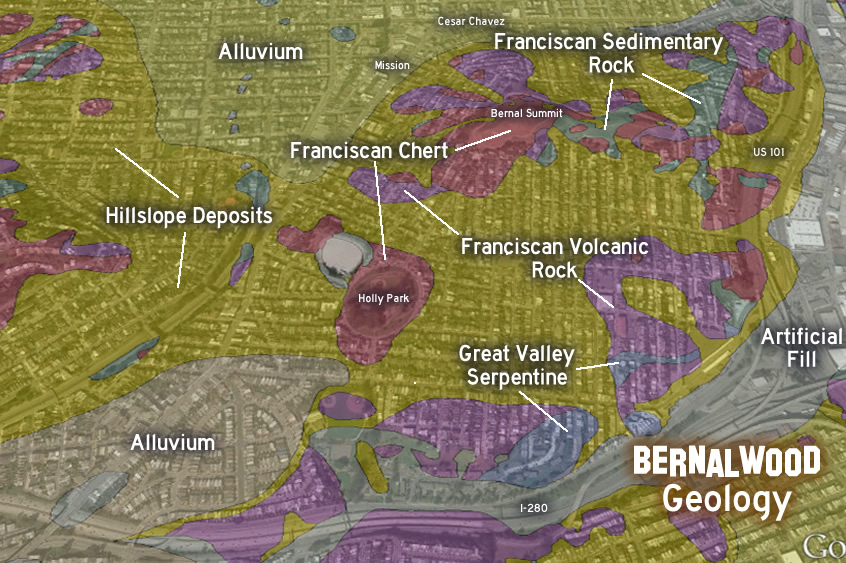
So that’s how Bernal ended up with all our chert, and how it got its coloring. And here’s how our chert is distributed, as seen through the spiffy Google Earth Geology layer:

bernalgeology4

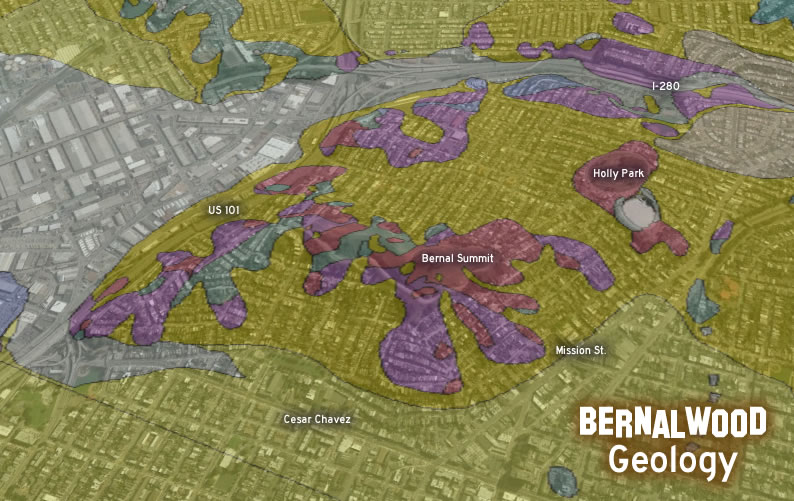
The red areas are Franciscan chert, purple is Franciscan volcanic rock, green is Franciscan serpentine rock, blue is Great Valley serpentine rock, and yellow is rock fragments in the form of hillslope deposits. The yellow-gray and lighter yellow are alluvium soil. The light gray is (eek!) artificial fill.

Here’s the reverse angle, looking at Bernal Hill from the north:

Bernalgeology.northview

As Julian explained a little while back, our beloved chert anchors Bernal Heights and absorbs much of the energy created by seismic waves.  So if you happen to be on Bernal Hill in the next few days, go ahead and find one of our rakish exposed chert formations. Then, approach the chert reverently, and give it a big wet kiss. Someday, the home that chert saves could be your own.

PHOTO: Chert on Bernal Hill, by Telstar Logistics

This Is What Bernal Heights Looks Like from Atop Sutro Tower

BernalfromSutroE

Every citizen of Bernalwood knows what it’s like to gaze out to the west from Bernal Hill and feel the sculptural, sci-fi presence of Sutro Tower standing proud above the City, Twin Peaks, and even Karl the Fog. For example, yesterday.

But have you ever wondered what it’s like to stand on Sutro Tower and look back at Bernal Hill?

Well, now you know, courtesy of the screengrab image above. From way up there, we look… unbig.

Earlier this month, the ever-awesome Exploratorium released a short documentary that provides a very satisfyingly geeky tour of the Sutro Tower complex, as well as lots of satisfyingly geeky history about how the tower works and how it came to be.

Of particular note to local YIMBYs will be the section at the end where the Sutro Tower spokesman considers the structure in the broader context of San Francisco’s other landmarks— while backhandedly suggesting that each generation’s Enemies of Progress should get over themselves:

“Everything that gets built in San Francisco is generally a problem when it gets built. The Transamerica Pyramid, certainly, and Sutro Tower very soon thereafter. Both have become icons of the City. People opposed the Golden Gate Bridge when it was built. But over time, people come to recognize it, and cherish it, and it’s become an icon and a real symbol of the City.”

Amen, and Hail Lord Sutro!

Here’s the video. The Bernal Hill cameo comes at around 02:15…

Neighbor Goes for Walk on Lost Streets of Bernal’s Yesteryear

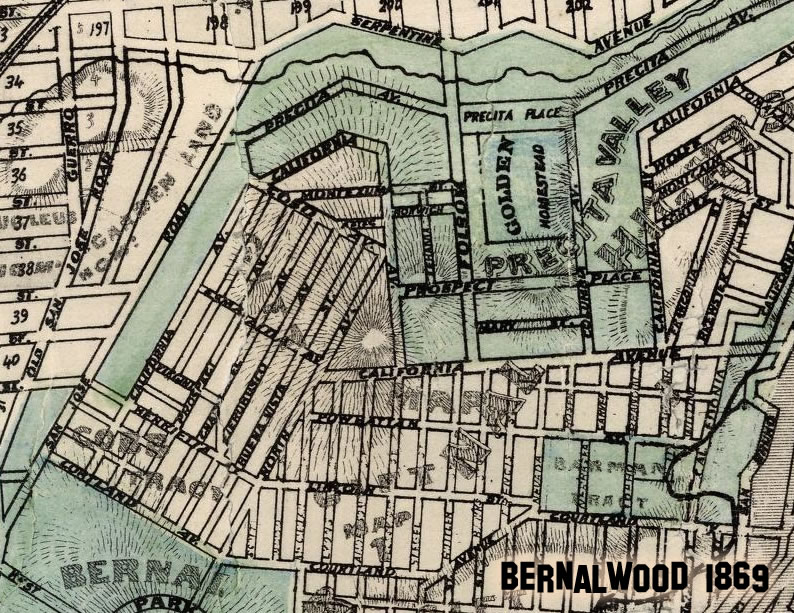
1869-sf-goddard-bernal
Bernal neighbor Michael Nolan has been here for many hundreds of moons, but he recently went for a short walk around west Bernal that sent him even farther back in time:

I walked down Heyman this morning en route to boot camp. It’s a block long street stretching from Prospect Ave. to Coleridge (formerly California), and just south of Virginia. We live here in West Bernal in the Heyman Subdivision of the Cobb Tract of Precita Valley Lands, once part of Jose Bernal’s rancho. I live on Elsie Street (formerly Cherubusco) which lies between and parallel to Bonview (formerly Buena Vista) and Winfield (formerly Chapultepec). Your corrections and amplifications of this history will be appreciated and acknowledged.

A quick comparison of maps old and new verifies many details of Neighbor Michael’s stroll down History Lane(s).

Here’s a west Bernal detail from the 1869 map. Notice Cobb Tract superimposed above the western end of Cortland (which, oddly, is spelled “Courtland,” but only east of North Ave., or modern-day Bocana):

1869-sf-goddard-map-westbernal

Compare that with 2014, courtesy of the Google:

2014map.westbernal What’s up with the Cobb’s Tract business? The lovely Tramps of San Francisco blog ‘splains for us:

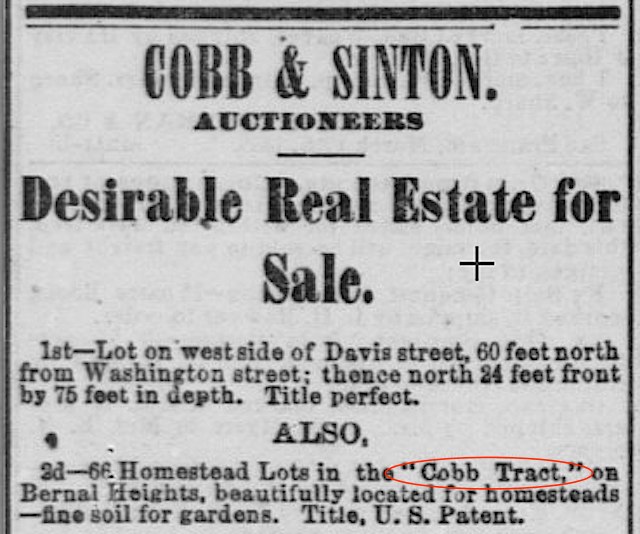
The first land sold in Bernal Heights had been transferred by auction at the real estate offices of H.A. Cobb and R.H. Sinton, 102 Montgomery Street, on July 14, 1860. The property consisted of “4, 5, and 6 acre lots on the ‘Bernal Heights’ …  within 15 minutes drive from City Hall … for sale at a very low rate … The lands, for beauty of locality, commanding scenery and fertility of soil, are not surpassed in the county of San Francisco.” In August 1865, another 66 homestead lots were offered in on the “Cobb Tract” of Bernal Heights and buyers were to receive title and a U.S. patent.

Verified!  Here’s an advert from the March 16, 1865 edition of the Daily Alta California:

In contemporary parlance, some might call H.A. Cobb a “speculator.” And the people who bought those homestead lots were “gentrifiers.” Especially if you were a displaced cow.

Anyway, It’s just a good thing Neighbor Michael wasn’t trying to meet his boot camp group at one of our many former California Avenues. He might never have found them.

If you enjoy fun with street history, our friends at the (awesome) Bernal History Project have complied a handy guide that explains where many of today’s Bernal streets got their names. To go even farther back, you’ll want peruse the top-secret spreadsheet Neighbor Michael keeps to track which of today’s Bernal streets used to be called something else. Want to see it? Just face toward Sutro Tower, chant the secret Bernalese password three times, and click here.

VINTAGE MAPS: 1869 map from the David Rumsey Map Collection, via Burrito Justice

Let’s Explore Life Magazine’s Mysterious 1969 Photo from Bernal Hill

117325467.jpg

We don’t know much about what’s going on here, because the caption doesn’t provide any context. (“Above San Francisco, 1969” is all it says. Thanks!) Still, it was nifty to stumble across this image in an online round-up of vintage LIFE magazine photographs of San Francisco.

While the activity taking place here is mysterious, there are nevertheless a few cool things to notice. Let’s use our special combination of algorithms to zoom and enhance the eastern side of the background:

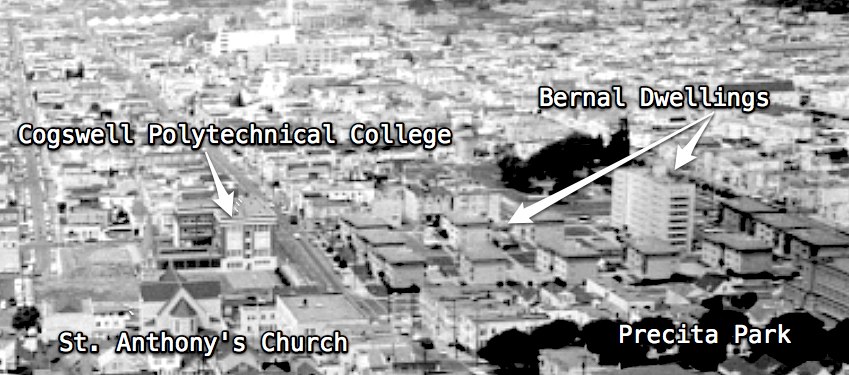
bernal1969annotated-1

There’s Cogswell Polytechnical College, on Folsom between 26th and (then) Army Street. Just south of that, the original St. Anthony’s church still stands, before it was destroyed by fire in 1975. And of course, the infamous Bernal Dwellings housing project, built in 1952, with its fortress-like residential tower, dominates the block on Army between Folsom and Harrison.

Now let’s look a little to the west…

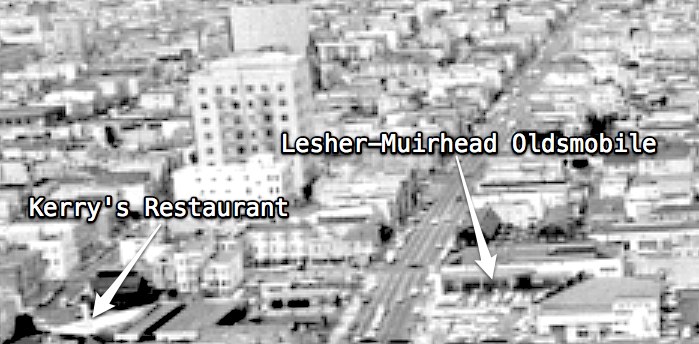
army1969nwest

There are lots of new cars lined up outside the Lesher-Muirhead Oldsmobile dealership on the corner of Army and South Van Ness, while just a little farther west we can see the big sign for Kerry’s Restaurant — open 24 hours a day, with ample parking! — rising above Army Street.

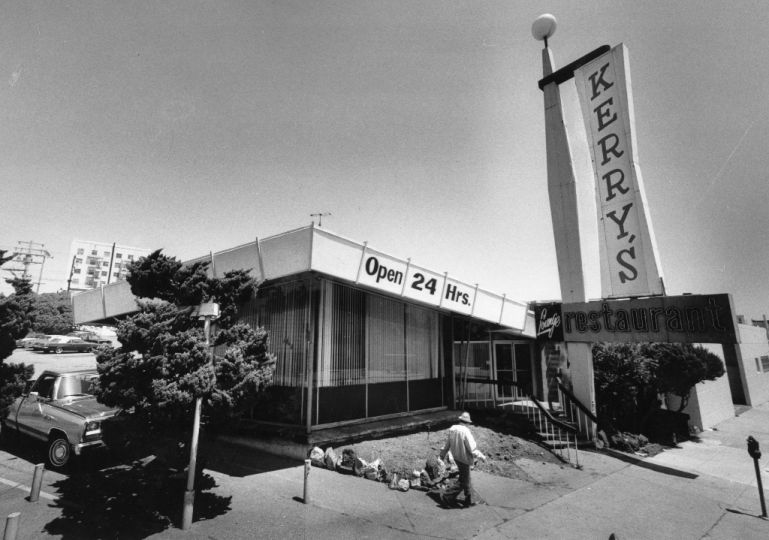
Bernalwood hasn’t geeked-out about Kerry’s Restaurant before, so let’s digress. Here’s a rather awesome 1986 (!!) shot of Kerry’s taken from street level, courtesy of the Chronicle:

Kerry'sRestaurant.1986

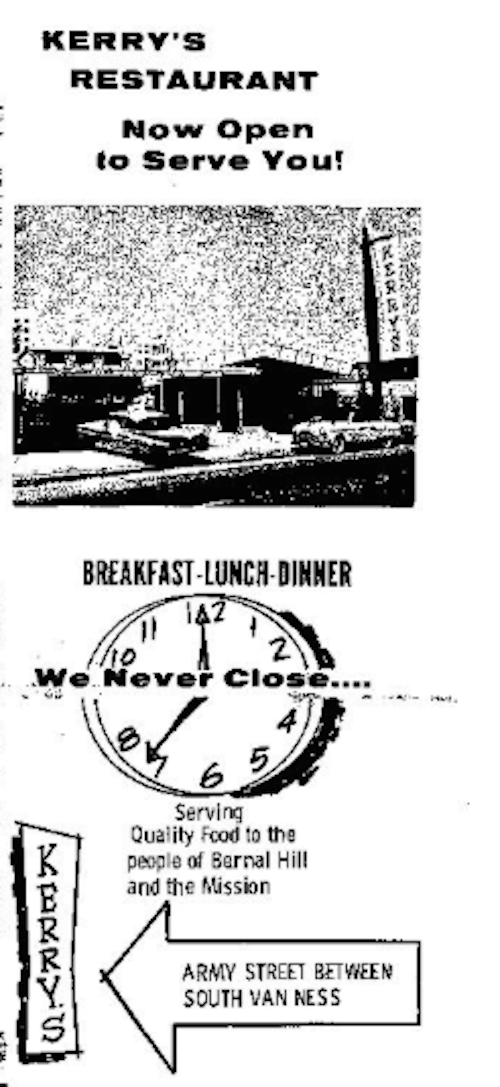
Here’s an advertisement for Kerry’s from a 1964 copy of the Bernal Heights Pictorial, which was an “antecedent to New Bernal Journal”:

kerrysadvert

Even more tasty, perhaps, is this 1960s menu from Kerry’s that we found in a dusty corner of the interwebs:

kerrysmenu

kerrysmenuinterior

Crab Louie! Cottage Cheese Salad! Breaded Veal Cutlet! Kerry’s was obviously a classy joint.

Meanwhile, if you happen to know anything about those two gentlemen frolicking in the foreground, please do chime in…

The Evolution of Bernal’s Lesbian Community, as Viewed from Wild Side West

Wild Side West

There’s an interesting story on the cover of SF Weekly this week that looks at the changing geography of San Francisco’s lesbian community.

It describes how “San Francisco’s lesbian enclave has shifted four times in the last 30 years, from Valencia Street to Noe Valley to Bernal Heights, and now, to Oakland, moving around in response to or anticipation of the next economic upheaval.” The Bernal Heights portion of that history turns out to be rather interesting — while providing a useful reminder that many of today’s venerable old-timers were once bizarre newcomers as well:

Bernal Heights was still largely an immigrant neighborhood [in the mid-1970s], so lesbians who moved there during the ’80s and ’90s were often perceived as perpetrators, rather than victims, of an early gentrification wave.

Against that backdrop, we then take a look at Bernal’s lesbian community, as seen through the prism of The Wild Side West on Cortland:

Domestic proclivities, compounded by the gender wage gap, are undermining the notion of a lesbian district. Younger, artsy people are descending on Oakland, but they don’t have the density, or the urgency, to create their own township. And there aren’t enough left in San Francisco to maintain a cultural critical mass.

Fritz, a gravelly voiced woman in a hooded sweatshirt, considers herself the “ambassador” of the Wild Side West, a historic lesbian bar in Bernal Heights. She offers tours to all variety of interlopers: ogling tourists, straights from the neighborhood, correspondents from local newspapers. Many are first-time patrons; some aren’t sure whether to treat the place as a neighborhood watering hole, or a shrine to Bernal’s past.

In fact, it’s a little of both.

The Wild Side West seems frozen in time, even as the city transforms all around it. And, on a balmy Thursday afternoon in May, it’s still packed with regulars: old men hunched over frothy beers, coarse-haired women unfolding crinkled newspapers, a large dog who lies, panting, in the corner. Fritz is unloading a bag of hot dog buns for anyone who wants to stick around later and watch the Giants game; she’s also taken it upon herself to lead another tour.

Sure, the neighborhood is changing, she acknowledges, strutting through the bar’s ample backyard and pausing to point out various amenities — the wood swing, the barbecue grill, the mannequin with a bottle-cap bikini. Fritz sits down at a picnic table and bunches her mouth studiously, taking mental stock of the new elements.

“When they got rid of the pay phones, that’s when the property values went up,” she says. Bernal used to be a working-class area with a small but noticeable population of drug dealers; now it’s dotted with organic tea houses and Pilates studios. In January, the online real estate brokerage Redfin crowned it the hottest neighborhood in the US, based on property listings searches; the median home price is just shy of a million dollars.

Fritz and her partner, June (not her real name), want to partake in the boom, too — they’re eyeing a $1.3 million house with two bedrooms upstairs and a studio on the ground floor. They think that by pulling together their savings, and June’s salary as a lawyer, they’ll be able to scrounge up the money.

Looking toward the future, she has few reservations about joining a new class of well-heeled startup workers and “couples pushing strollers” — even if she becomes the old-timer who doesn’t quite fit in anymore. A Long Island native, Fritz works at the Inlandboatmen’s Union and considers herself staunchly blue collar — making her part of an ever-dwindling population.

“I’ve seen younger gay women move in, but they’re mostly in the tech field,” Fritz says. The lesbians who came to drive forklifts or paint houses can’t afford their rent anymore.

PHOTO: Telstar Logistics


Meet the Sneaky Bernal Kid Who Earned a Cameo in the Famous “Bullitt” Car Chase Scene

bullitthen1e

bullittkids2

Our glamorous neighborhood’s most famous Hollywood moment took place in 1968, when Bernal Heights served as the gritty starting point for the classic Steve McQueen car chase sequence in the movie Bullitt.

Writing for the SF Weekly,  Joe Eskenazi tells a sweet “Where are they now?” story about a Bernal kid who scored some cameo screen time during the first moments of the famous Bullitt car chase (at about the 0:24 mark in the video below):

Joe writes:

It all starts with that turn off of Cesar Chavez and a slow cruise up York. And — blink and you’ll miss it — a pair of kids runs across the street where York meets Peralta.

Last week, your humble narrator’s cellphone rang. “This is Angel Sanchez Jr.” said the voice at the other end.

He was one of those kids. [ … ]

A movie like Bullitt offers the chance to look through the window and see an entire city we will never see again.

Sanchez, the boy who ran across the street in front of the movie villains’ Dodge Charger, will be 54 next week. His cameo in city lore was not scripted. Loren Janes, the stuntman who, in reality, drove like Steve McQueen, recently recalled how tightly choreographed the seemingly chaotic scenes were. The repetitious Volkswagen was, in fact, driven by a stuntman (or stuntmen). So was every car on the street, even the cable cars on Filbert. Film crews kept an eye out for vehicles backing out of garages and intervened to prevent pedestrians from becoming hood ornaments. But no one lifted a finger to stop those Bernal Heights kids from running across the street every time the director shouted “action.”

“He’d yell ‘Cut! Cut!’ But, finally, to hell with it. He left it in there,” recalls Sanchez. “We must have run across the street three, four times. We didn’t know any better.”

Sanchez didn’t even realize he was in a movie until many years later. And, by that time, both he — and the neighborhood — had changed.

There’s lots more goodness where this came from, so take a moment to enjoy all of Joe’s article — and the (somewhat melancholy) picture it paints of  life in Bernal Heights during the closing years of the postwar era.