Today is the 105th anniversary of the Great San Francisco Earthquake of 1906. So what was the big event like here in Bernal Heights?
Rather uneventful, actually. Bernal itself suffered relatively little damage — thank you, chert! — and the fires that ravaged much of the rest of the City never made it this far south. (As you can see above, Bernal Hill proved an excellent vantage point for gawking the disaster as it unfolded.) Later, parts of the neighborhood — most famously Precita Park — were used as encampments to shelter displaced City residents, which in part explains why the quake ultimately turned out to be a boon to Bernal Heights development.
Remember that post we did that post a few weeks back about about “What a 20something Sees When He Looks at Bernalwood?” That was the one where we shared a “review” of our neighborhood written by a young Bernal resident who described it as “the personification of well-known San Francisco stereotypes.” (Good times!) This generated lots of chatter from the Bernalwood Commentariat, including one by a reader who goes by the handle Welcome Wagon.
They have babies. They have dogs. They have unlimited lines of credit at the bank of mom and dad. They clog the sidewalks with their SUV baby carriages. They have jobs like “I blog” or “I consult on branding” or I teach yoga and visualization”. They are entitled and tend to complain to the city about every little thing. They dislike my parking my 1981 car in front of their houses. They complain to one another over their lattes about the older residents not keeping up their properties.
And because of them:
You just can’t get good quality crack on Cortland anymore. (that pictured gathering at Cortland and Ellsworth would have been Alemany crack dealers 30 years ago.) There’s a grocery store in the ‘hood where once was a putrid hole much worse than JC Super. You can walk on Cortland after dark. There are actually children in the playground behind the library–not drug dealers. There’s a bakery! And I won’t even mention, well OK, I will mention that they’ve done wonders for our property values.
Having the neighborhood become a yuppie rookery is a small price to pay for the benefits of gentrification.
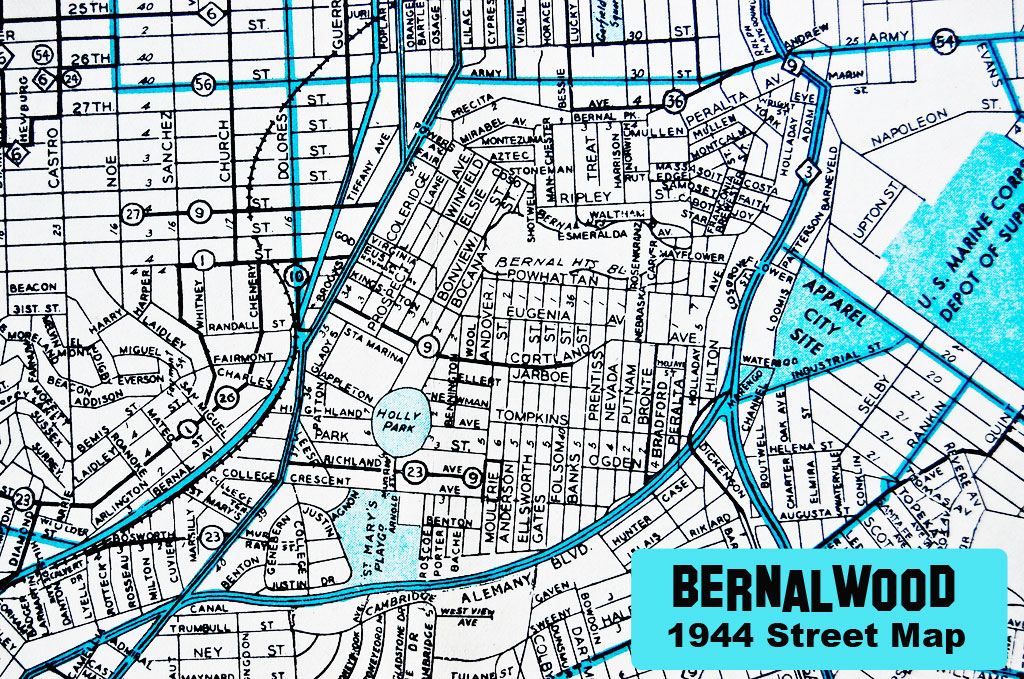
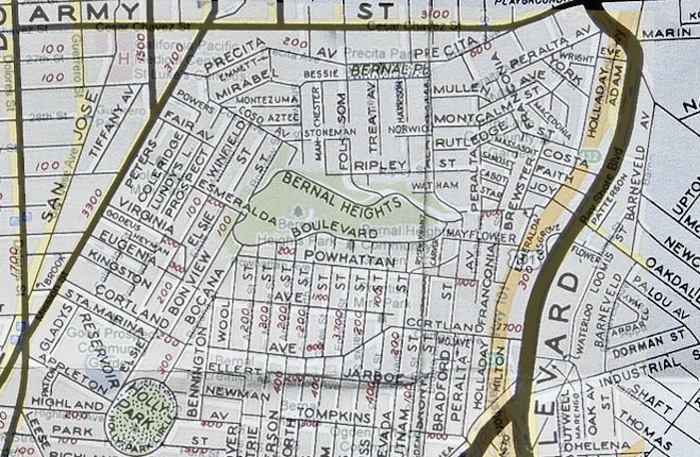
While poking through some of my bookshelves last weekend, I stumbled across two old San Francisco street maps from the 1940s. As you might expect, most of the Bernal Heights street grid is much the same today as it was then, with one big exception: The Bayshore Freeway wasn’t built until the 1950s, so the eastern slope of Bernal looked rather different.
The construction of the freeway reshaped some aspects of the neighborhood in ways are still visible today; most ominously by turning Faith into a dead end street. (METAPHOR ALERT!!!)
But let’s take an even closer look… with a Burrito Justice-style overlay of a circa 1940 map and a contemporary Google map:
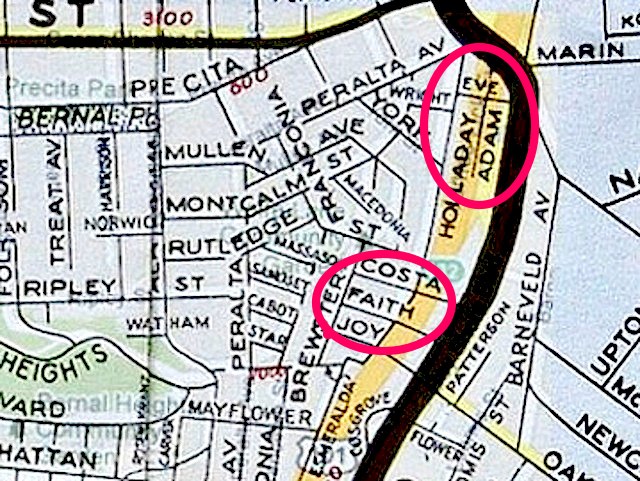
Look closer, and we see more detail. Impressively, Bernal’s streetscape survived the creation of the Bayshore Freeway with relatively little disruption or dislocation. Only two small streets disappeared entirely: Adam and Eve:
So while the physical damage to the neighborhood was relatively minor, the metaphysical damage was significant, considering that the freeway cut us off from Faith and Joy, while wiping out Adam and Eve so thoroughly that no trace remains. Talk about being cast from Eden…
Four years ago this week, Bernal Heights lost some of its most remarkable residents — a pair of Great Horned Owls. The owls lived in a tree along the western side of Bernal Heights Boulevard, and for a time they were a popular neighborhood attraction. Then one died, on April 9, 2007. The second died soon thereafter. And then they were gone.
When the great horned owls were spotted in the trees at the top of the Esmeralda Steps in the fall of 2007, something magical happened in the Bernal Heights community. People were captivated by the birds — their silent majesty and ferocity were so compelling! People came to the hill just to stand and look at them. No one could believe these wild birds had adopted our hill as their home, and they couldn’t resist hanging out with them for even just a few minutes every day.
As a result, the community of walkers, joggers, and dog-owners on Bernal Hill came together more intimately than ever before. People congregated under the trees where the owls lived and exchanged stories of their first owl sighting. Connections were formed as people exchanged names, petted friendly dogs, and jiggled the little fists of babies in the arms of their parents. A baby born during the owls’ visitation was named after them.
My husband Art is a photographer, and the owls provided endless photo ops for him. We went to the hill almost every day to see the owls and take photos of them. Art became known as “Mr. Owl Man” and I was “Mrs. Owl Man.” I would sit by the side of the path, asking passersby if they had seen the owls yet. It was always fun to point out the birds to someone who’d never seen them, and witness their complete surprise and delight upon spotting them camouflaged in the trees. They were very hard to see if you didn’t know what to look for, but once you saw them you were amazed at how big they were yet how easily you could miss them. Soon we began coming up to the hill at dusk to watch them take off to go hunting. First they would call to one another and jump around in the tree for a few minutes—one would fly off, and then the other. We followed them around the hill until it got too dark to see them.
The Hill is still a friendly and welcoming place, but it hasn’t bee quite the same since the owls have been gone. I miss them and the sense of communal wonder they inspired.
As if to prove that even the most timeless institutions don’t stay the same forever, change has come to the Old Clam House. The venerable eatery along Bernalwood’s eastern frontier has been in business since the days when Bayshore Boulevard was just a grubby plank road, and today it claims to be San Francisco’s oldest restaurant in continuous operation in the same location. But now it has new owners, a new menu, and new decor.
The Old Clam House has been bought by the group behind The Stinking Rose (who also own Calzone’s, Bobo’s, The Franciscan, and the upcoming Salito’s/old Margaritaville in Sausalito). The restaurant has been around since 1861, and when it became available, Jerry Dal Bozzo was interested in picking it up—the group’s director of marketing, Brandy Marts, reminded me he has an interest in historical properties: Dal Bozzo was the one to reopen the Cliff House in 1973. They are currently updating the space room by room, refreshing the paint, chairs, and other touches. They are also working to reopen the patio, which will be glassed-in.
I had a chance to catch up with chef Andrea Froncillo, who walked me through the menu changes. He’s taking a lot of the fried dishes off, and modernizing some of the preparations (for example, he’s simplifying the cioppino, with reportedly good feedback from some regulars). He also changed the clams from cherrystones to Manilas due to some availability issues, and added prime rib to the menu. You’ll also see more salads and some lighter lunch options for folks who work in the neighborhood. You can peek at the new menu here.
I confess that despite years of saying, “I should try that place someday,” I’ve never eaten at the Old Clam House. Over on Yelp, some of the old-timers are complaining about the new changes, but, really, I should try that place someday. Have you?
Lastly, if you want to taste a genuine slice of neighborhood history in the safety and comfort of your own home, try making this 1915 Old Clam House recipe for Clam Chowder. The recipe includes bacon, so it must be delicious.
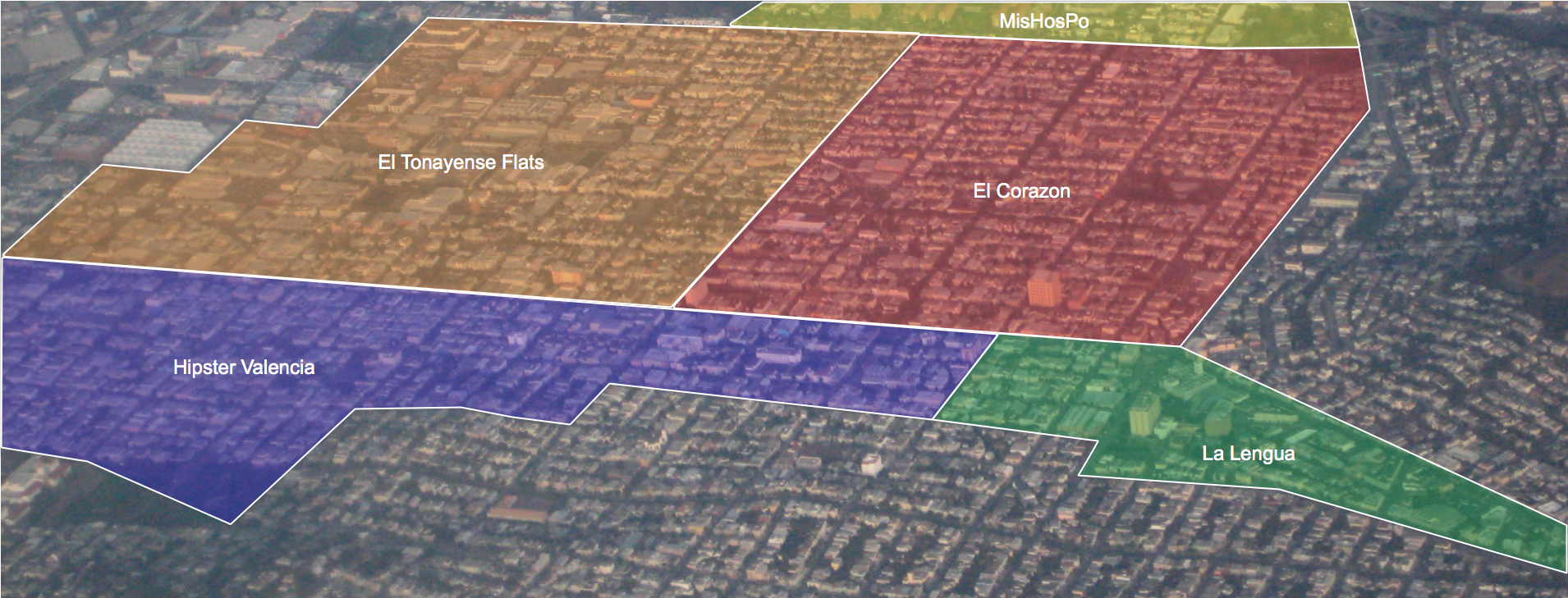
Vicky from the ever-excellent Bernal History Project passed along an announcement about a presentation by our favorite local separatist, La Lengua’s own Burrito Justice (aka Johnny O). It’s no exaggeration to say Burrito Justice put La Lengua on the map — but the really sly bit is that he also created the very first map upon which La Lengua first appeared. (Shown above.)
The talk takes place TONIGHT at 7 pm the Bernal Heights library. Vicky says:
This month’s Bernal History Project meeting features a special guest. Burrito Justice, La Lengua’s resident citizen cartographer and historian, presents a slideshow and talk that will take us on a tour of Bernal and the Mission in the 1860s. There’ll be maps, photographs, and all sorts of computer whizzery.
And if you don’t know where or what La Lengua is, come to the meeting and find out!
The presentation starts at 7 p.m. sharp in the downstairs meeting room at the Bernal branch library (500 Cortland at Anderson); turn left at the bottom of the stairs. As always, the meeting is free and open to all.
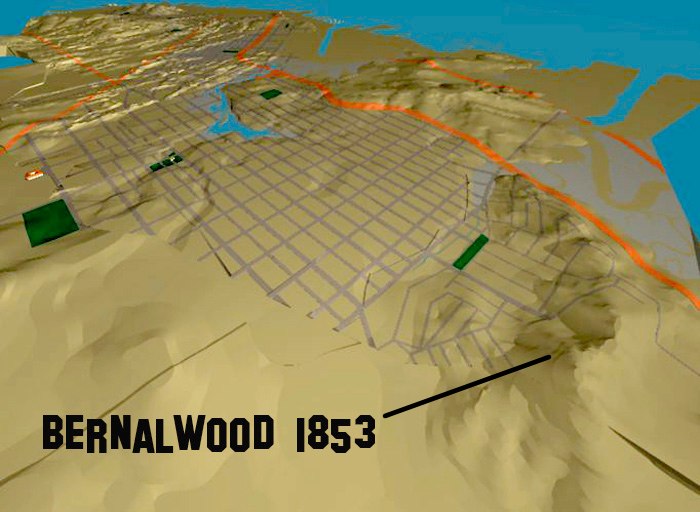
Although no one is alive today who ever once saw it, much of the land around Bernal Hill used to be riverbeds and wetlands — particularly to the north and east. But what exactly was the local topography like roughly around the time of the Gold Rush, before all the infill and reclamation that made yesterday’s wet parts dry today?
Architect Glenn Lym has created a 3D CAD map that illustrates the answer. Combining topographical data with historic surveys and a 2010 street grid, Glenn’s way-cool map reveals what was where around Bernalwood in 1853. Glenn explains:
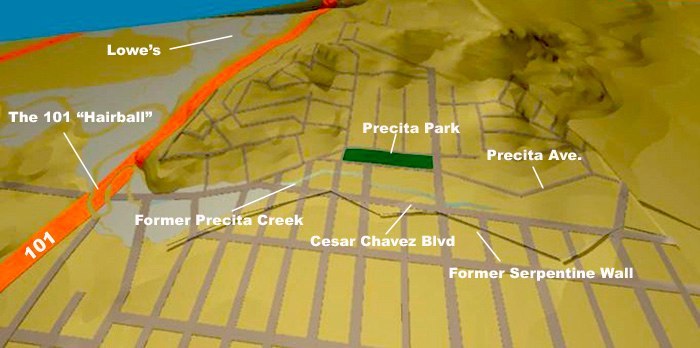
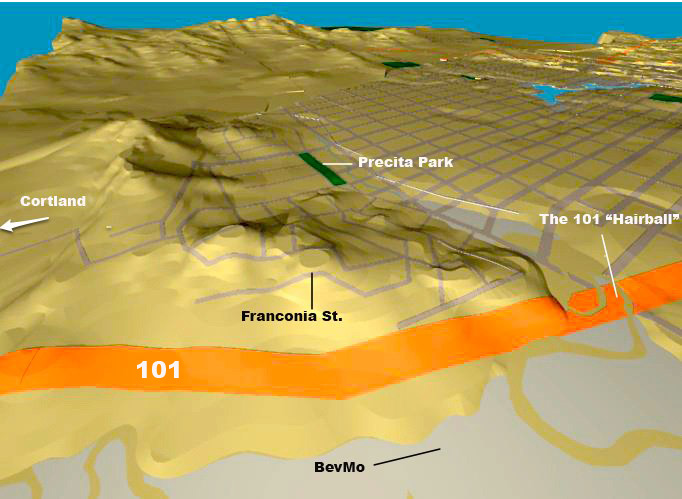
The pics show the 1852-3 US Coast Survey showing Bernal, the Mission and Potrero Hill as they were, as if overlain by the current shoreline and the current streets (101 and 280 shown in orange). Among the items here are:
1. The old Precita Creek Marsh that was a part of Islais Creek and Marsh sneaks up what is now Cesar Chavez, the creek itself shown wiggling between Chavez and Precita Streets on the Bernal side of Cesar Chavez. Note that Precita Street zigzags parallel to the old Serpentine Road/wall that was erected in the 1800’s, with the Precita Creek running down in the valley between these two landmarks (EDITOR’S NOTE: This is why Precita Street zig zags, even today.):
2. Bernal Heights had two other major peaks to it, to to the north east of the current peaks – roughly under what is now the flat planes that lie between Peralta, Rutledge and Franconia Streets . Vicky Walker of the Bernal History Project sent me a couple of their aerial survey maps that show that these two peaks were removed sometime between 1938 and 1948. Terry Milne said that they have been trying to find records which usually exist for 1900’s large excavations, about where all that hillside was dumped, but so far to no avail. Note that the peak between Rutledge, Massasoit and Brewster was not just chopped off, but gouged out from the Bernal hillside:
A reminiscence on barbers, and streetcars, and how both of these things don’t exist in Bernal Heights anymore, even though some people really need them.
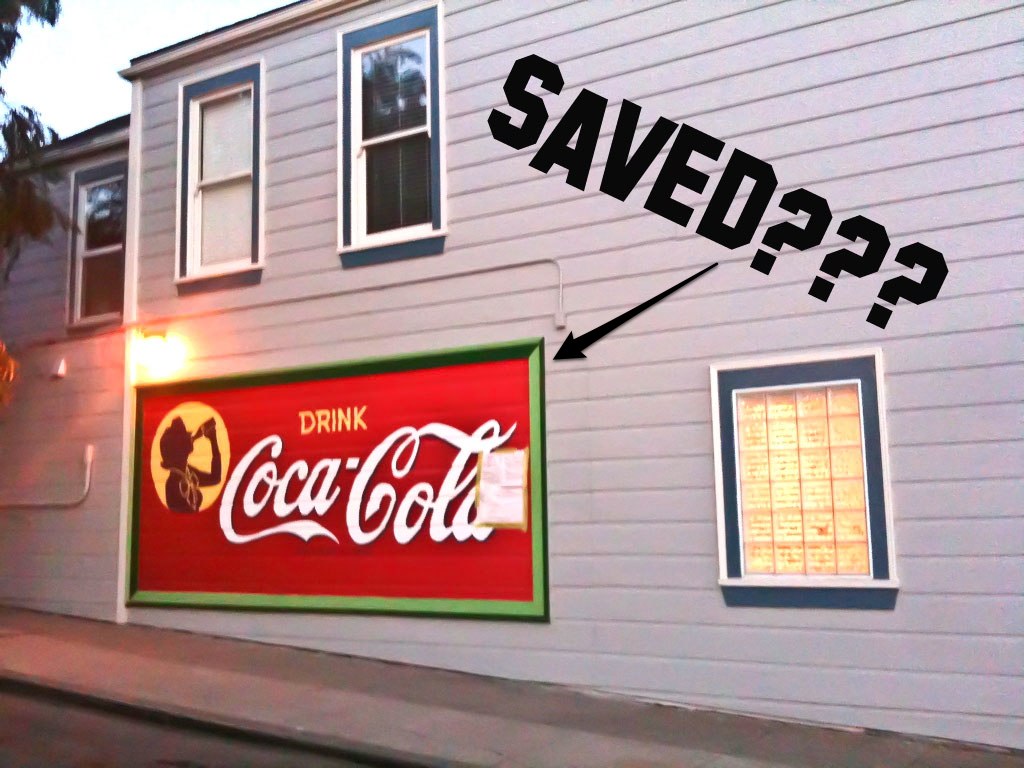
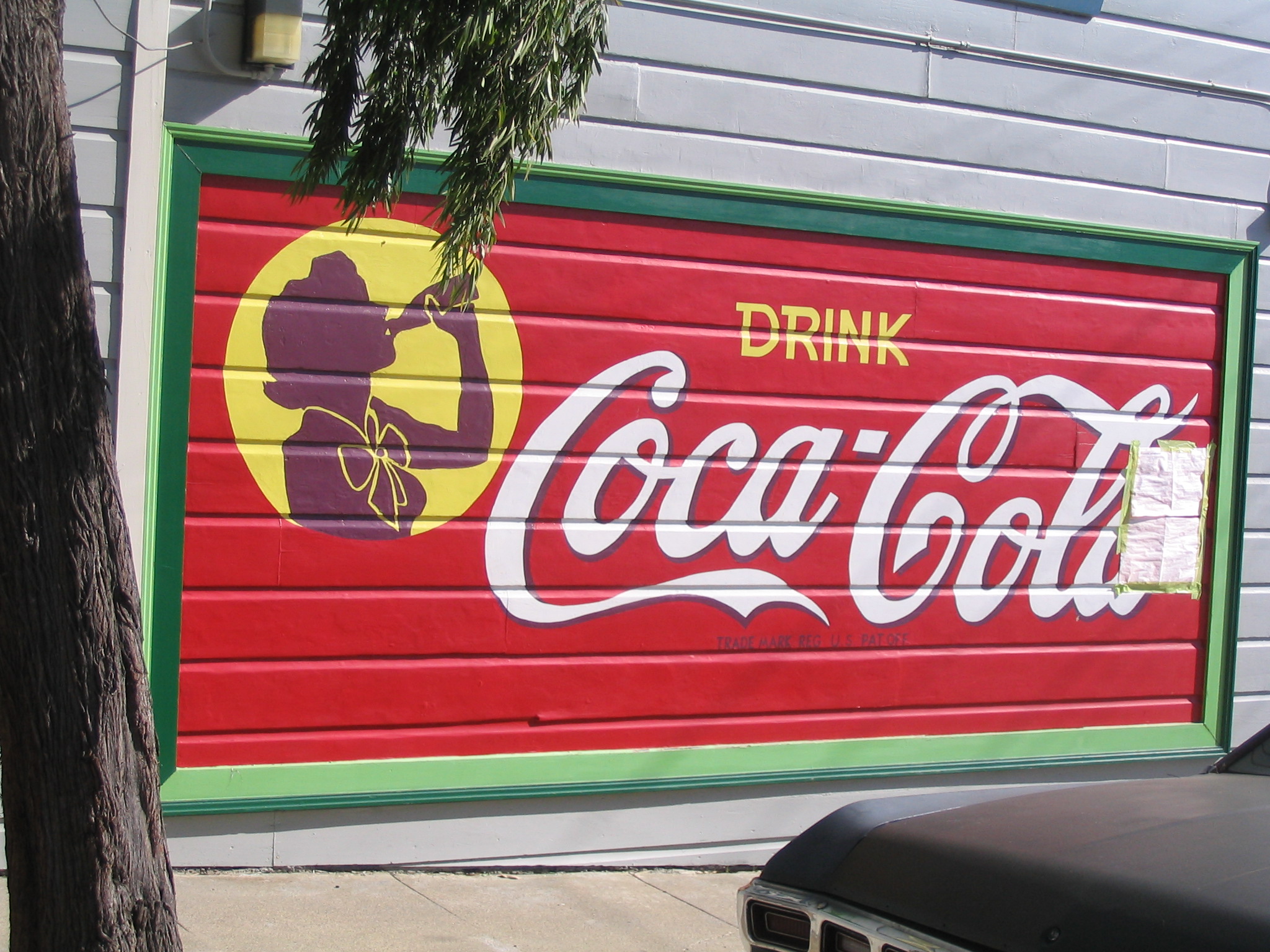
Supervisor David Campos’s office called today to share some very good news: Campos plans to introduce new legislation that will amend the City’s planning code to create a straightforward mechanism for preserving the historic-but-endangered Coca-Cola mural in Bernal Heights — as well as other historic signs throughout San Francisco. Wooot!
The legislative digest of the Campos proposal explains why this matters:
The look and style of signs have evolved over time. For that reason, a sign that has existed in a particular place for years gives continuity to the public space and becomes part of the community memory. In an era where signs are mostly uniform, a historic sign can add some individuality to the neighborhood in which it exists and also to the City as a whole. Michael J. Auer, in his article “The Preservation of Historic Signs,” notes:
Signs often become so important to a community that they are valued long after their role as commercial markers has ceased. They become landmarks, loved because they have been visible at certain street corners — or from many vantage points across the city — for a long time. Such signs are valued for their familiarity, their beauty, their humor, their size, or even their grotesqueness. In these cases, signs transcend their conventional role as vehicles of information, as identifiers of something else. When signs reach this stage, they accumulate rich layers of meaning. They no longer merely advertise, but are valued in and of themselves. They become icons.
Yes. Precisely. Just as Bernalwood and so many of our neighbors have argued all along.
In a nutshell, the new legislation would:
Create a clear definition of a historic sign as being one that “depict(s) in text or graphic form a particular residential, business, cultural, economic, recreational, or other valued resource which is deemed by the Planning Commission to be of historic value and contributes to the visual identity and historic character of a City neighborhood or the City as a whole.”
Stipulate that historic sings can be restored, framed, and regularly maintained, BUT property owners cannot change the art or copy of the original design.
Enable preservation of a single sign through a standard conditional-use permit issued by the City Planning Commision, without the need to go through all the hassle, expense, and hoo-ha of creating a special “Historic Sign District.”
This is great news, because it holds out the promise of a lasting solution not only for Bernalwood’s beloved Coke mural, but for historic signs throughout the city. Bravo!
Kudos to Supervisor Campos and his aides for making this happen, to the City Attorney’s office for the assist, and a round of snaps to every Bernalwoodian who raised hell to make it clear that the eradication of Bernal’s Coca-Cola mural was intolerable.
Supervisor Campos plans to introduce the legislation during the Board of Supervisors meeting that will take place this afternoon. From there it will go to a committee (probably Land Use), yadda yadda, then (hopefully) it will secure approval during two votes of the full Board of Supes before heading off to the Mayor for his John Hancock. Or his Edwin Lee. Or whatever.
We will keep you posted on the status and progress of this proposal as it moves through the lawmaking process, but for now, this is great news for our neighborhood, and for the fate of other historic signs all over town.
As you may recall, after a whinging NIMBY complained to the City about the presence of the vintage Coca-Cola mural at the corner of Tompkins and Banks, the City gave the property owner a February 24 deadline to present evidence that the artwork at 601 Tompkns pre-dates San Francisco’s 1965 sign ordinances.
In our quest to acquire said evidence, we got some big help from the sleuths at Burrito Justice, who proved conclusively that the property at 601 Tompkins was a corner store called Tiptons Grocery until roughly the late 1960s. But today — three days before our City-imposed deadline — we are happy to report that Bernalwood obtained conclusive proof that the sign is, in fact, way old.
Over the weekend, Bernalwood established contact with the homeowner, Mr. Richard Modolo. Mr. Modolo was away on vacation last week, but now he’s tanned, rested, and ready for a bureaucratic tussle. Even better, he’s got the historic goods. Let’s establish the facts:
FACT: Mr. Modolo has lived in Bernal Heights since 1954. He attended Paul Revere School, right across the street from the disputed Coca-Cola artwork, and he has vivid memories of Tipton’s Grocery store from when it was still in operation. Actually, “Mrs. Tips” (as the kids caller her) made his lunch every day. As we chatted in the very space that Tipton’s Grocery once occupied, Mr. Modolo gestured toward the spot where Mrs. Tips used to stand behind the counter, and told this story:
FACT: The vintage Coca-Cola artwork is, properly speaking, a “ghost sign.” Mr. Modolo explained that the mural re-appeared in 1991, when he removed the asbestos siding that had long covered the building. A thick layer of tar paper preserved the handpainted artwork through the decades, so it looked almost-new when it finally saw the light of day again.
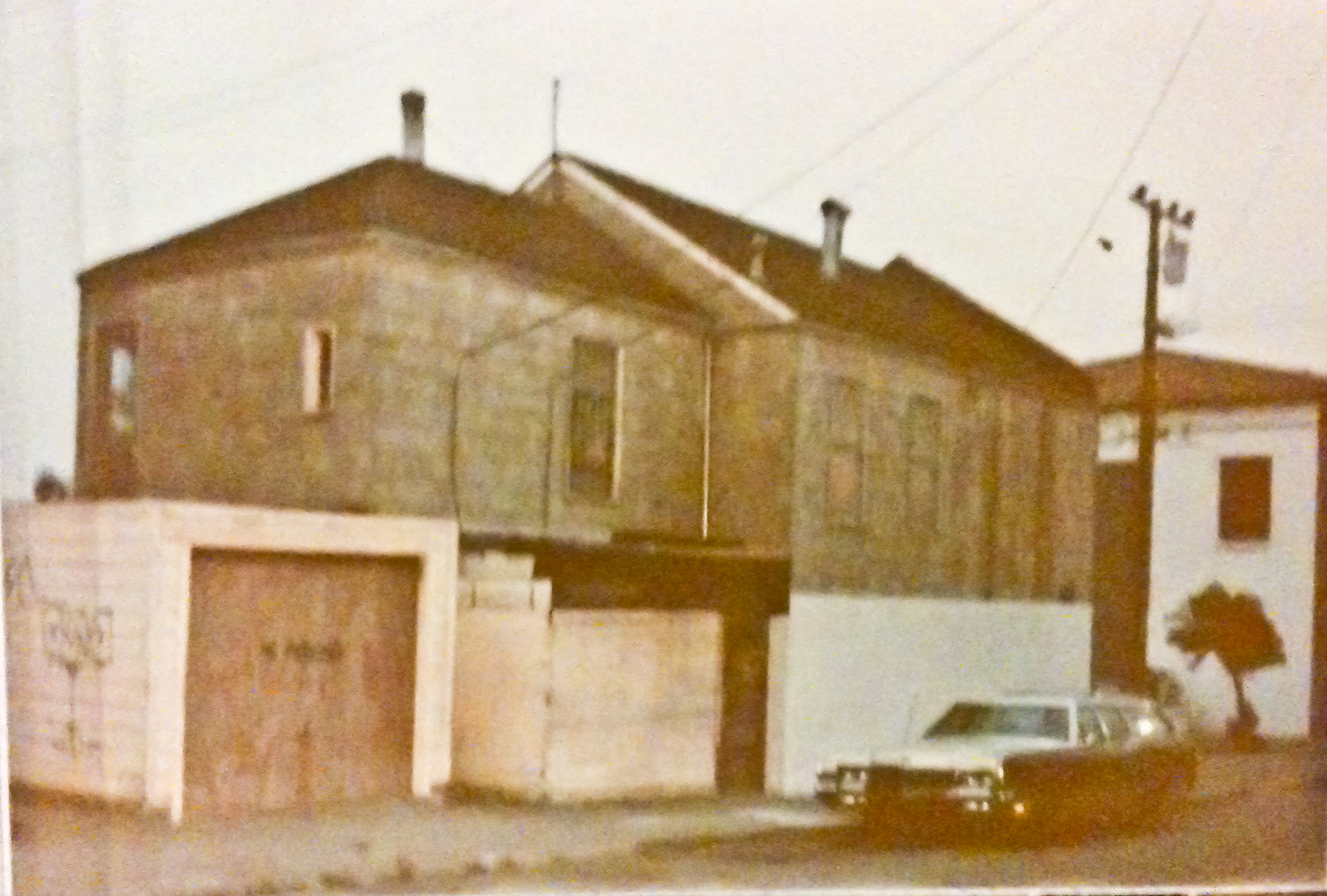
Here’s how the building looked when the asbestos siding was still in place:
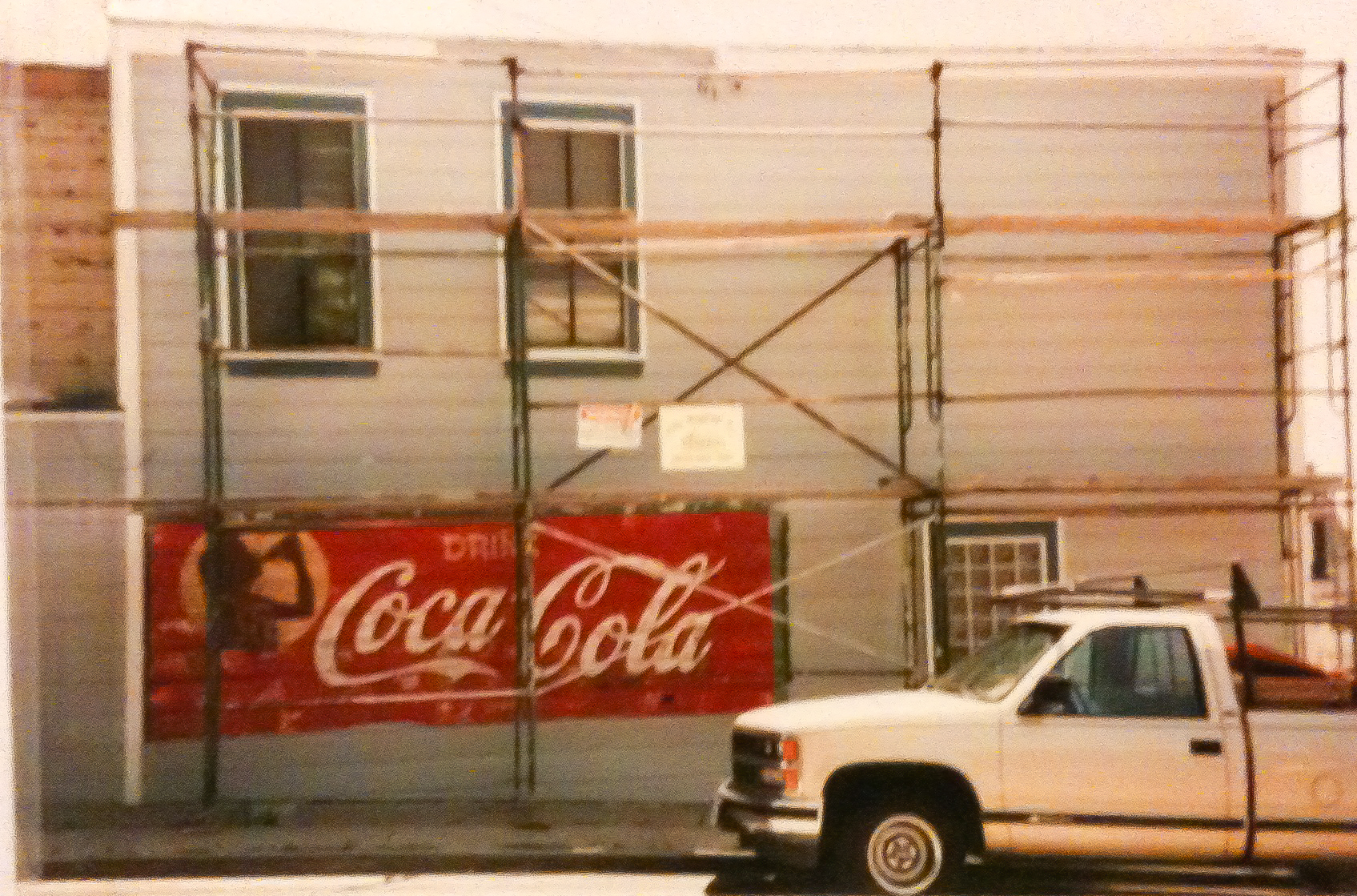
And (… drumroll…) here’s how the Coke artwork looked in 1991, immediately after the siding was removed:
At the time, Mr. Modolo added, he simply planned to paint over the ghost sign. But neighbors intervened, begging him to keep it in place. And so he has, repainting it three times during the last 20 years.
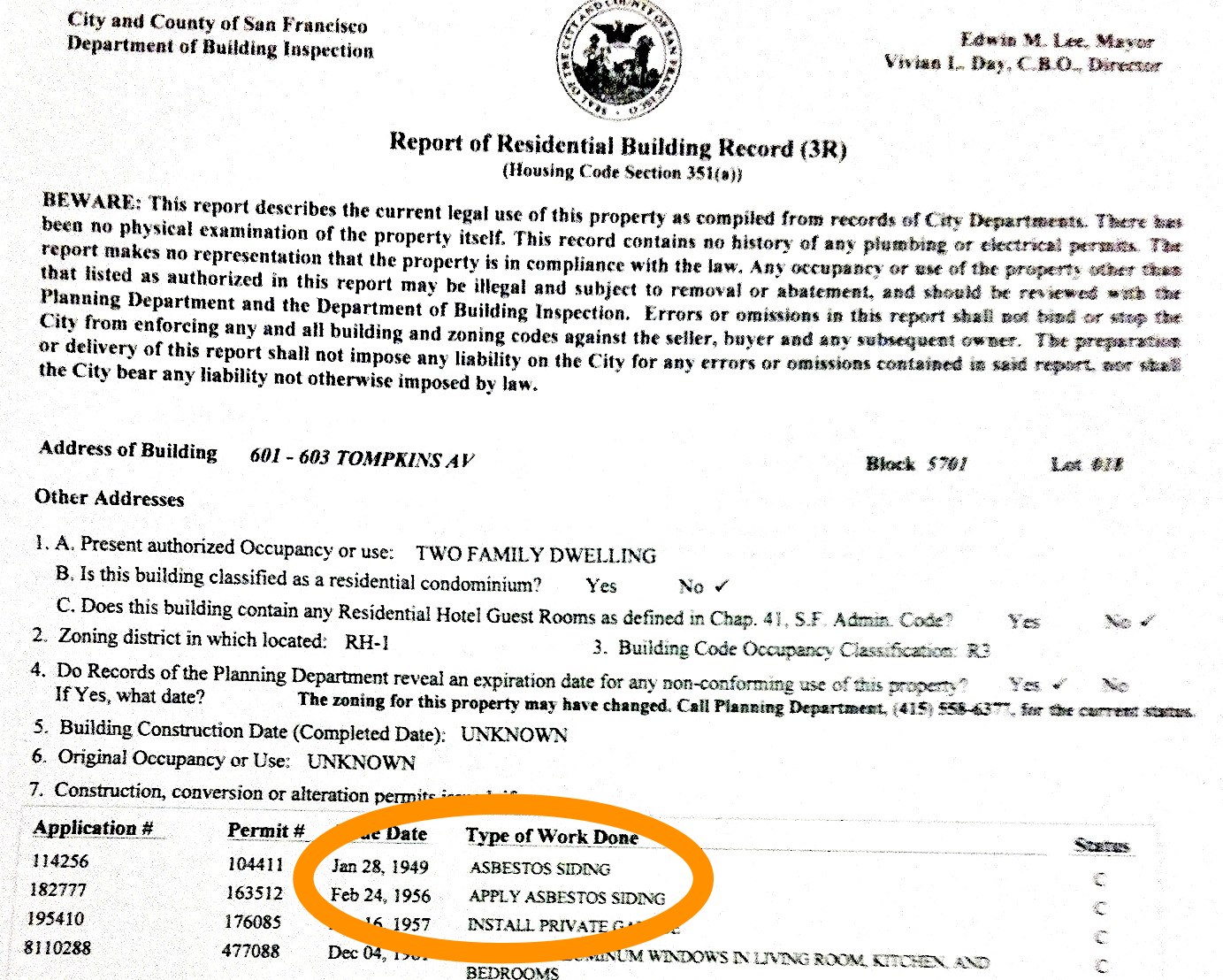
FACT: The ghost sign pre-dates the City’s 1965 regulations by at least a decade, and almost certainly more. How do we know this? Simple: The asbestos siding at 601 Tompkins was installed in 1949 and 1956, which means the sign was in place before it was covered over. And how do we know those dates? That’s simple too: Mr. Modolo has the permit history from the City’s Department of Building Inspection:
FACT: The design of the mural suggests it dates from the mid-1940s. Burrito Justice has stayed on the case, and he’s been Tweeting with an archivist from the Coca-Cola company, who says “The “silhouette girl” logo was used as early as 1939.”
The girl in the image is referred to in “Coke Lore” as Silhouette Girl. She was used from 1939 until around 1950 when she fell out of use. She is significant in dating items as she was one of the few characters that was used during the time we transitioned our “Trademark Registered” statement from the tale of the C in “Coca” to being placed under the words “Coca-Cola.” This transition occurred between 1941 and 1942.
The first thing I noticed with the sign was the mark was under the words so it had to be later than 1942.
So, game, set, match, right?
Not quite. Bernalwood has been in touch with Mr. Dan Sider from the Planning Department’s General Advertising Sign Program. This situation regarding our Coca-Cola is “entirely novel” and without precedent, he says. “Our staff has processed nearly 1,800 general advertising signs in the City,” Mr. Sider says. “Not once have neighbors wanted to preserve a sign, much less have they taken the initiative to repaint and restore a sign on their own accord.” Hey, what can we say, other than Welcome to Bernalwood.
Much now hinges on how the City decides to classify the artwork. Is it a “general advertising sign” or a “business sign?” Neither approach is ideal, as each comes with significant legal downsides. So perhaps Bernalwood can suggest an easy solution? Maybe it’s not a sign at all! And maybe it stopped being advertising sometime during the Truman Administration. Perhaps it’s really a “historic commercial mural!”Or something like that.
FACT: Homeowner Richard Modolo wants to keep the vintage Coca-Cola mural in place, as is, and if the dozens of comments Bernalwood has received are any indication, a nontrivial number of his neighbors do as well. Mr. Modolo says, “For better or worse, this building was once a grocery store, and this is part of the history of this neighborhood.” That’s now a confirmed fact too.
This is an unfortunate story about a neighborhood landmark, the NIMBY menace, City bureaucracy, and a call to action for Bernal Heights history geeks. More or less in that order. Follow along…
Decades ago, the building at 601 Tompkins Avenue, at the corner of Banks in Bernal Heights, may have once been a corner store. It’s now a private home, but a vintage Coca-Cola advertising sign from the earlier days has remained on the building regardless. Bernalwood’s irate tipster explains the situation:
Is this perhaps a little bureaucracy run amok in Bernal; the inevitable fallout from our Supervisors trying to outlaw sugary drinks?
The antique Coca-Cola ad has been part of the corner of Banks and Tomkins probably since the 1940’s at least. In my 30 years in Bernal, the homeowners have lovingly preserved this little bit of old Bernal—probably the last remnant of a grocery on that corner.
Now the City is apparently citing them for an unauthorized billboard. Note that the Planning Department documents say the homeowners must pay $3400 just to appeal the decision.
This is madness. A way-cool vintage Coke sign, preserved by neighborhood old-timers, is targeted for citation and removal by clueless City sign inspectors? Really? Why? And why does the San Francisco Planning Department hate America so much?
Bernalwood attempted to contact the property owner, but so far our efforts have been unsuccessful. We also called the City Planning Department, to ask WTF. This proved fruitful.
The City action against the vintage Coke sign came as the result of a complaint about the sign that was submitted by a nameless NIMBY whiner on January 14, 2011. With impressive alacrity, the Planning Department investigated the matter, and on January 25, 2011 a City notice was posted to indicate that the old sign must be either permitted or removed.
Bernalwood spoke to Mr. Dan Sider from the Planning Department’s General Advertising Sign Program . Mr. Sider had photos of the sign at 601 Tompkins at his disposal during our talk, and he was quite friendly. Yet when told that the Coke sign has been there since the 1940s, he seemed skeptical. It looks new, he said, and in fairness, he’s right — it does look new. “That’s because it’s been lovingly repainted and maintained by the neighbors,” Bernalwood explained sweetly.
Mr. Sider seemed surprised. “As a San Franciscan, I think that’s very neat,” he said. “But it is very clearly an illegal sign, and we don’t have much discretion.”
“But… but… surely there must be some way to save this historic piece of commercial art!” Bernalwood pleaded.
Indeed, Mr. Sider explained, there is. If some evidence can be produced that the sign was in place prior to 1965 (when the City’s operative sign ordinances went into effect), the matter may be resolved pleasantly. “But the clock is ticking,” he said. Said evidence must be received by February 24, 2011 — within 30 days of the issuance of the initial citation — or else fines may begin to kick in.
So, concerned Bernalwood citizen, there are two things you can now do:
2) Help track down evidence — preferably a photograph or other document — that demonstrates the old Coke sign on the side of 601 Tompkins has indeed been there since the Kennedy Administration, if not before. Activate your geektastic history researcher kung-fu powers, and keep your fingers crossed. If you find anything, Bernalwood will gladly pass it along to our friends at the Planning Department. But remember, the DEADLINE IS FEBRUARY 24.
2) Call our Supervisor, Mr. David Campos to advise him of your interest in this matter. Admittedly, the preservation of vintage commercial art is hardly a core plank in his Progressive agenda. Yet this is also the kind of stuff that gives a neighborhood a tangible connection to its own history — and that matters a lot. Besides, if they do nothing else, our Supervisors exist precisely to represent us when dealing with City Hall silliness. Perhaps Supervisor Campos could put in a call to Mr. Sider? Perhaps you’d like to call Supervisor Campos to suggest that idea? Supervisor Campos can be reached at (415) 554-5144.
Want to know who lived in your home before you did, and how old it is? Looking for historic photos of your street? San Francisco History Center staff will present an introduction to researching the history of a San Francisco house or commercial building and will provide an overview of print and online resources to help answer questions like these. All programs at the library are free and supported by the Friends of the SFPL.
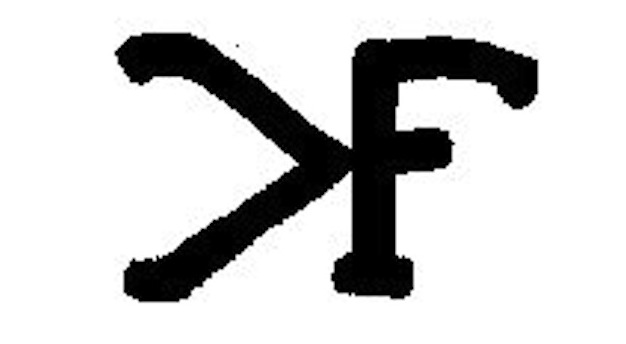
No, this isn’t Prince’s latest unpronounceable name-glyph. Instead, according our fellow history geeks at The Bernal History Project, this symbol was the cattle brand used by the Bernal family to mark their livestock in the days when José Cornelio Bernal ruled the rancho that is now our neighborhood.
The meaning of the symbol is unknown, but that only adds to our aura of mystery. Two things need to happen right away: Someone needs to turn this into a t-shirt to be sold at Heartfelt, and a few intrepid souls need to get this tattooed onto their body parts. (Free beer for the first person to send me a photo of same.)
Update: Reader Marina Cazorla has a theory about the meaning of the brand:
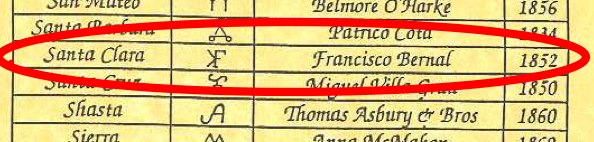
I was intrigued by the mystery of the brand, which looked like VF. After doing a bit of poking around, I’m fairly sure that the “V” stood for Vernal, an early spelling of Bernal. (Juan Francisco “Vernal,” born 1737, was José Cornelio Bernal’s grandfather, and the first member of the family to settle in the area.) And perhaps the F is for Francisco? Spanish/Mexican/Californio surnames usually have two names (one from the mother, one from the father) which would explain why the brand’s two letters possibly come from one person. Of course, it would be helpful to know what year (if any) that brand is associated with, that way we’d be slighter clearer on whether the brand was made during JFV’s lifetime.”
Updated Update: Reader someJuan comes through with an important confirmation. He writes:








 Bernalwood


