Ghost of Lyceum Theater Haunts Safeway Parking Lot

bernal.lyceumtheater

Over on the Facebook, the Bernal Heights History Project shares this terrific photo of the former Lyceum Theater, which stood on Mission Street at the intersection with Virginia, at the north entrance to our Taoist Safeway.

The photo above was taken in the 1920s, and a brief history of the 1400-seat Lyceum lives on at the Cinema Treasures website:

The Lyceum Theatre opened in mid-1907, with vaudeville and motion pictures. By the late-1920’s it was featuring Vitaphone Talking Pictures, and remained a popular low priced, late run house for patrons of the outer Mission district for the next twenty-five years.

Like so many other secondary houses, it was one of the first to feel the impact of television in the early-1950’s, and, after several closings and re-openings, became the temporary home of the San Francisco Revival Center [church], before they moved to the former State/Del Mar (q.v.) which they then made their permanent home.

Here’s a shot of the interior:

lyceuminterior

Lest we be tempted by nostalgia, one commenter at the Cinema Treasures site recalls that there was little to love about the Lyceum in its later days:

My aunt took me there once when I was a little girl. If Bette Davis went in there she would have said what a dump. It was full of people that kinda looked hard on their luck. We were both itching terribly afterwards and when I got home I had little bumps on my neck and my mother was furious. She called and raised hell and they told her that the exterminator was coming in, and offered her a couple of free passes. She yelled at him to save his passes and take the money and spray the damn place. Never went there again.

The Bernal Heights History Project notes that this experience was not uncommon:

Some locals called the Lyceum the Lice House because they often came home itching!

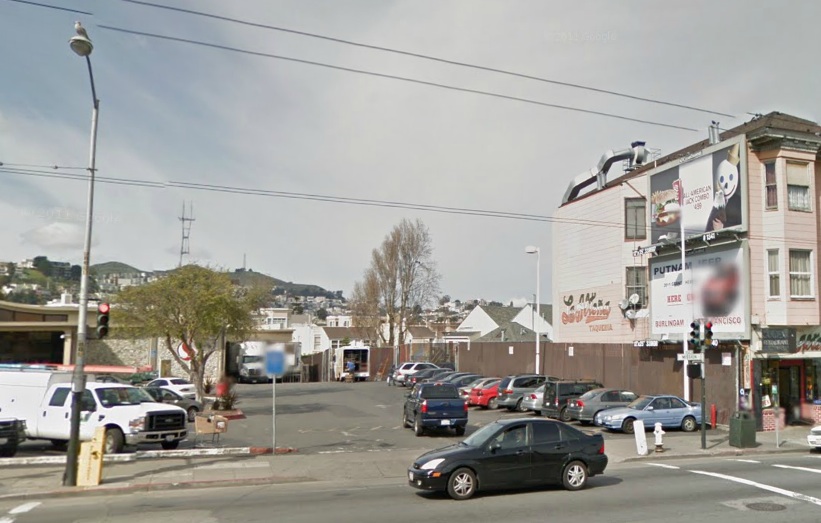
And of course, here’s how the site of the former Lyceum looks today:

formerlyceum

PHOTOS: Top, via Bernal Heights History Project. Interior via San Francisco Public Library.

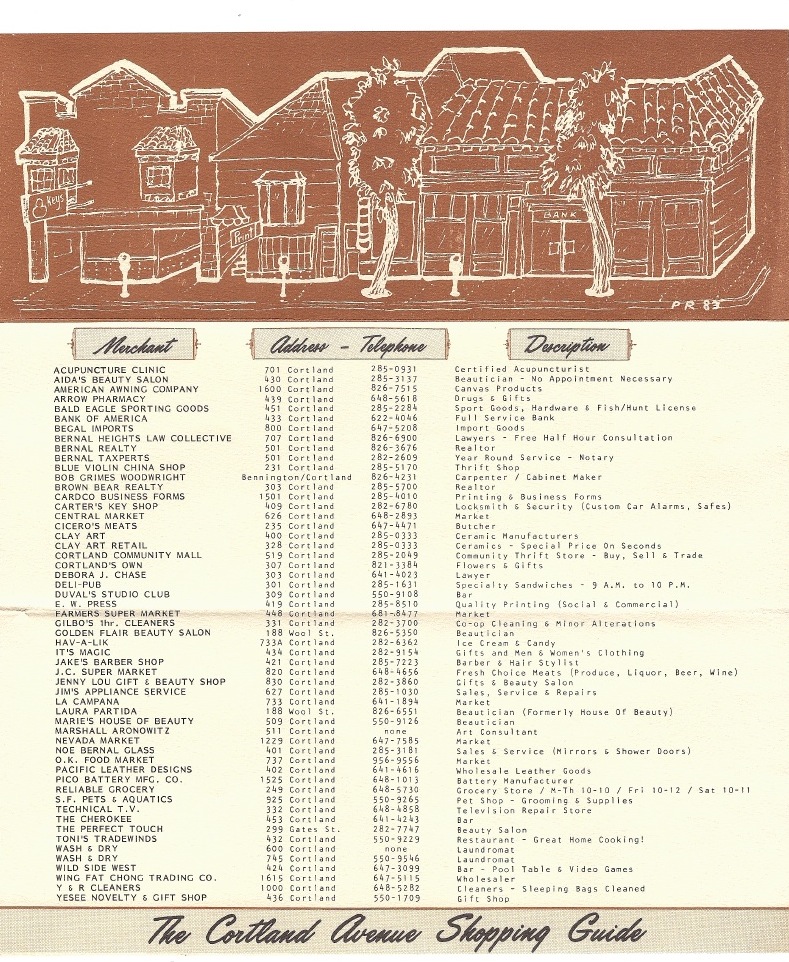
Do You Remember The Stores In This Vintage “Cortland Avenue Shopping Guide?”

vintageshoppingguide

Miss Vicky from the Bernal History Project found this vintage Cortland Avenue Shopping Guide, and she needs some help to interpret it:

We found this Cortland shopping guide in the SFPL archives. Do you remember any of these stores? Can you help us figure out the year on this list?

I noticed Toni’s Trade Winds, and Vicky calls out the Hav-A-Lik ice cream and candy shop. Based on the style and the presence of Toni’s, I guessed the guide is from the early 1980s. Notice also the “83” at the bottom right of the illustration, which may (or may not) support my theory.

If you recall any of these businesses, and/or can help date the directory, please do chime in.


Bernal’s Very Own Bourbon: The Making of “Mrs. Brickley’s 1877-Style Old Cherubusco”

OLYMPUS DIGITAL CAMERA

OLYMPUS DIGITAL CAMERA

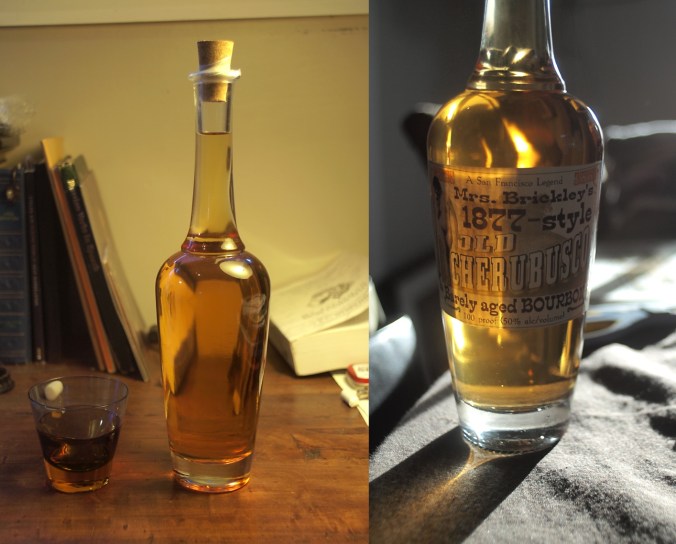
While some residents of Bernalwood find joy in brewing their own beer, others prefer the hard stuff. Neighbor Boris falls into the latter camp, as he has been making his own bourbon in his Bernal Heights home:

I built a distillation apparatus, and I have recently begun aging my spirits in a small oak barrel. I am not patient enough to wait the requisite three years for legitimate bourbon so I must settle for an underage, illegitimate spirit. Even so, a month in oak makes a big difference in the color and the taste.

In coming up with a name for this batch, I was inspired by a post on your blog.

Ha!

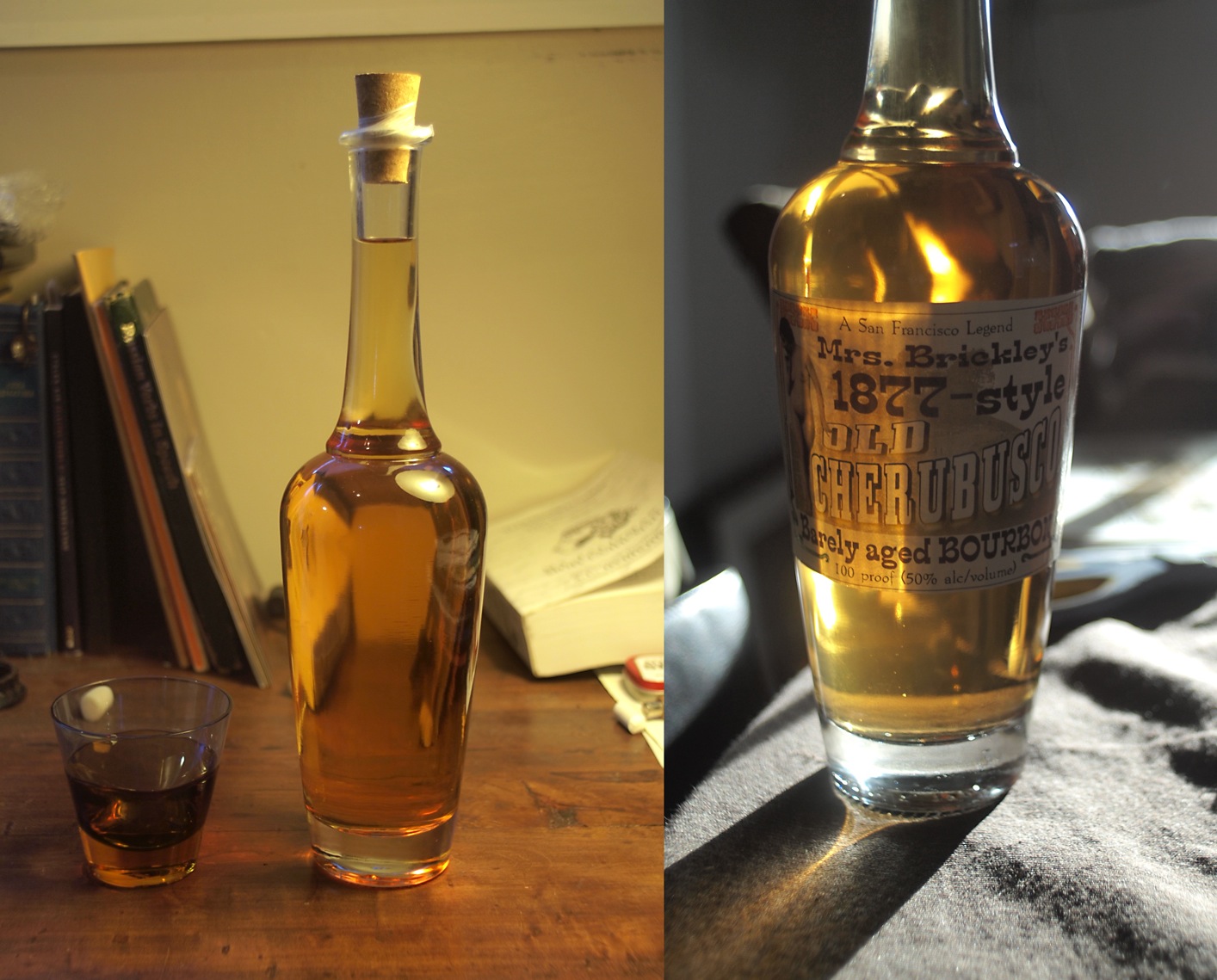
Celebrating the tale of the drunken woman who went for a naked swim in the Bernal Heights reservoir in the late 19th century, Neighbor Boris named his spirit “Mrs. Brickley’s 1877-Style Old Cherubusco Barely Aged Bourbon.”

Here’s the original story:

One morning in December 1877, Mrs. Peter Brickley of Cherubusco Street strolled naked (except for a wand tipped with several brightly colored ribbons) up to the reservoir. Once there, she took a leisurely bath first in a water trough and then in the reservoir itself. The reservoir-keeper’s aged father “shut his eyes tight and tried to fight her off with a garden rake,” but she managed to evade him. Finally, one young man jumped in to nab her; she was pulled to shore and wrapped in an assortment of clothing provided by the women of the neighborhood. The article concludes, “Mrs. Brickley was conveyed to the City Prison and thence to the House of the Inebriate, and her neighbors are using well water for a few days.”

And here is the insanely fantastic label Neighbor Boris made for his Bernal Heights bourbon:

Untitled

Bernalwood asked Neighbor Boris to describe his recipe:

Originally, I come from Russia, where, as young man, I worked in Kazakh oil field. In 1990‘s, after perestroika, I become entrepreneur. These are wild times but I make decent money working in ‘security’ and the ‘waste management’. Unfortunately, I have a disagreement with some ‘business partners’ and must leave Moscow quickly. Now, I am living for many years in beautiful Bernal Heights.

I was much interested to read about people in Bernal neighborhood brewing their own beer. This is quaint and enjoyable sport and I myself passed happy times making and consuming such weak alcoholic beverages. When I work in oil refineries, however, I learn a beautiful and, one might say, sacred art: the art of fractional distillation. Such a process can transform pale and ghostly beverages into strong spirits. Such strong spirits that make the nighttime warmer; old friends dearer; and women more beautiful.

Now I use my refinery skills to make strong spirits here in Bernal Heights. Yes, I know that this is illegal activity, but I consider this only an accident of history. You are, of course, free to condemn me as an immoral, anti-social, moonshine-making scofflaw. In fact, maybe I should put that in my Facebook profile.

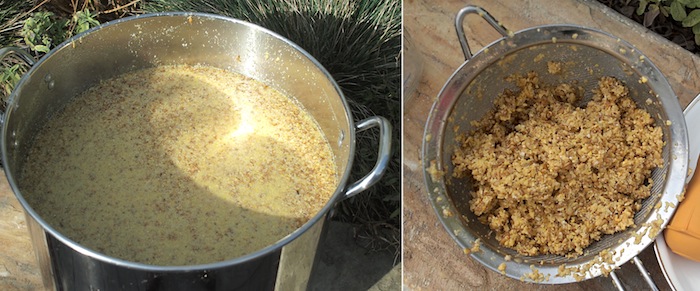
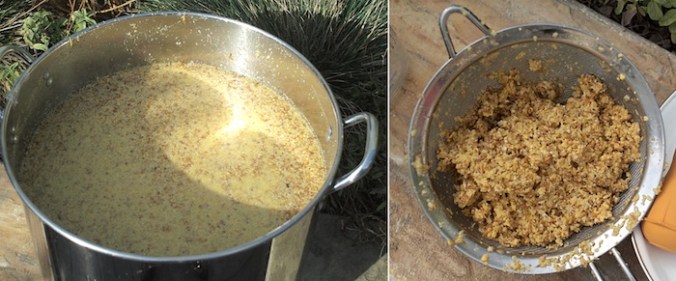
Here is how it works. Like beer makers, I use yeast to convert natural sugars into alcohol. The sugars can come from anywhere, even from the bakery aisle of our Taoist Safeway. Over the years I have used many organic materials as sources of sugar: pears, apples, plums. Many things will work, but you must be warned: some will taste better than others. If you are not careful, you can make a drink that leaves your mouth to taste like the waste barrel in an abandoned Soviet licorice factory. How do I know what such a thing tastes like? Long story. Now that I live America I use only corn mixed with barley malt and rye. For yeast, I use an old Russian strain, one that is inured to suffering and survives in high alcohol.
OLYMPUS DIGITAL CAMERA

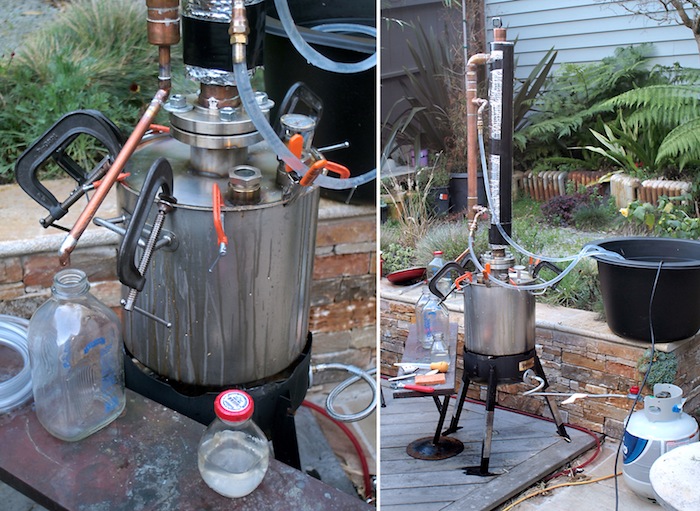
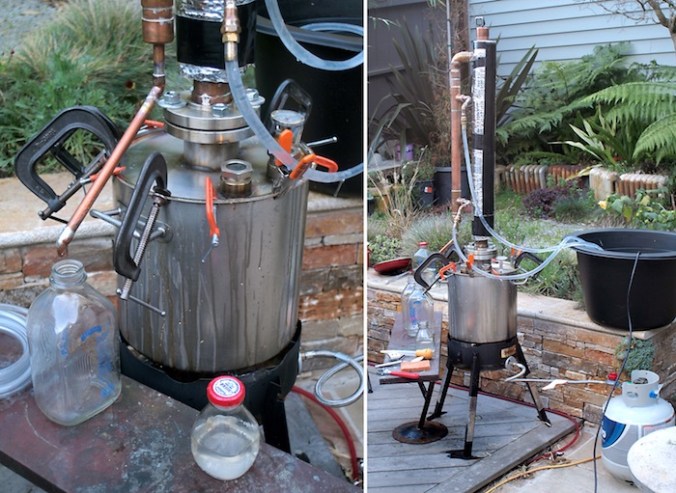
After the yeasts do their job, it is time for the distiller to go to work. I filter out the grain and load the beer into the boiler —a stainless steel stock pot. I heat the beer on a propane fish cooker and attach the distillation head.

Normally I do this in the dark of the night, to avoid the prying eyes. This is a common practice and I am told that this is where the name ‘moonshine’ comes from. Last weekend, however, the weather was too beautiful and I risked a daytime run.

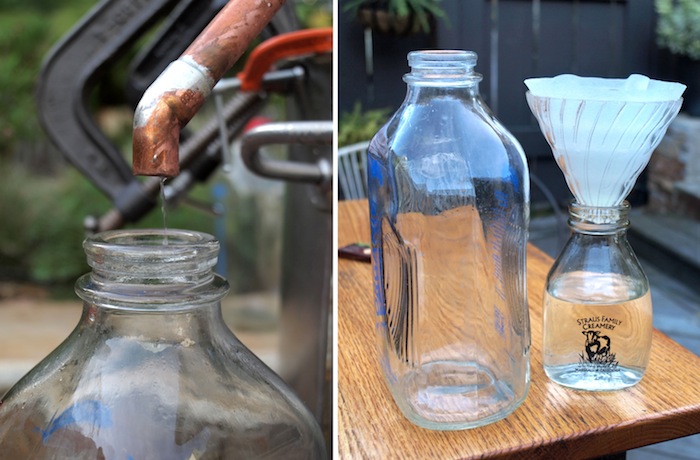
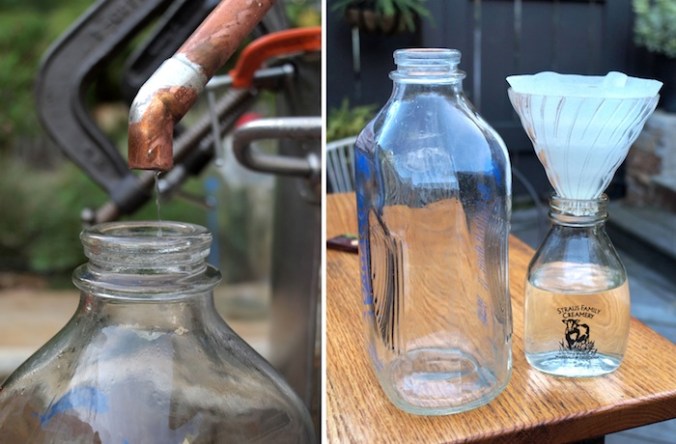
Alcohol is volatile so, when the mixture boils, the vapor is more alcohol than water. As the vapor rises up the column, it makes a pleasant murmur, like the rustle of dry grasses on the Caucasian steppe. At the very top of the still, the vapor makes a ‘U turn’ into a thinner copper tube, cooled by flowing water. There, the alcohol condenses back into liquid and runs down into collection vessel —usually a glass milk jug from Good Life Grocery.
OLYMPUS DIGITAL CAMERA

I split the distilled spirits into different fractions.

The first thing that comes out is nail polish remover. You can use it to thin paint or clean automobile engine blocks but, if you love life, you do not drink it.

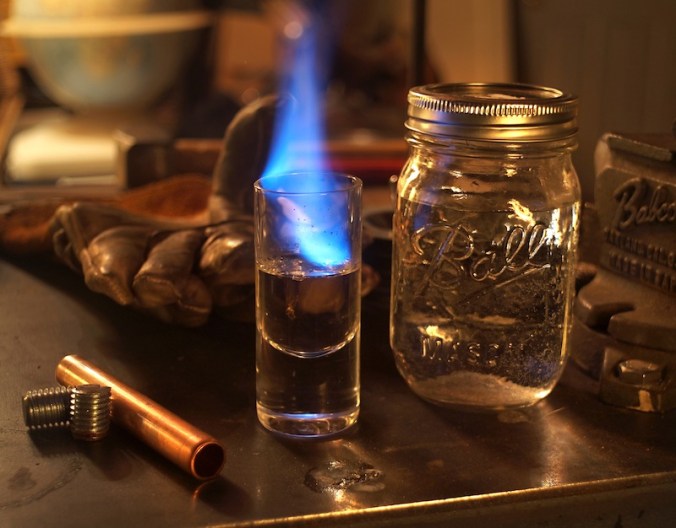
After paint thinner comes good alcohol. You can tell this by smelling.
OLYMPUS DIGITAL CAMERA

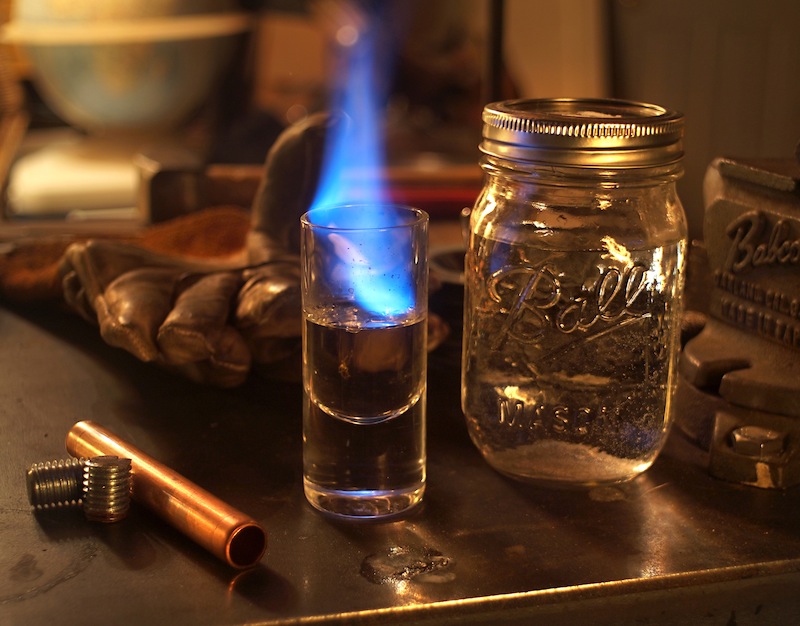
After pure alcohol come more complicated molecules. These have flavors from the grains and the yeasts, and many of these flavors are pleasant – like toasted barley. Here is the art: deciding which parts to keep and which to throw away.

Once I have collected and blended the spirits I share them with my friends. My wife, Natashka, she often frowns at the time I spend making spirits. In the end, she never refuses to sample the product and, often, it makes her smile.

We are smiling too. Underground, speakeasy-style tasting? Please!?

PHOTOS: Neighbor Boris

Who Really Created the Fabulous Labyrinth on Bernal Hill?

labyrinth.1212

WhirleyBird

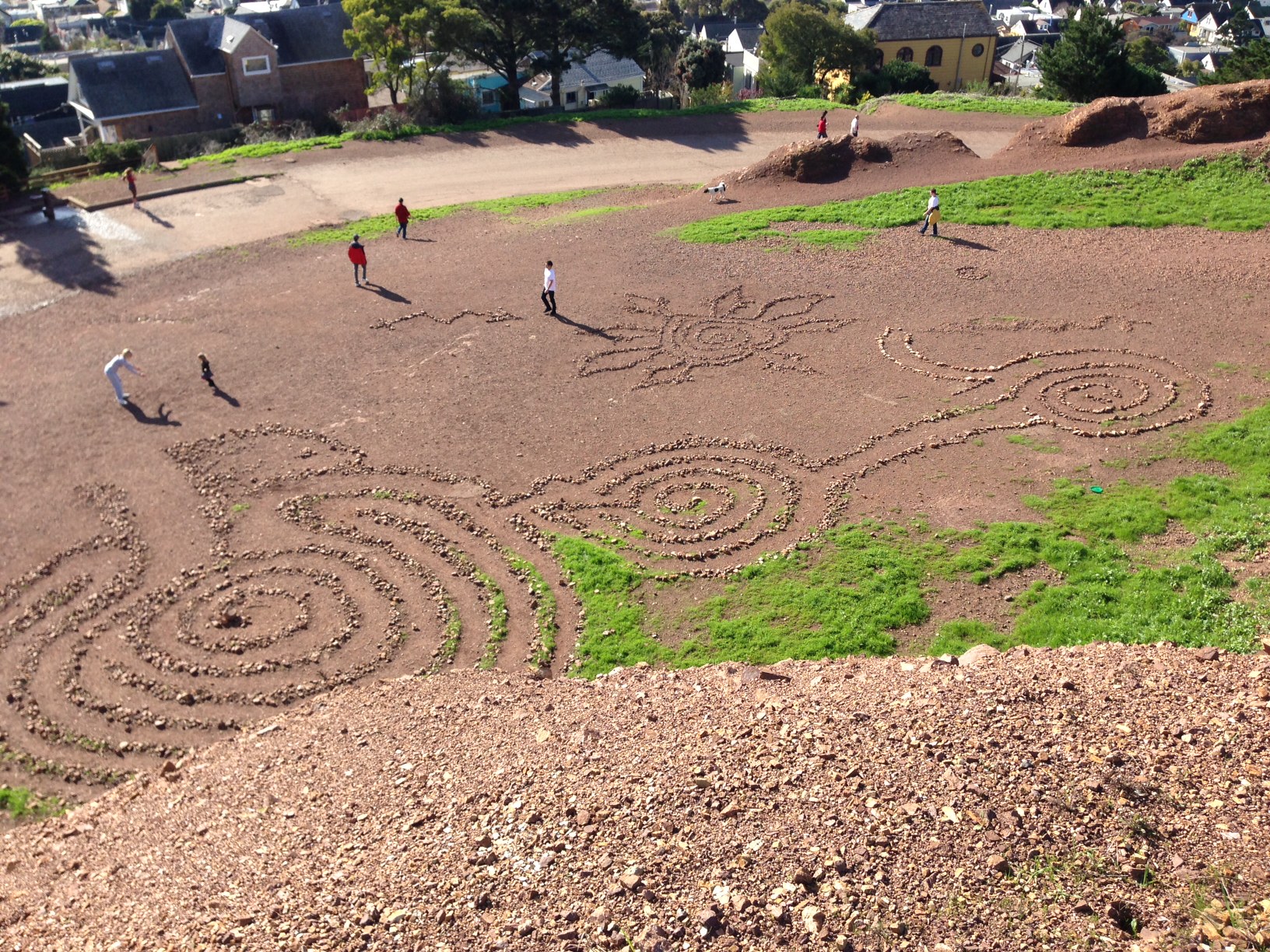
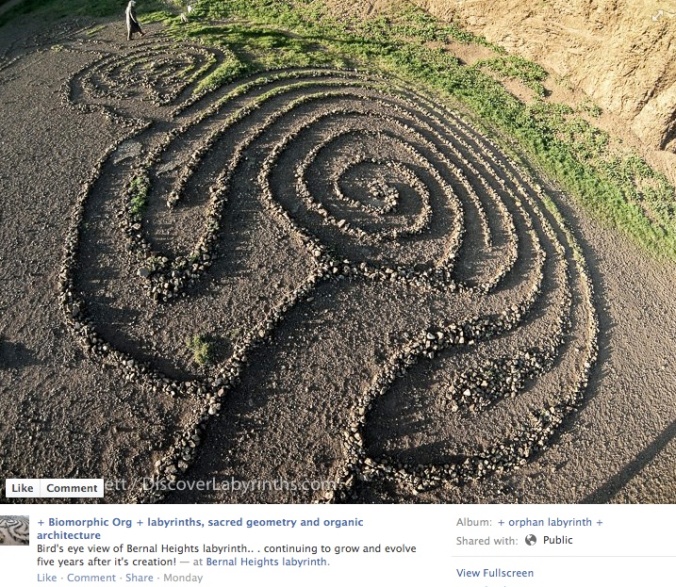
You’ve seen it. You love it. Maybe you’ve even walked it. The stone labyrinth in the old quarry site on the southwest corner of Bernal Hill is a charming neighborhood treasure. It tends to morph over time, but the Bernal Labyrinth is always well-maintained — even if no one knows who does all the morphing and maintaining.
Yet who created the Bernal Labyrinth in the first place? That’s suddenly become a topical question, because an article in the San Francisco Examiner last Monday told a rather distressing tale about how the labyrinth allegedly got its start:

It turns out the locally respected labyrinth in Bernal Heights is the brainchild of a man accused of stalking a woman, according to authorities.

Self-proclaimed artist Cesar Lopez, 34, of San Francisco is charged with one felony count of stalking in connection with a December incident in which he allegedly invited a woman to the labyrinth on Bernal Heights Boulevard in order to conduct a “cleansing ceremony.”

When they met 10 years ago, prosecutors said, Lopez agreed to tutor the girl in Spanish at the Mission Branch Library and she reportedly agreed to teach him English.

About two years later, the girl reportedly wanted to sever the relationship when Lopez became romantically interested. But Lopez allegedly carried on a one-sided relationship for the next eight years, sending letters and creating a rambling blog in order to communicate with her, prosecutors said.

He also apparently built the labyrinth near the woman’s home using stones from Bernal Hill. At one point, prosecutors said, he sent the woman a picture of a labyrinth “in the obvious image of her face” — it even included her glasses. He has since taken down that labyrinth.

But one design remains, and it is revered by neighbors.

According to labyrinthlocator.com, the Bernal Heights piece was built anonymously in August 2008.

“We don’t know who started it,” the website says, “but people are keeping it up and walking it daily.”

Yuck. Gross. Ewwwww. The Examiner story (and this similar piece from KPIX-TV) tells us that our lovely Bernal Labyrinth was in fact built by a Cesar Lopez, a sleazeball who used it as bait to seduce ladies. But should we believe them?

Fortunately, we have reason to think this untrue. Indeed, your Bernalwood Action News Investigative Team is convinced that Cesar Lopez did not, in fact, create the Bernal Labyrinth.

Instead, our evidence indicates the original labyrinth was created by Mr. Lars Howlett, a former Bernal neighbor. A committed labyrinth devotee, Lars is a Veriditas Certified Labyrinth Facilitator (???!),  who has even self-published a book on the subject. In other words: Impeccable credentials.

Coincidentally (for those of you who believe in coincidence), Lars posted about the Bernal Labyrinth on the very same day that the Examiner’s article about Cesar Lopes first appeared.

orphanlabyrinth

Lars’s post was intercepted by analysts from the Bernalwood Office of Neighborhood Signals Intelligence, and a dialog with him was initiated. He told us:

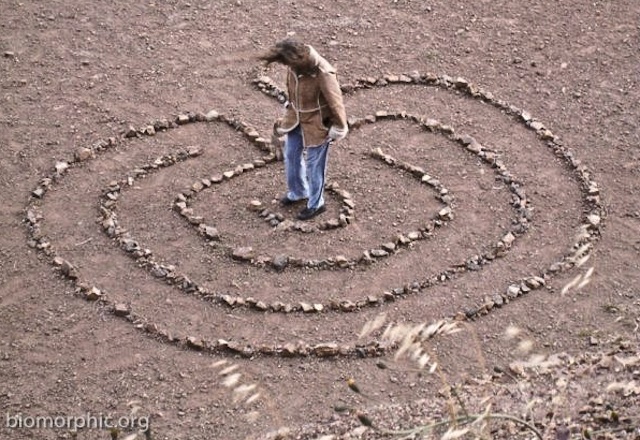
I created it on May 10th, 2008, first as a three circuit classical design. I call it the Orphan Labyrinth because I soon moved away from San Francisco and ever since it has taken on a life of its own!

Even better, he had a photo of the Bernal/Orphan Labyrinth taken on May 10, 2008 — three months before Cesar Lopez claimed to have created it — which shows what the labyrinth looked like as a wee little baby:

Bernal.babylabyrinth2

Bernalwood asked Former Neighbor Lars to tell us more about the making of the Bernal/Orphan Labyrinth:

One afternoon on May 10th, 2008, I found a scattered circle of rocks near the overlook at Bernal Heights where I was taking pictures. In half an hour I arranged a simple labyrinth and climbed up to photograph the first person to encounter it. I left for the summer and moved that fall to Half Moon Bay. A year later I returned and was surprised to find the path had grown twice its size!

I visit when I can and, if need be, provide some loving care, but mostly this labyrinth continues to leads a life of its own. I have documented it’s evolution through photography and have come to know it as the ‘Orphan Labyrinth.’

Almost five years later, the labyrinth continues to grow and evolve. There have been deviated paths to a peace sign and a heart created by others. I have walked the path with Lauren Artress (also a Bernal Heights community member) who brought the Chartres labyrinth to Grace Cathedral. I became a certified labyrinth facilitator studying with her in France and am now the apprentice to master builder, Robert Ferre.

I continue to design, build and walk labyrinths including my most recent project, the Labyrinth of Wisdom at Sofia University in Palo Alto. Other installations are temporary, such as the Literal Labyrinth made of books I created this summer at City Hall for the San Francisco Poetry Festival.

People use labyrinths for walking meditation, prayer, problem solving, healing, and finding peace. The Orphan Labyrinth at Bernal Heights is the oldest surviving labyrinth that I’ve built. I’m happy that the community has cared for it and helped it along the way.

All the best,

Lars

When you weigh all the data, Lars Howlett has a pretty compelling claim on the creation of the labyrinth — unlike the hapless Cesar Lopez, who enjoys a fantasy life so rich that it earned him an arrest and criminal trial.

So with that, we will leave you with two videos: Lars Howlett made this first one; a video about creating and walking a labyrinth on a beach in Marin:

… and Bernalwood created the second; it shows our intrepid Cub Reporter finding enlightenment in the labyrinth Lars originally created on Bernal Hill:

PHOTOS: Top, The Bernal/Orphan Labyrinth in December 2012, by Dr. Lapin; below, by Telstar Logistics in December 2010. All other photos by Lars Howlett.

Upside Down Car Is The Least Interesting Thing In This 1942 Bernal Heights Photo

ArmyFolsom1942

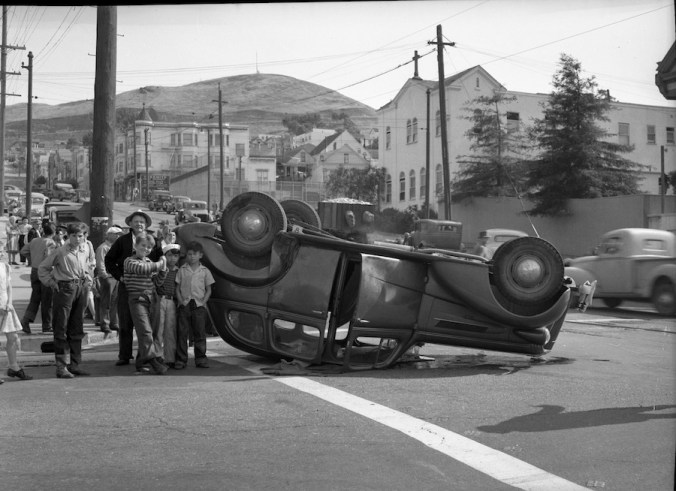
I found this photo via the San Francisco Public Library, and it’s wonderful in so many ways. This is a view of Army Street (Cesar Chavez) looking south at Folsom on May 29, 1942.

Let’s zoom and enhance

In the foreground we see a rather handsome group of neighbors, lounging casually alongside an overturned Chevrolet. (???!)  “Move along! Nothing to see here!!”

ArmyFolsom1942.peeps

In the background, the original parochial school building dominates the site of St. Anthony’s Church. (It’s still there today.)

ArmyFolsom1942.StAnt

Right behind that, there’s the Yosemite Meat Market, on the corner of Folsom and Precita, in the storefront now occupied by Charlie’s Cafe. The market’s sign is clearly visible on the Precita facade:

ArmyFolsom1942.Yosemite

And of course, behind that is Bernal Hill, looking rather bare-naked, with no Sutrito Tower or trees on the summit — just a lone antenna mast. Bernal Heights Boulevard had been completed just a few years before, however, and the full “loop to nowhere” was open to traffic all the way around the hill.

ArmyFolsom1942.hill

All in all, it’s a scene that feels very familiar and somewhat different, all at the same time.

PHOTO: San Francisco Public Library on Flickr

Bernal Journalist Publishes New Story About Madman Who (Literally) Drove Around the World

half-safe-cover

halfsafe_img

Here’s a locavore longread to carry you through the weekend.

Bernal Heights writer and anticool motorist James Nestor has just published a terrific new story over at the Atavist. It’s a true tale of adventure and obsession (though not necessarily in that order), and it’s called Half-Safe:

In 1948, a young Australian mining engineer named Ben Carlin set out to do the impossible: circumnavigate the globe, by land and sea, in a single vehicle. The vehicle in question was an amphibious jeep developed by the U.S. Army, which Carlin christened Half-Safe, after a deodorant slogan. It was a mechanical mongrel that was supposed to move with equal ease across land and water but in practice wasn’t much good for either one. Undaunted, Carlin and his wife Elinore set off across the Atlantic Ocean with dreams of fame and fortune, and of carving a small notch in history. What happened next is one of the most bizarre, remarkable, and forgotten adventure stories of the 20th century. In Half-Safe, author James Nestor endeavors to uncover Ben Carlin’s fate and finds a gripping story of love, danger, and extraordinary perseverance that spans three oceans and five continents. Half-Safe takes us from the eye of an Atlantic Ocean hurricane to the sweltering Sahara to the impenetrable jungles of Southeast Asia—and into the mind of a man who could overcome everything but his own demons.

Half-Safe costs as much as a cup of coffee, and you can download it for iPhone, iPad, Google Play, Nook, Kindle and probably any other e-readermadoodle you might favor — although be advised that it looks most sexy via the Atavist apps for iOS or Android.

One Year Later, Stephen Stymiest’s Daughter Wonders About the Dad She Didn’t Know

It’s been almost a year since the death of Stephen Stymiest, the homeless man who was was a fixture and a friend to many neighbors around Precita Park.

Stephen is remembered warmly in Bernal Heights, but over the holiday break Bernalwood received an email from Stephen’s daughter, which sheds some light on the complexities of his biography.

This is what Kara Messinese is thinking about, one year after her father passed away:

Some of you may remember, some of you may not. Some may have known him, may have spoken to him. Others may think he was just a bum. It’s easier to think he didn’t have a history, but that is not the case.

A year ago, a man died. He lost a battle, a very long battle. He was a homeless man, an alcoholic, a disabled man. His days were spent in a park from what I can gather. He spoke to people, was friendly to kids and animals, and to some, made the park a safer place. To others, he was just another homeless guy sitting on a bench. To me, he was my father. His name was Stephen Stymiest.

Many days it crosses my mind, as it has for the past 15 years, wondering where he is, what he’s doing, and why he never came back for us, his children. And now for the past year, when I have those thoughts, it slowly dawns on me I know where he is. And I know that I will never have the answers to the questions I always wanted to ask.

Following his death, a reporter contacted my mom and informed her of his passing. Then there were posts on a blog with pictures of people holding a memorial in his honor. An artist had created artwork in his memory. We asked for stories people had of him and people responded. But, my brothers and I had questions. And no one was there with answers.

Did he ever think of us? Did he ever talk about us? Why did other people get to see him for the past 15 years and we were just left wondering? Is it wrong to be jealous of those people? Why, when everything was getting worse, did he not contact us? He knew our names, someone could have googled us. If the reporter found us pretty easily, I’m sure someone else could have.

I continued to hope that at some point I could reconnect with Stephen. I’m not sure what I wanted out of it. I wanted truth. I wanted the answer to the question ‘why’. I wanted an apology. I wanted him to care.

It’s not as if I’ve been without a dad for 15 years. My mom got remarried to a wonderful guy who raised my brothers and I as his own. He adopted us a couple years after Stephen left us and my brothers and I have all graduated from high school. I graduated from college, married, and have a wonderful family with a beautiful one year old daughter (she was born just a couple weeks before Stephen passed away). Brent and Jerad are both in college working on their degrees. We have grown up to be intelligent, independent adults. But, there will always be a part missing. Something that was part of us that is no longer around. Knowing we can never access it again. We only have the material items, things Stephen had with him, things my mother had that were his. We have divided these evenly so we all have a little bit of him.

Someday I hope to make it to San Francisco, to Precita Park. I want to see what Stephen saw everyday. While I will never see it the way he saw it, I can still see it and maybe meet some of these people who cared about him.

From the daughter who did not get to know him as well as one should, who saw the bad sides of him, and was old enough to be hurt by his abandonment, but from someone who knew he was capable of so much more. I thank those of you who talked to him, who sat with him, listened to what he had to say. No matter how many nights I was upset or cried over his disappearance I hope that he got some enjoyment out of talking to people and meeting people in the park. I hope he was able to get some peace in the end. I’m still working on finding that peace.

PHOTO: Steven Stymiest memorial service in Precita Park, January 2012. By Telstar Logistics

1968: Envisioning Bernal Heights as a Much Prettier Place

BernalDesignElements.1968

This map comes to us via the good offices of the esteemed Eric Fisher. It shows what a group of city planners saw in 1968, when they evaluated Bernal Heights as an urban canvas in need of some serious beautification.

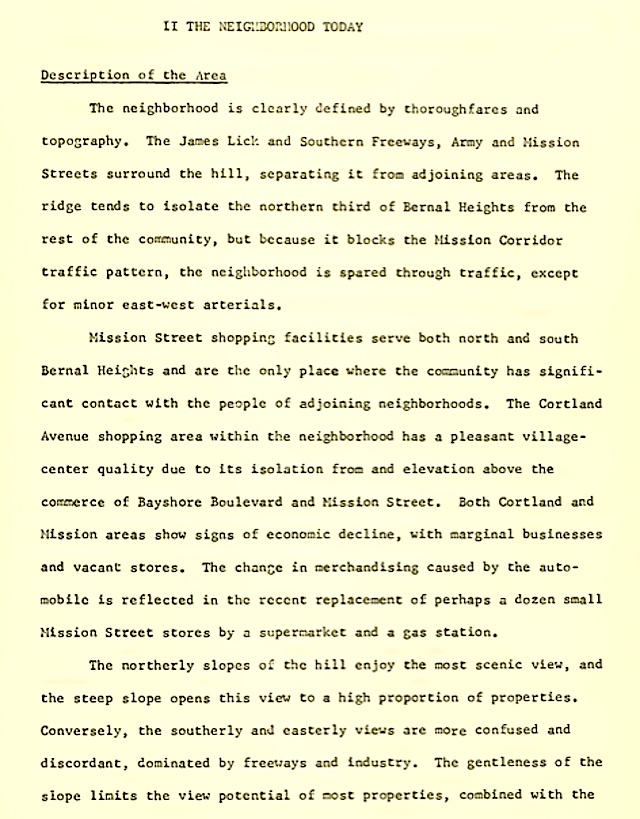
This wasn’t some grandiose urban-renewal effort, like those crazy 1940s visions of turning Bernal’s stretch of Mission Street into an elevated superhighway.  Quite the opposite: In 1968’s “Bernal Heights Improvement Program” (PDF here), the goal was to use Bernal to improve Bernal; to evaluate and exploit the geographic realities of Bernal Heights to offset the gathering forces of deterioration and “economic decline:”

BernalReport.1968

So with that as the context, it’s fascinating to see what those planners saw when they looked at Bernal Heights as set of assets and opportunities — at a time when Bernal’s streets were a little rougher around the edges and Bernal Hill was still just a feral, open space.

The “Design Elements” map notes the features that make Bernal feel like Bernal; the “physical elements that give definition and identity to Bernal Heights.” It identifies existing resources. It respects the topography. It celebrates great views. It highlights open spaces. It seeks to nurture interesting clusters and sub-corridors.

Those observations were distilled into a separate “Bernal Improvement Plan” map:

Bernal.ImprovementPlan.1968

Basically, the proposed plan advocates paving the last of Bernal’s dirt streets, building a few landscaped stairways, turning Bernal Hill into a proper park, creating a few other mini-parks, and planting lost and lots of trees

If all this sounds kind of familiar and ho-hum, it’s because that’s pretty much what we’ve spent the last 45 years doing here in Bernal Heights. So hats off to those clever planners in 1968. From the vantage point of 2013, we can now say that their vision looks pretty great today.

UPDATE April 2016: Neighbor Andras tells us that the full text of the 1968 Bernal Heights Improvement Program report is available here.

PHOTOS: Maps via Eric Fischer

Bernalwood 2012: The Year in Superlatives

Bernalwood.Unicorn

It’s late December, and 2012 is riding off into the sunset. Let’s use this time to review some of The Most Mostest Moments that happened in Bernal Heights this year.

===

Most Moving Appreciation For An Old Piece of Playground Equipment

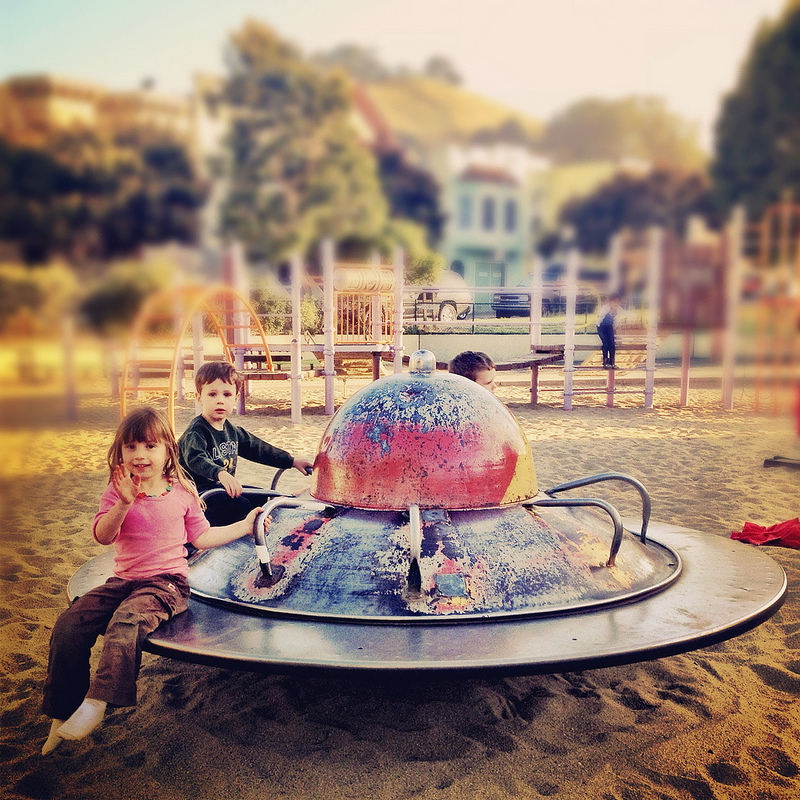
Neighbor Orlando’s ode to the Precita Playground “Satellite Spinner” reveals a deep personal history behind this battered landmark, and his words always put a lump in my throat. (June)

===

Most Exciting Headline Written Without Having to Stage a Fake News Event to Make It Happen

Finally!! Bigfoot Sighting on Bernal Hill!! (July)

===

Most Poignant Reminder That Bernal Heights Is a Special Kind of Place

Neighbors gather for a memorial service to honor Steven, the much-loved homeless gentleman who lived in the western end of Precita Park. (January)

===

Star-Sighting that Did The Most to Boost Bernal’s Indie Street-Cred:

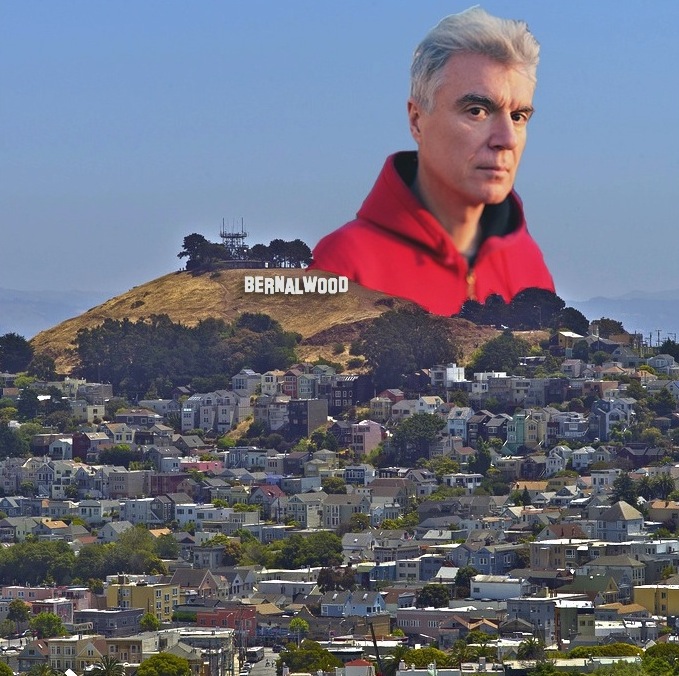
David Byrne strolls Cortland Avenue while in town for a series of shows. (October)

===

Most Boneheaded Way to Show Us That You Really Care:

Supervisor David Campos signals his deep concern for domestic violence by becoming one of only four Supervisors who voted to allow confessed domestic-abuser Ross Mirkarimi  to retain his job as Sheriff. (October)

===

Most Glamorous and Improbable Thing to Fly Over Bernal Heights

Space Shuttle Endeavour circles Bernal Hill during its farewell tour. (September)

===

Deepest Feeling of Loss About the Closure of a Local Business

StrayBarListing

Neighbor Karen decided to hang up her spurs at the Stray Bar on Cortland. (December)

Runner Up: Red Hill Books (only because it is morphing, if not quite closing)

===

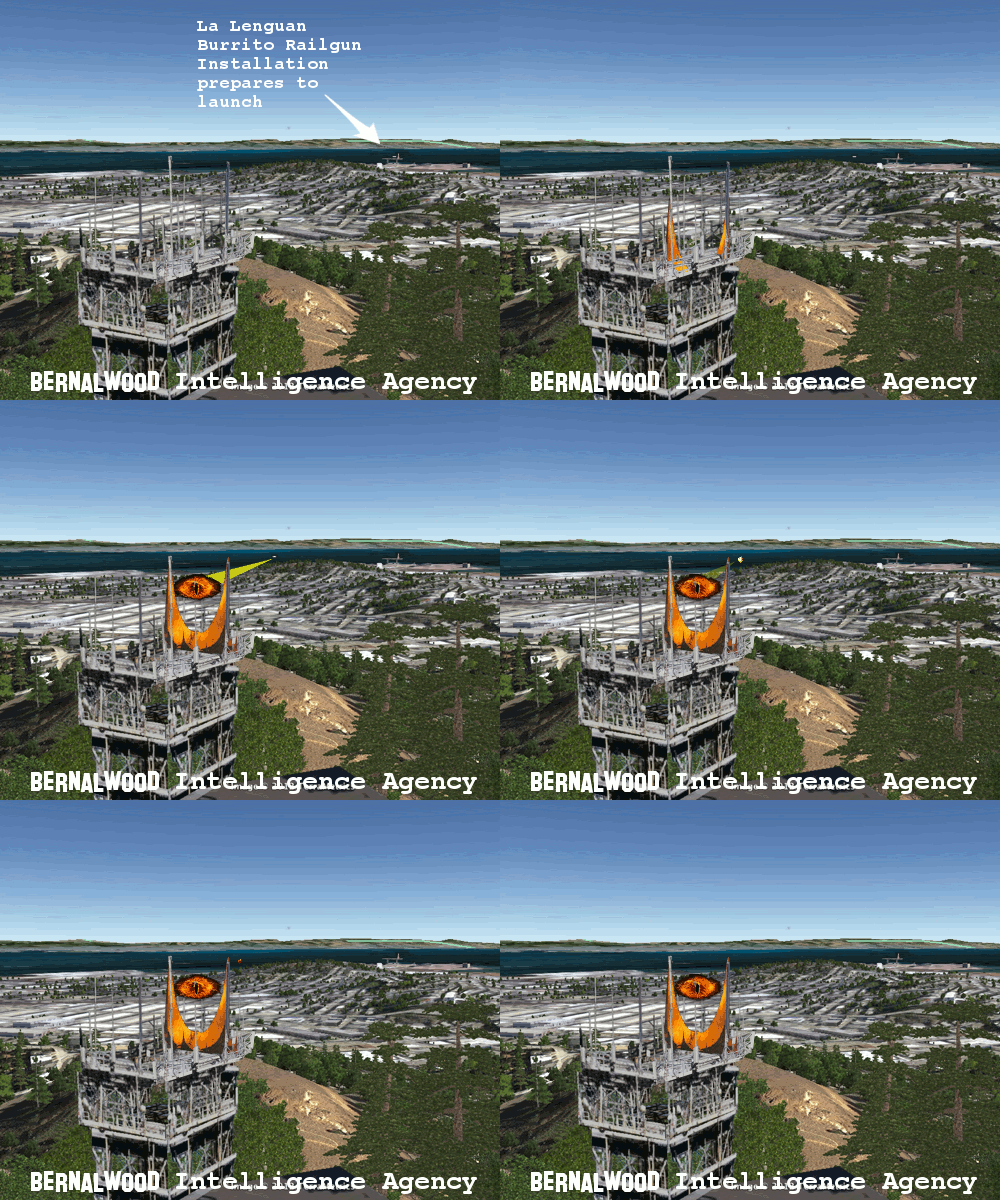
Most Awesome Animated GIF Ever Created to Protect Bernal Heights from Weaponized Burritos

Hats off to Neighbor Joe, who created this elaborate visualization to demonstrate the Mark II “Eye of Sautrito” Defense System , which is designed to counter the threat of La Lengua’s Burrito Rail Gun. Notice also that it zaps the burrito weapon Every. Single. Time.

===

Biggest Mystery We Don’t Really Want to Solve

Who is the Bikini Jogger, and where will she turn up next?

===

Best Passive-Aggressive Parking Note Written By Someone Who Doesn’t Even Live Here

Stencils of Doom

An outraged young man from out of town was very upset because his car was towed when he tried using Bernal Heights as a long term parking lot. He then declared that the removal of his vehicle “forever marked San Franciscas as snobby, me-first people in the eyes of my thousands of blog and internet followers.” (February)

===

Most Zen-Like Artistic Moment in the Convoluted History of the Bernal Heights Library Mural

There was that brief period; the November interregnum between the old mural and the new, when there was no mural painted on the Bernal Heights Public Library. It was an ephemeral moment, but that may have made it the most dramatic creative statement we’ll ever get to see there.

===

Most Heroic Performance By a Clearly Outclassed Domestic Animal

Feline Defender

That would be my cat Smudge, who single-handedly repelled an entire family of invading raccoons, using only mean facial expressions and Jedi mind tricks. (July)

===

Neighbor We Saluted Most for Rocking the Hardest

Enough good things cannot be said to properly endorse Neighbor Clarissa’s winning submission to the Bernalwood Air Guitar Photo Content that we held back in July. We were also thrilled to discover that Neighbor Toki has a bright future as a rockstar ahead as well. Keep an eye on that young man.

Hillside Supper Club Targets Fulltime Opening on Jan. 23

Hillside.Jonathan1

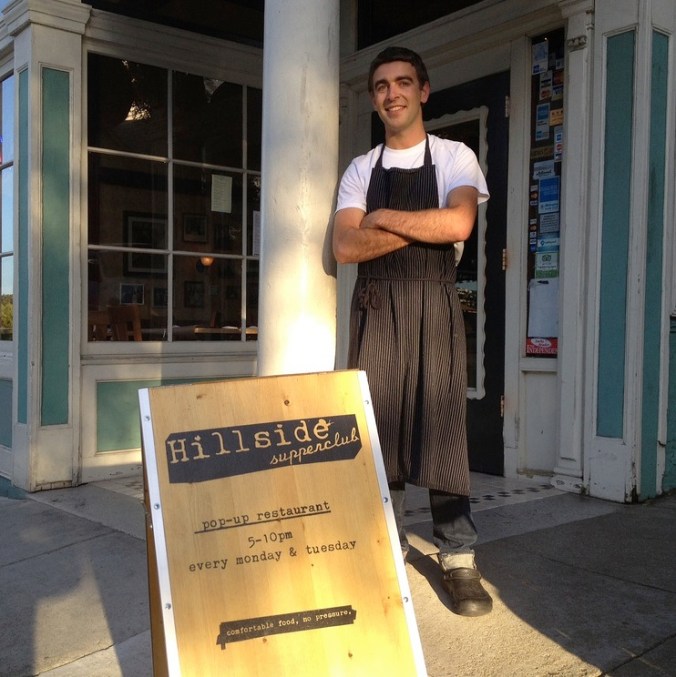
Let the record show that Bernalwood was a fan of the Hillside Supper Club even before it was cool.

We witnessed it’s ascent back in the days when it was just a fledgling popup called the Bernal Supper Club. We were there during the Disapora Year, when the Supper Club wandered from venue to venue in the hipster-encrusted flatlands of the Mission. We cheered when HSC found a more permanent home in Bernal Heights, and we smiled knowingly as Chefs Tony and Jonathan nurtured a sterling reputation for making yumolicious food. Then came the plan to open up fulltime inside the (former) Cafe Cozzolino space on Precita Park, and now the grand opening date has finally been announced: January 23, 2013.

EaterSF scored more details:

Hillside Supper Club main man Tony Ferrari writes today to say that he and business partner Jonathan Sutton have signed a lease at Caffe Cozzolino, where they’ve been staging pop-ups for the past year or so. Now, Cozzolino’s owners of 30 years are ready to pass the torch to the next generation, and thanks to Kickstarter, and loads of Bernal Heights’ support, they’ll open as a full-time restaurant on January 23, with a slightly scaled up version of their regular, changing fixed price menus of “rustic California fare.”

The last Hillside Supper Club pop-ups will take place on the 17th and 18th of this month. Then there will be one more final hurrah on New Year’s Eve. Ferrari and Sutton will take the first two weeks of January to do a remodel of the space. They’ll turn the loft space upstairs into a communal dining area, add a Redwood bar, redo the bathrooms, add two beer taps, and repaint everything. The decor will encompass light walls, dark charcoal wood beams and tinted Mason jars used as sconces on the walls.

This is joyous news, both for Chefs Tony and Jonathan, and for all the residents of Greater Precitaville.

Meanwhile, this is also an interesting moment in the grand sweep of Bernal Heights history.  Consider: The opening of the Hillside Supper Club will represent an almost unimaginable transformation for this commercial space at the corner of Folsom and Precita, which was, not all that long ago, a notoriously rowdy biker bar plagued by a weird spelling mistake and a scandalous reputation. Oh, how times change.

PHOTO: Chef Jonathan Sutton preparing to open for a popup evening, May 2012. By Telstar Logistics

Bernalwood Reader Solves the Mystery of 3365 Chavez

3365Chavez2

Yesterday’s blog post about an 1888 photograph of the intersection of Mission and Army (Cesar Chavez Blvd.) generated a lot of great comments… including a very geeky digression about the apartment building at 3365 Chavez, right next door to the Principality of Chicken John.

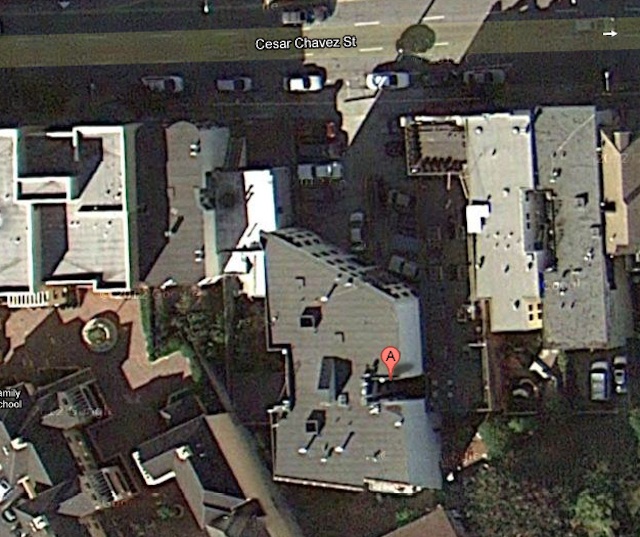
You can see the building above; it’s set back from the street, with an unusual, angled facade. The oddness is even more obvious from above:

3365Chavez.Aerial

So…. Why??

Reader Jonathan seems to have solved the riddle. He writes:

Without doing more research, the diagonal building on Cesar Chavez you’re talking about (3365 Cesar Chavez) appears to have been moved onto the lot from across the street, presumably when Army Street was widened. If you take a look at the 1938 aerial, you’ll see an angled building on Capp across the street with two light wells in a nearly identical position, just reversed. Thus, when the building was moved, it was swung around 180 degrees so that the old south portion of the building (facing Army Street) became the new north portion. As large as that building is, they certainly moved larger.

To test this hypothesis, I merged a 1938 aerial photo with a 2012 Google Map image, and — by Jove! — the theory seems to check out!

FlippedChavez2

Yes! Brilliant! So the mystery of the odd angle is solved. But why the deep setback from the street? Reader Jonathan again:

Why they placed it so deeply on the lot after moving it I can’t say, but a very logical guess is that they intended to build something else fronting on Cesar Chavez.

UPDATE: Reader Jonathan would like to revise this theory about the unusual setback at 3365 Cesar Chavez:

Now that I think more about it, they probably placed the building so deeply on the lot to allow for parking (rather than another building). Even in the 1940s parking was at a premium, and the building owner could have rented the spaces to tenants or others in the neighborhood.

Since the front of the building functions as a free-range parking lot to this very day, the latter theory certainly makes sense.

Time Travel: Exploring the Intersection of Mission and Army Streets in 1888

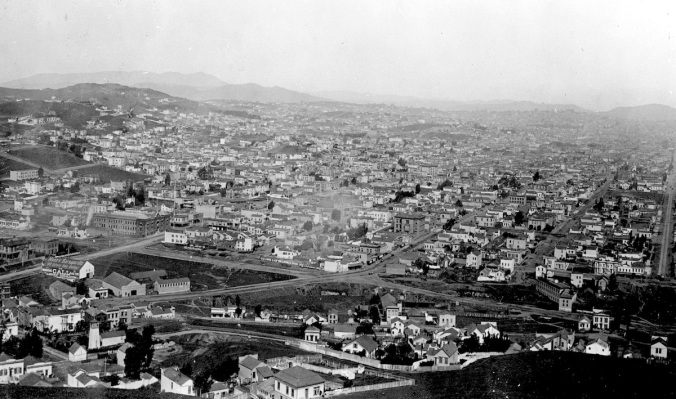
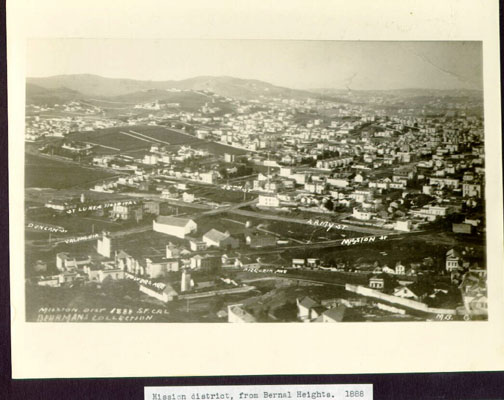
Mission.Army.1888jpgLet’s do some time travel, courtesy of the Bernal History Project (from whence this fantastic image came our way).

The year is 1888, and the place is the intersection of Mission Street and Army (now Cesar Chavez Blvd.), as seen from Bernal Hill.

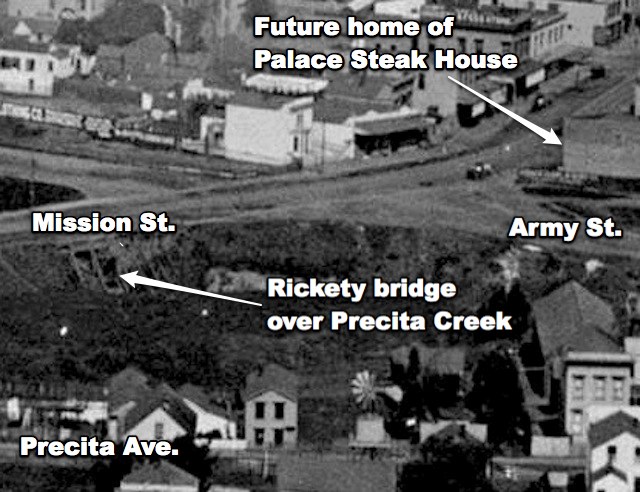
The resolution of this photo is extremely good, so let’s zoom in to take a closer look. We’ll start right at the intersection of Mission and Army. No Palace Steak House yet, and Precita Creek is still an exposed, swampy mess:

Mission.Army.1888.intersect2

A little farther south on Mission, we see some points of interest in the future La Lengua Autonomous Zone. There’s an awesome shed on Valencia painted with ads for Hood’s Sasparilla and The San Francisco Morning Call newspaper. We also see the site of the future El Rio, as well as the building that would later become Mission Chevrolet before becoming today’s O’Reilly Auto Parts. The Bancroft Library stands on the future expansion site of St. Luke’s Hospital. And what’s up with that lighthouse-like tower on Coso (which is also visible here)?

Mission.Army.1888.sw4

A little to the northwest, we see the intersection of Valencia and Army. Here too, Precita Creek is a muddy ravine, but that big brick building that’s now the Salvation Army on Valencia and 26th is clearly present. At the time, it was a shoe factory.

valenciaArmy.1888b

Lastly, we head east along Army, to the intersection of Army and Howard (later renamed South Van Ness). Apparently, Howard didn’t yet continue through to Army. Also, note that big, bendy building on Army, purpose unknown. UPDATE: Mapmeister Eric Fischer identifies the big, bendy building as the home of the North Star Brewery! Image Annotation added below.

Mission.Army.HowardArmy3

Thanks for journeying back through time with us. Feel free to geek-out with the high-res version of the full 1888 image on your own; please report back if you find anything interesting.

PHOTO: Courtesy of the Bernal History Project