Learn About the Lost Movie Theaters of Mission Street

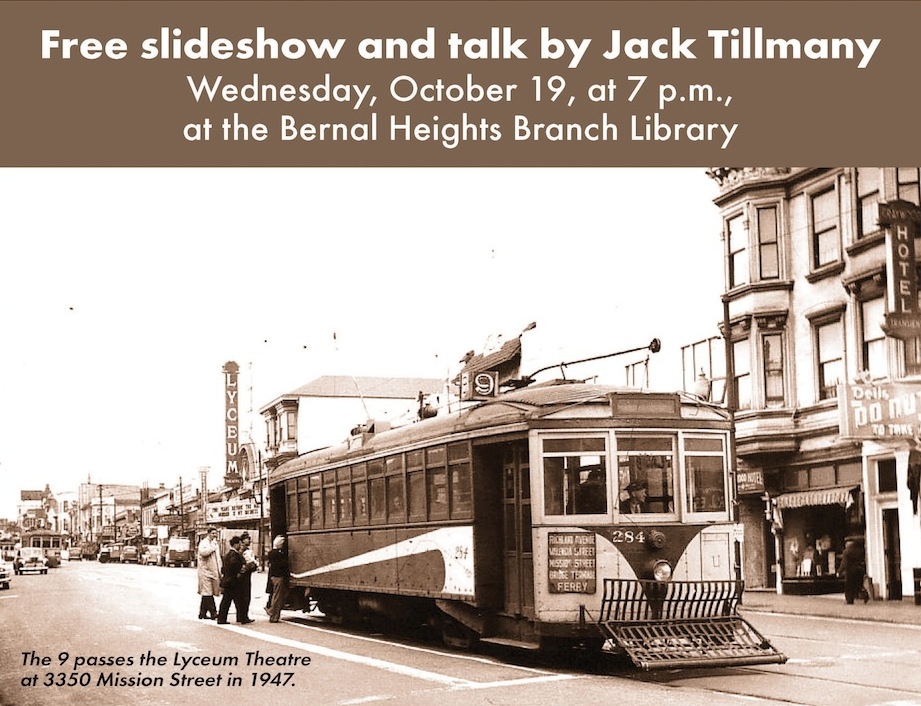
On Wednesday, October 19 at 7 pm, the ever-excellent Bernal History Project will host a talk in the meeting room the Bernal Heights Public Library about the lost movie theaters of Mission Street:

During the golden years of moviegoing in the first half of the 20th century, just about everybody went at least once a week. Ten thousand people a day went to the movies in San Francisco on Mission Street alone. Most of the theatres are gone now, or, worse yet, sitting vacant and abandoned as sad reminders of what once was, but will never be again.

But a couple of them have been in business for more than a century and continue to survive and, let us hope, prosper. Jack Tillmany’s presentation offers a guided tour of just about all of them, from 16th Street through the Mission and Bernal Heights to Daly City, in black and white and in color, along with the many streetcar lines that provided transportation on San Francisco’s longest thoroughfare. There will also be a small detour to visit Cortland Avenue’s movie houses, the Cortland and the Capri!

Jack Tillmany is a S.F. transit and movie theatre historian. He is the author of Theatres of San Francisco, Theatres of Oakland, and Theatres of the San Francisco Peninsula, the last with Gary Lee Parks, author of Theatres of San Jose. Copies of all four books will be available at the event at below cover price.

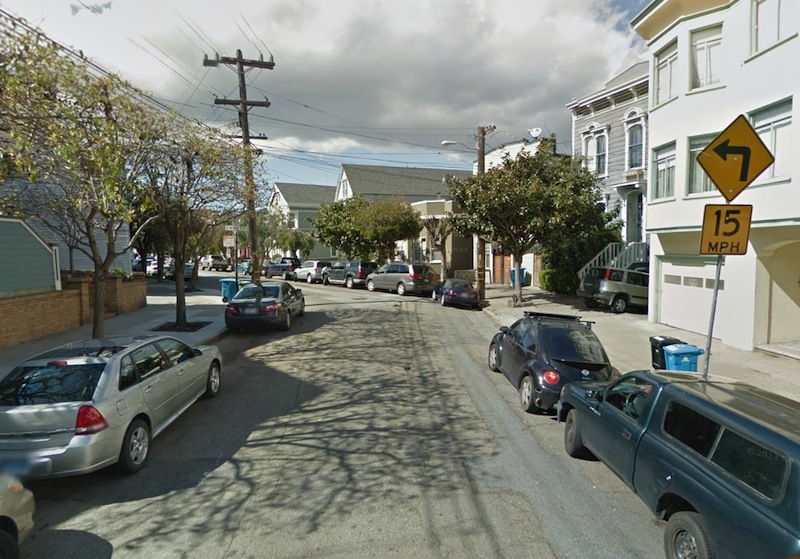
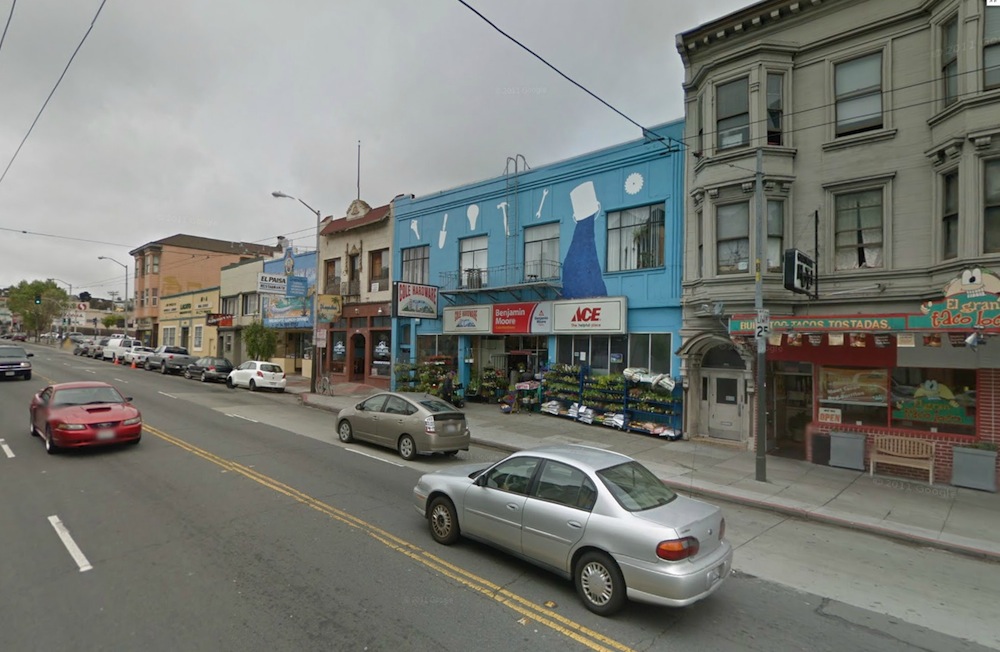
PHOTO: Above, the 9 streetcar passes the Lyceum Theater at 3350 Mission, home of the present-day Safeway parking lot. Photo from Jack Tillmany. Oh, and here’s how the view from the same spot looks today:

Skywriting Over Bernalwood

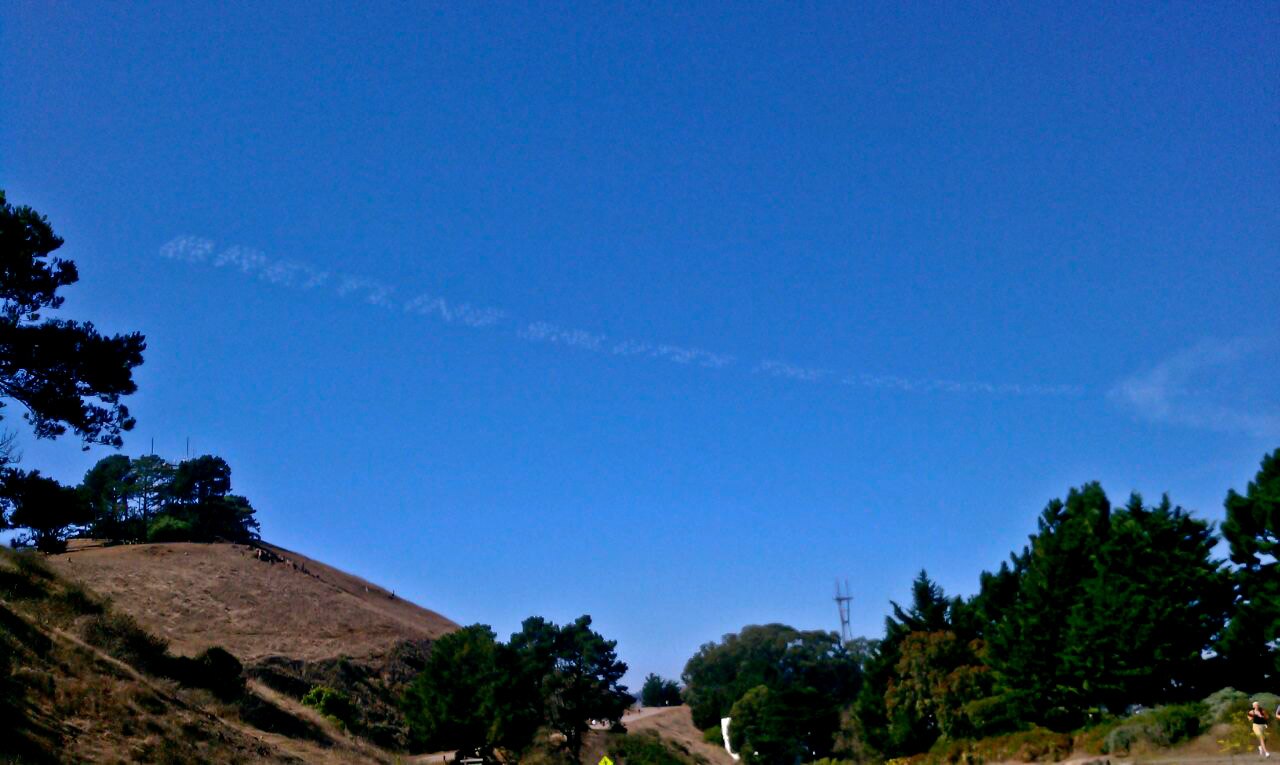
It’s a little challenging to read, but Rihannon Charisse captured some Fleet Week-related skywriting over Bernal today:

Sky writing over Bernal! “GREETINGS SALUTES THE CENTENNIAL OF NAVAL AVIATION”

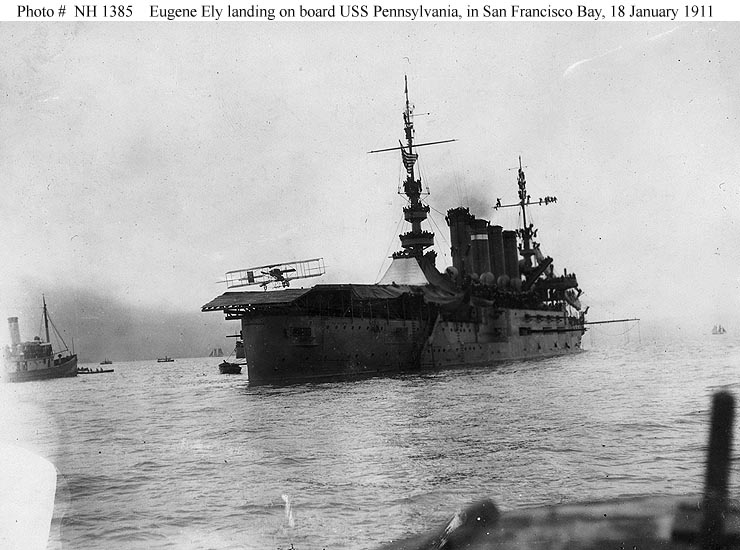
That “Centennial of Naval Aviation” thing is a fascinating historic tale with a fun local twist, and earlier this year my alter ego, Telstar Logistics, wrote all about what happened during that big day on San Francisco Bay in January 1911.

Here’s a little preview:

Happy Fleet Week!

PHOTOS: Rihannon Charisse, history.navy.mil 

Gulp! Why You Should Be Nervous About a PG&E Gas Pipeline with History of Big Trouble That Runs Through Bernal Heights

Did you happen to catch this anxiety-generating bit of news last week regarding the safety of PG&E’s gas pipelines?  From the San Jose Mercury News:

More than a year after the San Bruno natural gas explosion, PG&E still lacks “a large percentage” of the information it needs to accurately assess its pipeline risks and hasn’t taken needed steps to inform the public about its gas lines, according to the National Transportation Safety Commission’s final report on the 2010 disaster released Monday.

The 153-page report went further than earlier NTSB statements by including a strong warning about PG&E’s limited understanding of what other dangers may lurk underground.

Noting that PG&E uses data in a computerized system to gauge the risk posed by its pipelines, the agency said it fears the system contains “a large percentage of assumed, unknown or erroneous information for the Line 132” — the one that erupted in San Bruno — “and likely its other transmission pipelines as well.”

In addition, the report — the board’s final statement on the San Bruno catastrophe and largely a repetition of previously released documents — scolded PG&E for its continued failure to sufficiently educate the public about its gas lines and the hazards they pose.

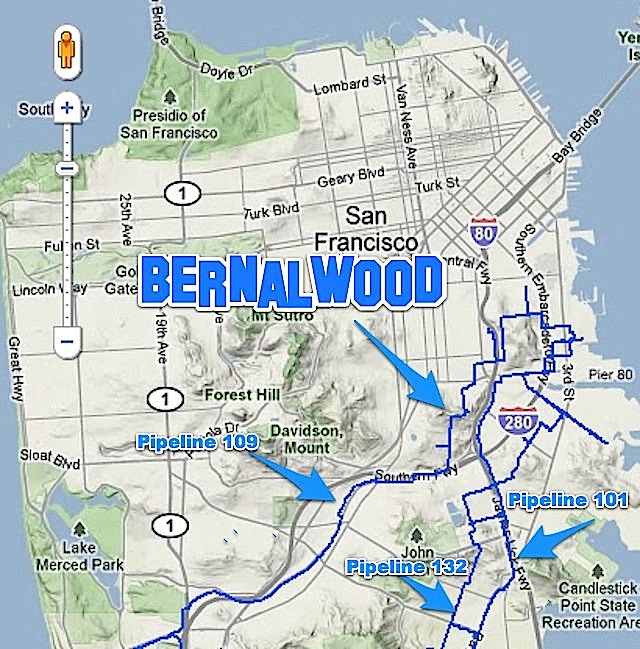
In other words, PG&E basically has no idea WTF is going on with its pipelines. Why is that an issue for Bernalwood? Because one of PG&E’s worrisome “other transmission pipelines” runs right through Bernal Heights:

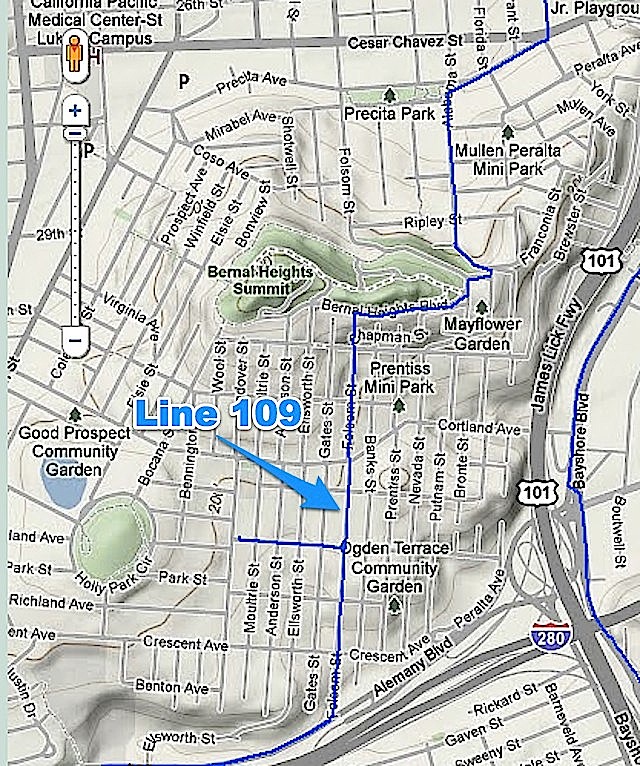
The PG&E pipeline that caused in the San Bruno explosion, Line 132, does not run through Bernal Heights. Instead, Bernal is traversed by another pipeline, called Line 109.

The flow of gas within Line 109 runs south to north. As you can see, the line comes in from Alemany and then heads north via Folsom, with an odd dead-end spur that shoots east along Tompkins Ave. At the top of Bernal Hill it traces Bernal Heights Boulevard, before heading down Alabama to Precita and north via York.

According to a must-read article in the San Francisco Chronicle, Line 109 has a long list of safety concerns and many of the same vulnerabilities as Line 132.

Experts point to the totality of Line 109 problems as warning signs that the older, untested lines in PG&E’s system are fraught with potential risks.

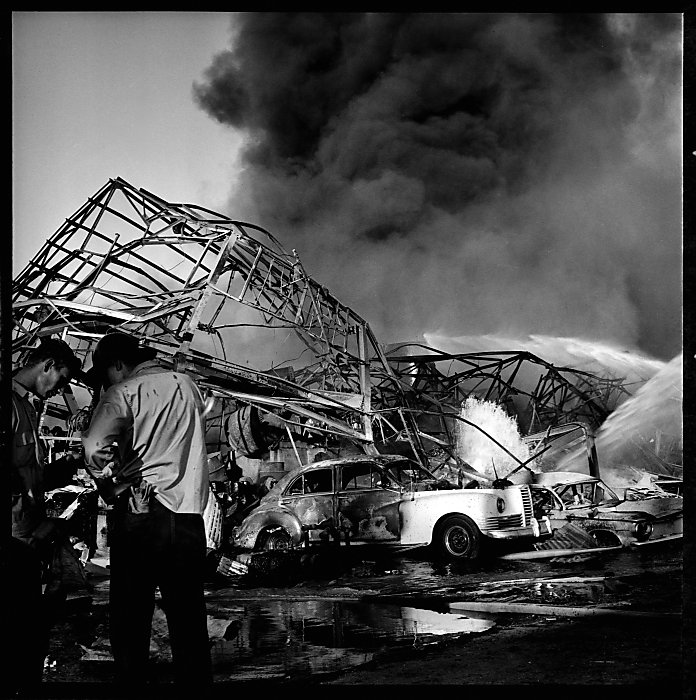
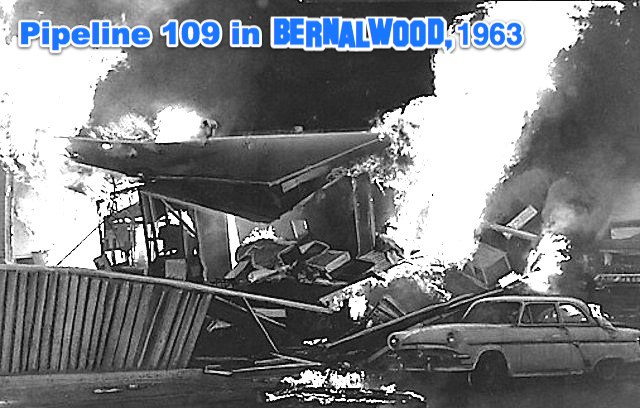
In the case of Bernal Heights, these concerns are not at all theoretical. Line 109 has caused big big BIG problems here before, most notably in 1963, when a segment the intersection of Nevada and Cresent exploded. Part of it looked like this:

And like this:

From the San Francisco Chronicle:

A Pacific Gas and Electric Co. gas pipeline running up the Peninsula into San Francisco has a long history of cracked and poorly constructed welds and even exploded once – but it’s not the one that blew up in San Bruno last year.

The pipeline is known as Line 109, and it failed disastrously in 1963 in the Bernal Heights neighborhood in San Francisco. The blast injured nine firefighters and led to the heart-attack death of a battalion chief. […]

Line 109’s problems first came to everyone’s attention almost 50 years ago.

On Jan. 2, 1963, the transmission pipe sprang a leak under Alemany Boulevard in San Francisco. About 1,000 homes were evacuated as firefighters rushed in to help.

Before PG&E crews turned off the line, gas spread to a nearby home, which exploded. Two of the nine injured firefighters were critically hurt, and Battalion Chief Frank Lamey, 63, died of a heart attack.

One of those critically injured was Anthony Marelich Jr. In an interview last week, he said PG&E had left the line active during the evacuation to avoid cutting off thousands of other customers and believed the gas was safely venting into the atmosphere.

Instead, it was filling a house on Nevada Street. Marelich said he had been standing with several firefighters when the home blew up and a wall “landed on top of me.”

“It was instantaneous,” said Marelich, now 73. His face was crushed, and doctors gave him almost no chance to survive.

He was forced to retire the next year, having lost several teeth and his sense of smell. Surgeons had to wire his jaw back on.

“Safety, right now, is in the limelight because of San Bruno,” Marelich said, adding that he thinks PG&E should have paid a steep price for the 1963 blast, “but they never showed any blame for it.”

“What happened to me and what happened to those people down in San Bruno, it should never have happened,” Marelich said.

Put another way, here’s a question we all should ask: In light of the NTSB’s staggering revelations about PG&E’s incompetent management of its gas pipeline network, what are the company and City officials doing to make sure it doesn’t happen in Bernal Heights… again?
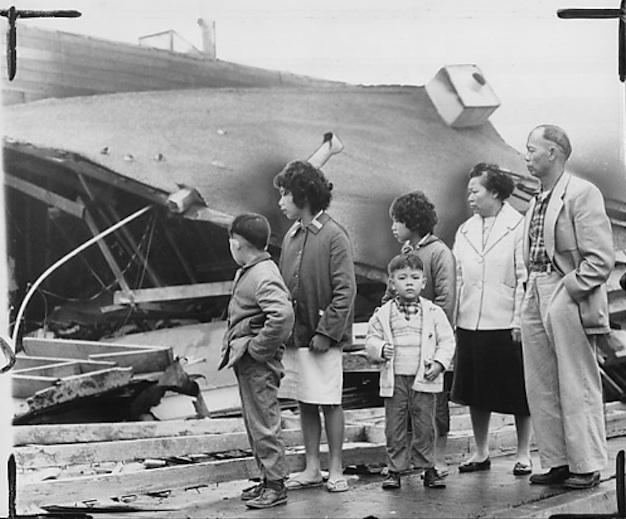
IMAGES: Pipeline maps, PG&E; 1963 photos, San Francisco Chronicle
Susie Bright Remembers a Life on Bessie Street

Susie Bright is a writer/activist who edited On Our Backs, an influential ‘zine about female and lesbian sexuality that was published during the 1980s. During the heyday of On Our Backs, Bright lived in a small apartment at 25A Bessie Street that also served as the magazine’s editorial office and photo studio.

Honey Lee Cottrell, Bright’s former partner and collaborator, has lived in the apartment on Bessie Street ever since. But on Friday she will be evicted. To mark the sad event, Bright wrote a short essay about years spent in the apartment, and she calls her recollection the “Annals of Bessie Street: From Revolution to Eviction.”

This Friday I am losing my long-standing home in San Francisco: 25A Bessie Street.

My first books Herotica and Susie Sexpert’s Lesbian Sex World were written inside this little nest. I grew up as a young woman in this apartment, my daughter grew up here from infancy to adulthood.

The best and most outrageous of On Our Backs pictures were conceived and often shot at Bessie Street. This is where Honey Lee Cottrell, my partner, and OOB’s staff photographer, became a legend.

We had a tiny garden that got a few rays of sun. We turned a roving green briar into a wandering rose. I held my first porno pajama parties there, which later became my big screen road shows: How to Read a Dirty Movie and All Girl Action. The thumb-size cactus we planted outside on the sidewalk grew into a behemoth.

We raised kids here— Honey Lee captured so many of our children’s best moments.

Some things I can’t get out of my mind. Fanny Fatale demonstrated “how to female ejaculate” on our kitchen linoleum one afternoon, and I said we should never clean that spot again. I think our apartment should be made into a feminist historical monument.

I moved to Bessie Street with my girlfriend, Honey Lee Cottrell, when I was 23 years old— and she was 37. It’s a tiny basement apartment on the steep north face of Bernal Hill. The bathtub is in the kitchen, which looks out over all of downtown and the Mission district. The kitchen windows are the one place where the light pours in.

Our first landlord was unsure if I could qualify as a tenant, because at 5’10”, I had to duck to get into some of the corners of the low-ceilinged apartment. I assured her I could— at $400 a month, the price was just right for the two of us. In the early 1980s, Bernal was still a poor and working class, multi-racial neighborhood, adjacent to “Needle Park,” which nowadays is filled with bouncy houses and miniature-dog birthday parties.

I moved out of Bessie Street when I was 30— we broke up after seven years— but I never “left.” I moved a few blocks away, and when Aretha was born, she went back and forth between our two homes. That never ended, no matter how many miles I moved away. The last two years, my daugther lived at Bessie Street with Honey, graduating from college.

Early this winter, the Bessie Street building was sold to a new owner, and after 30 years: “Eviction.” Ironically, it was bought by a wealthy man who wanted to make a home for his young son in the city who otherwise could never afford to rent a place…

There’s lots more at Susie’s site, including many more images from the pages from On Our Backs (NSFW). It’s a poignant tribute to a memorable time and an important place in the evolution of the Bernal Heights we all live in today.

Farewell, 25A Bessie Street.

PHOTO: Honey Lee Cottrell via Susie Bright.
Hat tip: Rita Roti

That Odd Bend in Precita Avenue, Explained

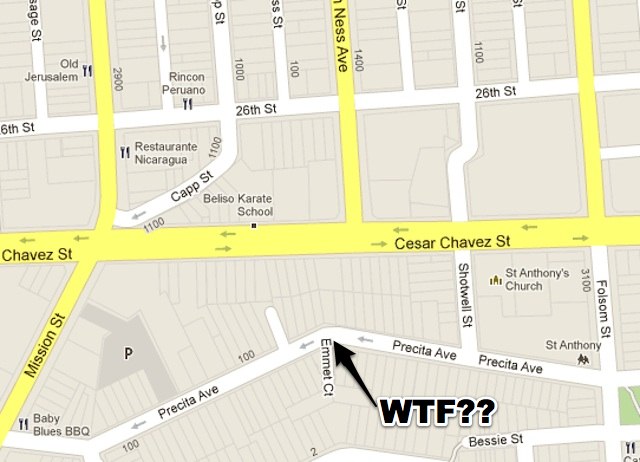
The machinations of the San Francisco Department of Public Works are obscure and mysterious, but after a long hiatus, work has resumed on Precita Avene’s sexxxy sewer replacement and street repaving project. The action is now happening just west of the sharp bend that redirects Precita on the stretch between Shotwell and Mission Streets.

But wait… why does that bend exist at all? The hook to the left certainly seems arbitrary, given the flatness of the terrain.  So what’s up with that? And why is the entire length of Precita so ziggity-zaggedy?

Happily, this question was answered — and answered well! — by Burrito Justice, the leader of the La Lengua separatist movement. When he is not fomenting geo-cultural secession from the Dominion of Bernalwood, Burrito Justice is also a bit of a map geek, and his work in this area is impressive (as we shall soon see).

Precita is a very old street by San Francisco standards, because it was first laid down sometime during the early 1850s, just a few years after the 1849 Gold Rush that transformed San Francisco from a podunk outpost into a burgeoning city. The street ran alongside a freshwater stream called Precita Creek that flowed from springs near Twin Peaks down to the wetlands that occupied present-day Bayshore.

Here’s some revealing cartography from 1876:

During the 1880s, Precita Creek was replaced by an underground sewer pipe that runs under today’s Cesar Chavez Boulevard (which is now being replaced). But before all that, Precita Avenue shadowed the banks of its eponymous waterway so closely that the road meandered in tandem with the creek.

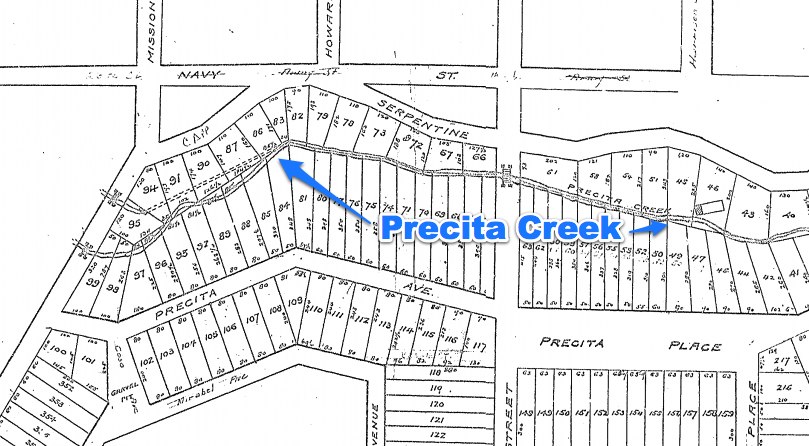
You can see that clearly in this 1859 Assessor’s Map (click to enlarge):

Other things to notice on the map: Army Street (today’s Cesar Chavez) didn’t exist yet. Also, 26th Street was called Navy Street. Also also, the little green/park on Coso just off Precita was originally a gravel pit. But most revealing of all, perhaps, is the fact that there was another street on the northern side of Precita Creek that also shadowed the stream.

That parallel road was called Serpentine, and as Burrito Justice explains:

Serpentine followed the old stone wall marking the northern border of Jose Bernal’s giant plat of land.

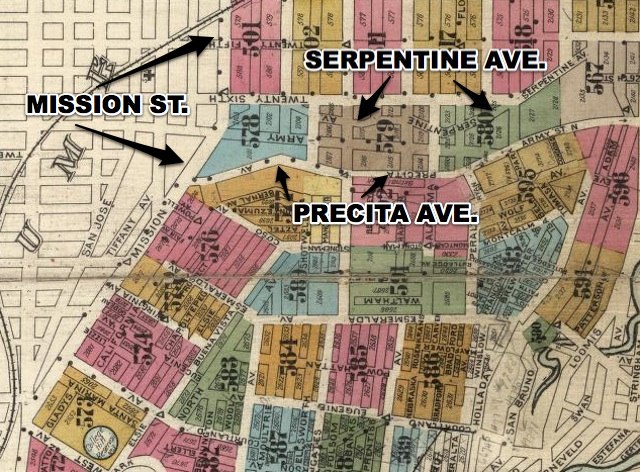
Serpentine Ave. endured even after Precita Creek was paved over to create Army Street, as you can see in this map from 1905:

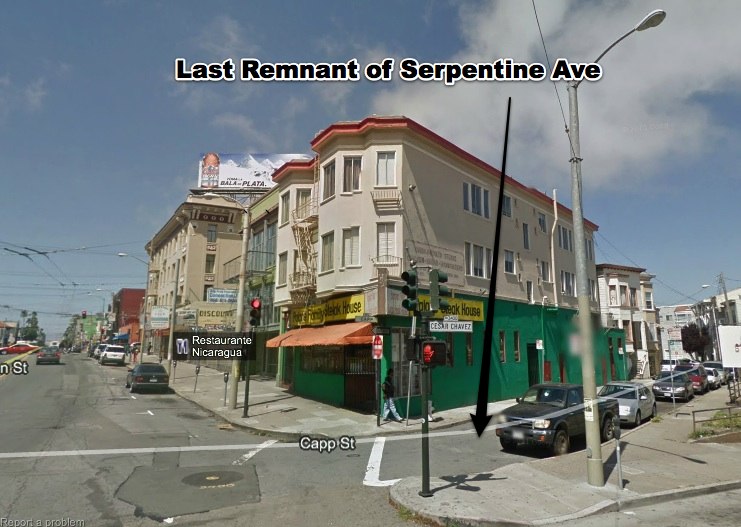
In later decades, of course, Serpentine Ave. disappeared as the land beneath it was opened up to development. Yet the weird bend in Precita Avenue survives, hinting at all the geography and topography that once defined the area. Meanwhile, one teeny-tiny stretch of Serpentine Ave. still exists, and it even parallels the bend on Precita.

And where is that?

Now called Capp Street, the last remnant of Serpentine, which used to run alongside Precita Creek, now juts out at that weird angle right alongside our own Palace Steak House:

SPECIAL THANKS: Burrito Justice

Bricks Make Big Comeback on Winfield Street

looking down, winfield street

We all know that infrastructure is sexy. Sometimes, however, it can also be rather sweet.

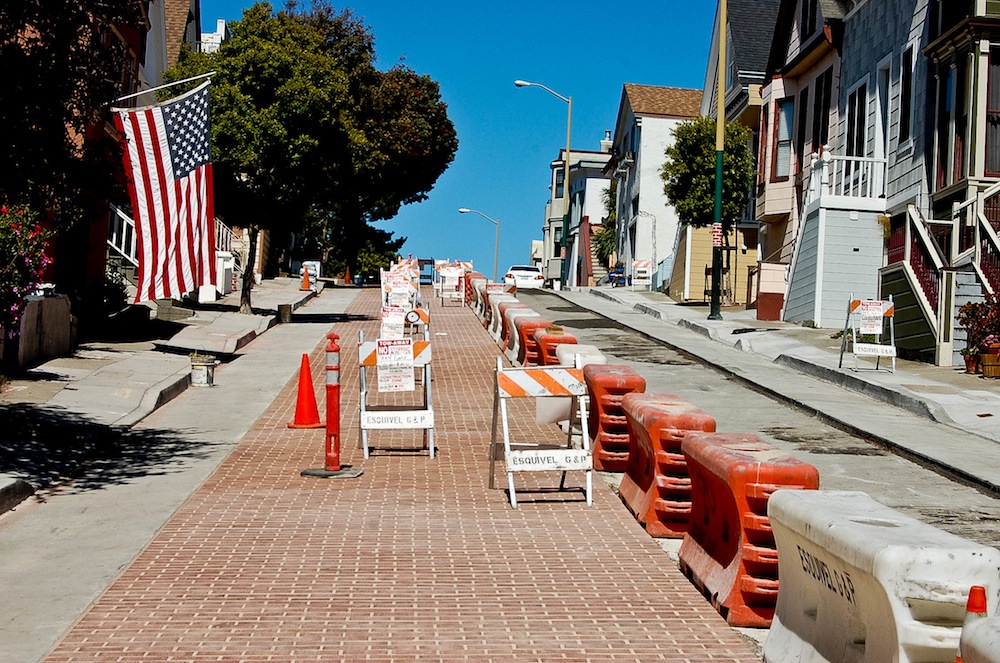
The photo above shows the new roadbed on Winfield Street; It represents a tasty victory in a hard-fought battle to preserve a subtle link to Bernal Heights history. The image was captured by Neighbor Art Siegel, who also owns the feet that appear in the pic. Art writes:

It must have been 7 or 8 years ago that the city announced it had to replace our sewer on Winfield and would replace the bricks with concrete.

As there are only a few brick streets left in San Francisco, the neighbors responded with the “Save Bernal Bricks” campaign, and the city relented.

Here’s what it looked like when workers began tearing up the old brick:

bernal bricks

And here’s a photo I took on September 5, that gives an overall sense of how Winfield’s bricks are coming back together:

See what I mean? A new sewer pipe AND a fresh brick road surface. Sexxy and sweet.

Photos, Art Siegel and Telstar Logistics

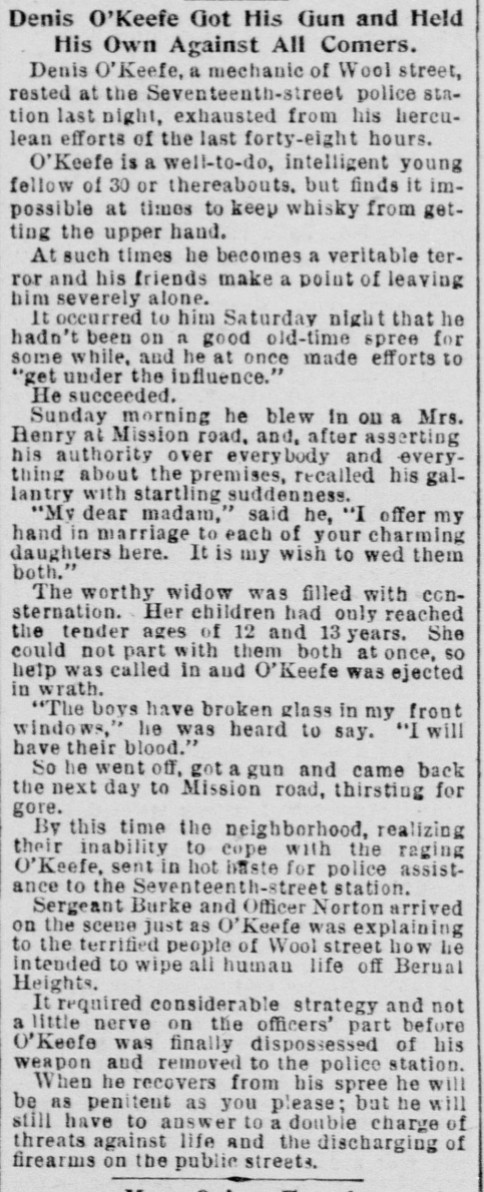
1892: Irate Man Threatens to “Wipe All Human Life Off Bernal Heights”

The old-timers say that Bernal Heights has changed a lot over the years. But even the old-timers aren’t old enough to recall when Bernal was *this* rough around the edges…

In 1892, a Wool Street resident named Denis O’Keefe allowed whisky to “get the upper hand,” on his otherwise intelligent nature. During his “good old-time spree,” Mr. O’Keefe propositioned two young sisters, and, when rebuffed, flew into a rage which culminated in the shooting of guns and much consternation among the neighbors.

This is how the story appeared in the November 22, 1892 edition of the San Francisco Call. Read on… it’s a great little tale:

Many thanks to The Bernal History Project, Fred Sharples, and Burrito Justice for the tip!

Before There Was Bernalwood, There Was Bernaltown

Yes, that’s right: Before there was Bernalwood, there was Bernaltown.

Bernaltown was a 1997 film project by Gregory Gavin, starring neighborhood kids and a variety of locals. It premiered in early June 1997, in an outside screening at the Bernal Heights Playground behind the library. 500 people showed up.

A narrative neighborhood film project structured around the Powerbuilders, a foursome of pre-teen superheroes who resist an evil scheme to build a gigantic casino on top of the community’s sacred resource – Bernal Hill. Instead of fighting evil with guns the kids build fantastic crime fighting gadgets in a secret underground workshop from which they also launch their homemade soap box cars through secret tunnels into the narrow streets of Bernaltown.

VHS copies of the movie are — or were — available at the Bernal Heights Library and 4-Star video. You can watch some excerpts from it on Gavin’s website.

So, find a hat like mine, and you get instant street cred.

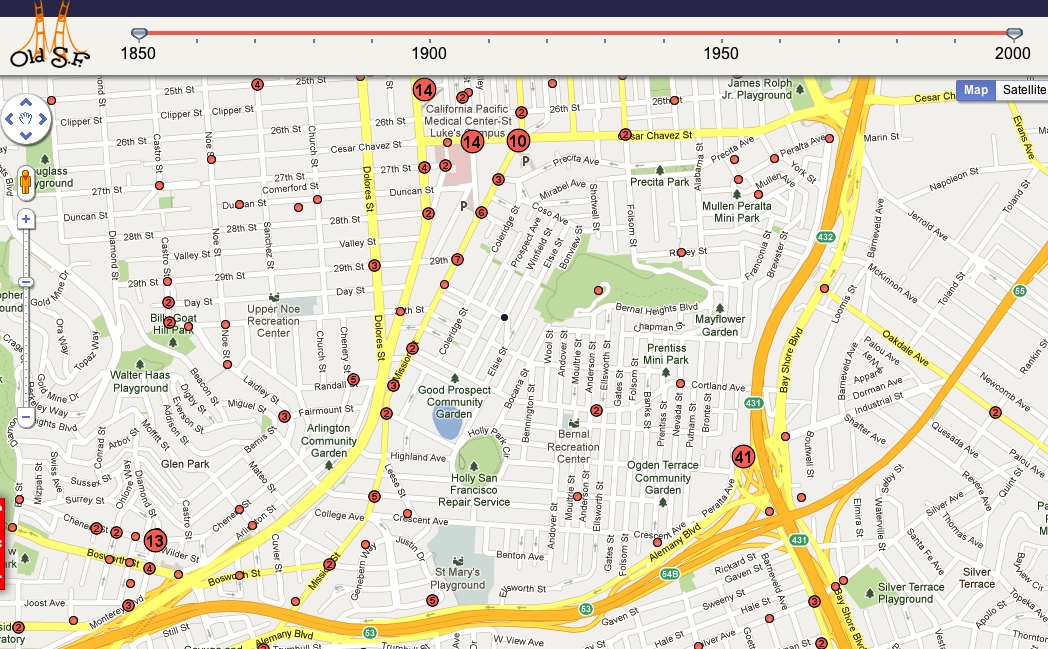
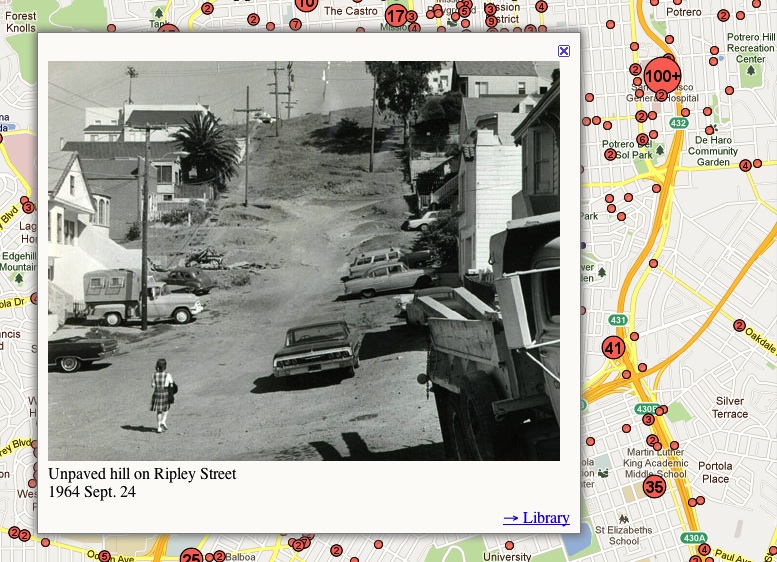
Interactive Map Enables Bernal Heights Time Travel


Get ready to spend the next few minutes immersed in blissfully satisfying distraction. There’s a new website called OldSF that combines interactive maps with geolocated historical photographs to create an easy-to-navigate history tour of San Francisco. Co-creator Dan Vanderkam explains:

Several years ago, I searched for my cross-streets on the Library’s San Francisco Historical Photograph Collection […]. The image was mislabeled — the intersection in the foreground is actually Waller and Fillmore, not Waller and Webster. Which meant that this photo from 1945 was taken from my roof!

I put together a now-and-then shot, but it always bothered me that the mislabeling of the image was so crucial to my finding it. This led to the idea of putting the images on a map.

And now, years later, we have that map!

It’s awesome. It’s geeky. It’s deep. And it’s got Bernal Heights covered. Kiss your productivity goodbye.

A Vision of the Future to Make NIMBY Heads Explode

San Francisco: Mission Freeway (1948)

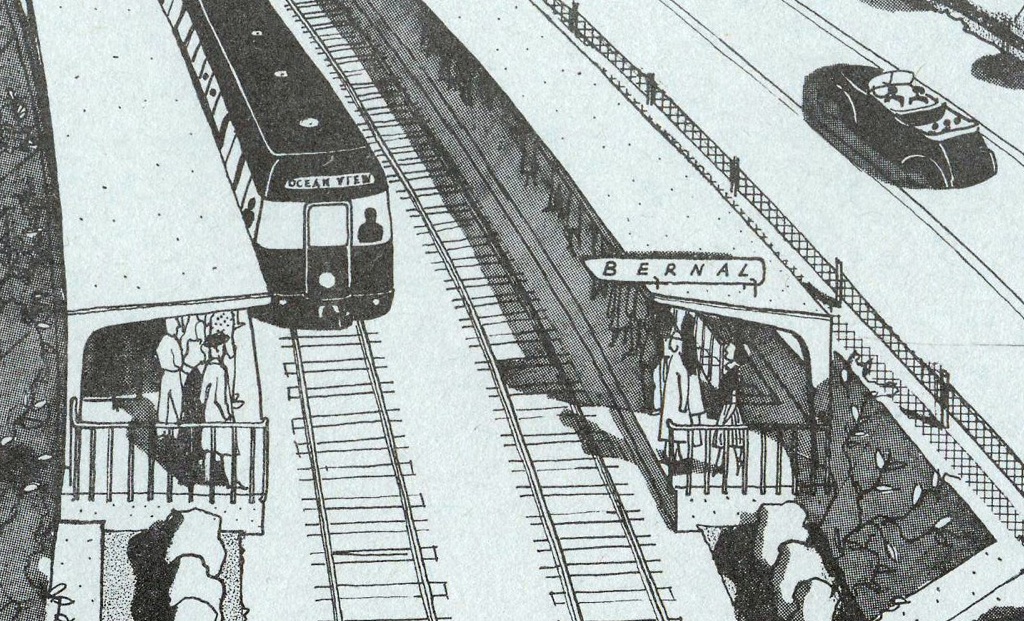
If you were impressed by the amount of NIMBY energy expended to stop the installation of new cellular antenna towers and Smart Meters, just try to wrap your head around the fury that would be directed toward this proposed project from 1948.

The basic plan was very simple: Along the axis of the Bernal Heights segment of Mission Street, erect a combination elevated freeway and public transit rail line. The incomparable Eric Fischer tracked down this alternate-universe vision of the future, and he explains:

Looking northeast toward Cortland and what would now be called 30th Street BART, between Mission and Coleridge, from the 1948 Transportation Plan for San Francisco.

Yup, that’s Cortland, shooting uphill near the top right corner of the image. This may not have been an attractive plan, or even a desirable one, but on the upside we would have gotten our own eponymous train station out of the deal. Notice:

IMAGES: via Eric Fisher

Bernalwood’s Ultimate Anticool Driving Machine

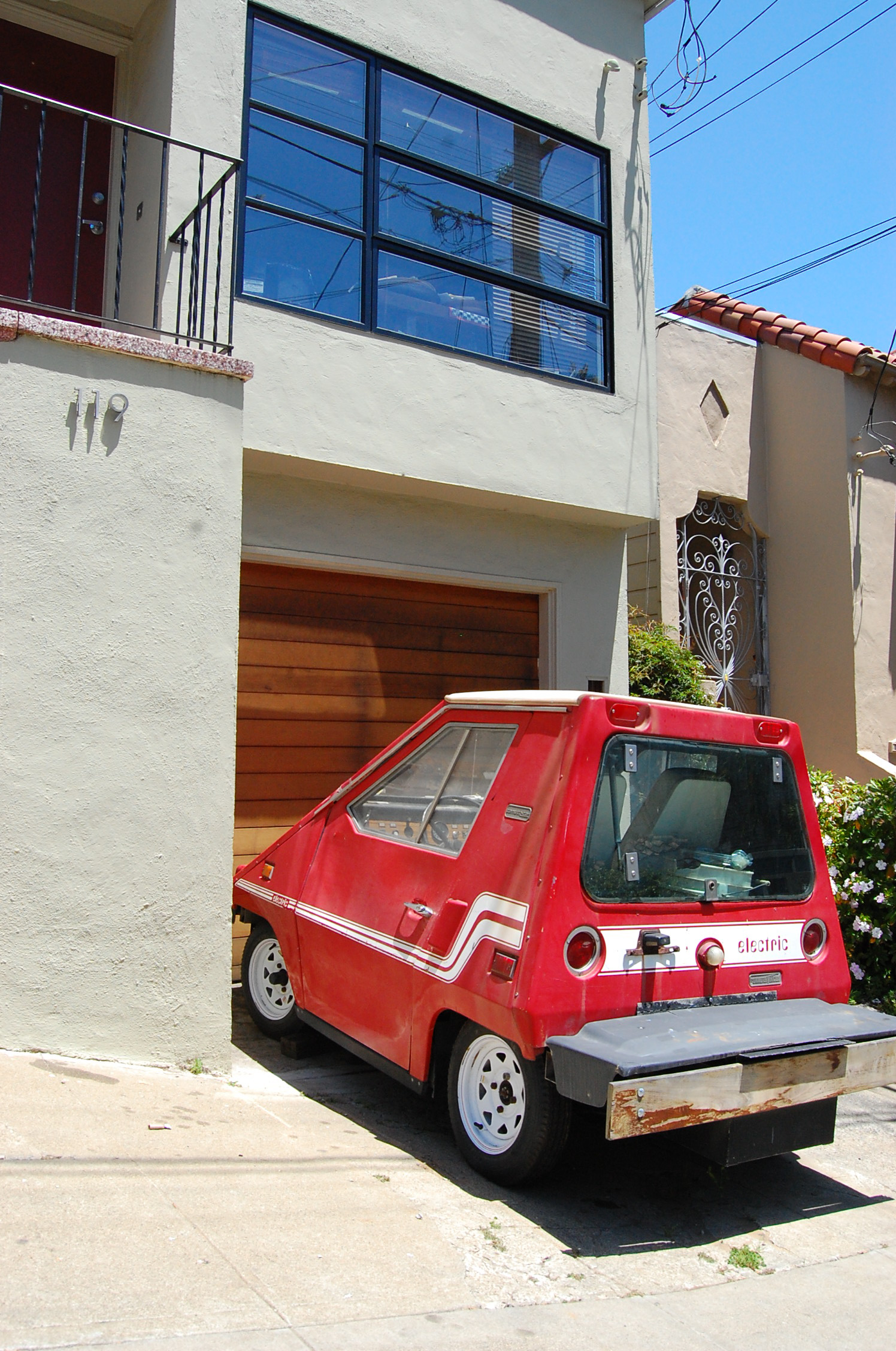
Spotted this curious ride on Ellert not long ago, parked in front a new home that’s been tastefully adorned in the contemporary Dwellian style. I thought the car and the house paired nicely, but the little car is the big attention-grabber.

Electric Modern

It’s a Comuta-Car, an electric vehicle from Jerry Brown’s first term as governor and the Logan’s Run era of 1970s industrial design. The Wikipedia telleth more:
Produced in their Sebring Florida Plant the CitiCar was a small Wedge shaped electric vehicle. Early versions had no extra features and can be considered an experiment in minimalist automotive design; it was as basic a people mover as you could get at the time. By 1976, enough CitiCars were produced to promote Sebring-Vanguard to the position of being the U.S. #6 auto manufacturer after GM, Ford,Chrysler, AMC, and Checker (taxis); but ahead of Excalibur and Avanti Motors. Production of the CitiCar continued until 1977 with about 2,300 CitiCars produced.

Commuter Vehicles, Inc. purchased the CitiCar design, and renamed the vehicle Comuta-Car. Production of this upgraded version began in 1979 and Commuter Vehicles, Inc. produced an estimated 2,144 Comuta-Cars and Vans.

Bernal’s example aged rather gracefully, and those custom white-spoke wheels make it look even more eco-macho. When this Comuta-Car encounters a Prius on the street, it probably chuckles to itself and says, “Poser!” Indeed, this may well be the most Bernal Heights car in Bernal Heights, because it is Ultimate Anticool Driving Machine.

Electric Modern

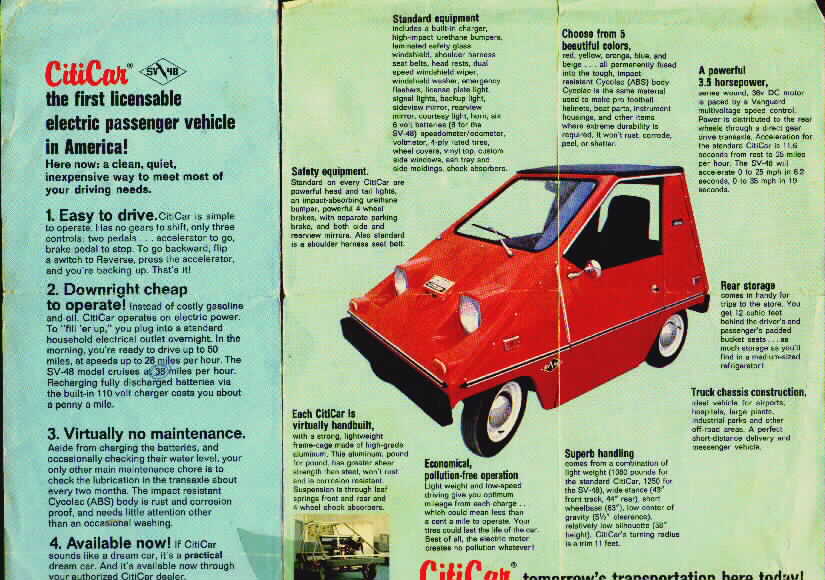
But to understand how true that really is, you really have to see the CitiCar as it looked when it was new, circa 1975. Notice that it coordinated nicely with bellbottom slacks and pre-ironic sideburns:

If you’re still curious, there’s also a more recent video about a guy who now uses a Comuta-Car as his daily driver. Chaaaaarge!

UPDATE July 29, 2011:

Turns out, the owner of this Comuta-Car is a member of the Bernal Heights literati. (We should have known.) Here’s his article about this very car, written for ReadyMade magazine:

The Comuta-Car, the focus of my dirty-handed frustration, was the first American mass market electric car. I bought mine, a 1980 model, two years ago on eBay from a farmer who had left it rotting in the back of his barn for 20 years. In its own weird way it’s a beautiful thing, a design seemingly pulled from the bad graphics of an old Atari video game, an electric answer to our gas-guzzling woes. But for all its good intentions and Logan’s Run retro coolness, this car, quite frankly, sucks. It’s slow, it’s clunky, it’s small, and it’s wholly impractical for anything but the occasional Why-Be-Normal street fair or trip around the block with chuckling friends.

PHOTOS: Telstar Logistics. Vintage catalog image via Frank Didik

Then and Now: Peralta Overlook, 1982 vs. 2011

Bernal  Hights, San Francisco

When we geek-out on then-and-now photos here in Bernalwood, we usually end up marveling at how dramatically the neighborhood has changed in such a relatively short span of time. But here’s one view that’s hardly changed at all: Peralta just off Powahattan, looking south across Cortland.

The image at the top is from 1982, and it was shared via the Bernalwood Flickr group courtesy of photographer Dave Glass and his deeeeeep archives. I went out to recreate the shot last weekend, and amazingly, it almost looks the same. Someone has updated the collection of 30 year-old cars parked there, and the billboard facing 101 now promotes Apple’s iPad, but this part of the ‘Wood (so far) seems impervious to the passage of time:

Powahattan Then and Now

PHOTOS: Top, Dave Glass. Bottom, Telstar Logistics

Historic, Mysterious Fizzy Drink Bottle Found In Bernal Home

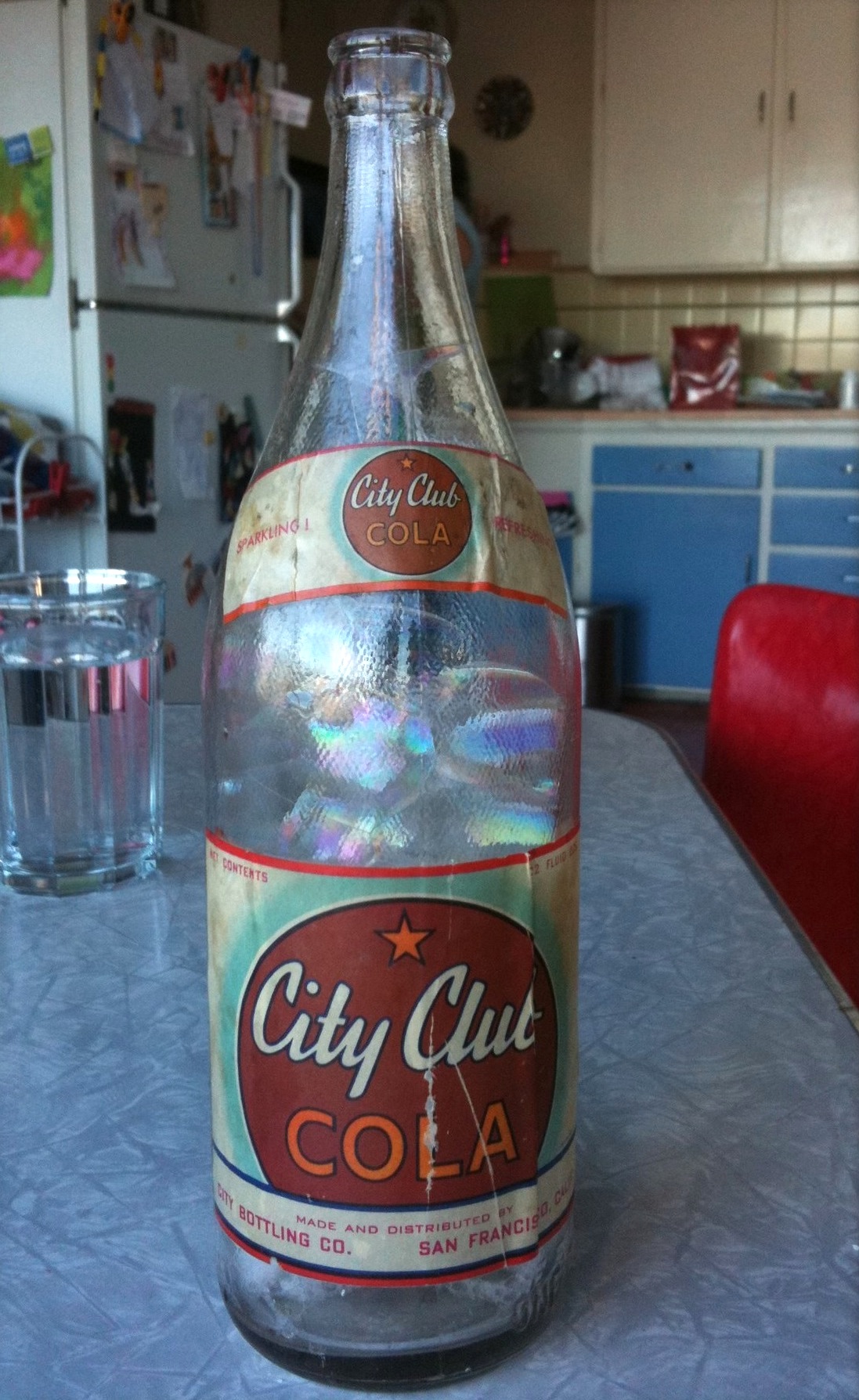
Here’s a fizzy little mystery for all you armchair consumer-product sleuths and local history enthusiasts. Neighbor Brent explains how this colorful bottle came into his possession:

Maybe you and your crack team of City researchers can provide information about the City Bottling Company of San Francisco?

The joy of homeownership: leaks. To combat a leak in our house, we’re replacing some siding. Yesterday, when removing the siding from one of our walls, our contractors found a bottle inside the wall. The bottle is for “City Club Cola”, and the label reads at the bottom, “Made and Distributed by City Bottling Co. San Francisco, Calif”.

A simple (but not exhaustive) search on Google found no references to the cola or the bottling company.  We figure it could date back to 1945, when the house was built. Maybe your crack team of researchers, or your readers, can solve our mini-mystery!

I’m curious about something that was San Francisco made and distributed, and wonder if the bottle really dates from 1945.  I mean, the label is in decent condition considering that it could be 66 years old!

Let the historical geekery and barroom hypothesizing begin!

PHOTO: Neighbor Brent