
Did you happen to catch this anxiety-generating bit of news last week regarding the safety of PG&E’s gas pipelines? From the San Jose Mercury News:
More than a year after the San Bruno natural gas explosion, PG&E still lacks “a large percentage” of the information it needs to accurately assess its pipeline risks and hasn’t taken needed steps to inform the public about its gas lines, according to the National Transportation Safety Commission’s final report on the 2010 disaster released Monday.
The 153-page report went further than earlier NTSB statements by including a strong warning about PG&E’s limited understanding of what other dangers may lurk underground.
Noting that PG&E uses data in a computerized system to gauge the risk posed by its pipelines, the agency said it fears the system contains “a large percentage of assumed, unknown or erroneous information for the Line 132” — the one that erupted in San Bruno — “and likely its other transmission pipelines as well.”
In addition, the report — the board’s final statement on the San Bruno catastrophe and largely a repetition of previously released documents — scolded PG&E for its continued failure to sufficiently educate the public about its gas lines and the hazards they pose.
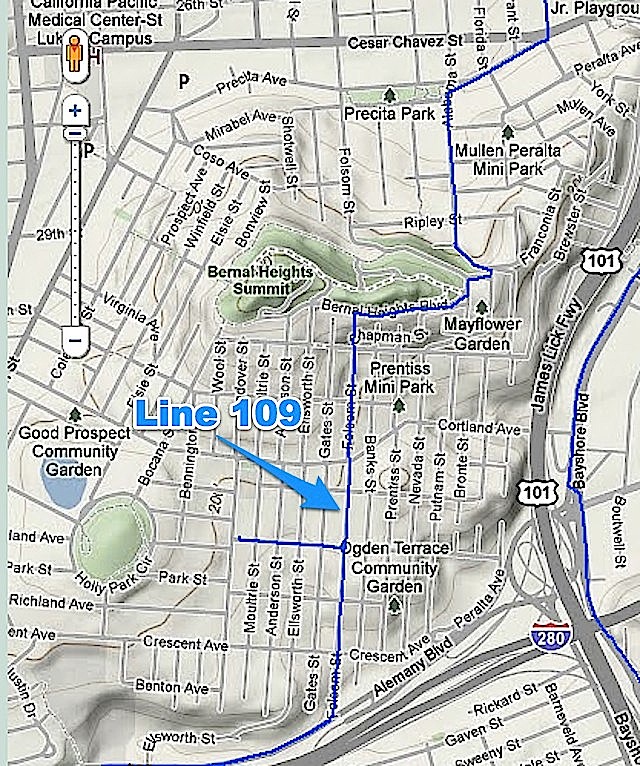
In other words, PG&E basically has no idea WTF is going on with its pipelines. Why is that an issue for Bernalwood? Because one of PG&E’s worrisome “other transmission pipelines” runs right through Bernal Heights:

The PG&E pipeline that caused in the San Bruno explosion, Line 132, does not run through Bernal Heights. Instead, Bernal is traversed by another pipeline, called Line 109.
The flow of gas within Line 109 runs south to north. As you can see, the line comes in from Alemany and then heads north via Folsom, with an odd dead-end spur that shoots east along Tompkins Ave. At the top of Bernal Hill it traces Bernal Heights Boulevard, before heading down Alabama to Precita and north via York.
According to a must-read article in the San Francisco Chronicle, Line 109 has a long list of safety concerns and many of the same vulnerabilities as Line 132.
Experts point to the totality of Line 109 problems as warning signs that the older, untested lines in PG&E’s system are fraught with potential risks.
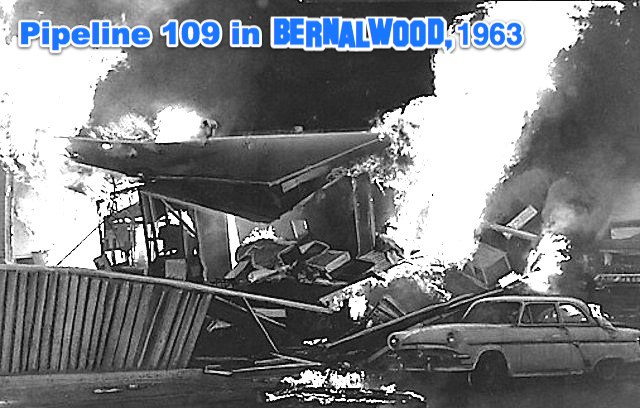
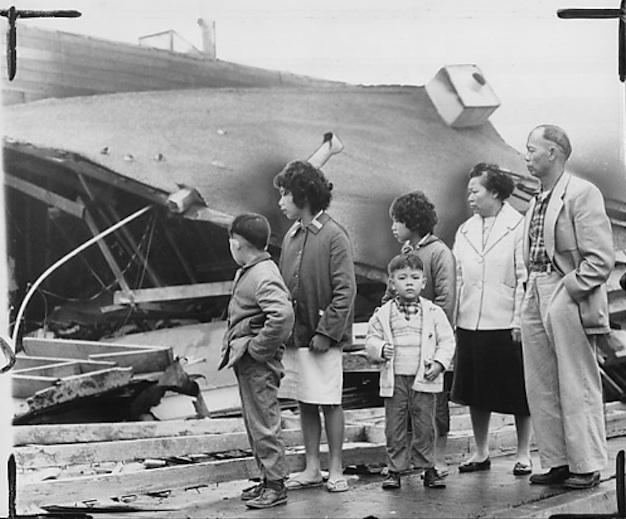
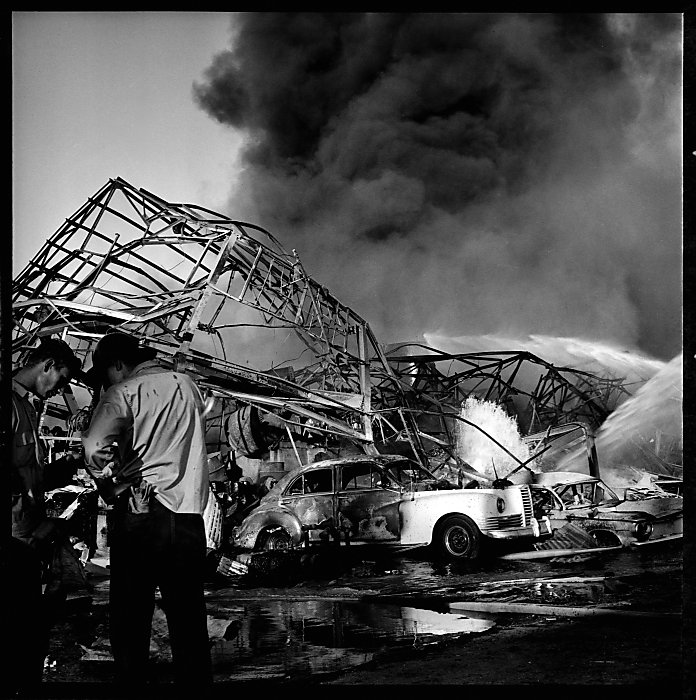
In the case of Bernal Heights, these concerns are not at all theoretical. Line 109 has caused big big BIG problems here before, most notably in 1963, when a segment the intersection of Nevada and Cresent exploded. Part of it looked like this:

And like this:

From the San Francisco Chronicle:
A Pacific Gas and Electric Co. gas pipeline running up the Peninsula into San Francisco has a long history of cracked and poorly constructed welds and even exploded once – but it’s not the one that blew up in San Bruno last year.
The pipeline is known as Line 109, and it failed disastrously in 1963 in the Bernal Heights neighborhood in San Francisco. The blast injured nine firefighters and led to the heart-attack death of a battalion chief. […]
Line 109’s problems first came to everyone’s attention almost 50 years ago.
On Jan. 2, 1963, the transmission pipe sprang a leak under Alemany Boulevard in San Francisco. About 1,000 homes were evacuated as firefighters rushed in to help.
Before PG&E crews turned off the line, gas spread to a nearby home, which exploded. Two of the nine injured firefighters were critically hurt, and Battalion Chief Frank Lamey, 63, died of a heart attack.
One of those critically injured was Anthony Marelich Jr. In an interview last week, he said PG&E had left the line active during the evacuation to avoid cutting off thousands of other customers and believed the gas was safely venting into the atmosphere.
Instead, it was filling a house on Nevada Street. Marelich said he had been standing with several firefighters when the home blew up and a wall “landed on top of me.”
“It was instantaneous,” said Marelich, now 73. His face was crushed, and doctors gave him almost no chance to survive.
He was forced to retire the next year, having lost several teeth and his sense of smell. Surgeons had to wire his jaw back on.
“Safety, right now, is in the limelight because of San Bruno,” Marelich said, adding that he thinks PG&E should have paid a steep price for the 1963 blast, “but they never showed any blame for it.”
“What happened to me and what happened to those people down in San Bruno, it should never have happened,” Marelich said.
Put another way, here’s a question we all should ask: In light of the NTSB’s staggering revelations about PG&E’s incompetent management of its gas pipeline network, what are the company and City officials doing to make sure it doesn’t happen in Bernal Heights… again?
IMAGES: Pipeline maps, PG&E; 1963 photos, San Francisco Chronicle
 Recognize the red-and-white car in the photo above? That’s right, it’s “The Whale,” the battle-scarred Volvo 240 wagon driven by the Bernal Dads Racing Team during the recent 24 Hours of LeMons race at Sears Point.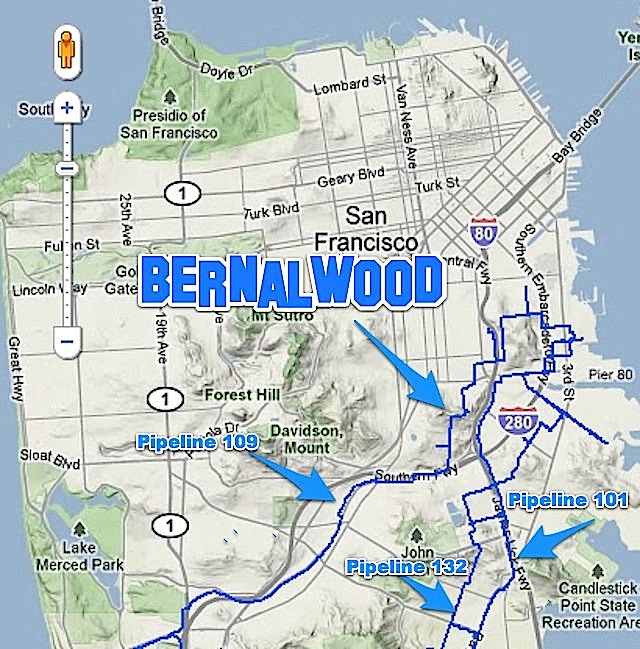




 Bernalwood