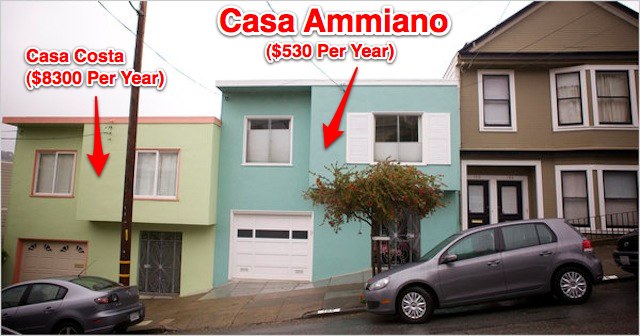
By way of introducing us to a new proposal by State Assemblyman Tom Ammiano to close a Prop 13 loophole used by some commercial real estate owners to keep their property tax obligations ridiculously low, today’s New York Times points out that Mr. Ammiano has made no effort to change the provisions that allow some residential homeowners to pay ridiculously low property taxes.
The Times then notes that Mr. Ammiano himself is a “signal beneficiary” of the residential provision, and — with a somewhat conspicuous amount of glee — the paper also details just how little property tax Mr. Ammiano actually pays for his Bernal Heights home:
Mr. Ammiano, who is also a comedian, pays just $530 a year in taxes on the Bernal Heights home he has owned since 1974. As far as the city and Proposition 13 are concerned, his house is worth $45,600. Zillow estimates its current worth at $645,000. At that value, the tax would be about $7,500.
How good a deal is this? Imagine for a moment that Mr. Ammiano’s house was a car. If he parked the car at a metered space near his Civic Center office, the amount he now contributes each day to the commonweal in the form of property tax would buy just a hair less than 29 minutes, curbside.
Perhaps his next stand-up routine could be built around this theme: San Francisco on $1.45 a Day.
There is nothing illegal about Mr. Ammiano’s good fortune. As long as a property does not change hands, Proposition 13 limits annual increases to 2 percent or the rate of inflation, whichever is less.
The Times then compares Tom Ammiano’s property taxes to those of his next-door neighbor, Anthony Costa, who’s lives in a home that is almost identical. Mr. Costa, a City College librarian, bought his home in 2004 and pays $8400 per year in property taxes. Not surprisingly, Mr. Costa is displeased:
While he says he bears his neighbor no ill-will, what Mr. Costa does object to — strenuously — is the reduction in government services he attributes squarely to Proposition 13.
“Prop 13 is a tragedy which has made things in California worse every year since it was passed,” Mr. Costa wrote in an e-mail. “The people of California have to settle for inferior schools, libraries, transit, roads, sewers, parks and other services. I don’t object as much to my personal tax bill, as I do the obscene discrepancy between the great wealth of this state and the relative poverty of our government and public institutions.”
Let the debate begin…
PHOTO: The New York Times
 Bernalwood
Yup. Prop 13 is essentially a state-wide suicide pact. CA’s finances are not going to improve until it is repealed.
Oh, no… I can’t stomach hearing the people who still think Prop 13 was a great idea. Plus, I would think they’d all be pretty close to dead by now, given how the bill was designed to allow retirees to stay in their homes when the real estate prices where skyrocketing around them in the 70s.
The beneficiaries of the homeowner provisions in Prop. 13 are a self-renewing population; people who bought in the 1990s are locked in at those assessed values too. (Ammiano, having bought in the mid-’70s, is an extreme example, but the contrast with his neighbor Costa certainly illustrates the situation well.) If you think prices were skyrocketing in the 1970s, I suggest you compare 1991 with 2011. The value of the average lot in SF is now many times the value of the improvements; 20 years ago, it was the other way around.
There’s a case to be made that Prop. 13 makes for a stable community; I would assume that most of Bernalwood’s readers support a community where they’d be able to retire in the home they’ve lived in without worrying about tax bills spiraling out of sight.
Yes, the commercial property roll needs to be assessed at market value, but that actually stands a chance of passing. Prop. 13’s residential protections are a third rail in California politics, and nobody in their right mind would mess with those. Ammiano may be a lot of things, but he isn’t stupid or crazy.
Single residential property can remain. Or event two. Close the loop hole for those that own 3 or more properties.
Prop 13 is right up there with Prop 187 as Pretty Much The Worst Ideas California Could Ever Have. Of course, anything that jeopardizes education funding generally makes me want to vomit. Either sever that relationship or reassess fairly, perhaps every ten years. That can mean creating special programs to protect seniors or other populations that need protecting. Starting with commercial property seems like a great idea. Collecting everyone’s fair share seems like the right thing to do.
And I guess I don’t understand why this is a state matter when municipalities (or is it counties?) set the rate…?
Prop. 13 has created disaster for our state along with major inequities. It’s a valid news story to do an expose of that, but it’s an amateurish cheap shot for Bay Citizen/the NYT to treat it as some kind of conflict of interest or wrongdoing for Ammiano to try to work on changing Prop. 13 while (at this point in his life) benefiting from its tax limits.
As someone who was a California voter and homeowner when Prop. 13 passed (I voted no), I’ve opposed its inequities and followed the discussion closely since that time — 33 years now. It’s generally agreed that the limit on homeowners’ property taxes will never be successfully changed, partly because that aspect did address a genuine problem. So it’s not like Ammiano is some kind of skunk for not attempting to touch that, as the article ignorantly or maliciously implied.
The corporate exemption and issues like the 2/3 requirement for passing local tax increases need to be changed, and depending on the future political climate, perhaps that can happen — otherwise California is (even more) screwed. One aspect of Prop. 13 WAS changed by Prop. 39 in 2000 — previously, a 2/3 vote was required to pass a local school bond; Prop. 39 cut that to 55%. So we know it can happen.
The Bay Citizen/NYT’s notion that a legislator whose personal/financial situation is affected by Prop. 13 has a conflict is absurd, though — all legislators’ personal/financial situations are affected by Prop. 13 unless they live (free) in a cave. And furthermore, a journalist covering any aspect of Prop. 13 is in the same situation and by the ethical standard that she has imposed must also disclose her homeownership situation (and if she’s a possible future homeowner who COULD be impacted by Prop. 13 if she ever becomes one, that counts too).
If Ammiano or any other legislators can start the momentum to make the needed changes and save California, more power to them. Meanwhile, cheap-shot journalism needs to be called out, debunked and discouraged.
Well said.
I was against Prop 13 when it was on the ballot. I could see it really hurting education, and it has. Property taxes paid for all those great schools we built in the 50s and when we wanted to build more in the late 60s, and raise property taxes, all of the elderly started screaming bloody murder, and this law was passed. Old people vote.
Fast forward 4 decades, and I am the old person who has been in my home for 3o years, a small tract home in Fresno, and I pay more in property taxes than Mr. Ammiano does for a home in the most expensive place to live–San Francisco. That seems kind of ridiculous, but it is the way it is. What with the way real estate prices have fallen, I wonder if Prop 13 could pass should it be put to the vote again? Fewer people are homeowners now than back then.
Like many other good citizens and property owner, Mr. Ammiano is doing no wrong. He is simply paying taxes according to the laws in place.
If his neighbor does not like those laws, then said neighbor should exercise is right to change the laws.
This article is dramatically unfair to Tom Ammiano, who I’m sure would vote to repeal the residential provisions to Prop 13. Its not as though repealing it is in the cards for now whatever his personal situation is. Good for him to attempt to refine it however. And I’m sure he has voted for every new bond assessment that the schools propose – he certainly has publicly endorsed those.
And obviously there are ways to get rid of Prop 13 that would protect elderly homeowners, and several states have such provisions (Maine comes to mind).
A good way to ease in Prop 13 removal would be to repeal most of it but allow a primary residence to be covered by it still. People who own rental properties that are being rented at market rates should not get a discount on their property taxes.
Those of us who pay thousands of dollars more in property taxes than our neighbors are becoming a much larger group. We are resentful that the neighbor next door can pay less than $1000 per year in property taxes while we are paying thousands more (just as illustrated above). It isn’t fair that their children can inherit the property with such low taxes either. Many of those who are in the market for a home now were not born when proposition 13 was passed. Is it fair to them to have to pay such high taxes while their older neighbors pay so little? And, if a homeowner can’t pay for some reason, there is no help available. In fact, the penalties are very steep and incredibly unfair. My husband and I have decided to give up our home rather than pay the most property tax in our neighborhood. Other neighbors (who also pay a lot more property tax than most in the neighborhood) are feeling the same way. I predict that if California doesn’t reform proposition 13 that their property tax revenues will fall even further as people with give up homeownership or buy a home in another state.
I don’t know that you’re becoming a much larger group — at every given time, the new homeowners in any given neighborhood are paying far more property taxes than their longtime neighbors. As a 23-year homeowner, I pay far lower taxes than the new homeowners on my block. But when I was a new homeowner, I paid far higher taxes than the longtime neighbors on my block.
I agree that the situation is BS. But it is cyclical.
What REALLY BS is to call Tom Ammiano out about it as though he’s getting some special favoritism. Again, every homeowner or possible future homeowner stands to be affected by any change in Prop. 13, so singling out any individual legislator and hinting that he has a conflict is crap. That’s lazy, arrogant, slapdash journalism.